
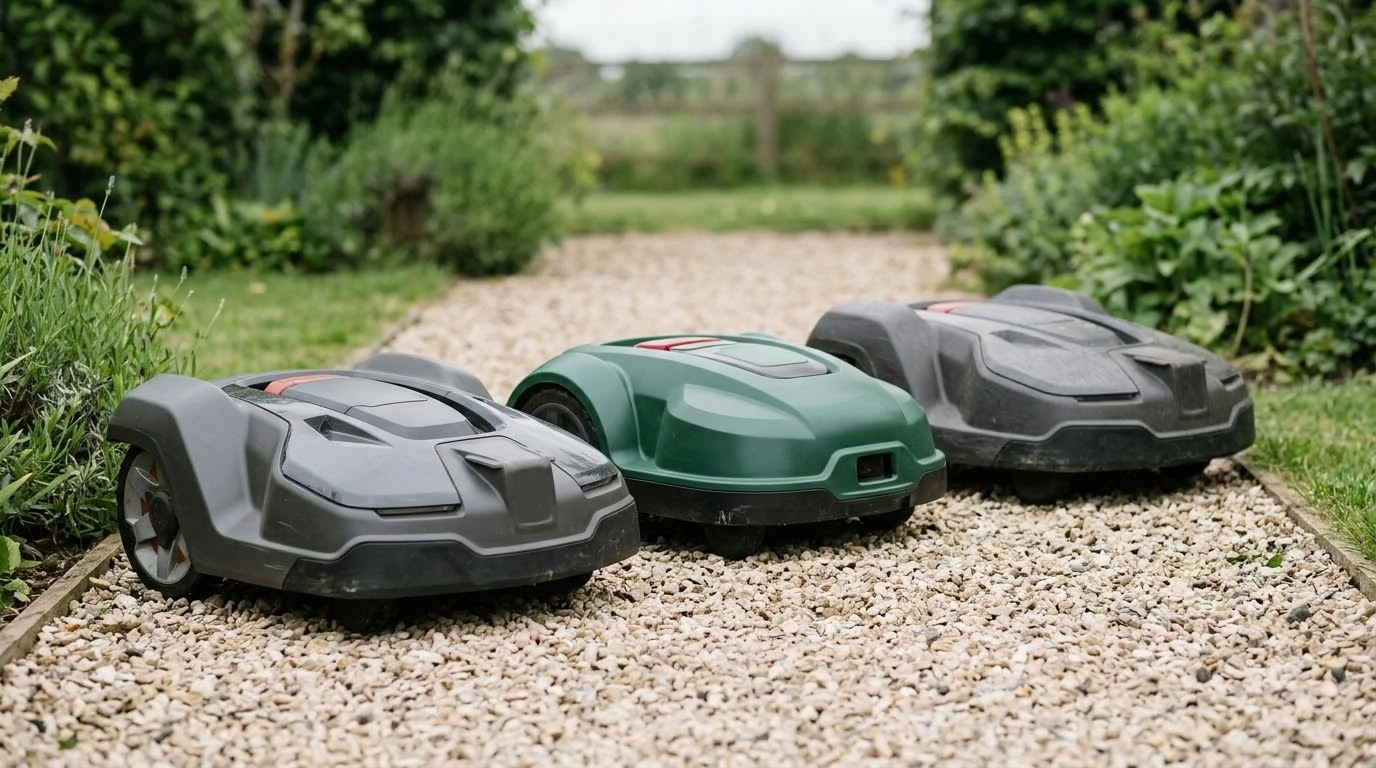

No, a robot mower bridge for drainage ditch crossings is not a documented accessory. None of the manufacturer guides we read approve a raised plank or span over a ditch. The workable options are a level, firm passage set in the boundary wire, or keeping the mower off the ditch and its banks.
The short answer
- No approved span. Manufacturer material describes passages at lawn level, not bridges over drops.
- Keep the crossing level. Robomow says the height difference between lawn edge and pavement should be identical; otherwise backfill.
- Use wire passage widths. Husqvarna lists 60 cm with a guide wire and 2 m without one.
- Keep the bank out. Treat ditch banks and channel bottoms as no-mow areas and trim them by hand.
Why a robot mower bridge for drainage ditch crossings adds new edges
A bridge adds a deck, a lip, and two ends that sit above or below the lawn. Each of those is an edge that a robot mower can drive off or get stuck on. Robot mower guides treat edges and drops as the main hazards, not the span itself. Our reading is that a homemade bridge would move the risk to the ends, where the wheels meet the lip.
The closest manufacturer language we found is about drops, not bridges. Sunseeker lists sudden drop-offs among the natural obstacles on uneven ground. Eufy’s slope guide warns that sharp drops “trap mowers easily.” Neither brand describes a bridge as a safe way across one. For the mowing question itself, see mowing a drainage ditch with a robot mower.
What a passage in the boundary wire actually is
A passage is a narrow strip of the lawn that the boundary wire keeps the mower inside, and it connects two parts of the work area. Husqvarna’s US guide defines it as “a narrow section of the work area with boundary wire on each side.” That is a wire layout on the ground, not a physical structure, and it is the only crossing type the guide covers.
| Setting | Figure from the Husqvarna US guide |
|---|---|
| Minimum width with a guide wire | 60 cm / 24 in between boundary wires |
| Minimum width without a guide wire | 2 m / 6 ft 6 in between boundary wires |
| Recommended width for 435X AWD and 535 AWD | 2 m / 6 ft 6 in for a good cutting result |
| Guide wire clearance from boundary wire | At least 30 cm / 12 in |
Note that the guide says nothing about ditches, water or drops. A passage that crosses a ditch is therefore outside what the guide describes. The yard guide on the minimum passage width for a robot mower gives more context on widths. Husqvarna’s passage guide is the reference for the wire figures above.
How height differences at a crossing are handled
A crossing works best when the ground on both sides sits at the same height. Robomow’s guidance on paths says “the difference in height between the lawn edge and the pavement should be identical.” If the surfaces do not match, the advice is to backfill with soil so the robot can climb the step rather than catch on the edge.
The same page warns about loose surfaces. Loose gravel carries “a high risk of a loose stone getting caught in the running mower,” and the robot can get stuck in it. Flat paved areas are described as unproblematic. Our reading is that a robot mower bridge for drainage ditch use is a height change by design, so it fails the first rule.
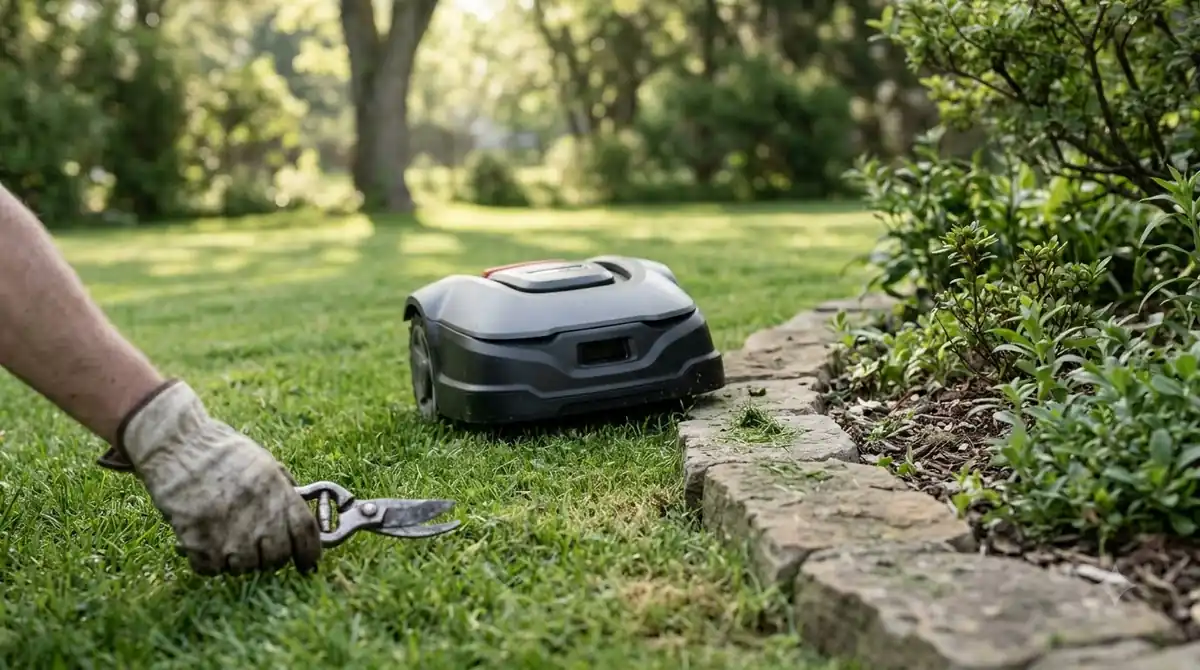
Robomow also says a gravel path can be driven over “although not always advisable,” which points to a judgment call rather than a standard. Robomow’s path guide gives no advice on drops or ditches, so it does not settle the bridge question.
Slope and drop limits at the ditch banks
A ditch bank is usually steeper than the lawn, so the slope limit of the model matters as much as the crossing. Husqvarna’s UK steep slope guide tells owners to “position the boundary further in on flat ground before the slope begins,” and asks for at least 50 cm (1.6 ft) of level ground between a flat area and a steep one.
The same guide gives a wider setback for its strongest models. For AWD units rated 50 to 70%, it recommends keeping 1.5 m (5 ft) between the bottom of the slope and the boundary wire. Those are Husqvarna’s figures for its own models, so check your model’s manual before using them. The guide to a robot mower for side slopes and ditches goes further on bank slopes.
Eufy’s slope guide adds a dip rule. Soil dips “greater than 3 cm” need filling or a virtual boundary, which means a ditch edge should not be left as a dip in the lawn. Eufy is a brand source, so treat the 3 cm figure as its own guidance.
Setting the wire for a crossing
Set the wire so the mower never reaches the lip, even when it overruns. Robomow’s edge guidance says a wire laid right at an edge lets the mower “go a little beyond it,” and “in some models even as much as 30 cm.” A ditch lip should therefore sit well outside the wire, not under it.
Our reading is that a passage across a ditch only makes sense where the ground is filled or culverted to lawn height, is firm, and is at least as wide as the passage figures above. Where the ground drops off on either side, do not route the wire across it. For wire routing in general, see laying boundary wire around obstacles.

Safer alternatives to a robot mower bridge for drainage ditch crossings
If the far side of a ditch is hard to reach, a simple layout avoids the need for a bridge. Most setups work with one of the steps below.
- Keep the ditch out of the wire. Route the boundary wire on the near side of the lip, and leave the channel and bank outside the work area.
- Mark a no-mow zone. Sunseeker recommends no-mow areas for steep embankments, so use the model’s no-go setting if it has one.
- Trim the bank by hand. Cut the ditch bank and bottom with a hand trimmer after the robot finishes the lawn above.
- Fill the dip if you must cross. Eufy’s 3 cm guidance points to filling dips, which is the step before any crossing is considered.
What to check before you cross
Before you set a robot mower bridge for drainage ditch crossing, or any passage over a ditch, check the points below. The table lists what each one protects against.
| Check | Why it matters |
|---|---|
| Surfaces at the same height | Robomow says the height difference should be identical; otherwise backfill |
| Passage width | 60 cm with a guide wire, 2 m without, per Husqvarna’s guide |
| Lip clearance | Overrun can reach 30 cm in some models, so keep the wire back from the edge |
| Bank slope | Stay within the model’s rated limit; leave steep banks as no-mow zones |
| Surface type | Loose gravel can damage blades and trap the mower |
Frequently asked questions
Can I use a robot mower bridge for drainage ditch crossings?
We did not find a manufacturer guide that approves one. The sources we read describe crossings at lawn level, with a wire passage on the ground. A raised deck adds edges, which the guides treat as risks.
How wide does a passage need to be?
Husqvarna’s US guide gives 60 cm (24 in) between boundary wires with a guide wire, and 2 m (6 ft 6 in) without one. The guide wire should be at least 30 cm (12 in) from the boundary wire.
Should the boundary wire go right up to the ditch edge?
No. Robomow says some models overrun the wire by as much as 30 cm, and a wire placed too close to an edge risks the mower slipping and getting stuck. Keep the wire well back from the lip.
Does a height difference between the lawn and a path matter?
Yes. Robomow says the height difference between the lawn edge and the pavement should be identical. If it is not, backfill with soil so the robot can climb the step.
Sources
- How to create a passage in an Automower boundary wire installation (Husqvarna): passage widths and guide wire clearance.
- Can a robotic lawnmower cross paths? (Robomow): height difference, backfill, gravel and bark cautions.
- How to optimise an Automower installation for steep slopes (Husqvarna UK): boundary setback and level ground near slopes.
- How cleanly does a robotic mower cut the lawn edge (Robomow): wire overrun near edges.
- Robot lawn mower slope limits (eufy, brand blog): drops, dips and embankments.
 Up next10 min readGearBest Garage for Mammotion YUKA: Fit, Roof and Drainage ChecksUpdated Nov 14, 2026
 8 min readGearBest Garage for eufy E15: Fit, Airflow and Drainage ChecksUpdated Nov 11, 2026
 7 min readGearSolar Power for a Robot Mower Charging Station: What WorksUpdated Nov 19, 2026
 8 min readGearBest Lawn Edging to Bury Robot Mower Wire: What Works and What to AvoidUpdated Nov 14, 2026
 7 min readGearBest Landscape Edging for Robot Mower Borders: What Works and What to AvoidUpdated Nov 13, 2026
 8 min readGearBest Garden Fence for Robot Mower No-Go Zone: What Works and What Doesn’tUpdated Nov 13, 2026