
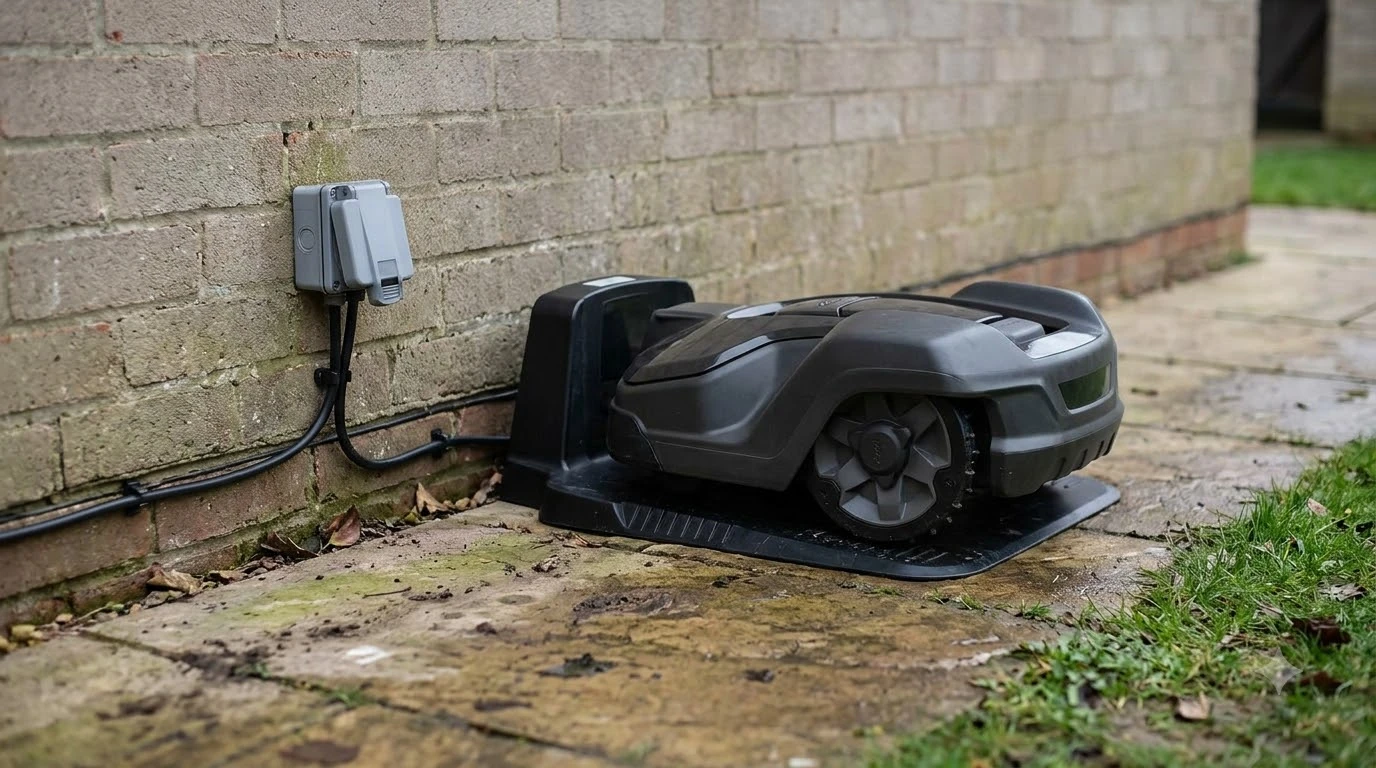

Solar power for robot mower charging station setups works through a dedicated solar charger kit matched to the mower’s power supply. Husqvarna sells four solar charger systems plus one for its EPOS reference station, and describes them as a grid-independent power supply. Generic panels are not covered by the sources we read, so the kit has to fit the mower.
The short answer
- Kit, not a generic panel: Husqvarna’s solar charger systems are sold for specific Automower models.
- Match the voltage: 1-18 and 2-18 for 18 V models; 2-230 and 4-230 for 230 V models.
- One mower per system: each kit supports one robotic mower.
- Check the sizing: the Husqvarna page gives no battery capacity, panel wattage or sun-hour figures, so ask the seller before you buy.
What a solar charger kit includes
Husqvarna’s solar charger line covers two voltage families, so the kit for solar power for robot mower charging station use depends on your model. The 1-18 has one panel, the 2-18 has two, the 2-230 has two and the 4-230 has four. A separate EPOS system is sold for the reference station alone. The kits are described as plug-and-play with low maintenance.
| System | Panels | Mower supply it fits | Powers a reference station too |
|---|---|---|---|
| 1-18 | 1 | 18 V models | Yes, with an optional wire assembly |
| 2-18 | 2 | 18 V models | Yes, with an optional wire assembly |
| 2-230 | 2 | 230 V models | Yes, no extra parts needed |
| 4-230 | 4 | 230 V models | Yes, no extra parts needed |
Model fit is narrower than the voltage split. Husqvarna says the Automower 560 EPOS works only with the 2-230, and the 580 EPOS and 580L EPOS work only with the 4-230. All other Automower models work with every system. Our reading: if you own an EPOS model, confirm the exact model before you order a kit.

What solar power for robot mower charging station use must deliver
A solar kit still has to deliver what the station’s charger expects. The Toro Turf Pro charging station manual lists a 120 VAC, 60 Hz input at 3.5 A, with a 360 W maximum. That is the figure to compare against any power source, solar or mains, when you check the station. The guide to charging station power requirements covers the same electrical ground for mains setups.
The same manual says not to plug the station into a power strip or an extension cord. Outdoor power also needs care in general. The U.S. Consumer Product Safety Commission advises using only extension cords labeled for outdoor use, and a GFCI detects a current difference as small as 0.006 A. Husqvarna adds that the power supply should not sit in an enclosed box, because it needs open sides and airflow.
- Input match: confirm the charger’s voltage and current against the source you plan to use.
- No strips: connect the station straight to a weatherproof outlet.
- Protection: use a GFCI on any outdoor outlet that feeds the station, and see the guide to a GFCI outlet cover for a robot mower for the outlet itself.
- Ventilation: keep the power supply in the open, not inside a closed box.
What stops a robot mower from charging
Before you blame the power source, check the basics. Husqvarna’s support page says the mower will not charge if its battery temperature is outside the accepted range, although it gives no numeric range. The mower also has to sit squarely in the station with the charging plates in full contact, and leaves or clippings on the contacts can block that. If the mower still will not charge, the fix for a robot mower that is not charging walks through more causes.
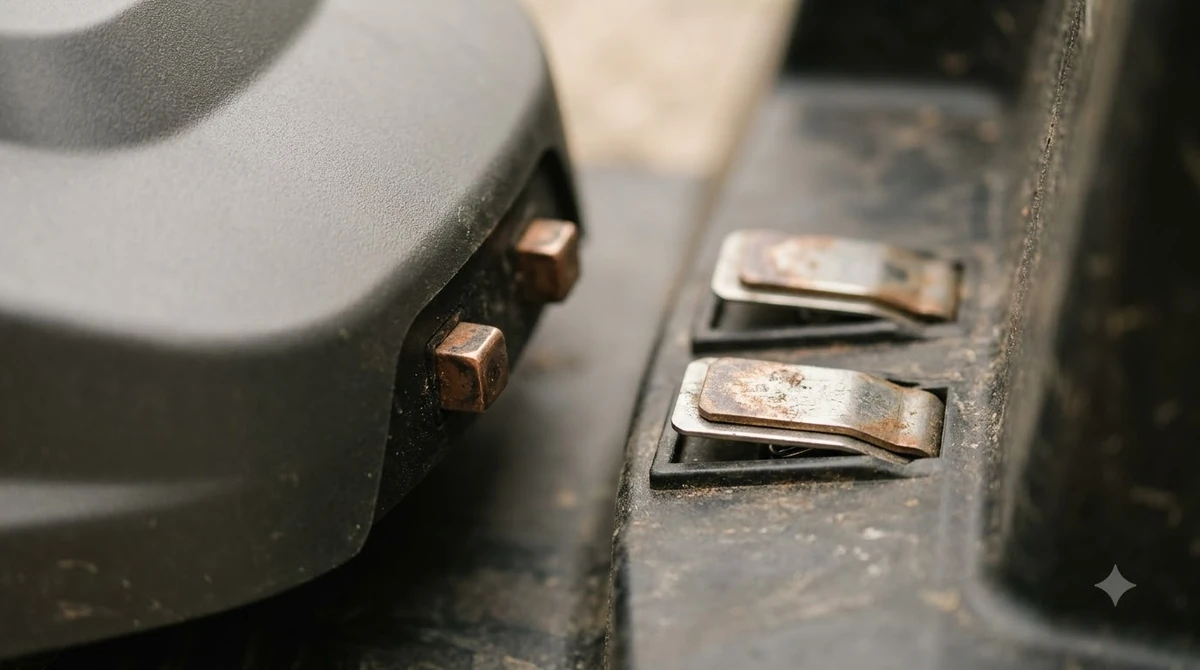
- Check the dock. Clear leaves, clippings and debris from the docking area and from the contacts on both the mower and the station.
- Check the seating. Make sure the mower sits in the station with the charging plates touching.
- Check the battery. A battery stored without a full charge can be too deeply discharged to charge normally. Husqvarna’s suggested fix is to bring the mower indoors, place it on the station, and leave it for several hours.
- Check the lights. A flashing yellow light on the station points to a damaged guide wire, and a flashing red light may point to a damaged antenna in the station baseplate, which needs an authorized service center.
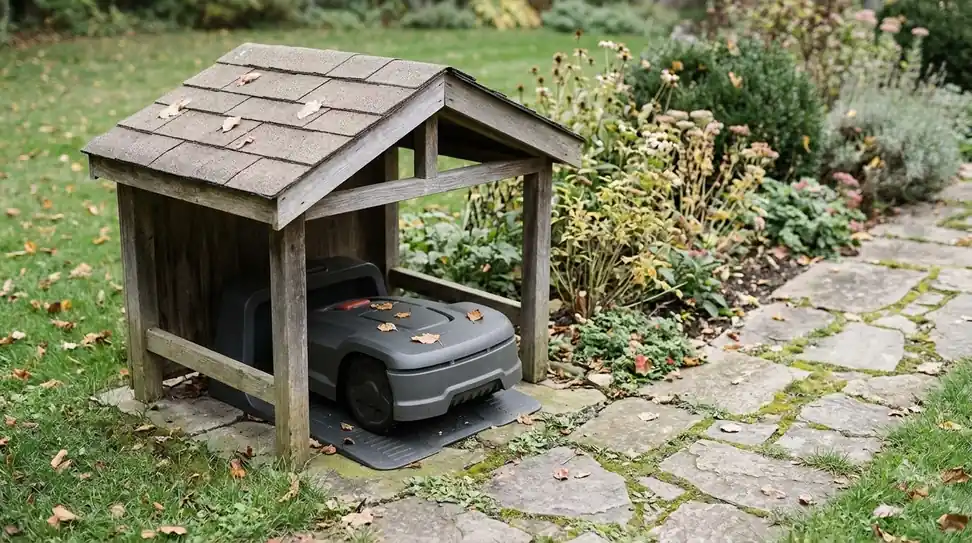
Sun and heat matter as well. Robomow notes that sunlight and temperature play a key role in battery life and recommends placing the station in a shaded spot. Our reading: a shaded spot for a solar power for robot mower charging station setup is the safer default for the battery, whatever power source feeds the station. The guide on where to put a robot mower charging station covers placement in more detail.
Heads up
The solar kits we read are sold for specific brands and models. Do not mix a kit from one brand with a charger from another without checking the voltage and the dock design first. The Husqvarna page we read is its Ireland site and lists 230 V systems, so confirm which kits your own dealer sells before you plan around one.
Checklist before you buy a solar setup
Work through these points in order before you buy solar power for robot mower charging station use. Each one narrows the choice before you spend money.
- Find your mower’s supply voltage. The kit must match 18 V or 230 V.
- Check the model. EPOS models have specific kit requirements.
- Decide whether you need a reference station powered too. That decides between the 2-230 or 4-230 and the optional wire on the 18 V kits.
- Ask for sizing data in writing. Battery capacity, panel wattage and expected sun hours are not on the page we read, so the seller has to supply them.
- Plan the winter. Store the battery fully charged indoors during the cold season.
Frequently asked questions
Can solar power for robot mower charging station use work with any brand?
No. Husqvarna’s kits are matched to its 18 V and 230 V systems, and each supports one robotic mower. Match the kit to the mower’s supply before you buy.
Does the Husqvarna solar kit also power the EPOS reference station?
The 2-230 and 4-230 do so without extra parts. The 1-18 and 2-18 can also power both, but they need an optional wire assembly.
How many watts or amp-hours do I need in the panel?
The Husqvarna page gives no battery capacity or panel wattage figures. Ask the seller for sizing based on your daily runtime and season length.
Should the charging station go indoors in winter?
Husqvarna advises storing the battery fully charged indoors during winter. Its support page also says a battery stored without a full charge may be too deeply discharged to charge normally after winter.
Sources
- Husqvarna solar charger for robotic mowers (Husqvarna): kit names, voltage match, model fit and dual-power notes.
- Husqvarna support: Automower won’t charge or shows empty battery error (Husqvarna): battery temperature, dock contacts, winter recovery and lights.
- Toro Turf Pro charging station installation manual (Toro): 120 VAC, 60 Hz, 3.5 A input and no power strip.
- CPSC extension cords and power strips (U.S. Consumer Product Safety Commission): outdoor-rated cords.
- CPSC GFCI fact sheet (U.S. Consumer Product Safety Commission): 0.006 A detection level.
- Robomow: how long the battery of a robotic lawnmower lasts (Robomow): sun and temperature effects on battery life.
 Up next9 min readGearRobot Mower Charging Station Power Requirements ExplainedUpdated Nov 19, 2026
 7 min readGearRobot Mower Base Station Solar Panel: Is It Enough?Updated Nov 20, 2026
 10 min readGearRTK Base Station Power Cable Outdoor: What to Check FirstUpdated Nov 19, 2026
 7 min readGearBest Outdoor Power Strip for RTK Base Station: 5 ChecksUpdated Nov 16, 2026
 6 min readGearRobot Mower Weather Station Integration: What Works and What to CheckUpdated Nov 20, 2026
 8 min readGearRobot Mower Cover for Charging Station: What the Manuals SayUpdated Nov 19, 2026