


Robot mower lawn edging strips do not replace the boundary wire, but they can make the edge easier to set up. The installation guides we read place the wire a set distance from hard edges, soft edges and beds, and they treat metal edging as a special case. This guide explains how to think about edging strips, how far the wire should sit from them, and when burying the wire matters more than the strip itself.
The short answer
- Edging is a border, not a signal: the wire still defines the mowing area, so plan the wire first.
- Keep the wire clear of solid edges: one installation guide gives 30 to 35 cm from walls, fences and raised beds.
- Hard edges need less clearance: the same guide puts the wire 10 to 15 cm from paths and beds that are level with the grass.
- Metal edging needs a check: the sources we read did not give a number for metal, so test the loop before you bury it.
What robot mower lawn edging strips do for the mower
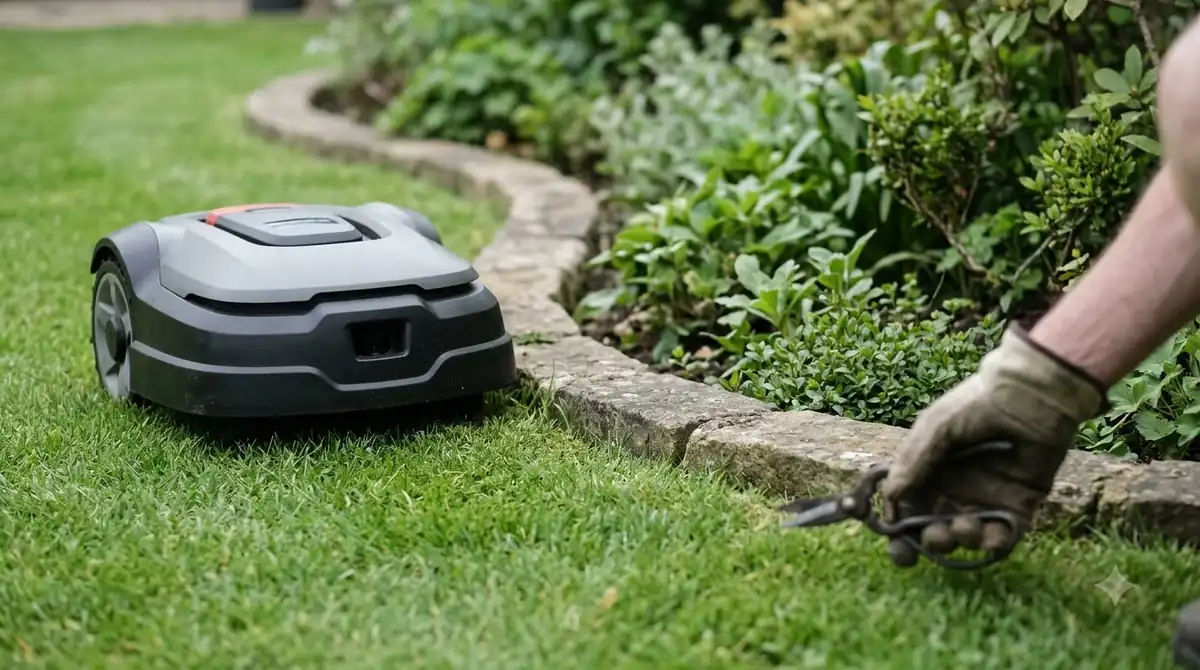
A robot mower lawn edging strip gives the grass a clean line, and it can stop soil and mulch from spilling onto the lawn. For a robot mower, that line is useful only if the mower can see where the lawn ends. The strip itself does not tell the mower where to stop. The boundary wire does that job. Edging strips are one of several border options, and landscape edging for lawn borders compares others. A flush paved strip is a more durable alternative, and mowing strip pavers along the lawn edge let wheels run right to the border.
So the order is simple. Lay the wire first, decide where the strip goes, and then check the gap between the two. A strip that sits too close to the wire can leave the blades striking the edge, while a strip set far outside the wire leaves an uncut band.
How far the wire should sit from the edge
The distance depends on what the edge is. Anker’s guide says to keep the wire 30 to 35 cm from solid obstacles such as walls, fences and raised beds, so the blades do not strike them. The GroundTech guide gives 10 to 15 cm for flower beds, hedges and paths that are level with the grass. The distance from the wire to the edge interacts with trimming, so a lawn edger for the edge line helps keep the border clean.
An edging strip usually sits between those two cases. A strip that is raised above the lawn behaves more like a solid edge, while a flush strip behaves more like a level path. Measure the height of your strip before you pick a distance.

Metal edging needs a closer look
Metal strips are the case most owners ask about, and the sources we read do not give a clear distance for them. Treat metal as a reason to test the loop, not as a reason to skip it. Run the wire above ground, mow a full cycle, and watch the edge. If the mower bounces off the strip or leaves a gap, move the wire in or out a few centimetres and test again. Metal edging can interfere with the signal, so edging that leaves room for buried wire is a safer option.
The guides we read did not compare plastic, rubber and metal strips directly, so do not assume one material is safer. Use a short test with your own strip rather than a rule of thumb.
When burying the wire matters more
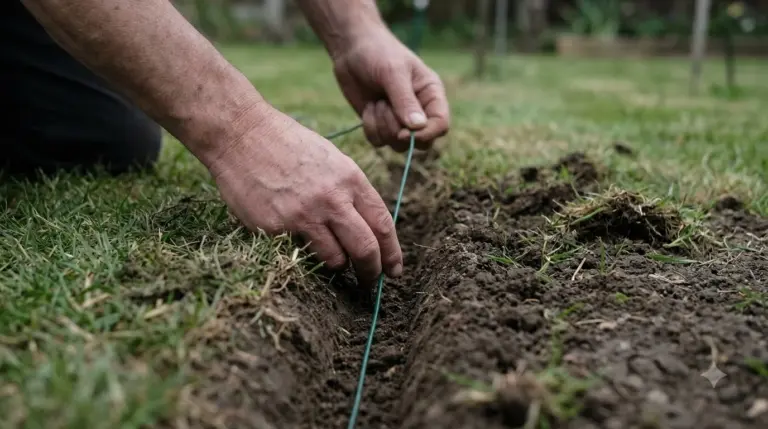
Burying the wire protects it from edging tools and from blades that run close to the boundary. Anker’s guide describes burying at about 4 to 5 cm deep, with a maximum of about 7 cm. Bury only after the route works. Once the wire is in the ground, moving it is slow work. Burying is easier with the right cable, and boundary wire that can be buried is covered in the cable guide.
If your lawn has a strip that you cut with a trimmer every season, bury the wire under the strip or a few centimetres inside it. That keeps the trimmer line away from the wire.
A simple check before you finish
Walk the edge yourself after the first full cycle. Look for grass blades that are longer along the strip than in the middle of the lawn, because that is the clearest sign the mower stopped short. Look for scuffs or fresh cuts on the strip, which show the blades reached it. Either sign is worth a note before you change the wire. Run the mower for at least one full cycle with the strip in place. Look for three things: the blades touching the strip, uncut grass against the border, and the mower turning away too early. Each of those points to a wire position problem, not a strip problem. The edge check should also include paths, so flush stepping stones in the lawn deserve the same scrutiny.
Set up a short trial run
Before you bury anything, set the wire on the surface along the edge you care about, peg it at about 1 metre intervals, and run the mower for a full cycle. The GroundTech guide we read gives those pegging and clearance figures as a starting point, so treat them as a first setting rather than a final one. A short trial run will show whether path pavers where the mower crosses gravel sit low enough.
Keep a note of which section gave trouble, such as a metal strip, a raised bed or a corner. Moving the wire in or out a few centimetres at that one point is usually quicker than rerouting the whole run. Once the trial is clean for a full cycle, bury the wire and recheck the edge after the first rain.
Edging strips also settle over time. Frost can lift a strip or push soil under it, so check the gap each season and adjust the wire if the strip has moved.
Frequently asked questions
Can an edging strip replace the boundary wire?
No. The strip gives a visual border, but the mower follows the wire to know where its area ends.
How far should the wire be from a raised edging strip?
Treat a raised strip like a solid edge and keep the wire about 30 to 35 cm away, following Anker’s guide. Check the gap with a trial run.
Does metal edging stop a robot mower?
The guides we read do not give a distance for metal edging. Test the loop above ground first, because a metal strip can change how close the wire can sit.
How deep should I bury the wire near an edge?
Anker suggests about 4 to 5 cm, with a maximum of about 7 cm. Bury the wire only after the route works in a trial.
Sources
- Anker (mower brand): 30 to 35 cm from solid obstacles, burial depth about 4 to 5 cm with a maximum of about 7 cm.
- GroundTech (installer): 10 to 15 cm from flower beds, hedges and level paths, and pegging about every 1 metre.
 Up next6 min readGearRobot Mower Outdoor WiFi Extender: 3 Simple TestsUpdated Nov 20, 2026
 7 min readGearHow to Change Worx Landroid Blades in 7 Simple StepsUpdated Nov 19, 2026
 9 min readGearBest Rubber Edging for Flower Beds with Robot Mower: What the Rules SayUpdated Nov 14, 2026
 8 min readGearBest Lawn Edging to Bury Robot Mower Wire: What Works and What to AvoidUpdated Nov 14, 2026
 7 min readGearBest Landscape Edging for Robot Mower Borders: What Works and What to AvoidUpdated Nov 13, 2026
 7 min readGearRobot Mower Wire Tensioner: 4 Simple Checks FirstUpdated Nov 14, 2026