
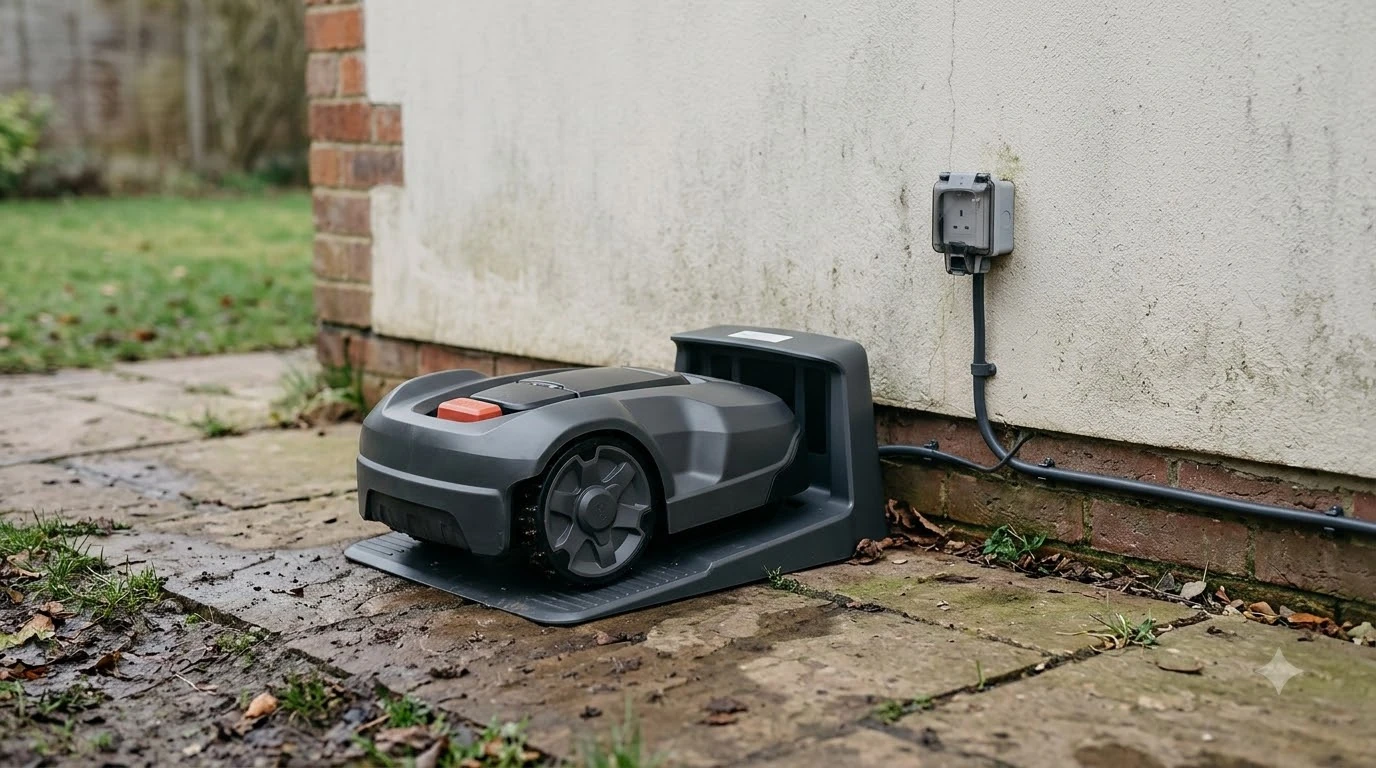

Can a robot mower charger run on a generator? The sources we read do not name generators at all, so there is no manufacturer approval for this setup. What they do give is firm: a charging station needs a supply inside its rated input range, it should go straight into a suitable outlet rather than a power strip or extension cord, and outdoor outlets need GFCI protection. A generator can only meet those rules if it delivers clean power inside that range at the station. Until your mower maker confirms it in writing, treat a generator as an unverified power source.
The short answer
- No source we read names generators. Toro’s professional charging station is rated for 100 to 240 VAC, 50 to 60 Hz and 3.5 A on the input side.
- Extension cords and power strips are ruled out. Toro says not to plug its station into either, and Robomow says the cable should not be extended.
- Outdoor outlets need GFCI protection. The University of Illinois Extension recommends GFCIs on outdoor outlets, and portable GFCIs where an outlet has none.
- Our reading: a generator is only worth considering if it can hold your charger’s voltage and frequency ratings at the station, with no cord in between, and the maker approves it.
What the charging station draws from its power source
A robot mower charging station is not a battery charger in the way a phone charger is. It is a base that takes power from the wall and passes low-voltage power to the mower through its contacts. Robomow states that a nearby power outlet matters because the charging station runs on a low-voltage cable from the supply, so the outlet and the cable are part of the same system. The mower itself only ever sees the low-voltage side. Our guide to robot mower charging station power requirements shows how to read the input and output labels.
Professional units show the numbers clearly. The Toro charging station for its Turf Pro series, as described in its installation instructions, is rated at 100 to 240 VAC, 50 to 60 Hz and 3.5 A on the input side. Its charge output is 23 to 32 VDC at 10.7 A. Home models are sized differently, so these figures show the kind of supply a charger expects rather than the exact rating of your model.
| Spec | Toro Turf Pro value | What it means for your setup |
|---|---|---|
| AC input | 100 to 240 VAC, 50 to 60 Hz, 3.5 A | The supply must stay inside the rated voltage and frequency range and carry enough current |
| Charge output | 23 to 32 VDC, 10.7 A | The base delivers this to the mower; a weak supply can limit it |
| Operating temperature | 0 to 50 C (32 to 122 F) | Keep the station within this range, outdoors or in a shed |
| Installation | Qualified professional; circuit protected by an RCD; good ground connection | A hardwired install is a job for a qualified person |
Our reading is that the voltage and frequency range matters more than any wattage headline. Two supplies can both read “120 volts” and still differ in frequency or in how steady the output is under load. Check the charger’s input label and manual before deciding that any supply is good enough.
Can a robot mower charger run on a generator? What the sources say
This is the question most people actually ask, and it is the one the sources answer least. The short version of “can a robot mower charger run on a generator?” is that it needs the maker’s approval first. We searched for manufacturer guidance on running a robot mower charging station from a portable generator and found none. The results were general power requirements from the same manufacturers, with no statement either approving or banning a generator.
Husqvarna’s placement guide for its Automower charging station says to place the station near a power outlet, and that the power supply must not be enclosed in a box. Those two points are the closest thing to a generator rule in the sources, and they are about placement and airflow, not about the power source itself. A generator is a different kind of supply from a wall outlet, so the outlet guidance does not settle the question. Another off-grid option has its own limits, covered in solar power for a robot mower charging station.
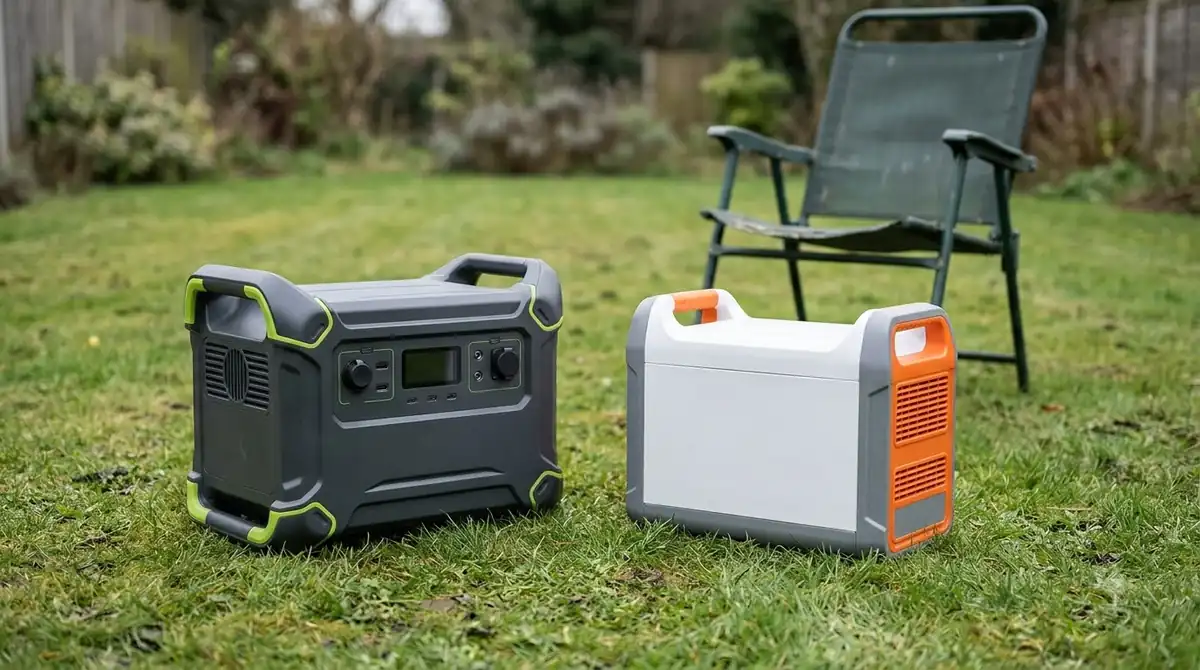
Our reading: a generator is only a reasonable option if it can hold the charger’s stated voltage and frequency, has enough rated output for the charger’s input current, and can sit close enough that the charger connects without an extension. If any of those three is missing, the setup breaks the rules the sources do give. Ask the mower’s maker before connecting, and get the answer in writing.
Why extension cords and power strips do not belong in the setup
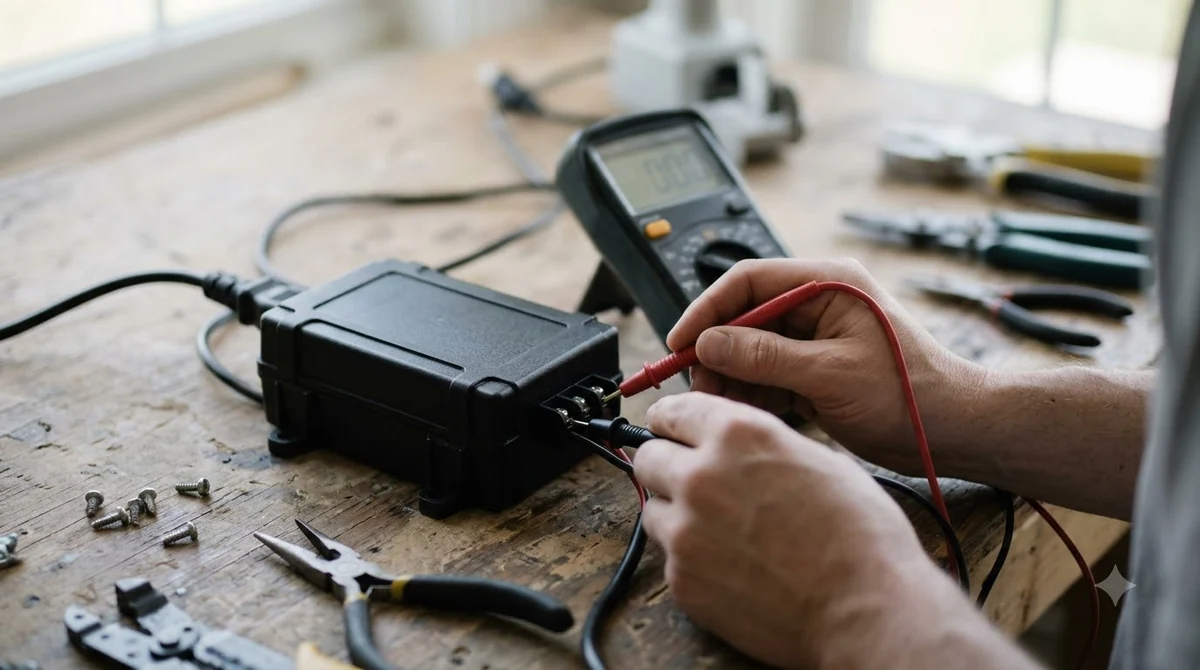
Extension cords and power strips are the most common shortcut, and the sources say no to both. Toro’s installation manual says: “Do not plug the charging station into a power strip or an extension cord.” Robomow advises that the low-voltage cable should not be too long or extended. The manuals give no voltage-drop number, so this article does not quote one.
Generator setups often rely on cords, because the generator sits away from the station. That is the situation the rule was written to avoid. Our reading: if a generator can only reach the station through a cord, the setup conflicts with both the Toro and Robomow advice, so the generator should be placed close enough for a direct connection instead.
- Plug the station’s power supply directly into a suitable outlet or supply.
- Do not add a power strip between the generator or outlet and the station.
- Keep the low-voltage cable at its supplied length and do not extend it.
GFCI protection and outdoor outlets
A GFCI, or ground fault circuit interrupter, cuts power when it senses current leaking along an unintended path. The University of Illinois Extension recommends installing GFCIs on outdoor outlets, so any outdoor outlet feeding a charger should ideally have one.
The same page advises using portable GFCIs for outdoor outlets that do not have them. Toro’s installation instructions go a step further for its professional station: the station may only be connected to a supply circuit protected by a residual current device with a tripping current below 30 mA, and it needs a good ground connection. For a charger that sits outside all season, this is the simplest protection to check first.
Our reading: GFCI protection is about the outlet, not about the mower. A generator does not remove the need for it. Check that any outdoor point feeding the station has protection, and test it before you rely on it. A weatherproof outlet box and a GFCI outlet cover can protect the outdoor point itself.
Keep the supply dry, ventilated and away from water
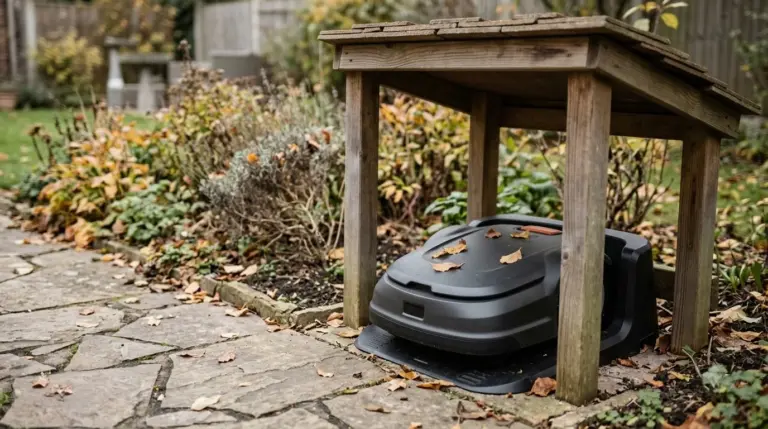
Outdoor power equipment has to handle sun, rain and splashing water, which is also the question behind whether robot mowers can be left outside. Husqvarna says the power supply must not be placed in an enclosed box, because the open sides and airflow are part of how it stays cool. Robomow says the outlet and transformer need protection from direct sun and from splashing water. Toro requires its station to sit at least 15 m (49 ft) from the water edge, and says there should be no risk of flooding after heavy rain.
Toro also asks that obstacles sit more than 6 m (19.7 ft) from the station. That keeps the approach clear for the mower and avoids a crowded corner where cables and cords tend to collect. We could not read a generator safety page in this round, so this article does not give generator exhaust or clearance distances. Follow the generator’s own manual on those points.
How charge time depends on the battery
Whatever the supply, the charge time depends on the battery. Robomow gives a formula: battery capacity in mAh, divided by charging current in mA, multiplied by 1.3, gives the charging time. Its figures describe smaller models at about 1,500 mAh and large-lawn robots above 4,000 mAh. Robomow also says a modern Li-ion battery may charge in as little as an hour, depending on capacity.
Our reading: a supply that cannot hold the charger’s rated current will charge more slowly than the formula suggests. The sources do not say how often this happens, so treat the formula as the best case and check the charger’s current rating before you trust any charge time.
What to check before you connect
Use this list before you act on any answer to “can a robot mower charger run on a generator?” or connect any unusual supply to the station. Each step comes from the manufacturer or regulator sources above, or from our reading where noted.
- Read the charger’s input label. Note the voltage, frequency and amps, and compare them with your supply.
- Check the generator’s rated output. It should stay inside the charger’s input voltage and frequency range and carry the input current with margin. This is our reading of the Toro input rating.
- Ask the mower maker in writing. No source we read approves or bans a generator, so get a clear answer for your model.
- Use no power strip or extension cord. Both Toro and Robomow say this.
- Confirm GFCI or RCD protection. Outdoor outlets should have one, and portable GFCIs are an option where none exists.
- Keep the setup dry and away from water. Toro gives 15 m (49 ft) from the water edge as its minimum.
Frequently asked questions
Can a robot mower charger run on a generator if the manual is silent?
The sources we read do not say either way. Toro says not to use a power strip or extension cord with its charging station, so check your mower’s manual and ask the maker before connecting to any generator.
Does a robot mower charger need a GFCI outlet?
The University of Illinois Extension recommends GFCIs on outdoor outlets, and portable GFCIs where an outlet has none. Toro’s installation instructions for its professional station call for a supply circuit protected by a residual current device.
How much power does a robot mower charger use?
Toro’s professional charging station for its Turf Pro series is rated at 100 to 240 VAC, 50 to 60 Hz and 3.5 A on the input side. Home models differ, so read the rating on your own charger.
How long does a robot mower take to charge?
Robomow’s formula is battery capacity in mAh divided by charging current in mA, then multiplied by 1.3. It also says a modern Li-ion battery may charge in as little as an hour, depending on capacity.
Sources
- Husqvarna Automower charging station placement guide (Husqvarna): outlet placement and the no-enclosed-supply rule.
- Robomow charging station installation guide (Robomow): nearby outlet, low-voltage cable, weatherproof socket and sun and splash protection.
- Robomow charging frequency article (Robomow): charge-time formula and battery size ranges.
- Toro Charge Station installation instructions (Toro): no power strip or extension cord, input and output ratings, RCD and ground requirements, 15 m from water, 6 m obstacle clearance.
- University of Illinois Extension electrical safety page (University of Illinois Extension): GFCIs on outdoor outlets and portable GFCIs where none exist.
 Up next7 min readLearnDoes a Robot Mower Charger Need Its Own Circuit Breaker?Updated Nov 12, 2026
 6 min readLearnWhy Does My Robot Mower Keep Going Back to the Charger?Updated Nov 14, 2026
 10 min readLearnCan Kids Play in the Yard While a Robot Mower Runs?Updated Nov 11, 2026
 9 min readLearnShould a Robot Mower Run After Aeration?Updated Nov 12, 2026
 8 min readLearnIs It Legal to Run a Robot Mower at Night?Updated Nov 11, 2026
 8 min readLearnIs It OK to Run a Robot Mower Every Day?Updated Nov 11, 2026