
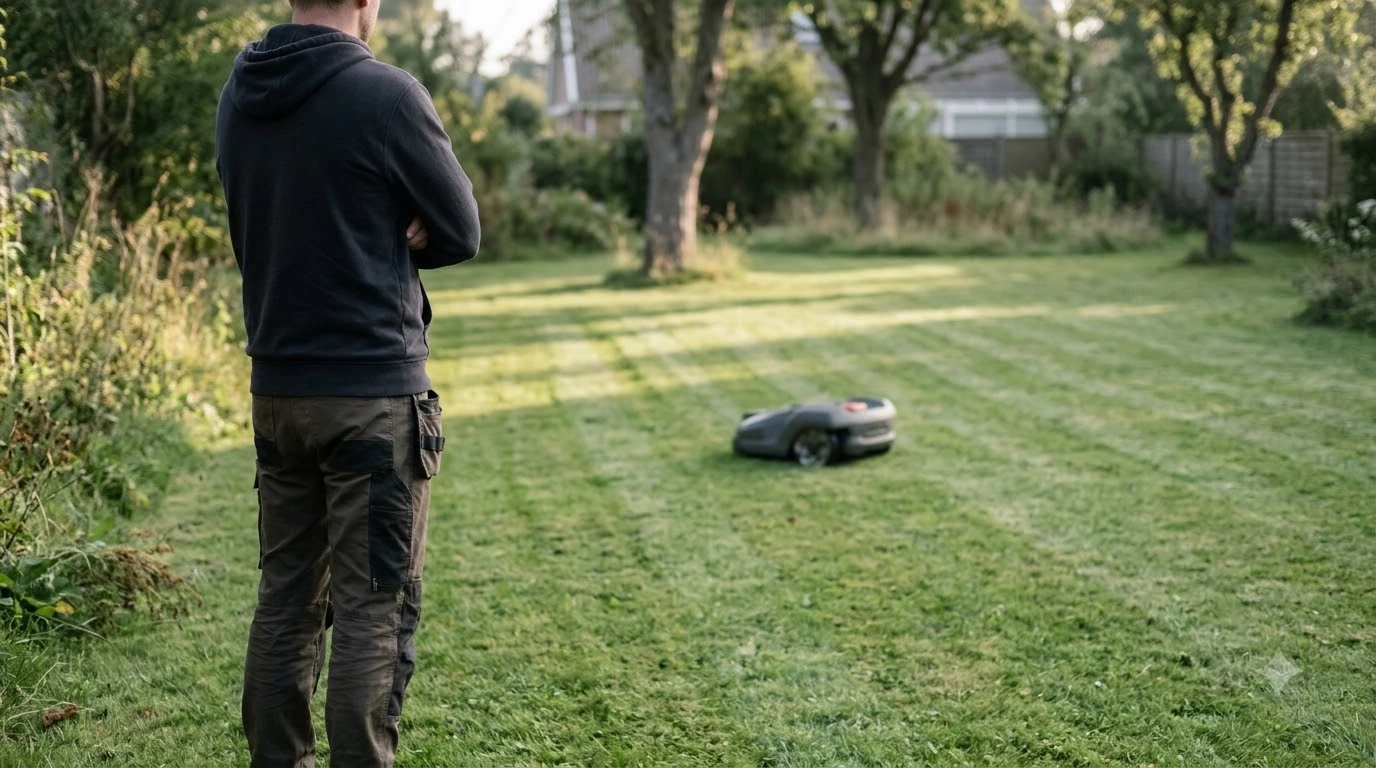

Do robot mowers mow in straight lines? Many do not by default. Many robots run a random pattern: each run goes straight until it reaches the boundary wire, an obstacle or a sensor alert, then turns. Straight, repeatable rows come from a systematic mode such as parallel, checkerboard or triangle, combined with positioning that holds a line, usually GPS or RTK. Whether a given model can do this depends on its settings and sensors, as of November 2026.
The short answer
- Default behavior. Many robot mowers use a random path, so a single session does not produce neat rows.
- Systematic modes. Parallel, checkerboard and triangle modes cut organized tracks that can create visible stripes.
- Positioning. Systematic modes usually rely on GPS or RTK navigation, and RTK accuracy depends on a clear view of the sky at the base station.
- What to check. Look for a systematic mode and the positioning method in the model’s specification or manual before you buy.
Do robot mowers mow in straight lines by default?
Many robot mowers default to random paths: each run goes straight until the mower meets a boundary wire, an obstacle or a sensor alert, and then it changes direction. Mammotion describes this random pattern and lists its drawbacks as being less efficient, producing more overlap and following no predictable path.
Random mowing still works over time. Mammotion states that random mowing “eventually achieves full coverage when performed frequently”, although it gives no timeframe. So a random robot can cover the whole lawn, but the path inside each session is irregular, which is why it does not look like a row of stripes after one run. Our broader explainer on random versus striped mowing patterns compares the two approaches.
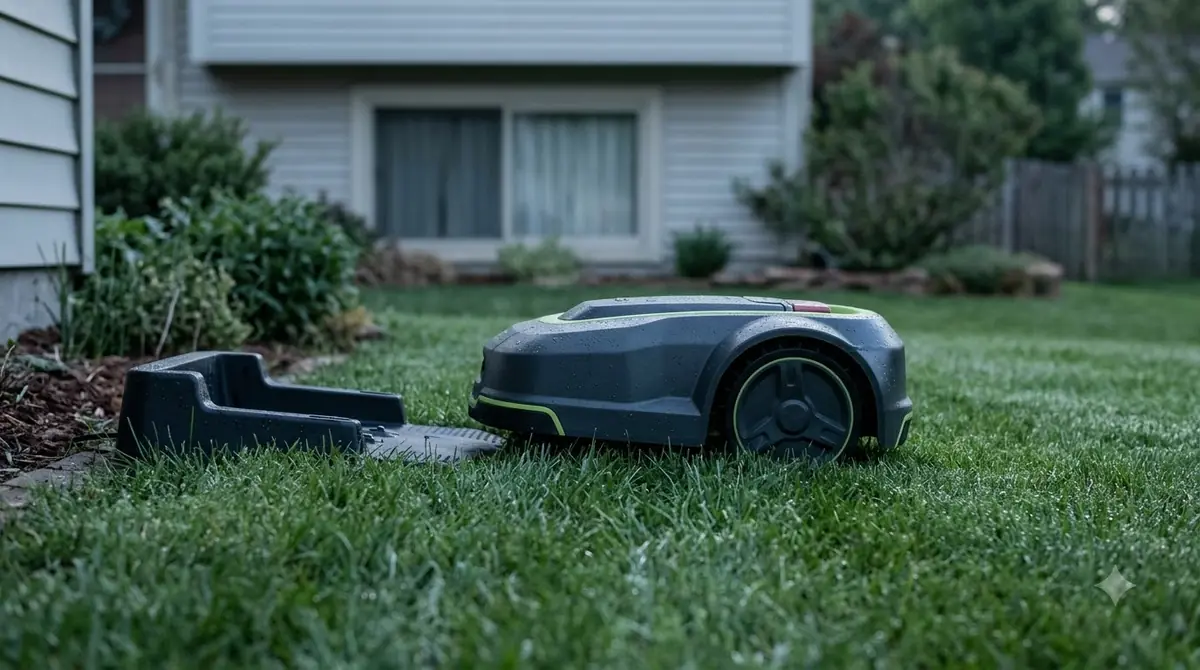
Our reading: so, do robot mowers mow in straight lines if you want neat rows? Not from a random-mode robot. Check whether the model offers a systematic mode first, because the direction of each session is what makes the pattern visible, and our guide on how to get stripes with a robot mower covers the settings side.
Heads up
Mammotion also recommends alternating the mowing direction weekly to even out coverage. Changing direction is a habit you can apply regardless of the mower brand.
Systematic modes: parallel, checkerboard and triangle
Systematic modes cut in organized, repeating directions. Husqvarna describes three of them, parallel, checkerboard and triangle, and says they create a striped effect on the lawn. Each one changes the direction of the next session in a different way, which changes how visible the stripes are and how the edges are covered.
| Mode | How the next session runs | Stripe visibility | Edge coverage |
|---|---|---|---|
| Parallel | Runs in one direction each session | Clear parallel stripes | Can leave edges uncut |
| Checkerboard | Turns 90 degrees from the previous session | Visible stripes | Covers edges from multiple angles |
| Triangle | Turns 60 degrees from the previous session | Less visible than parallel or checkerboard | Covers edges from multiple angles |
Mammotion describes the parallel, or zigzag, version as “long, straight passes that run back and forth across the lawn in alternating directions”, with the mower turning at each boundary and returning along a neighbouring path. Mammotion says systematic patterns “reduce overlap and mowing time”, which is a manufacturer statement rather than an independent measurement.
The table shows the trade-off. If the stripe is the goal, parallel and checkerboard are the modes Husqvarna describes as most visible. If edge coverage matters more, triangle and checkerboard are the options Husqvarna’s edge guidance favours, because they cover the boundary from more than one angle.
Confirm that the mode is available on the exact robot you are considering rather than assuming it is standard.
Why GPS or RTK is the usual route to straight rows
A straight row needs the mower to know where it is across the whole lawn, not just where the boundary wire is. If you are new to the term, see what RTK stands for on a robot mower. Mammotion says systematic mowing “uses advanced navigation (like GPS or RTK) to cut the lawn in organized rows”, and that this approach is more efficient because it reduces overlap. That is a vendor description, so treat the efficiency claim as the manufacturer’s view.
RTK is the more precise option. Sunseeker Elite, which sells RTK mowers, says a phone’s GPS “might get you within 5-10 meters” while RTK “can pinpoint a location to within a few centimeters”. Those figures are marketing claims, and the page cites no independent testing for them.
Mammotion makes the same point from the mower side: “RTK or GNSS-enabled models excel at producing precise straight lines.” Its wording is about models rather than a specific accuracy figure, so it supports the positioning requirement without settling how straight a given yard will look.
The same page recommends a base station with an open view of the sky, “ideally with a 160-degree vertical view”, and warns that “heavy tree cover, walls, or roof overhangs can weaken accuracy”. The 160-degree figure is not explained, so use it as a starting point for checking your own yard, and read where to place an RTK antenna in a yard with trees if your lot has heavy cover.
Our reading: when you ask do robot mowers mow in straight lines on an RTK model, the answer is only as good as the sky view at the base. A yard with tall trees or a house wall close to the base station may not get the precision the spec sheet suggests.
Edges, obstacles and yard shape
Straight-row patterns tend to break down at the edges and around obstacles, so the lawn’s shape matters as much as the mode. Husqvarna says systematic mowing is most suitable for flat, open areas with few obstacles, while its irregular mode is intended for lawns with slopes, complex work areas and many obstacles, and it cuts uniformly from all directions.
Do robot mowers mow in straight lines all the way to the boundary? Not always, and the edge issue is specific to parallel mowing. Husqvarna notes that a parallel pattern, where the mower runs only in one direction, can leave edges uncut. Checkerboard or triangle patterns cover the edges from multiple angles, which Husqvarna calls effective for edge cutting.
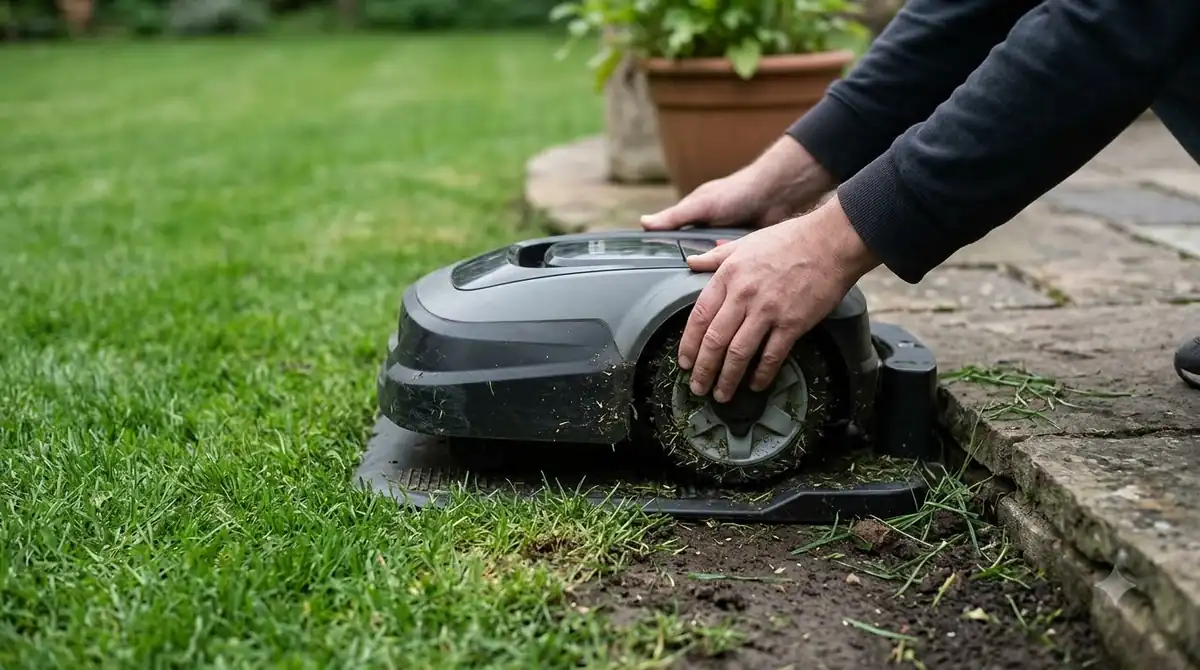
Mammotion also notes a trade-off: “AI vision or LIDAR may handle obstacles better but with slightly less pattern accuracy.” So a model with a clean straight-row pattern and a model that navigates a cluttered yard well may not be the same machine.
Heads up
On a sloped or irregular yard, a systematic mode may not be the best fit, even if the model offers it. Husqvarna’s own guidance points to its irregular mode for those conditions.
What to check before you buy
If you are still asking whether robot mowers mow in straight lines on your own yard, treat the pattern and the positioning as separate questions. The checklist below uses only the criteria covered by the sources above.
- Systematic mode. Confirm the model lists parallel, checkerboard or triangle in its specification or app, not only random mowing.
- Positioning method. Find out whether the mower uses boundary wire, GPS or RTK, or another method. Systematic rows generally depend on GPS or RTK.
- Base station sky view. If the model uses RTK, check the manufacturer’s sky-view requirement against your yard, especially around tall trees and house walls.
- Yard shape. A flat, open lawn with few obstacles suits systematic mowing. A sloped or cluttered yard may suit an irregular mode better, according to Husqvarna.
- Edge handling. Ask how the mode covers the boundary. A parallel-only pattern can leave edges uncut.
- Current manual. Specifications and app features change between firmware versions, so verify the mode and positioning in the current manual as of November 2026.
Frequently asked questions
Do robot mowers mow in straight lines all the time?
No. Random-mode robots travel straight only within each run, then turn at the boundary wire, an obstacle or a sensor alert. Straight rows across a session need a systematic mode, and the pattern depends on the model’s settings.
Can I make a robot mower cut stripes?
Only if the model offers a systematic mode such as parallel or checkerboard. Husqvarna describes these as creating a striped effect. Mammotion also advises alternating the mowing direction weekly to keep coverage even.
Do I need RTK for straight rows?
Not always, but systematic modes usually rely on GPS or RTK navigation. RTK is described by one manufacturer as accurate to within a few centimeters, a vendor claim without independent data. Check the positioning method in the spec sheet.
Why does my robot leave uncut edges in a striped pattern?
Husqvarna notes that a parallel pattern, where the mower runs only in one direction, can leave edges uncut. Checkerboard or triangle patterns cover the edges from multiple angles, so switching modes may help.
Sources
- What is systematic mowing? (Husqvarna): parallel, checkerboard and triangle patterns, angles, edge coverage and the irregular mode.
- Lawn mowing patterns for robotic lawn mowers (Mammotion): random pattern behavior, systematic GPS or RTK navigation and weekly direction changes.
- What is RTK technology? (Sunseeker Elite, vendor page): RTK accuracy claims, base station sky-view guidance and factors that reduce accuracy.
- Systematic pattern for robotic mower (Mammotion): zigzag and checkerboard path descriptions, overlap, and the RTK or GNSS and vision or LiDAR trade-off.
- How to get stripes on your lawn (Husqvarna): parallel, stripes, triangle and checkerboard options, and the irregular mode cutting from different directions.
 Up next7 min readLearnDo Robot Mowers Damage Drip Irrigation Lines?Updated Nov 12, 2026
 9 min readLearnHow to Pair a Robot Mower with a Smart Gate OpenerUpdated Nov 19, 2026
 8 min readLearnSegway Navimow Positioning Lost? What It Means and 6 Simple Fixes to TryUpdated Nov 10, 2026
 7 min readLearnHow to Clean Under a Robot Mower Deck: 6 Easy StepsUpdated Nov 14, 2026
 8 min readLearnCan a Robot Mower Mow Over Sticks? What the Sources SayUpdated Nov 11, 2026
 9 min readLearnWhy Do Robot Mowers Mow Every Day?Updated Nov 11, 2026