
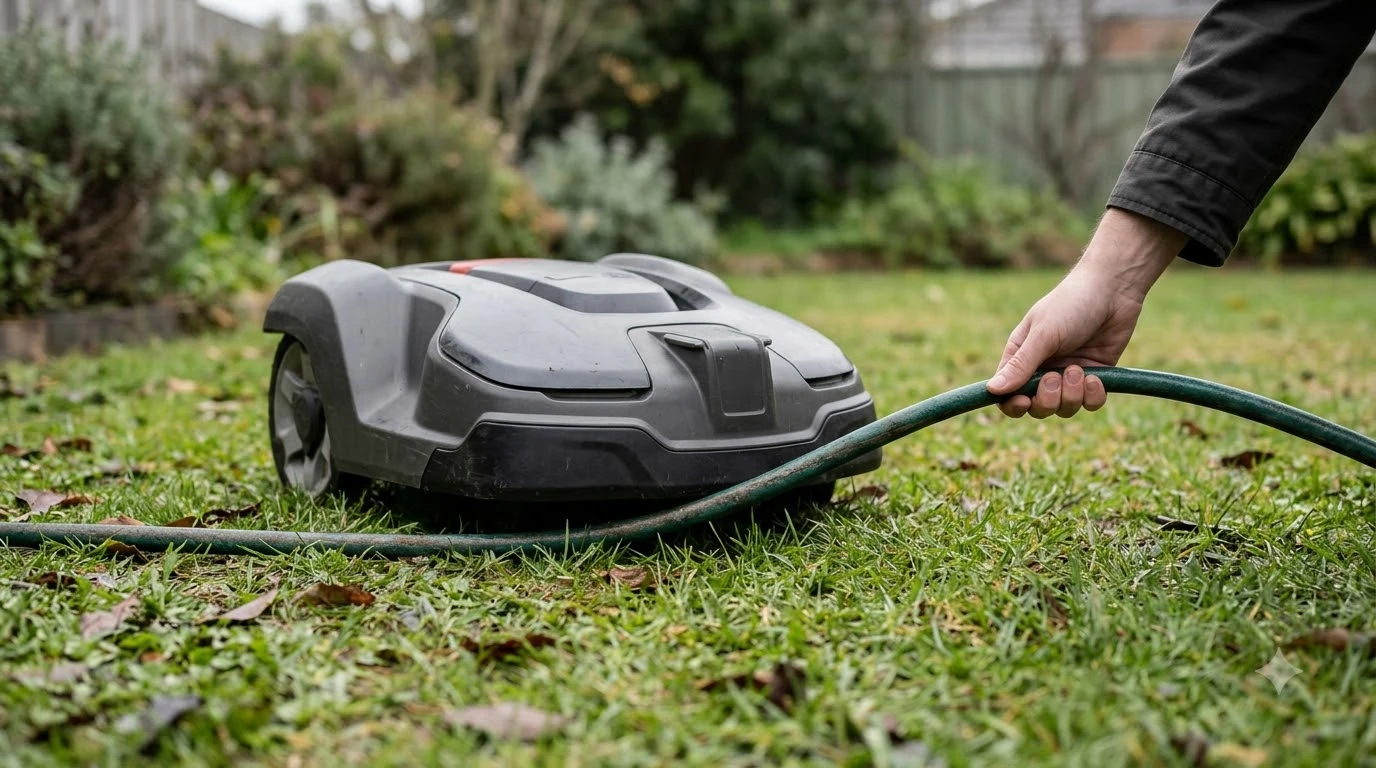

Do robot mowers damage drip irrigation lines? Usually not by cutting, but they can snag or drag loose tubing and fittings. No manufacturer source we read says a mower cuts drip tubing. The documented risks are low hazards the mower can miss, loose lines that get caught, and map errors after you change the yard. As of 2026-11-12, we found no independent test of drip line damage, so the points below rest on manufacturer guidance and our reading.
The short answer
- Cutting: no source read says a robot mower cuts drip tubing.
- Snagging: loose or exposed lines and fittings are the main risk.
- Detection gap: low fittings can sit below the obstacle-detection height.
- Protection: no-go zones and map updates reduce the risk.
Do robot mowers damage drip irrigation lines on the surface?
The answer to “do robot mowers damage drip irrigation lines?” depends mostly on whether the tubing lies on the surface and how loose it is. A robot mower can run over a drip line that lies on the surface, especially where the line is loose. Eufy’s troubleshooting guide lists hose fittings and sprinkler heads among the low objects a mower can miss, and recommends no-go zones around exposed pipes.
Husqvarna’s FAQ says that when a mower encounters an object, it stops, reverses and goes in another direction, so a line that is only lightly in the way may be handled that way rather than cut. Our guide on what happens if a robot mower runs over a hose covers the closest everyday case.
Our reading is that the realistic damage to drip irrigation lines is indirect: a line pulled out of its fitting, a dripper knocked off a bed, or a tangled hose that stops the mower. The sources do not give a clearance distance for drip tubing, so treat the risk as a condition of the yard, not a fixed rule.
Which low hazards can a robot mower miss?
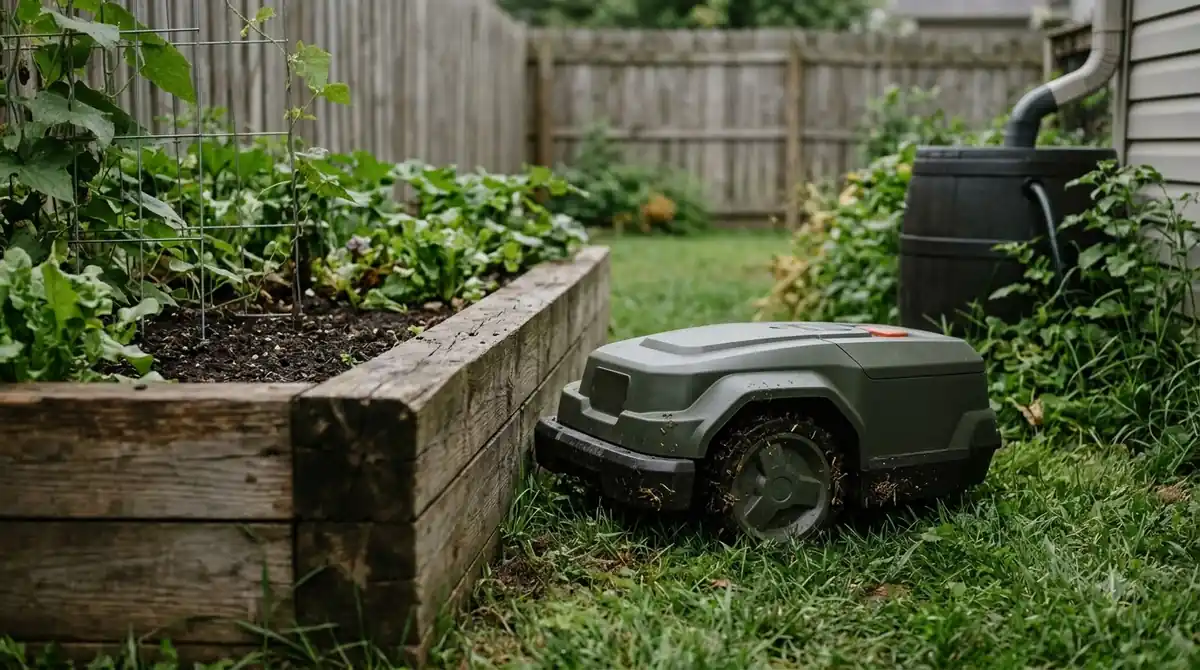
Low hazards are the main concern. Eufy says sprinkler heads, hose fittings, wire pegs and similar low objects may sit below the mower’s normal obstacle-detection height, and long grass makes them harder to see. Drip systems often have fittings, emitters and short risers at ground level, so they fall into this category.
Heads up
Eufy also notes that low hazards can be hard to spot in tall grass. A line that looks clear before a mow can become a hazard once the grass grows.
- Exposed pipe and fittings: the usual snag point for a mower’s chassis or wheels.
- Low sprinkler heads: Eufy lists them alongside exposed pipes as hazards to mark on the map. See how a robot mower handles sprinkler heads.
- Wet ground near outlets: Eufy advises repairing recurring muddy patches near irrigation outlets, which suggests these spots need attention on any mower.
Clemson HGIC’s sprinkler guide explains that pop-up sprinkler heads rise and return to the ground, while fixed risers stay up. Pop-up spray head bodies are typically 2 to 12 inches tall. The same guide, describing one high-vacuum mower rather than a robot, says that occasionally a sprinkler was drawn up and chopped off by the intense suction. That is the clearest documented case of irrigation parts being damaged by mowing, and it applies to raised heads, not to drip tubing.
Check each fitting by hand after you set up the drip system. Our reading is that a part sitting lower than the grass line is the most likely point of contact for a robot mower.
How to protect drip lines from a robot mower
Protection is the practical answer to “do robot mowers damage drip irrigation lines?” The most direct step is a no-go zone around the drip line, which Eufy recommends for exposed pipes and low sprinkler heads. Husqvarna’s stay-out zone guidance adds practical limits: zones can go almost anywhere except where the charging station or guide wire are located.
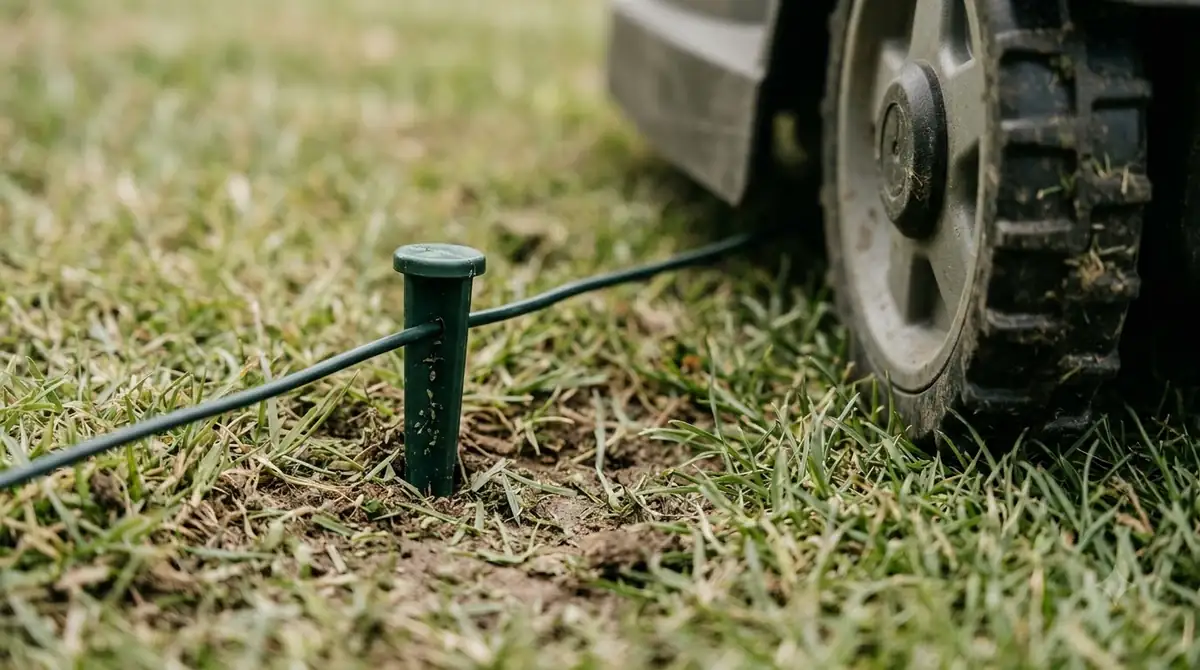
- Map the lines. Walk the drip run and mark every fitting, riser and exposed section on the map.
- Add no-go zones. Eufy suggests no-go zones around exposed pipes, low sprinkler heads and steep drops. Use the app if your model supports it, and see how to set up no-go zones on a robot mower for the steps.
- Keep zones off the wire. Husqvarna says a zone over the guide wire stops the mower returning to charge, so keep zones off it.
- Fence pool and street areas. Husqvarna says stay-out zones cannot stop a mower entering a swimming pool or the street, and advises fencing those areas with the boundary wire and a barrier at least 15 cm (6 in) high.
Our reading is that a no-go zone is a better first step than burying the line, because the zone can be checked after each map change. The sources we read do not describe buried drip tubing as a mower hazard, though buried lines still need their own protection from digging and wet-ground ruts.
What to recheck after irrigation work
Map errors are a common cause of trouble after you change a yard, and they can leave drip irrigation lines inside the mowing path. Eufy says new garden beds, play equipment, irrigation work and landscaping can make an old map unreliable, and that the map must reflect the real position of low hazards.
- Review boundaries and no-go zones after you add, move or repair drip lines.
- Check the map again after any new bed or hardscape that changes the mowing path.
- Look at the lawn near irrigation outlets for ruts or muddy patches after rain.
Our reading is that a current map is the simplest way to settle “do robot mowers damage drip irrigation lines” in your own yard, and our note on using a robot mower with sprinklers covers timing. Husqvarna’s FAQ also advises inspecting the blade disc once a week, because grass or other objects can twist around it. A tangled line or piece of tubing can cause that kind of wrap-up, so the weekly check is a useful habit.
Frequently asked questions
Do robot mowers damage drip irrigation lines by cutting them?
No manufacturer source we read says a robot mower cuts drip tubing. The documented risks are snagging, dragging loose lines and missing low fittings. Protect exposed drip irrigation lines with no-go zones rather than relying on the mower to avoid them.
Can a stay-out zone protect a drip line?
Husqvarna says stay-out zones can go almost anywhere except where the charging station or guide wire are. The zone must not block the mower’s return path. Stay-out zones are not a substitute for a fence near pools or streets.
Is wet ground a risk near drip irrigation outlets?
Eufy advises repairing recurring muddy patches near irrigation outlets, and says clay soil and worn turf can soften after regular sprinkler use, so a wheel may sink. Keep the mower away from those spots after watering until the ground dries.
Does debris damage the blade disc?
Husqvarna says grass or other objects can twist around the blade disc, and it recommends inspecting the blade disc and blades once a week. A drip irrigation line caught in the disc should be removed before the next mow.
Should I bury drip lines before using a robot mower?
The sources we read do not require burying. Our reading is that marking the lines with no-go zones is the clearer protection, and that burying does not remove the need to recheck the map after digging.
Sources
- Robot lawn mower stuck: causes and fixes (Eufy): low hazards, no-go zones, map updates and irrigation outlets.
- Creating stay-out zones with AIM Technology (Husqvarna): zone limits, guide wire and the 15 cm barrier for pools and streets.
- Robotic lawn mower FAQ (Husqvarna): object response, blade disc inspection and debris.
- Landscape irrigation equipment, part 1: sprinklers and spray heads (Clemson HGIC): pop-up and fixed head types, pop-up heights, and the note on mower suction (read this run).
 Up next8 min readLearnDo Robot Mowers Mow in Straight Lines? 6 Smart ChecksUpdated Nov 11, 2026
 9 min readLearnShould a Robot Mower Run After Aeration?Updated Nov 12, 2026
 8 min readLearnHow to Register a Robot Mower Warranty: Deadlines and ProofUpdated Nov 12, 2026
 8 min readLearnHow to Clean Robot Mower Sensors Safely, Step by StepUpdated Nov 12, 2026
 7 min readLearnWhat Do Robot Mower Charging Station Lights Mean?Updated Nov 12, 2026
 8 min readLearnHow Long Does the Husqvarna Automower 430X Battery Last?Updated Nov 12, 2026