
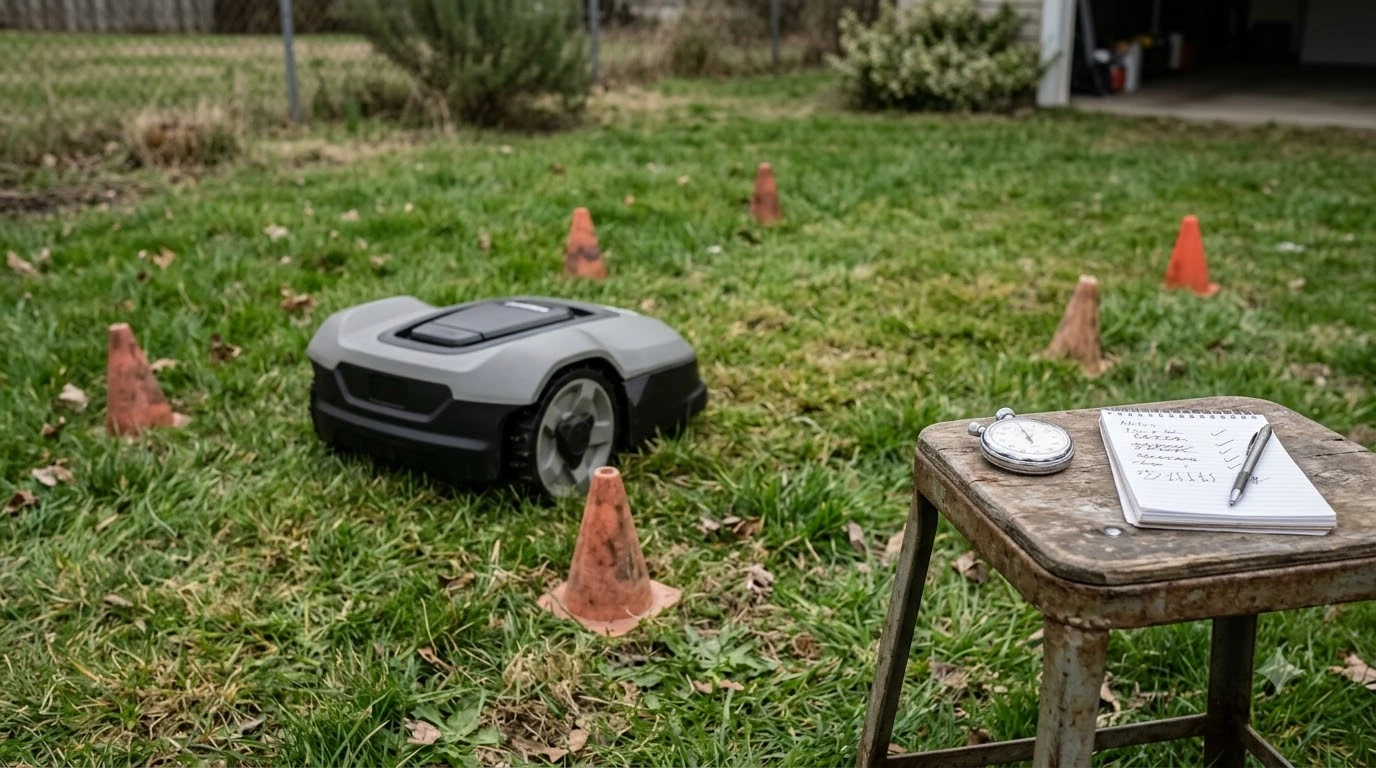

This page explains what is UWB navigation on a robot mower in plain terms: a tag on the mower measures radio distances to fixed anchors placed around the lawn, and the mower works out its position from those distances. It does not depend on satellite signals, so it is an alternative to GPS-based methods such as RTK. Controlled tests of UWB positioning report good results, but the sources reviewed here give no verified accuracy for a commercial mower on a real lawn.
The short answer
- Radio ranging: UWB measures distance from the time radio signals take to travel between a tag and fixed anchors.
- Position: The mower’s location is calculated from several distances, a method called multilateration.
- Setup: The anchors must sit at known positions around the lawn before the mower can use them.
- Limit: Lab accuracy is not the same as yard accuracy, and UWB usually gives position but not heading.
What is UWB navigation on a robot mower and how it works
UWB navigation works by timing radio signals between one tag on the mower and several fixed anchors, then solving for the tag’s position. The tag rides on the mower, and the anchors are small radio modules placed at known points around the yard. A 2021 study in the journal Sensors describes the general method as multilateration, where the position is estimated from distances measured by time of arrival or time difference of arrival.
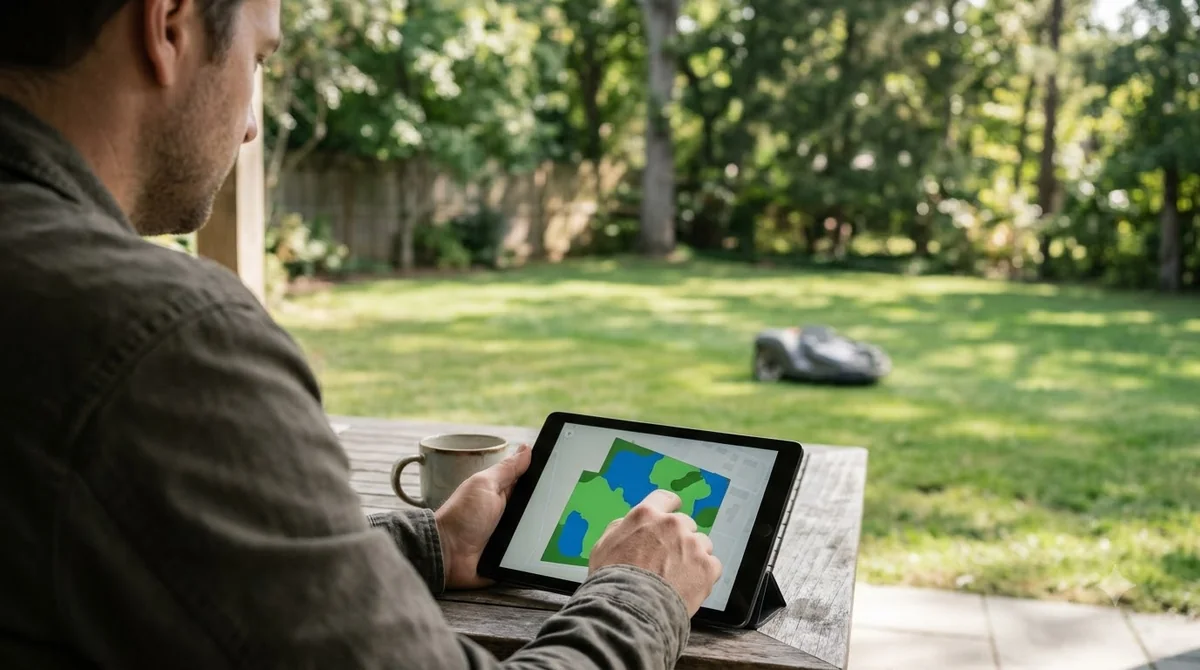
Distance comes from timing. The study’s UWB modules operated at 3.25 to 3.75 GHz with 500 MHz of bandwidth, and the authors say positioning accuracy depends on the time resolution of the signal. The same paper states that UWB can distinguish direct signals from multipath reflections in complex environments, which is one reason the method is studied for indoor and outdoor robots. For a plainer overview of the wire-free alternatives, see how robot lawn mowers work without a wire.
A do-it-yourself lawn mower project published by Arduino shows the same basic layout. It uses one onboard tag and three fixed remote anchors, and the author notes that three anchors can determine a tag’s exact location in 3D space. Hackaday’s coverage of the same build describes the anchors as placed in a triangle around the area to be mowed.
How accurate is UWB on a lawn?
In controlled tests, UWB positioning is accurate to roughly ten centimeters, but the meeting-room figures were not measured on grass. The 2021 Sensors study reports an average navigation error of 0.10 m in a meeting room, with an RMSE of 0.13 m, and an average measured RMSE of 0.257 m across its tests.
The same paper also describes a mower scenario on a 10 by 17 meter lawn with a tree, using four anchors at the corners and two tags on the mower. The authors do not report accuracy figures for that lawn, and they say only that the system worked with high positioning accuracy even on rugged terrain, without giving numbers. The DIY Arduino build describes its result as centimeter-scale positioning but gives no measured figure in the article.
So what is UWB navigation on a robot mower worth in accuracy terms? Our reading is that these results show what UWB can do under good conditions, not what a specific mower will achieve in your yard. Slopes, trees, walls, and metal objects all change the radio environment, so a real yard needs its own test.
Why anchor placement matters
Anchor layout strongly affects the result, so placement is part of the system rather than an afterthought. Anchor placement is a large part of the answer to what is UWB navigation on a robot mower in practice. The Sensors authors report that tags inside the rectangle formed by their anchors had smaller errors than tags outside it, and they advise installing anchors so they cover every position a tag can reach.
Setup also takes time. The Hackaday build notes that the mower must be within range of the tags before autonomous operation can start, and the DIY builder used Bluetooth during setup to drive the mower around the perimeter. Our reading is that anchor count, spacing, and coverage should be checked before you rely on any UWB mower.
UWB vs RTK GPS on a robot mower
RTK GPS and UWB both aim for precise position, but they get it from different places. RTK depends on satellites plus a correction source, while UWB depends on anchors you place around the lawn. Conventional GPS is good to about a couple of meters according to Hackaday’s summary, and GNSS enhancement techniques are described there as reaching around 1 or 2 centimeters.
| Criteria | UWB navigation | RTK GPS |
|---|---|---|
| Signal source | Radio between the tag and fixed anchors | Satellite signals plus correction data |
| Setup | Place and cover the lawn with anchors | Base station or correction service |
| Ongoing cost | Not stated in the sources read | Correction service subscription, per the Arduino article |
| Accuracy in sources read | About 0.10 m average in a meeting-room test | Around 1 or 2 cm with enhancement, per Hackaday |
| Yard limits | Line of sight and anchor layout matter | Sky view and correction coverage matter |
In plain terms, what is UWB navigation on a robot mower next to RTK? A local radio system you install yourself, instead of satellites plus a correction source. Our reading is that the choice depends on how much setup work you accept and whether a correction service fits your budget. Our guide on how RTK works on a robot lawn mower covers the satellite side. Neither method was verified on a commercial mower in the sources reviewed for this page. For a wider three-way view, read RTK versus LiDAR versus vision navigation.
What UWB cannot do alone
UWB usually gives a position but not a heading, and it needs the anchor positions to be known in advance, so robots often combine it with other sensors. A 2025 robotics paper from the University of Würzburg states that UWB positioning schemes “require the position of the anchors to be known a priori” and usually determine the position but not the heading of the robot.
The same group combined UWB distance measurements with wheel odometry in an extended Kalman filter. In their experiments with four anchors, the fused system performed considerably better than wheel odometry on its own, and it kept working through a UWB outage, although accuracy after the outage was not the same as before.
- Heading: Position alone may not show which way the mower faces.
- Obstacles: The DIY build uses ultrasonic sensors and LIDAR to detect obstacles, a separate job from positioning. Our page on how robot mowers avoid obstacles explains that side.
- Blocked signals: The Sensors paper says UWB can work in non-line-of-sight conditions, but it gives no quantified error for that case.
Our reading is that dense tree cover or long walls are conditions to test rather than assume, because the sources read here do not measure them for a mower.
What to check before you buy a UWB mower
Before you buy, get a clear answer to what is UWB navigation on a robot mower for that specific model. Check how the mower positions itself, what the anchors need, whether a correction service or boundary wire is required, and whether the maker’s accuracy claim comes from a lawn or a lab. Use the maker’s own manual for each point.
- Positioning method: Ask whether the mower uses UWB alone, RTK, or a mix of sensors.
- Anchor count: Confirm how many anchors the system needs to cover your lawn shape.
- Accuracy context: Find out whether the figure was measured on grass or in a lab.
- Subscription: Confirm whether a correction service is required.
- Start-up rule: Check whether the mower must be in range of the tags before it starts.
- Boundary wire: Check whether a wire is still needed, as covered in do robot mowers need a boundary wire.
Frequently asked questions
Does UWB navigation need satellites?
No. UWB positioning uses radio signals between a tag on the mower and fixed anchors, so it does not need satellite signals to calculate position. The sources reviewed describe the anchors as fixed radio modules placed around the yard at known points.
How many anchors does a UWB mower need?
The DIY build described by Arduino uses one tag on the mower and three fixed anchors, and the article says three anchors can locate a tag in 3D space. Hackaday describes the same three-anchor triangle. Commercial models may use a different count, so check the manual.
Is UWB more accurate than GPS?
The sources give different kinds of numbers. Hackaday says conventional GPS is good to about a couple of meters, while the Sensors study reports an average meeting-room error of 0.10 m for UWB. Those tests were not run on the same kind of site, so treat the comparison as a rough guide only.
Can a UWB mower work without a boundary wire?
In principle, yes, because the position comes from anchors rather than from a wire. The sources reviewed here do not confirm how any commercial UWB mower handles its boundary, so check the maker’s manual before you decide whether to install a wire.
Sources
- Ultra-Wideband Positioning Sensor with Application to an Autonomous Ultraviolet-C Disinfection Vehicle (Sensors, 2021): UWB ranging method, accuracy results, multipath and NLOS claims.
- An Ultra-Wideband Localization Approach for Unknown Anchor Distributions (University of Würzburg, 2025): known anchor positions, heading limit, fusion with wheel odometry.
- Centimeter-scale lawn mower positioning without GPS RTK (Arduino blog, 2022): DIY anchor count, sensors used, RTK subscription note.
- Lawnmower Doesn’t Need A Base Station (Hackaday, 2022): anchor triangle, setup limits, GPS accuracy context.
 Up next8 min readLearnWhat Is VSLAM Navigation on a Robot Mower?Updated Nov 11, 2026
 7 min readLearnCan You Overseed With a Robot Mower?Updated Nov 11, 2026
 8 min readLearnCan You Install a Robot Mower Yourself?Updated Nov 11, 2026
 8 min readLearnHow Often Does a Robot Mower Need to Charge?Updated Nov 11, 2026
 7 min readLearnHow Much Does a Robot Mower Weigh?Updated Nov 11, 2026
 7 min readLearnDo Robot Mowers Work in Hot Weather? Temperature Limits ExplainedUpdated Nov 11, 2026