
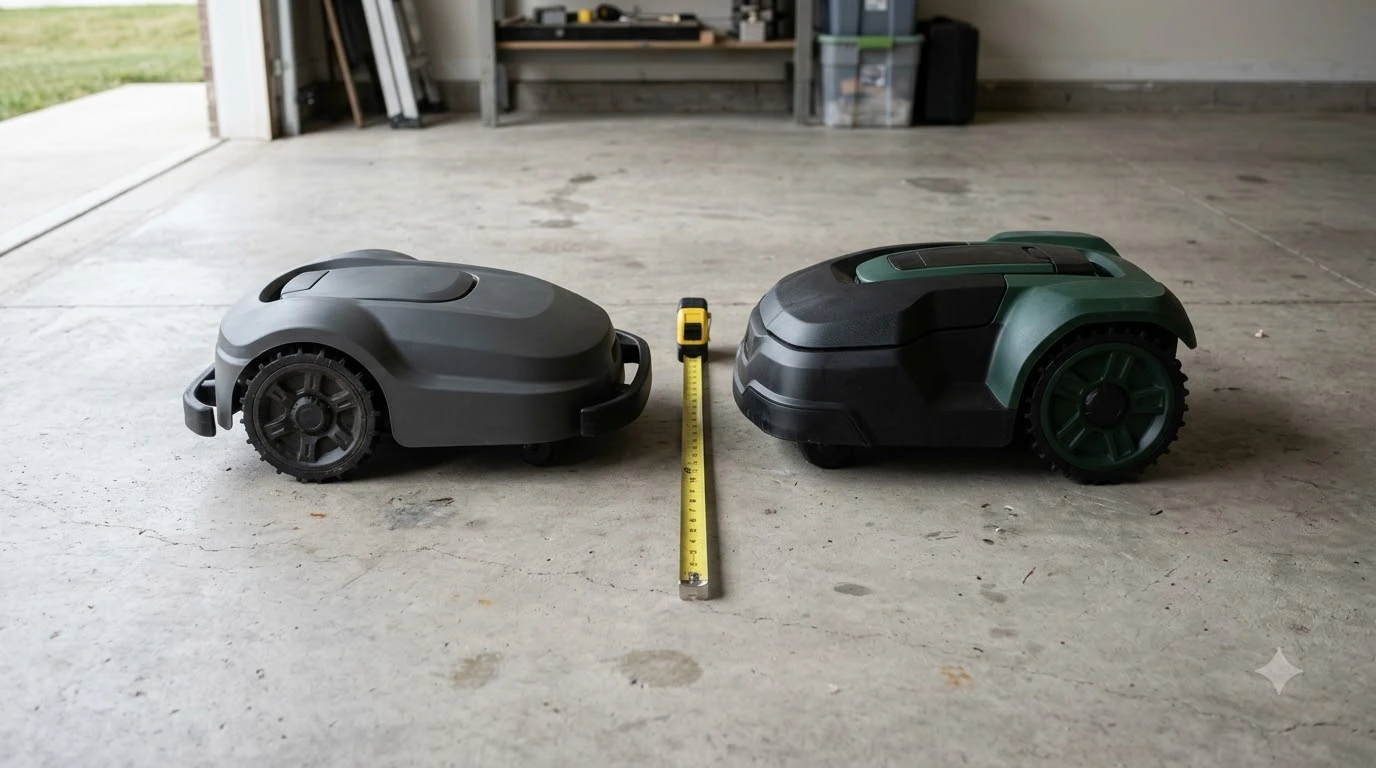

What to look for in a robot lawn mower starts with the lawn area it is rated for, then battery recharge time, cutting height, slope claims, boundary type and noise. These six checks cover most of what separates one model from another, and the figures behind each one come from manufacturer and buyer guides we read for this page, as of 2026-11-10.
The short answer
- Lawn size: pick a model rated for at least 20 to 30 percent more than your measured lawn area.
- Battery: compare mowing time with recharge time, not the maximum runtime alone.
- Cutting height: confirm the adjustment range covers the height your grass needs.
- Slope: read the rated slope as a best-case figure and check the conditions behind it.
- Boundary: know whether the model uses a physical wire, a virtual boundary, or both.
- Noise and blades: check the decibel rating and how easily the blades are replaced.
What to look for in a robot lawn mower, starting with lawn area
Lawn area is the first filter for any robot mower, because manufacturers rate their models by the area they can handle. Sunseeker’s UK buying guide advises choosing a model rated for an area at least 20 to 30 percent larger than your own calculation, which, in our reading, leaves room for odd corners and slopes. A buffer matters because a rating is a ceiling, not a guarantee that the mower will finish a large or complicated lawn every day. Our guide on what size robot mower you need for a quarter acre shows the sizing math for one common lot.
Ratings are published in different units, so convert before you compare. Sunseeker groups its models by lawn size: it describes entry-level machines as designed for small, flat lawns, typically under 1,000 square meters, and says larger or steeper properties over 3,000 square meters call for a premium model. A square meter is about 10.76 square feet, so 1,000 square meters is roughly a quarter acre.
American listings are often given in acres. Husqvarna’s US range shows the 410 iQ with up to 0.5 acres of mowing capacity and the 420 iQ with up to 1 acre. Lawnlove, a buying guide, makes the same point in plain terms: most residential robot mowers can comfortably handle up to about 0.5 acres. Robotmower.info notes that some models can handle areas up to several acres, while small yards may not need a high-capacity machine at all.
| Lawn size band | Typical description in the sources |
|---|---|
| Under 1,000 m2 (about 0.25 acre) | Entry-level tier for small, flat lawns (Sunseeker UK) |
| Up to 0.5 acre | Residential capacity most guides describe (Lawnlove; Husqvarna 410 iQ) |
| Up to 1 acre | Husqvarna 420 iQ capacity |
| Over 3,000 m2 (about 0.74 acre) | Premium tier for large or challenging properties with steep slopes (Sunseeker UK) |
Our reading is that the simplest way to use these numbers when you decide what to look for in a robot lawn mower is to measure your lawn, multiply the result by 1.2 to 1.3, and shop only among models rated at or above that figure. A yard split into several zones or with many beds may need a higher rating than its plain area suggests.
Compare battery runtime with recharge time
For many buyers, battery is the easiest spec to misread. Runtime on its own does not tell you how much grass a mower cuts in a day. What matters is the balance between mowing time and the time the mower spends on its charging dock. Sunseeker gives a clear example: a model that mows for 70 minutes and recharges in 50 minutes may cover more ground across a day than one that mows for 90 minutes but needs 120 minutes to recharge.
Battery size also drives recharge time. According to robotmower.info, a smaller battery can charge in under an hour, while a larger battery may take a couple of hours. A bigger battery can mean a longer mowing session, but it can also leave the mower docked for longer between sessions, so the right choice depends on how much lawn you need covered each day.
Our guide on how often a robot mower needs to charge covers the cycle in more detail. Ask the seller or read the spec sheet for the runtime and recharge figures together. If the page only gives a maximum runtime, treat it as an incomplete answer and look for a model whose manufacturer also publishes charging time.
Heads up
Battery figures change between product generations. Check the current model’s specification sheet rather than a review written about an earlier version.
Match the cutting height to your grass
Cutting height is a basic spec to check. Most lawns need a cutting height between about 1.5 and 4 inches, and that range is the first thing to check against your grass type. Lawnlove advises looking for a model with at least a 1 to 4 inch adjustment range. A mower that cannot reach the height your lawn needs will either scalp the turf or leave it too long for a neat finish. If height range is your priority, see our picks for a robot mower with adjustable cutting height.
Not every model reaches the same range. Robomow states that the cutting height of many robot mowers remains limited to 60 millimeters, which is about 2.4 inches. That limit is fine for many lawns, but it can rule out a model if you want to keep a taller turf or have a mix of grass types across your yard.
Our reading is that a wide adjustment range is more useful than a narrow one if you plan to change the cut height through the seasons. The pages we read did not describe how each model’s height control works, so check the manual for the mechanism.
Read slope claims with care
Slope capability is one of the most advertised features of robot mowers, and it is also the one most often misread. Husqvarna’s US page lists the 435 iQ AWD as navigating slopes up to 70 percent. That is a manufacturer claim for one model, measured under the conditions the maker chose, so it is a ceiling rather than a promise for every lawn.
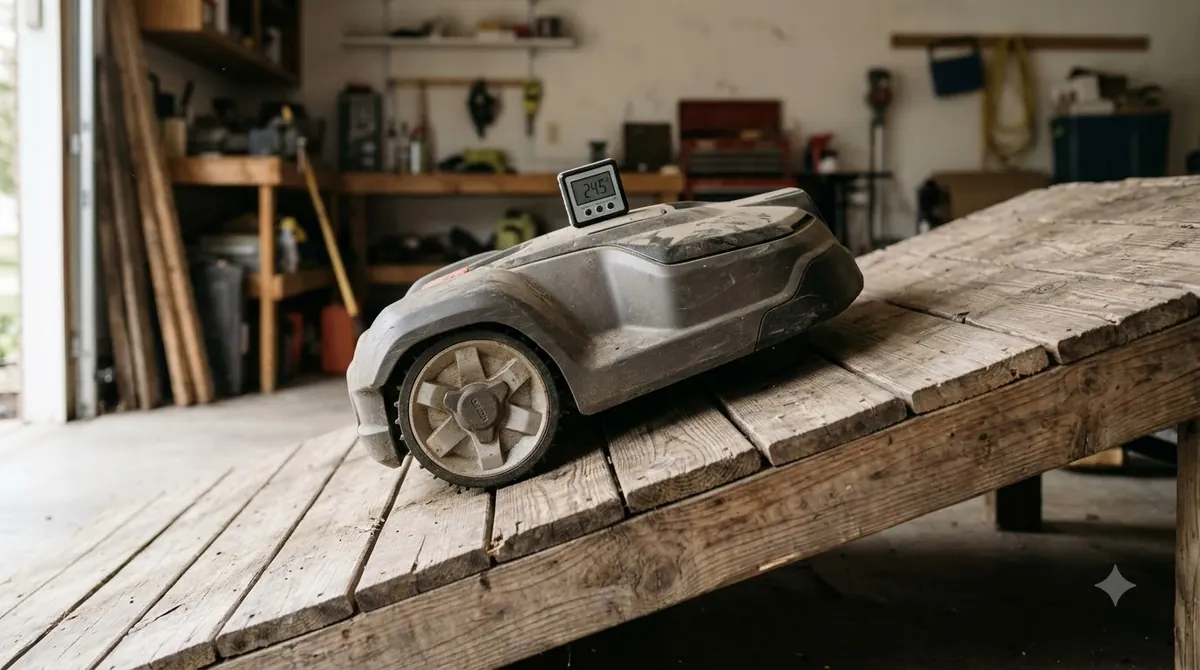
Independent guides are more cautious. Lawnlove’s reviewer writes that in real-world conditions, anything over about 25 percent is where problems start. That is one reviewer’s opinion, not a test standard, but it shows why the headline number should not be the only figure you use. Our reading is that ground conditions such as wet grass also affect how a mower handles a slope, so the rated figure is a starting point.
Our reading is to match your steepest section against the rated figure, then add a margin, since slope is the spec that most often goes wrong. Our guide to the best robot lawn mower for hills goes further. If your lawn has a bank or a slope near the top of a model’s rating, consider whether the boundary layout will keep the mower away from the edge, and whether you are willing to reshape the hill or leave that area unmown.
Heads up
The pages we read gave slope figures for only a few named models, so you will need the spec sheet for the exact model you want. Ask whether the rating assumes a particular installation.
Decide between boundary wire and virtual wire
Boundary type is a practical point to settle early when you decide what to look for in a robot lawn mower. A robot mower needs to know where the lawn ends, and most models rely on a physical boundary wire laid around the edge and under the grass. Husqvarna’s US filter lists two boundary types, physical wire and virtual wire. The page does not explain the difference in depth, so read the manual of the model you are considering to see how each boundary is set up and what it needs.
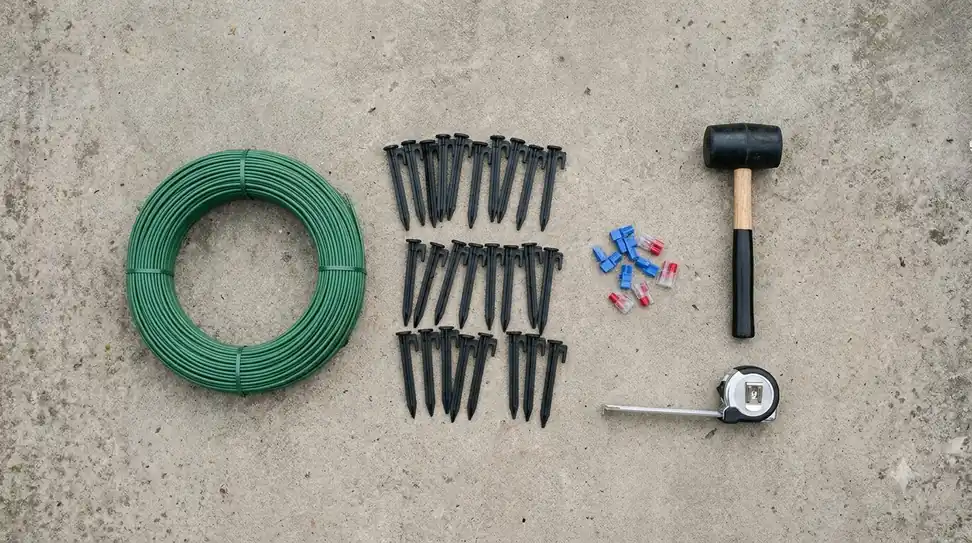
Physical wire works by carrying a signal. According to robotmower.info, boundary wire usually runs a small constant current through it, and the mower detects the signal to stay inside the perimeter. Installing it means laying the wire, fixing it with pegs, and joining the ends. Our reading is that the job takes time, especially around flower beds, trees and paths, and our walkthrough on how to install a robot mower boundary wire covers the steps.
Our reading is that installation effort is the main practical difference you will notice. Before you buy, check whether the model you want needs a wire at all, how much wire and how many pegs the kit contains, and whether the manufacturer’s installation steps are simple enough for you to do yourself.
Check noise, blades and warranty
Noise and blade upkeep decide how comfortable a robot mower is to live with, and both are easy to check before you buy. They are quieter items on the list, but they belong with what to look for in a robot lawn mower because they affect daily use. Robomow states a noise level of 65 decibels or less for its mowers. Ask for the decibel rating on the spec sheet and compare it against how close the mower will run to windows, patios or a neighbor’s fence.
- Noise: look for a published decibel figure, not just the words “quiet”.
- Blades: Robomow says its blades can be swapped in just a few minutes, so check whether replacement parts are easy to buy.
- Edges: blades that extend past the wheelbase reach closer to fences and edging, which Robomow describes as an edging function.
- Warranty: robotmower.info advises checking the warranty period before you buy, and notes that robot mowers vary widely in price.
Warranty and support deserve as much attention as the mower itself. Read what the warranty covers, how long it lasts, and whether the brand has a local service route, since a mower that sits in a repair queue all summer is a poor buy even if its specs look strong.
Frequently asked questions
How big a robot lawn mower do I need?
Measure your lawn in square meters or acres, then choose a model rated for at least 20 to 30 percent more than that figure. Sunseeker’s UK guide gives this buffer, and Lawnlove suggests the same margin for acreage.
Does a robot lawn mower need a boundary wire?
Some models use a physical boundary wire, and Husqvarna’s US range also lists virtual wire as a boundary type. The pages we read do not compare the two in detail, so check the manual for the specific model before you buy.
How steep a lawn can a robot mower handle?
Manufacturers publish their own maximum slope, such as up to 70 percent for one Husqvarna model. A Lawnlove reviewer reports problems in real conditions above about 25 percent, so plan around a margin below the rated figure.
How long does a robot lawn mower take to recharge?
According to robotmower.info, a smaller battery can charge in under an hour, while a larger battery may take a couple of hours. Sunseeker’s example shows a mower needing 120 minutes to recharge after 90 minutes of mowing, so check the figures for your model.
Put simply, what to look for in a robot lawn mower is a short set of figures you can check against your own yard before you buy.
Sources
- Husqvarna robotic lawn mowers (US) (manufacturer): capacity by model, the 70 percent slope claim and the boundary type filters.
- Sunseeker, what to consider when buying a robot mower (manufacturer): the 20 to 30 percent area buffer, size tiers and the battery runtime and recharge example.
- Lawnlove, best robotic lawn mowers (buyer guide): residential capacity, cutting height ranges and the reviewer’s slope comment.
- Robomow, the 5 most important features for a robotic mower (manufacturer): the 65 dB noise figure, the 60 mm cutting height limit and blade replacement.
- robotmower.info, things to consider before buying a robot mower (buyer guide): lawn area in acres, battery charging times, boundary wire current and the warranty advice.
 Up next7 min readLearnDoes a Robot Mower Work With a Dog in the Yard?Updated Nov 11, 2026
 7 min readLearnDo Robot Mowers Hurt Frogs and Toads?Updated Nov 11, 2026
 8 min readLearnHow to Reset a Robot Mower: Restart First, Then Factory ResetUpdated Nov 11, 2026
 9 min readLearnCan Someone Hack a Robot Mower? What Published Research ShowsUpdated Nov 11, 2026
 8 min readLearnCan a Robot Mower Handle Acorns and Pine Cones?Updated Nov 11, 2026
 8 min readLearnDo Robot Mowers Increase Home Value?Updated Nov 11, 2026