
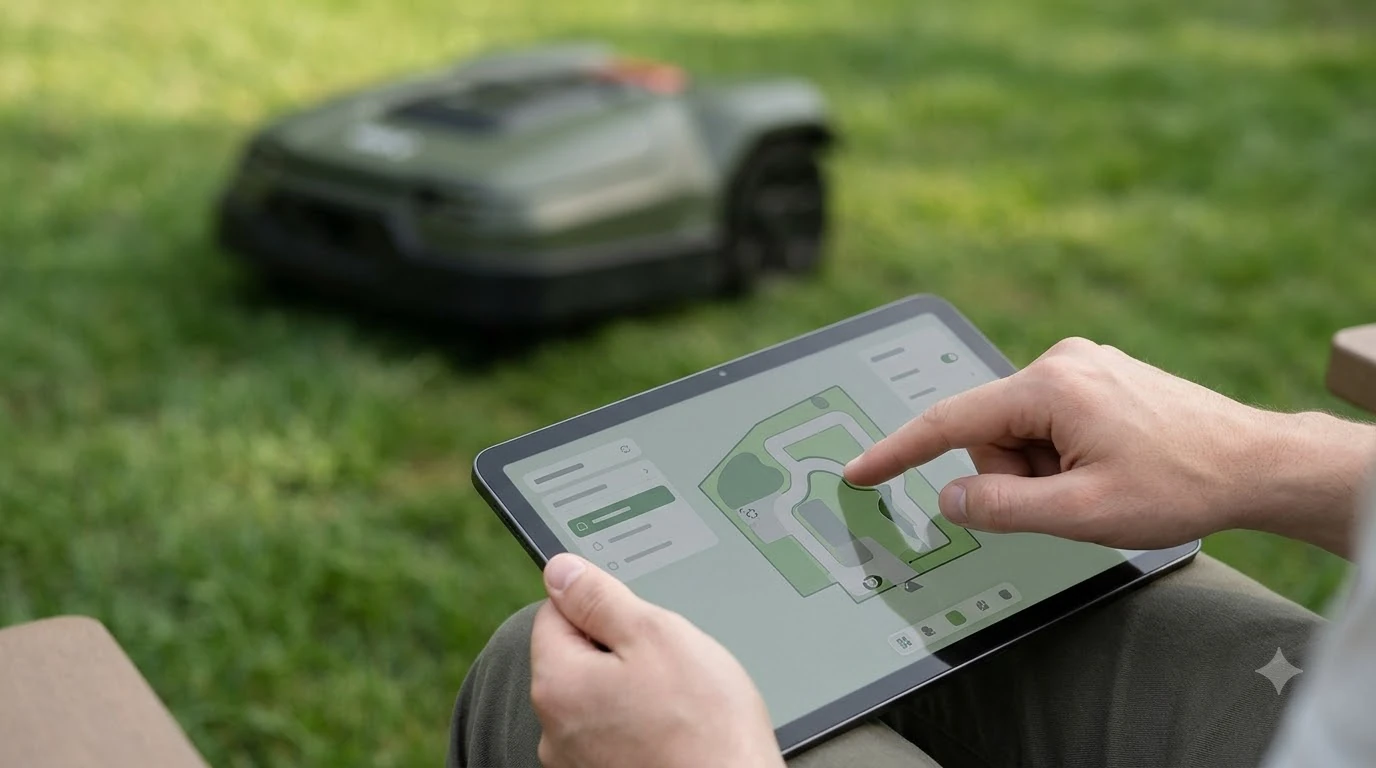

The ecovacs goat vs segway navimow app comparison comes down to positioning and warranty, because the apps both cover the basics that matter most, multi-zone mapping and no-go zones, so the choice depends more on the mower’s positioning and the warranty than on the app itself. Published spec pages list the same mapping features and the same smart-home links for both brands, while the one clear difference is how each mower finds its position. Details below are as of Nov 2026, and they are based on spec and buying-guide pages, not hands-on app testing.
The short answer
- Mapping: in the ecovacs goat vs segway navimow app comparison, both brands list multi-zone mapping and no-go zones on the models compared.
- Smart-home links: both list Alexa, Google Home and Home Assistant support.
- Local control: both are listed as “partially” local, so plan on the app for daily use.
- Positioning: the compared GOAT A2000 LiDAR PRO uses LiDAR, and the Navimow i110N uses RTK.
- Warranty: in the pair compared, the Navimow i110N lists 3 years and the GOAT A2000 LiDAR PRO lists 1 year.
What the two apps have in common in the ecovacs goat vs segway navimow app comparison
Both mowers in the comparison require a PIN before they can be controlled, according to the spec page. Both connect over 2.4 GHz Wi-Fi and Bluetooth, which is typical for this class of mower and means the app is the main control surface. Both list multi-zone mapping and no-go zones, which covers the two features most owners use to keep the mower off flower beds, pools and trees. The apps are only part of the picture, and Ecovacs against Navimow overall compares the full brands side by side. Reports on the other app differ, and Navimow app problems collect the main complaints and workarounds.
Smart-home support is also the same on paper. Both are listed for Alexa, Google Home and Home Assistant, so a voice command or a home dashboard can start, stop or check the mower without opening the app. Our reading is that this is a convenience layer on top of the app, not a replacement for it, since the spec pages describe local control as “partially” available on both.
Where the apps are not compared
None of the sources we read compares the two apps on scheduling, mapping speed, map editing or update frequency. The spec page does not describe the apps’ remote-control or scheduling features, and the buying guide we read does not give app detail either. That gap matters, because a mower that maps quickly but schedules poorly can be a worse daily experience than one with slower mapping and better controls.
A third-party buying guide calls Segway Navimow “a mature robotic mower platform known for its polished app experience.” That is a reviewer’s characterisation with no feature list behind it, so treat it as an opinion. For GOAT, the same guide says the models “leverage LiDAR and 3D mapping to navigate complex gardens with ease,” again without naming app features.
How positioning changes the app experience
The positioning method affects what you see in the app more than the app’s layout does. A LiDAR mower builds its position from sensors on the mower itself, while an RTK mower relies on satellite signals and a base station. RTK is sensitive to the sky view. The buying guide we read says “RTK systems can struggle in yards with dense tree cover or tall walls that block satellite signals,” and adds that antenna placement matters. Adding a third brand changes the picture, and a three-brand comparison with Mammotion shows where each app stands.
That means a yard with heavy tree cover or tall walls may need a closer look at the Navimow side, while a yard with many overhead branches may suit the LiDAR side better. Check the fix status in the app during the first weeks, whichever brand you choose.
Warranty and model choice
In the pair compared on the spec page, the Navimow i110N lists a 3-year warranty and the GOAT A2000 LiDAR PRO lists 1 year. That is a real difference if you plan to keep the mower for several seasons. Warranty terms change, and the figures here are as of Nov 2026, so confirm them on the brand’s site before buying. If you are choosing specific models, O1000 LiDAR Pro against Navimow i110N compares hardware as well as software.
The buying guide also warns that “model names and capabilities vary, so it’s essential to compare the exact version you’re considering,” and that some features “may only be available on higher-end models.” Compare the exact model and check whether the mapping and scheduling features you want are in its app version.
Heads up
Spec pages list the same features for many models. Before you buy, confirm the feature list on the model’s own page, because the app may differ between a LiDAR and an RTK version of the same range.
Who each app suits
- Choose the Ecovacs GOAT side if the yard has many overhead branches or a sky view that RTK would struggle with, and you want LiDAR-based positioning.
- Choose the Segway Navimow side if the yard is mostly open and you value the longer warranty in the compared pair.
- Test before you commit if the app’s scheduling and map editing matter more than positioning, since the sources we read do not settle those points.
Related reads: If Navimow is on your shortlist, the Worx Landroid vs Segway Navimow comparison sets it against another popular brand.
Frequently asked questions
Is the Ecovacs GOAT app better in an ecovacs goat vs segway navimow app comparison?
The sources we read do not settle it. Both list multi-zone mapping, no-go zones and smart-home links. The Navimow app is described as polished in one buying guide, but that is an opinion without a feature list.
Do both mowers need the app for daily control?
Both are listed as only partially controllable locally, so the app is the main daily tool on either brand. Check the exact model’s local control options before you buy.
Which has the longer warranty in this comparison?
In the pair compared, the Navimow i110N lists 3 years and the GOAT A2000 LiDAR PRO lists 1 year. Confirm the terms on the brand’s site, since they change.
Does the positioning method change the app experience?
Yes. An RTK mower depends on the sky view, so fix status in the app can drop under dense trees or tall walls. A LiDAR mower builds its position from its own sensors, so check the app’s map and fix status in the first weeks either way.
Sources
- SmartHomeCompared, Ecovacs GOAT A2000 LiDAR PRO vs Segway Navimow i110N (third-party spec comparison): used for multi-zone mapping, no-go zones, smart-home support, partial local control, the PIN requirement, connectivity, positioning method and the warranty figures.
- HOOKII, robot lawn mower buying guide (Neomow X2, Navimow, GOAT, MOVA) (third-party buying guide): used for the “polished app” characterisation, the RTK sky-view caveat and the note that model capabilities vary.
 Up next8 min readReviews & CompareSegway Navimow i110n vs Ecovacs GOAT O1000 RTK: What the Specs SayUpdated Nov 13, 2026
 7 min readReviews & CompareEcovacs GOAT A1600 RTK vs Dreame A1 Pro: Sourced Spec ComparisonUpdated Nov 11, 2026
 8 min readReviews & CompareEcovacs GOAT O1000 vs Mammotion LUBA 3: Spec ComparisonUpdated Nov 11, 2026
 8 min readReviews & CompareHusqvarna Automower Alternatives: Navimow, Mammotion and ECOVACS GOAT ComparedUpdated Nov 16, 2026
 11 min readReviews & CompareEcovacs GOAT O1000 LiDAR PRO vs Navimow i110N: Specs ComparedUpdated Nov 16, 2026
 6 min readReviews & CompareRobot Mower App Comparison: Husqvarna vs Mammotion FeaturesUpdated Nov 14, 2026