
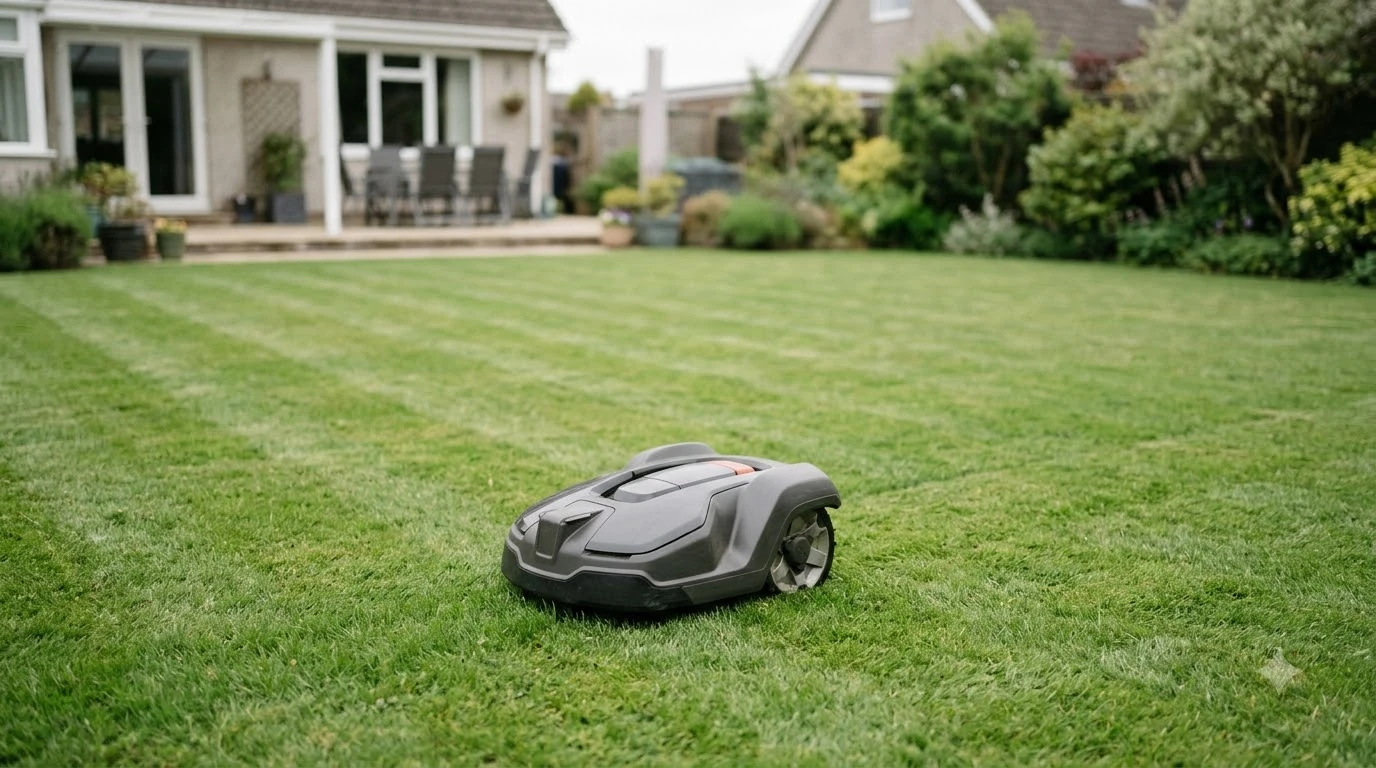

The best robot mower for an irregular shaped lawn is the one whose manual allows your narrowest passage, sharpest corner and steepest slope. No single model wins on shape alone. As of November 2026, the published figures from manufacturers (passage widths, guide wire distances and maximum inclines) decide most of the fit.
The short answer
- Passages: Husqvarna recommends 60 cm between boundary wires with a guide wire, and 2 m without one.
- Slopes: Gardena lists a 25% maximum incline for SILENO minimo and 35% for SILENO city, life and SILENO+.
- Zones: Husqvarna’s EPOS system sets stay-out zones at a minimum of 30 x 30 cm to keep the mower off trees, roots, stones and steep ground.
- Our reading: measure the narrowest passage, the steepest slope and the sharpest corner first, then compare them with the model manual.
Why an irregular shape is harder for a robot mower
An irregular lawn is harder because its shape creates narrow passages, pockets and tight corners that the mower has to turn in. Robomow describes its best output as a “simple, optimally rectangular area with zero obstacles to maneuver around.” Few yards fit that description, so the question becomes how much room each part of the yard gives the mower.
Uneven ground adds a second problem. Robomow states that bumpy ground or rough obstacles “always result in an irregular cutting pattern that looks messy,” and points to rigid blades that do not follow the surface as one cause. Our reading is that a shaped lawn with dips and bumps needs a mower with a deck that follows the ground, and a check on the uneven areas before you buy.
Mowing modes: irregular vs systematic
Most robot mowers offer more than one pattern, and the choice matters when you pick the best robot mower for an irregular shaped lawn. Husqvarna says irregular mowing “is ideal for lawns with slopes, complex work areas and areas with many obstacles,” because the lawn is cut from all directions. Systematic mowing, which cuts in parallel stripes (see robot mower mowing patterns), is “most suitable for flat, open areas with few obstacles.”
| Mode | Husqvarna’s suitability note | Figure stated |
|---|---|---|
| Irregular | Slopes, complex work areas, many obstacles | Cuts evenly from all directions |
| Systematic | Flat, open areas with few obstacles | Increases work area capacity by at least 50% on typical residential lawns |
The trade-off is coverage against suitability. Husqvarna’s capacity figure favors systematic mowing on open lawns, but its own guidance points to irregular mowing for complex shapes. Our reading is that the irregular pattern is the safer starting point for an odd-shaped yard, with systematic mowing kept for any open strip. For sloping lawns, Husqvarna recommends setting the pattern direction to move straight up the slope.
Narrow passages and guide wires
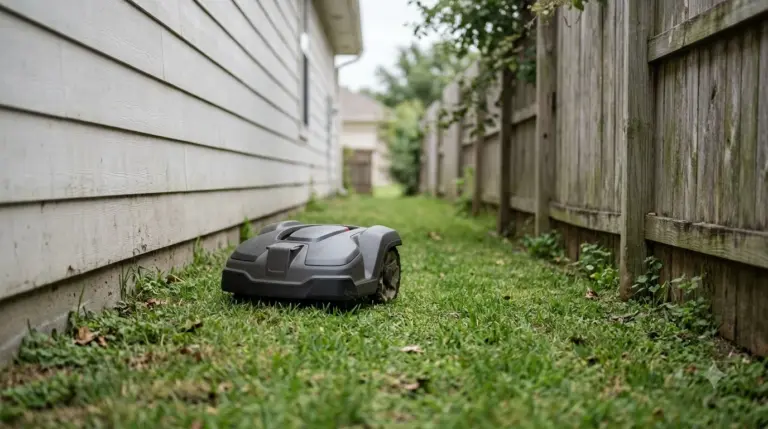
Passages decide whether a mower can reach a side yard or a strip between beds, and our guide to robot mower narrow passage width goes deeper on that one spec. The figures differ by brand and by whether a guide wire is installed, so check the wording for your model.
| Setup | Husqvarna (boundary wire) | Gardena SILENO |
|---|---|---|
| Passage with a guide wire | 60 cm (24 in) minimum between boundary wires | 60 cm wire to wire, with CorridorCut where a guide wire is installed |
| Passage without a guide wire | 2 m (6 ft 6 in) between boundary wires on each side | At least 1.5 m |
| Guide wire position | At least 30 cm (12 in) from the boundary wire | Guide wire needed for the 60 cm CorridorCut |
Husqvarna also recommends 2 m for its 435X AWD and 535 AWD models to get a good cutting result. A narrow passage that ends in a dead end is not a failure. Husqvarna says that when a passage has a dead end, the mower “will turn around and mow back through the passage.” Our reading is that a dead end is acceptable on a long side yard, but a short pocket with no exit is harder for the mower to finish cleanly.
Corners, obstacles and uncut strips
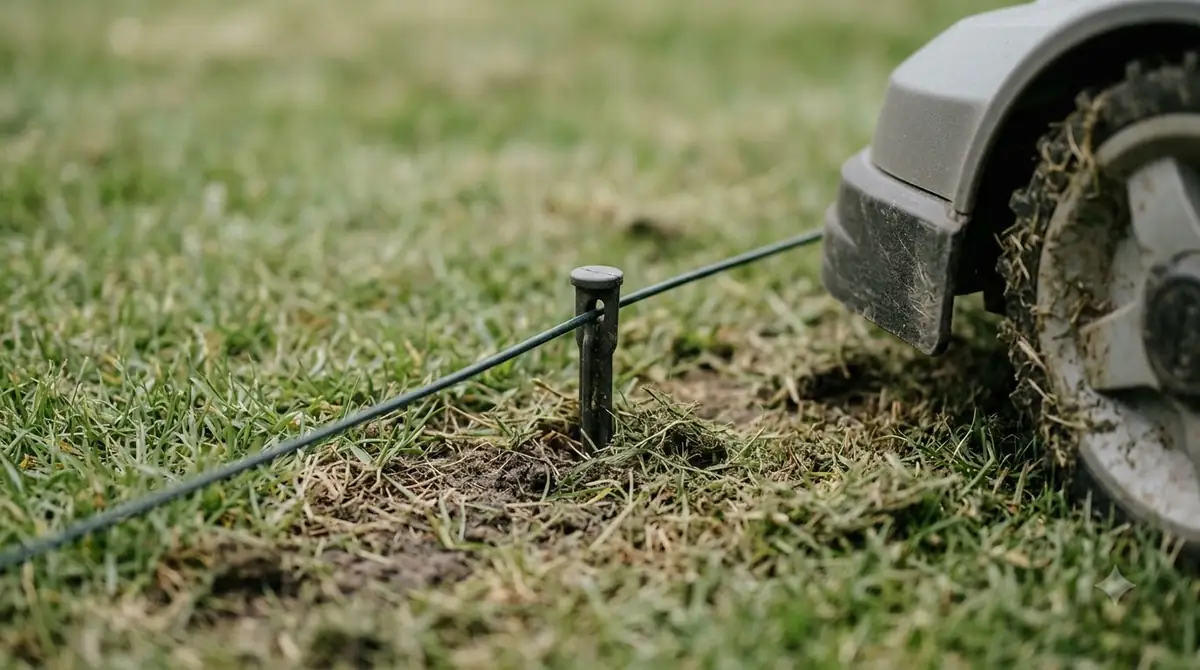
Corners and obstacles are where an odd-shaped lawn loses cut quality. Any shortlist for the best robot mower for an irregular shaped lawn should be checked against its sharpest corner first. Husqvarna says that “any areas less than 1 metre/3.3 feet between an unexpected obstacle and the virtual boundary will remain uncut.” That 1 m strip is a concrete figure to measure for beds, benches and fences along the edge, and it is worth planning how to lay boundary wire around obstacles before you peg anything.
- Sharp corners: the mower needs room to turn, so a tight corner may stay partly uncut. Check the corner depth against the mower’s turning space in the manual.
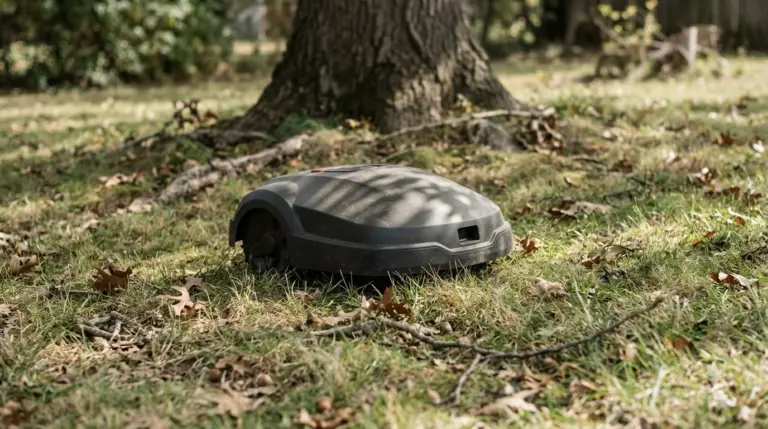
- Trees and roots: Husqvarna recommends stay-out zones around trees, roots and stones, so the mower does not repeatedly bump the same hazards.
- Beds and borders: measure the gap between the bed edge and the boundary line, then compare it with the 1 m uncut figure.
Stay-out zones and charging station access
On an irregular lawn, a stay-out zone is often the simplest fix for a problem spot. Husqvarna’s wire-free EPOS system requires a stay-out zone to be at least 30 x 30 cm (1 x 1 ft). The same page notes that a transport path is needed when the charging station docking point sits outside the work area, and that there must be at least 6 m (20 ft) of free space in front of the charging station.
Charging station placement is easy to overlook when the shape is irregular. If the only path to the dock runs through a narrow strip, the free space rule and the passage widths both apply, so check them together before you choose a mounting spot. Our note on where to put a robot mower charging station covers the basics.
Slopes on an odd-shaped lawn
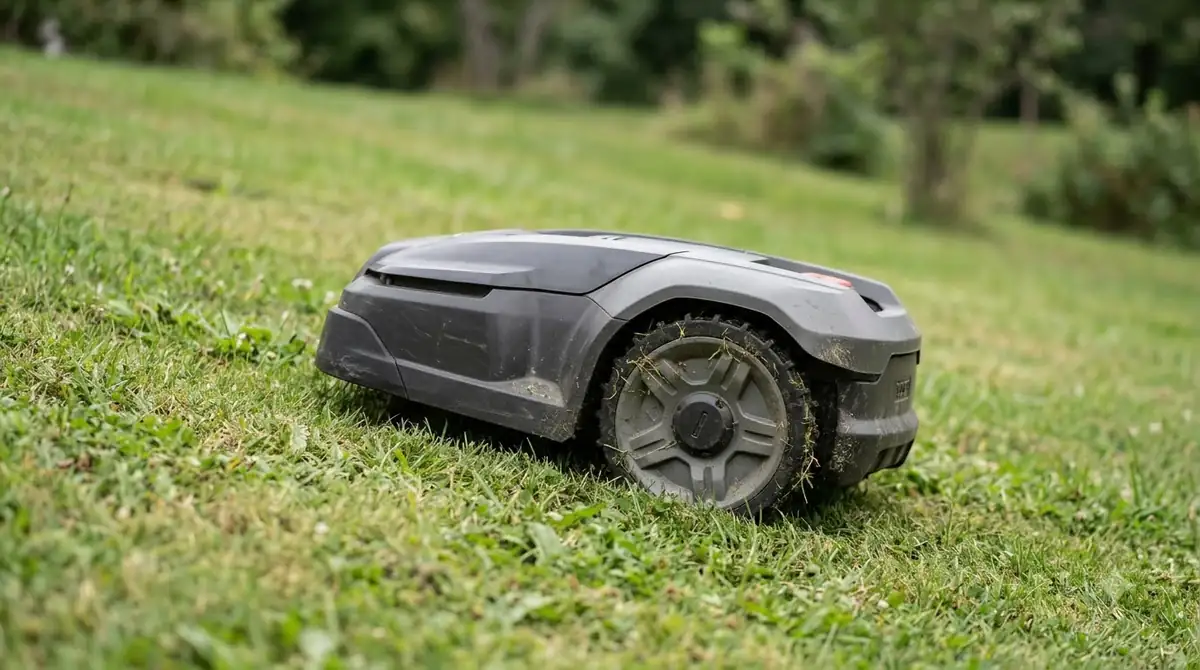
Slopes often sit in the same parts of a yard as the narrow passages, so the incline limit matters as much as the width. For the best robot mower for an irregular shaped lawn, the incline figure is often the one that rules a model in or out. Gardena lists the following maximum inclines for its SILENO range.
| Gardena SILENO model group | Maximum incline | Lawn area rating (±20%) |
|---|---|---|
| SILENO minimo | 25% | 250 m² and 500 m² |
| SILENO city and smart SILENO city | 35% | 250 m² and 500 m² |
| SILENO life and smart SILENO life | 35% | 750 m² to 1,250 m² |
| SILENO+ and smart SILENO+ | 35% | 1,600 m² and 2,000 m² |
Robomow says limits are “often only 20-25% for smaller robots and 45% or more for larger ones,” and advises buyers to “consider the maximum slope when purchasing a robotic mower.” Use the figures from each model’s own documentation rather than mixing brands in one comparison, and see robot mower slope rating explained for how makers state them.
To measure a slope, Worx suggests placing a stake about 1 m along the steepest part of the slope and reading the angle with a phone level app. Our reading is to measure the steepest point you plan to mow, not the average.
Best robot mower for an irregular shaped lawn: what to check before you buy
Use this checklist to compare models on the figures that matter for an irregular lawn. It avoids brand promises and works from the manual.
- Narrowest passage. Measure wire to wire, then compare it with 60 cm (with a guide wire) and 1.5 to 2 m (without one).
- Sharpest corner. Note the corner depth and whether the manual gives a turning requirement.
- Steepest slope. Measure it, then check it against the model’s maximum incline.
- Obstacles. Count trees, roots and stones that need a stay-out zone.
- Lawn area. Compare the total area with the model’s area rating and its ±20% tolerance.
Frequently asked questions
Do I need a guide wire for a narrow passage?
Husqvarna gives 60 cm between boundary wires with a guide wire, and 2 m without one. Gardena states at least 1.5 m for a long narrow passage without a guide wire.
What happens at a dead-end passage?
Husqvarna says the mower turns around at the dead end and mows back through the passage.
Can I keep a robot mower off a steep part of an odd-shaped lawn?
Yes. Husqvarna’s EPOS guide describes stay-out zones as a way to exclude slopes that are too steep for the mower, and the model manual gives the maximum incline.
Does the area rating matter for an irregular lawn?
It does when you shop for the best robot mower for an irregular shaped lawn. Gardena gives a ±20% tolerance on its lawn area ratings, so a yard near the top of a model’s rating may need a larger model. Check the table for your model.
Sources
- Husqvarna passage and boundary wire article (manufacturer): passage widths, guide wire distance, dead-end behavior.
- Husqvarna, what is systematic mowing (manufacturer): irregular and systematic mowing suitability, capacity, uncut strip.
- Husqvarna EPOS stay-out zones and transport paths (manufacturer): zone size, charging station free space, obstacles.
- Gardena robotic mower support FAQ (manufacturer): SILENO passage widths, CorridorCut, maximum incline, area tolerance.
- Robomow, can a robotic lawnmower mow well on uneven surfaces (manufacturer blog): simple layouts, irregular pattern, slope ranges.
 Up next8 min readBy YardCan a Robot Mower Work in an Irregular Shaped Lawn?Updated Nov 11, 2026
 9 min readBy YardHow to Choose a Robot Mower for a Yard With a Garden ShedUpdated Nov 16, 2026
 9 min readBy YardCan a Robot Mower Work in an L-Shaped Yard?Updated Nov 11, 2026
 9 min readBy YardBest Robot Mower for a Yard With Sprinkler Heads: 5 ChecksUpdated Nov 13, 2026
 8 min readBy YardBest Robot Mower for Kentucky Bluegrass and Fescue: What to CheckUpdated Nov 13, 2026
 8 min readBy YardBest Robot Mower for a Yard With Tree Roots: What to CheckUpdated Nov 13, 2026