
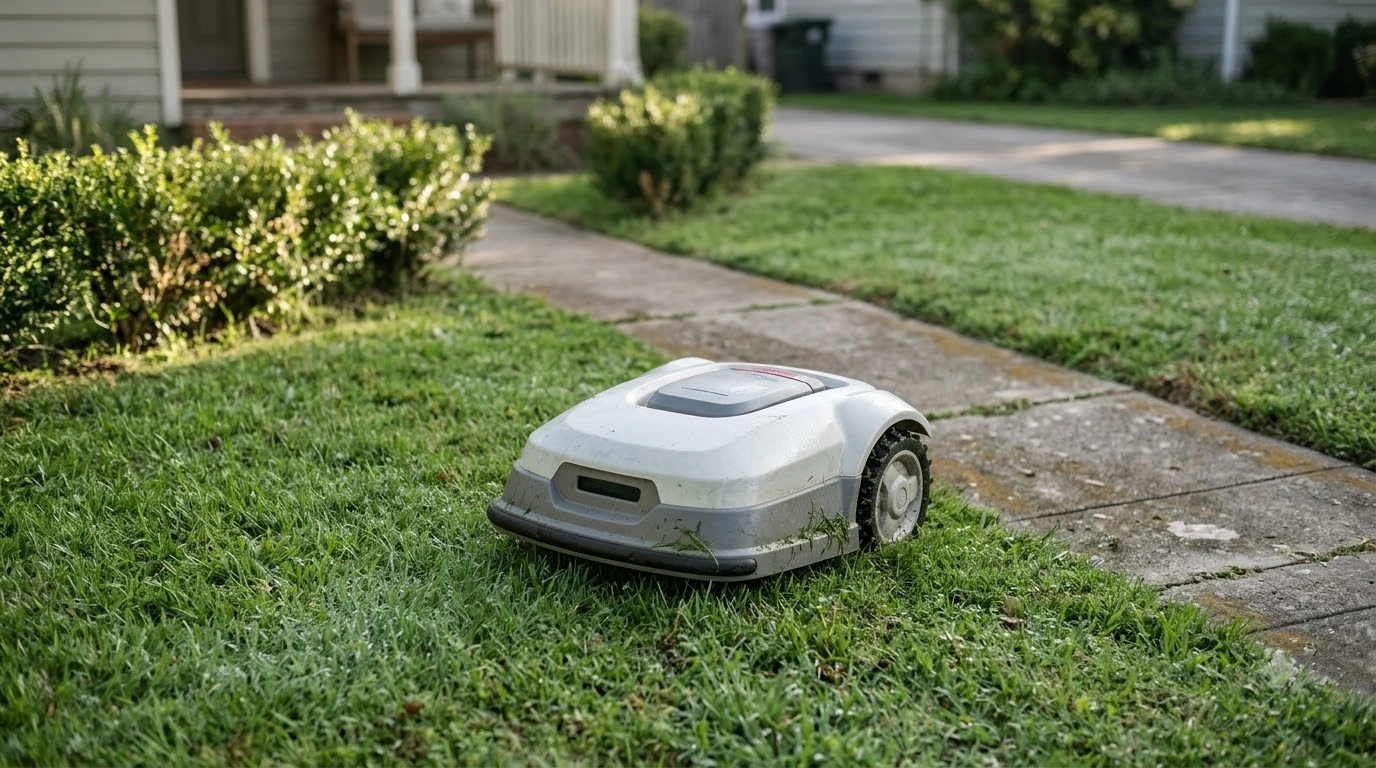

The best robot mower for a yard with sprinkler heads is the one whose contact response and island support you can confirm for your own heads. A pop-up head can rise about 4 inches under pressure, and a head that stays up sits in the mow path. The points below come from manufacturer and extension sources, as of November 2026.
The short answer
- Check the contact response. Husqvarna says its Automower stops, reverses and goes in another direction when it meets an object.
- Fence raised heads with wire. Worx’s island guide gives a 26 cm distance from the obstacle and says to keep islands smaller than 6 m by 6 m.
- Know your head type. A pop-up head drops back flush after watering, but a head that stays up stays in the mow path.
- Treat camera claims as claims. Vision detection is a manufacturer description until the spec sheet and test conditions say what it covers.
Why sprinkler heads change the buying decision
A sprinkler head is a fixed target that sits in the mowing path, so the best robot mower for a yard with sprinkler heads depends on its sensors more than it would on an open lawn. Clemson’s extension notes say that mowing around fixed sprinklers was once quite a chore, and the pop-up design was developed to solve that problem. Our reading is that a robot mower should be judged on how it handles a head that stays up, not on general marketing about obstacle detection.
A bump is not the same as protection. The mower’s sensor responds after it reaches the object, so the head has already been in its path. Our reading is that repeated contact can wear both the head and the blades over time, which is why the layout around the heads matters as much as the brand you choose.
What the mower does on contact and when lifted
Husqvarna’s Automower FAQ says that when the mower encounters an object, it will stop, reverse and go in another direction. The same page says that when the mower is lifted, the blades shut off automatically and immediately. For a head in the lawn, that is a response to contact, not a promise that the head is never touched.
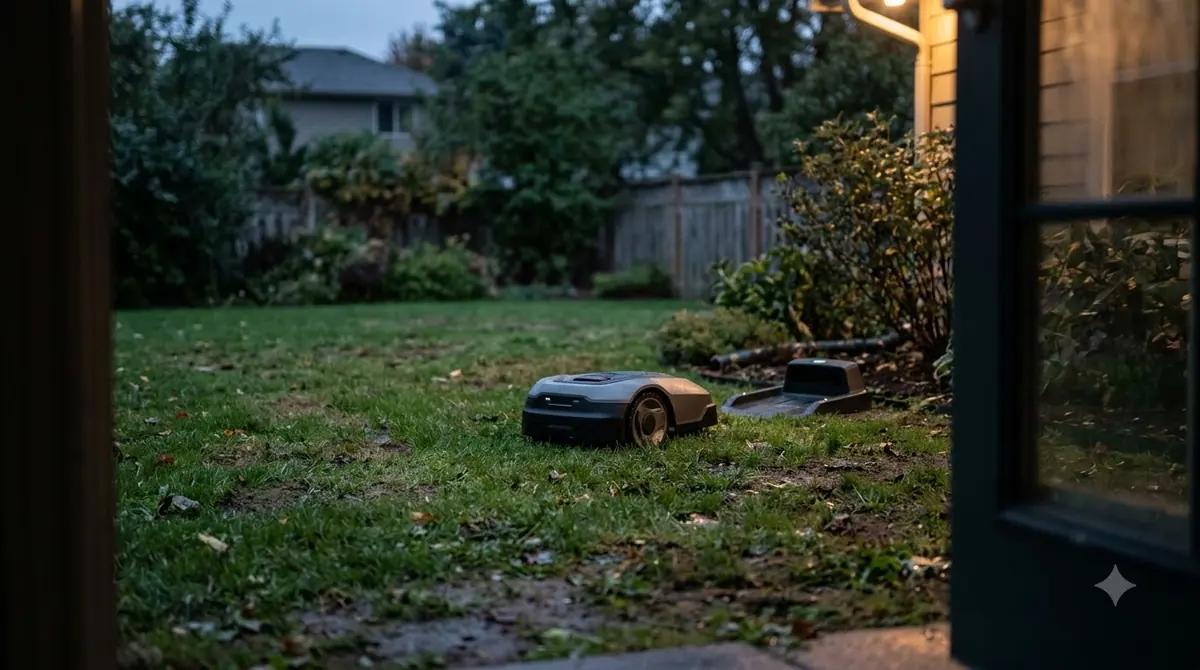
Behavior differs by brand, so read the safety section of the manual for the model you are considering. Husqvarna’s description applies to its own mowers, and it does not establish how every robot on the market reacts to a fixed object. Ask the seller to point to the exact wording for the model you plan to buy.
Pop-up heads versus fixed risers
A pop-up head is the lower-risk type on a mowed lawn. Clemson HGIC says a pop-up impact sprinkler rises about 4 inches above the grass when pressurized, and that the spring pulls the sleeve down, lowering the head when the pressure is removed. Our reading is that a head that drops flush is far less of a hazard than one that stays raised.
A head can stay up for a mechanical reason. Clemson notes that sand and dirt can cause a head to remain extended after the water pressure is turned off. A head in that state sits in the path of the mower, so check each head after watering, not only when the system is installed.
Fixed risers and older tall heads are a different case. Our reading is that these are the heads a robot mower is most likely to meet, because they stay in the grass all season. Plan a wire island around them before the first mow.
Wire islands: the layout that keeps a mower off a head
A wire island is the most direct way to keep a mower away from a fixed head. Husqvarna’s UK guide says islands are used for areas the mower should not enter, such as flower beds or rockeries, and the same logic applies to a raised sprinkler head (see also robot mowers for a yard with flower beds). Lay the wire from the border to the obstacle and around it, then close the loop carefully. App-mapped mowers use a virtual keep-out area instead, explained in what a no-go zone is on a robot mower.
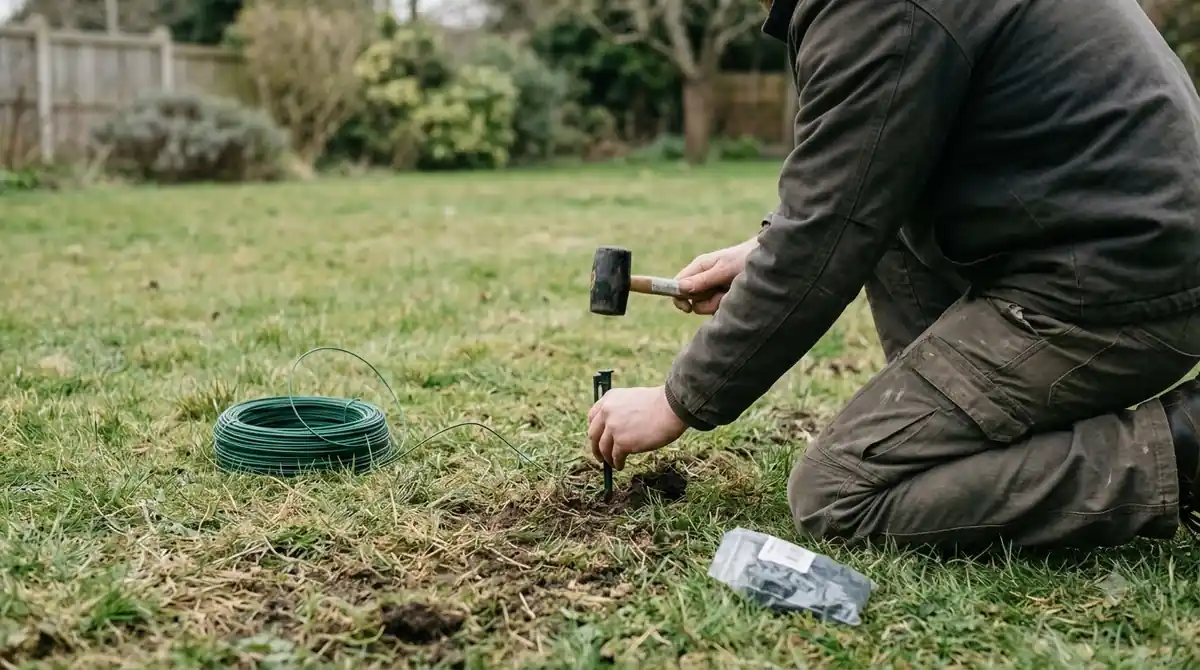
Two rules matter most. Worx’s island guide says to keep a 26 cm distance from the obstacle while the wire surrounds the area, and to lay the wire clockwise so the mower does not enter the island. Husqvarna’s guide warns that the wires must not cross, because the mower will not recognize the island and will stop. These are instructions for two specific product lines, so use the figure in your own manual.
Size matters too. Worx says islands should be smaller than 6 m by 6 m (19 ft by 19 ft). A yard with several heads in different beds may need several small islands rather than one large one. Our reading is that small islands are easier to route cleanly than one long wire loop around many heads.
Camera and sensor claims need a source before you rely on them
Some mowers use a camera or vision system to detect objects that a boundary wire does not cover. Those claims come from manufacturers, and this article did not test any model. Ask for the object list and the test conditions, and check whether the claim covers a small raised head or only larger objects.
A camera claim also does not change the wire rule for a head you know is there. Our reading is that a wire island is the setup you can verify from the installation guide, while a vision feature is a backup you cannot check in your own yard before you buy.

Wet grass and scheduling around watering
Mowing should wait until the grass is dry, and the drying time depends on the storm. ECOVACS says grass usually dries in about 3 to 5 hours after a light shower, and that it can take 24 hours or longer after a heavy storm. Wet cutting can leave an uneven cut and compact the lawn, so a sensor does not change that rule (see robot mowers for a soggy lawn). A mower that runs near sprinklers also needs a suitable water rating, covered in what IP rating a robot mower should have.
Watering and mowing also overlap. The EPA’s WaterSense guidance recommends avoiding watering in the middle of the day, and says to keep water on the lawn and off pavement. Our reading is that a mower docked before the sprinklers start, and set to run after the grass dries, avoids most of the overlap without any hardware change.
Common mistakes with sprinkler heads and mowers
Most problems come from assuming the mower will avoid a head without any setup. Each mistake below has a simple fix.
- Crossing the island wires. Husqvarna says crossed wires stop the mower, so keep the outgoing and return wires close and never let them cross.
- Skipping the head check after repairs. A moved or replaced head can end up outside the island you planned around.
- Trusting the sensor alone. A contact response is a reaction, so it does not replace a fence around a head that stays raised.
- Mowing wet grass to save time. Wet cutting causes uneven cuts and compaction, so wait for the lawn to dry.
Best robot mower for a yard with sprinkler heads: what to check
Use this table to compare models. Each row names one question a best robot mower for a yard with sprinkler heads should answer, and where the answer should come from.
| Check | Why it matters for heads | Where to confirm |
|---|---|---|
| Response to contact | Shows whether the mower stops and turns after touching a head | Manufacturer FAQ or manual |
| Lift shut-off | Stops the blades if the mower rides up onto a raised head | Safety section of the manual |
| Island support | Lets you fence a head with wire and route it cleanly | Installation guide |
| Minimum wire distance | Sets how close the mower can run to a fixed object | Installation guide, model specific |
| Camera or vision detection | May flag objects a wire does not cover, if the spec says so | Spec sheet, with test conditions |
Our reading is that a model with a documented island method and a clear lift shut-off is easier to set up safely around heads than one with neither. Check both in the manual before you buy, not after installation. The best robot mower for a yard with sprinkler heads is therefore the one whose documented behavior you have confirmed for your own heads.
Frequently asked questions
Can a robot mower run over a sprinkler head?
It can, if the head sits in the mow path and stays raised. Husqvarna says its mower stops and turns when it meets an object, but that response happens after contact, so a wire island is the safer setup for a head that stays up.
Do sprinkler heads need boundary wire around them?
Heads that stay raised are the ones to fence. Husqvarna’s island guide says islands are used for areas the mower should not enter, and Worx gives a 26 cm distance for its islands. Our reading is that a head that sits flush is less likely to need a wire island.
Should a robot mower run while the sprinklers are on?
Keep the two apart where you can. ECOVACS says mowing should wait until the grass is dry, which can take about 3 to 5 hours after a light shower. Our reading is that a mower docked before the water starts avoids the overlap.
Do camera-based mowers see sprinkler heads?
Some manufacturers say their camera or vision systems detect objects, but this is a vendor claim. This article did not test any model, so ask for the object list and test conditions, and check whether a small raised head is covered.
Sources
- Landscape Irrigation Equipment Part 1: Sprinklers and Spray Heads (Clemson HGIC): pop-up design, about 4 inches of rise, spring return, sand or dirt holding a head up.
- Robotic lawn mower FAQ (Husqvarna): stop and reverse on contact, blades off when lifted, wire around obstacles.
- How to create islands in a boundary wire Automower installation (Husqvarna): islands for flower beds, crossed wires stop the mower.
- Setup an island (Worx): 26 cm distance, clockwise wire, islands smaller than 6 m by 6 m.
- Can You Cut Grass When It’s Wet Without Damaging Your Lawn? (ECOVACS): drying times after light and heavy rain.
- Watering Tips (U.S. EPA WaterSense): midday watering, keeping water off pavement.
 Up next9 min readBy YardHow Does a Robot Mower Handle Sprinkler Heads?Updated Nov 11, 2026
 9 min readBy YardRobot Mower for Lawn With Mulch Beds: 5 Simple ChecksUpdated Nov 11, 2026
 7 min readBy YardBest Robot Mower for Bunch-Type Tall Fescue: 3.5 Inch CheckUpdated Nov 14, 2026
 6 min readBy YardBest Robot Mower for Fine Fescue: 1.5 Inch Low Cut GuideUpdated Nov 17, 2026
 8 min readBy YardBest Robot Mower for a Yard With Tree Roots: What to CheckUpdated Nov 13, 2026
 6 min readBy YardRobot Mower for a High Altitude Yard: What Changes and What to CheckUpdated Nov 11, 2026