
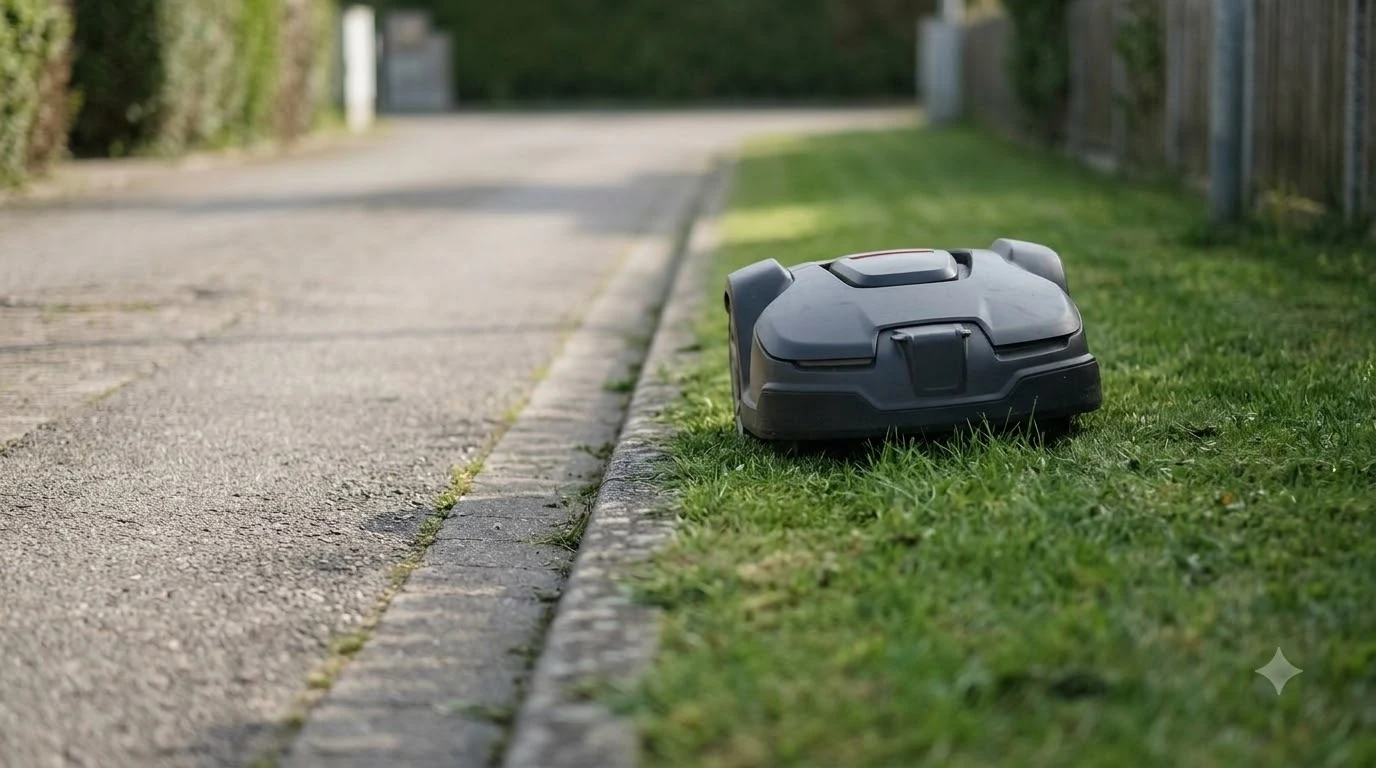

Perennial ryegrass mowing height and schedule: cut at 1.5 to 2.5 inches and mow once the grass has grown about one-third taller than that. The University of Kentucky and UC IPM both give 1.5 to 2.5 inches, while Kansas State lists 2 to 3 inches.
For perennial ryegrass mowing height and schedule, growth matters more than the calendar. Ryegrass grows faster than Kentucky bluegrass, so it needs more cuts in spring and fall and fewer in summer heat.
The short answer
- Target height: 1.5 to 2.5 inches for most lawns in the Kentucky and UC guidance. Kansas State lists 2 to 3 inches.
- Frequency: mow when the grass reaches about 1.5 times the target height, so no more than one-third of the leaf comes off in one cut.
- Season: mow more often in spring and fall, and less during summer heat and drought.
- Overseeding: lower the height gradually in spring when warm-season grass is emerging.
- Blades: keep them sharp, because shredding is worst in May and June.
Perennial ryegrass mowing height and schedule: what the sources say
Most extension sources put perennial ryegrass between 1.5 and 3 inches, and the Kentucky and UC ranges overlap at 1.5 to 2.5 inches. The table lists each source as it states the number.
| Source | Context | Recommended height |
|---|---|---|
| University of Kentucky, AGR-209 | Home lawns in Kentucky | Optimum 1.5 to 2.5 inches |
| UC IPM Healthy Lawns | Perennial ryegrass tips | Mow at 1.5 to 2.5 inches |
| Kansas State University | General turf mowing guide | 2 to 3 inches |
| Rutgers Turfgrass Proceedings, 2002 | Sports fields | As low as 0.5 inch, with regular irrigation and pesticides below 2 inches |
The differences between these numbers come from the lawn and the use each source describes. The Kentucky publication is written for home lawns, while the Rutgers paper covers sports fields, where playing quality can justify more management.
Heads up
Rutgers says perennial ryegrass can be mowed as low as 0.5 inch, but below 2 inches it needs regular irrigation and pesticide use. A lower cut is a management choice with real costs, not a free upgrade.
Choosing a height for your lawn
When you set perennial ryegrass mowing height and schedule for a home lawn, 2 inches sits in the middle of the Kentucky and UC range and is a safe starting point. Going lower brings costs that the Kentucky publication describes directly, and a separate guide explains what happens if you cut grass too short.
- Drought: low mowing gives shallower roots, which reduces summer drought tolerance.
- Traffic: low mowing reduces rhizome growth, which slows recovery after foot traffic.
- Weeds: a thinner canopy lets sunlight reach the soil and allows crabgrass to germinate.
- Pests and disease: cut-low turf has less tolerance to diseases and insects.
The same publication notes that low heights give finer texture and darker color. The trade-off is appearance against resilience, so the right height depends on what the lawn has to handle.
The one-third rule and how often to mow
Mow when the grass reaches about 1.5 times your target height, because removing more than one-third of the leaf in one cut causes trouble. The University of Kentucky states that no more than one-third of the leaf should be removed at one time. Its example: a lawn kept at 2 inches should be mowed when it reaches 3 inches.
Removing more than one-third leaves clumps of dead clippings that block sunlight to the living grass beneath. Mowing wet grass makes clumping worse, so wait for the lawn to dry when you can. The one-third rule for mowing grass applies to every grass type, not only ryegrass.
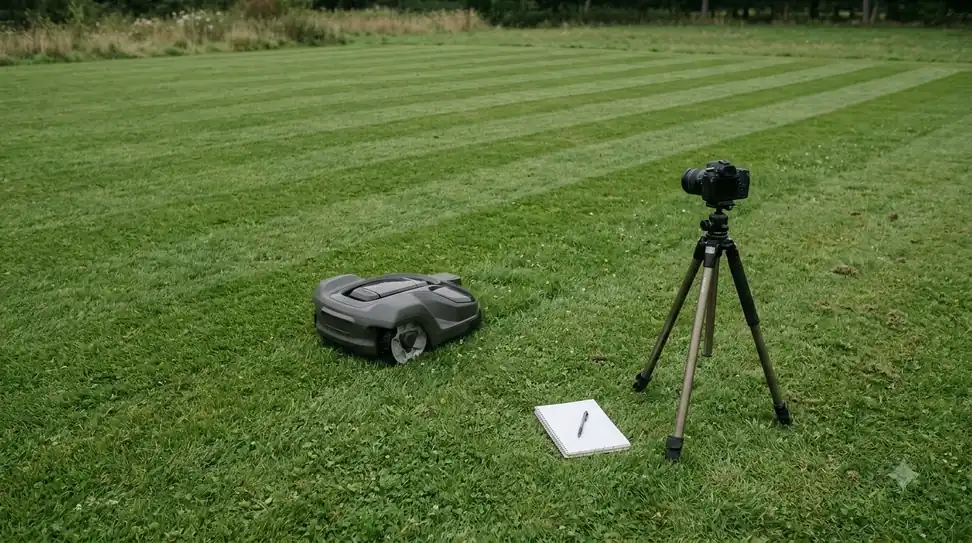
Frequency follows from that rule. Rutgers gives minimum frequencies for sports turf, and they work as a rough guide for a home lawn.
| Target height | Mow when grass reaches | Rutgers frequency example |
|---|---|---|
| 1.5 inches | About 2.25 inches | Three times a week |
| 2 inches | 3 inches | Twice a week |
| 3 inches | 4.5 inches | Once a week |
Our reading is that the one-third rule matters more than the day count. Kansas State says turf should be mowed as necessary rather than on a preset schedule, which is the right way to read these tables.
Seasonal schedule: growth sets the rhythm
Perennial ryegrass grows fast in spring and fall and slows in summer, so its mowing schedule should follow growth rather than the calendar. The Kentucky publication says ryegrass needs more frequent mowing than Kentucky bluegrass because it grows faster.
The same publication says there is no need for regular mowing during the slow growth season for any grass. It also warns that frequent mowing of cool-season grass during a hot, dry period can severely stress the lawn and even kill it.
Rutgers describes summer as a time to reduce mowing. Where spring needs two mowings a week, summer stress may allow one every 7 to 10 days. It also says to stop mowing when the turf is wilting, because mowing wilted grass severely damages it.
As growth slows in late fall, mow less often. Our reading is that a schedule should drop to fewer runs as growth falls, and stop once the lawn is dormant or frozen.
Spring overseeding and gradual height changes
When overseeding a warm-season lawn with ryegrass in spring, lower the ryegrass height gradually so the warm-season grass can emerge. For brand-new seed, see the guide on when to first mow new grass seed. UC IPM advises mowing more closely and more often during that transition.
Avoid changing height in one cut. Rutgers gives an example: a lawn that has grown to 5 inches with a 2-inch target should be cut to 3.5 inches, then 2.5 inches, and finally 2 inches. The Kentucky publication gives the same advice, reducing heights gradually rather than in one mowing.
Our reading is that the same step-down applies when you change a robot mower’s setting. Lower it one step at a time over a few mowings.
Shade, drought and scalping
Shade and drought call for a higher cut in perennial ryegrass, and scalping can weaken the grass for a long time. Scalping means removing more than half the plant in one pass, which cuts the leaf tissue that feeds root growth.
The Kentucky publication says grass in shade grows more quickly than grass in full sun, so raising the mowing height in shaded areas reduces scalping. UC IPM lists ryegrass as drought sensitive, which argues for a higher setting in dry spells. For more on dry weather, see the guide to mowing lawn in summer heat and drought.
K-State warns that severely scalped turf may not recover in some cases. If you see brown stems after a cut, raise the height and check the mowing interval before the next pass.
Blade sharpness and spring shredding
Dull blades shred perennial ryegrass, and the Kentucky publication says the damage peaks in May and June. Two or three days after a dull-blade mowing, leaf tips look brown and shredded.
The cause is that the grass tears instead of being cut cleanly. Shredding is most common in perennial ryegrass and tall fescue, and the publication ties the spring peak to tough flowering stems. The same source says dull blades can raise fuel use by as much as 20 percent.
Kansas State makes the same point, noting that dull blades tear turf and leave a ragged look. The Kentucky guide expects most mowers to need sharpening several times each year. Sharp blades matter as much as the setting itself.
What this means for a robot mower
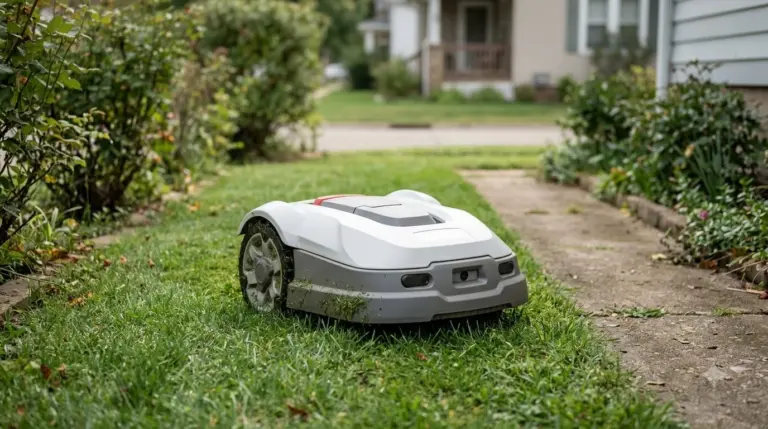
The extension sources above were written for push and ride-on mowers, so this section is our reading, not a quote. A robot mower can keep perennial ryegrass near the middle of its height range when the lowest setting reaches your target and the mower runs short, frequent sessions.
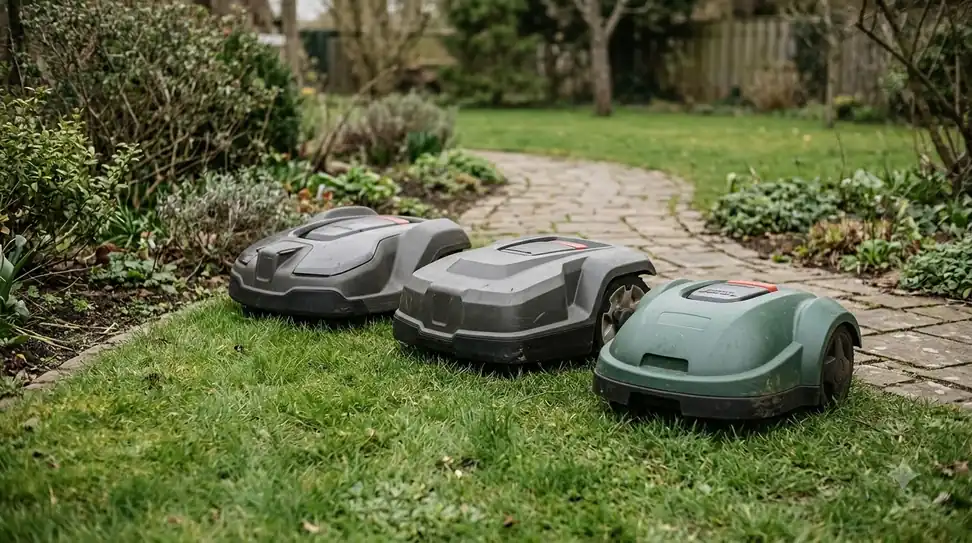
Kentucky notes that rotary mowers make a single impact cut, which is less clean than the scissor action of a reel mower. That makes sharp blades more important, not less, for a robot mower.
Frequent short runs fit the schedule set out above, and they fit the one-third rule without any measuring, because each session removes only a small slice. Check the lowest setting on the spec sheet before buying. If it stops above your target height, the mower will always cut too high. A guide on whether a robot mower can cut perennial ryegrass covers that fit in more detail.
Frequently asked questions
The best perennial ryegrass mowing height and schedule for your lawn is the one that keeps every cut under one-third of the leaf through the season. Adjust it as growth changes, and let the grass, not the calendar, set the next mow.
What mowing height is best for perennial ryegrass?
The University of Kentucky and UC IPM both recommend 1.5 to 2.5 inches, and Kansas State lists 2 to 3 inches. For most home lawns, 2 inches falls inside the overlap and is a safe starting point. Raise the setting in shade, heat and drought.
How often should I mow perennial ryegrass, and what schedule fits?
Perennial ryegrass mowing height and schedule both come down to one rule: mow when the grass reaches about 1.5 times your target height, so no more than one-third of the leaf comes off. Kentucky says ryegrass needs more frequent mowing than Kentucky bluegrass, and Kansas State advises mowing as needed rather than on a preset schedule.
Can perennial ryegrass be cut below 1.5 inches?
Rutgers says it can be mowed as low as 0.5 inch on sports fields. Below 2 inches, though, it needs regular irrigation and pesticide use. Weigh that cost before setting the height below 2 inches, and check the water and pest demands of your lawn first.
Should I lower ryegrass in spring?
Yes, lower it gradually. UC IPM advises mowing more closely and more often in spring when warm-season grass is emerging, and the Kentucky publication says to reduce heights in steps rather than in a single cut.
Sources
- Mowing your Kentucky Lawn, AGR-209 (University of Kentucky Cooperative Extension): optimum heights, one-third rule, frequency and shredding.
- Perennial ryegrass tips (UC IPM Healthy Lawns): mowing height, overseeding transition, drought sensitivity.
- Mowing (Kansas State University Turfgrass Information): height table, one-third rule, as-needed frequency, scalping and blade sharpness.
- Mowing Management as It Affects Turf Quality (James A. Murphy, 2002 Rutgers Turfgrass Proceedings): low-height limits, frequency examples, spring and summer strategies on sports turf.
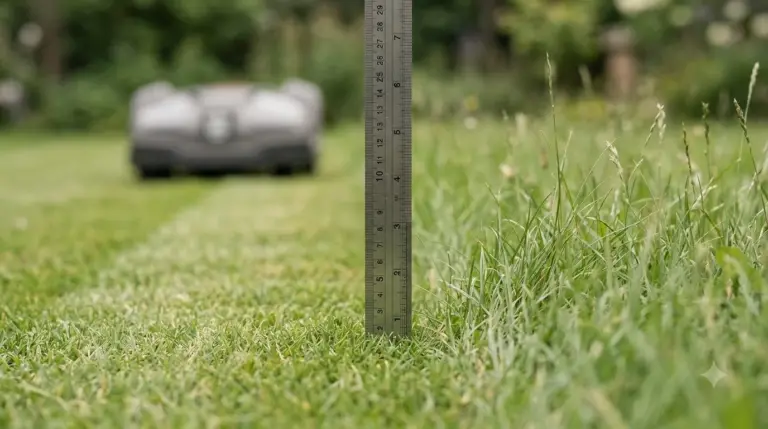 Up next7 min readBy YardCan a Robot Mower Cut Perennial Ryegrass? What the Sources SayUpdated Nov 11, 2026
 8 min readBy YardBahia Grass Mowing Height and Schedule: What Extension Sources SayUpdated Nov 11, 2026
 8 min readBy YardHow Often to Mow Buffalo Grass (Schedule and Height)Updated Nov 11, 2026
 8 min readBy YardBest Mowing Height for St Augustine GrassUpdated Nov 11, 2026
 8 min readBy YardBest Mowing Height for Zoysia Grass: Summer, Spring and FallUpdated Nov 11, 2026
 8 min readBy YardBest Mowing Height for Buffalo Grass (What Extension Guides Say)Updated Nov 11, 2026