
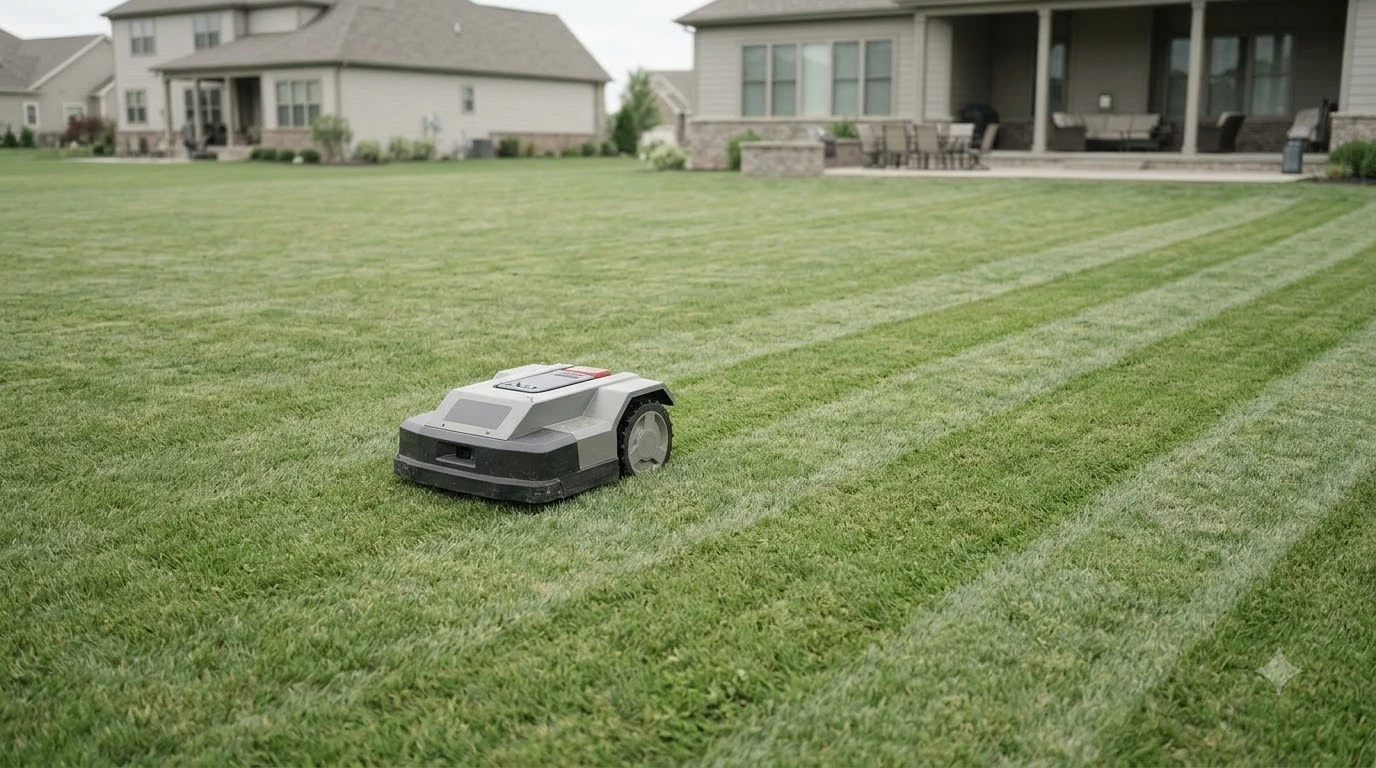

A robot mower for a drought prone area works best when you raise the cutting height, mow less often, and match the schedule to how much water the lawn gets. The mower matters less than the settings, so a robot mower for a drought prone area is mostly a scheduling question. Stressed grass recovers more easily when the cutting rules change along with the weather.
The short answer
- Raise the deck: the extension sources we read give roughly 2.5 to 4 inches in drought, depending on grass type and water supply.
- Cut less often: slower growth in drought means less mowing, so reduce the robot’s schedule.
- Check your water: irrigated and non-irrigated lawns need different advice.
- Keep blades sharp: dull blades tear grass and lose more moisture.
What a robot mower for a drought prone area changes
A robot mower cuts small amounts on a schedule that often runs several times a week. In a dry spell, that frequency is the setting that matters most. Virginia Tech turf guidance notes that you should not need to mow very often during drought, so an automatic schedule that works in spring can remove more leaf than the grass can spare in summer.
Eufy’s own robot mower guidance makes the same point from the manufacturer side. It advises reducing activity when heat, drought or slow growth makes frequent cutting unnecessary. Our reading is that the schedule, not the mower’s hardware, is the first thing to change.
How high to set the cutting height
Raising the cutting height is where most extension sources start, and taller grass shades the soil and supports deeper roots. The exact number depends on the university and the grass type, so the table below lists the figures from the sources we read rather than one universal setting. For lawns near the high end of that range, see how a robot mower’s cutting height range is set.
| Source | Drought height guidance | Context |
|---|---|---|
| Virginia Tech | Minimum 3 to 3.5 inches; 4 inches if the lawn tolerates it | Summer and drought mowing |
| UNH Extension | 2.5 to 3 inches | Shade and moisture retention |
| Purdue Turfgrass Science | No fixed number given | Older article (2007); warns that raising height is simplified advice |
The gap between sources is real, and the Purdue article is a reminder that no single number suits every lawn. For a robot mower, check that the minimum and maximum settings in the manual reach the height your grass type needs. If the top setting stops below 3 inches, that is a limit to note before you buy.
Irrigated and non-irrigated lawns need different rules
Raising the height helps most when the lawn gets water. Purdue Turfgrass Science calls drought height advice very simplified and says it can be harmful on droughty sites that are not irrigated, while it can help irrigated turf. The older Purdue article is still useful for that distinction.
UNL Water guidance suggests raising height by about 20 percent and avoiding large sudden changes. Our reading is that on a robot mower this means changing the height in steps over several cuts rather than jumping straight to the top setting, and that a lawn with no irrigation should be treated more cautiously. The choice should follow your water supply rather than the calendar.
How often a robot mower should run in dry weeks
Slower growth is the signal to mow less. UNL Water advises mowing less at the start of a drought, since the grass grows slowly and needs fewer cuts. A robot mower that runs on a daily or near-daily schedule in June may need fewer scheduled days in a dry August. Our reading is to cut the number of run days first and then check the height, rather than changing both at once.
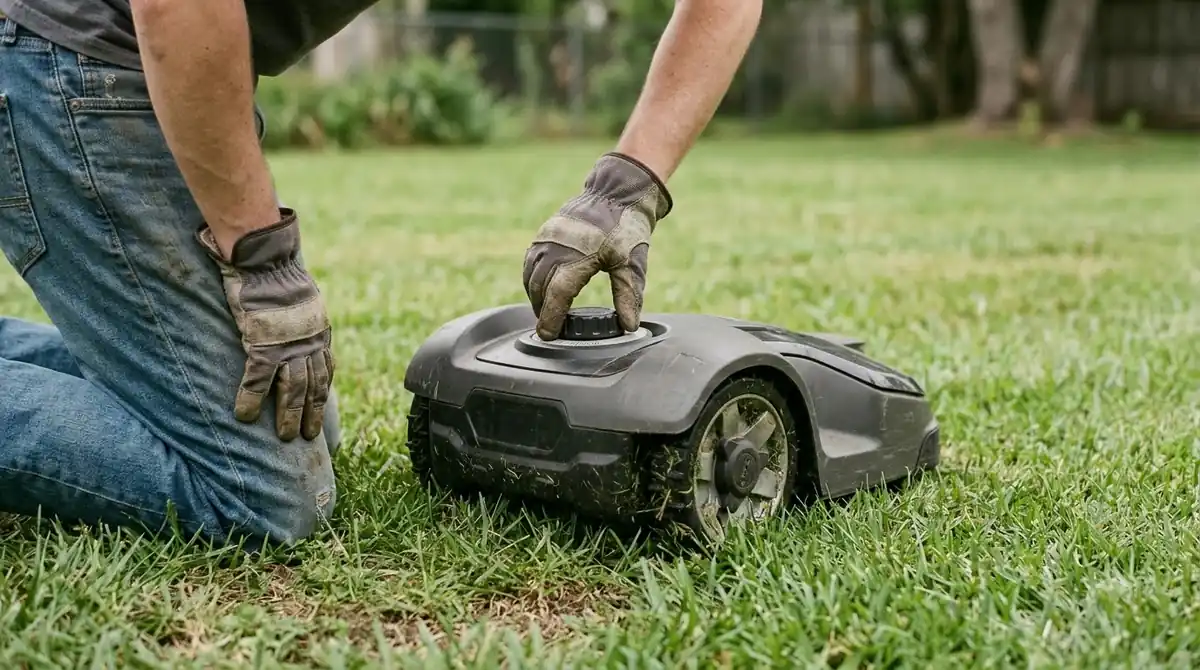
Eufy also warns against trusting the dial alone. Its guidance says to measure the lawn after mowing rather than relying only on the number printed beside the height control, and it notes that one height does not suit every lawn. For a robot mower for a drought prone area, our reading is to check the grass height every week or two during a dry spell and adjust the schedule from what you see.
Blade sharpness and the one-third rule
Keep the cut to no more than one-third of the leaf blade in a single mowing. Virginia Tech gives this rule for mowing in general. It matters more in drought, because stressed grass has less capacity to recover from a heavy cut.
Dull blades are a separate problem. UNL Water notes that dull blades tear grass and lose more moisture. Because a robot mower cuts often, check the blade condition on a regular basis and replace or sharpen the blades on the manufacturer’s schedule, especially in summer. A related question is whether robot mowers cause thatch buildup on a stressed lawn.
Clippings and watering on a robot-mowed lawn
Leaving clippings is usually fine when they are light. UNL Water says a light sprinkling of clippings acts as mulch. Our reading is that a robot mower, which cuts small amounts, leaves clippings light enough to fit that description.
For watering, UNH Extension suggests about half an inch of irrigation a couple of times a week. It estimates 20 to 60 minutes to apply half an inch, and advises watering only when the grass begins to wilt, early in the morning between sunrise and about 8 a.m. If water puddles or runs off, split the session into shorter cycles. A robot mower does not change these watering rules, but a yard with irrigation can plan around them; see the robot mower for a yard with sprinkler heads guide.
What to check before you buy
Before you commit to a robot mower for a drought prone area, look for three things in the manufacturer manual: the minimum and maximum cutting height, the mower’s recommended mowing schedule, and whether it can run less often without a setting change. Those details matter more for a drought area than headline features.
Next, check the grass type. Cool-season and warm-season lawns respond differently to height changes, so the same number may not fit every yard, and our guides to robot mowers for Kentucky bluegrass and fescue and to robot mowers on warm-season grass cover two common cases. Our reading is that the grass species on your lawn should set the target height, and the mower should then be set to that target and checked against a ruler after the first few cuts.
Ask the seller or the brand which height the mower can cut at and how the schedule is changed. Our reading is that a mower you can set high and run less often is a better fit for a drought prone area than one that only works well at a short cut.
Frequently asked questions
Should a robot mower for a drought prone area run during a drought?
Yes, but less often. Virginia Tech notes that you should not need to mow very often in drought, so the schedule should be cut back as growth slows.
How high should a robot mower be set in a drought?
Sources differ. Virginia Tech suggests a minimum of 3 to 3.5 inches, and UNH Extension suggests 2.5 to 3 inches. Check the grass type and whether your lawn is irrigated.
Does a robot mower need different settings in dry weather?
Usually the height and the schedule change. Eufy advises measuring the lawn after mowing rather than relying on the dial alone.
Is it safe to mow a dormant lawn with a robot mower?
The sources we read do not give one answer for every lawn. Our reading is to reduce cutting on stressed grass and raise the height, and to check the lawn before each change rather than follow a fixed rule.
Sources
- Virginia Tech News (university): drought height minimum, one-third rule, mowing frequency.
- UNH Extension (university): 2.5 to 3 inch height, irrigation amount and timing.
- UNL Water (university): gradual height increase, mowing less in drought, clippings mulch, dull blades.
- Purdue Turfgrass Science (university, article dated 2007): counterpoint on irrigated and non-irrigated turf.
- Eufy blog (robot mower manufacturer): reduce activity in drought, measure height after mowing.
 Up next8 min readBy YardMowing Lawn in Summer Heat and Drought: What to ChangeUpdated Nov 11, 2026
 7 min readBy YardBest Robot Mower for a Suburban Yard with a Play AreaUpdated Nov 17, 2026
 6 min readBy YardRobot Mower for a High Altitude Yard: What Changes and What to CheckUpdated Nov 11, 2026
 8 min readBy YardRobot Mower for Compacted Soil Lawn: 4 Checks FirstUpdated Nov 11, 2026
 8 min readBy YardBest Robot Mower for Shaded Lawn: 4 Things to CheckUpdated Nov 11, 2026
 8 min readBy YardRobot Mower Under Trees: What Changes and What to DoUpdated Nov 11, 2026