
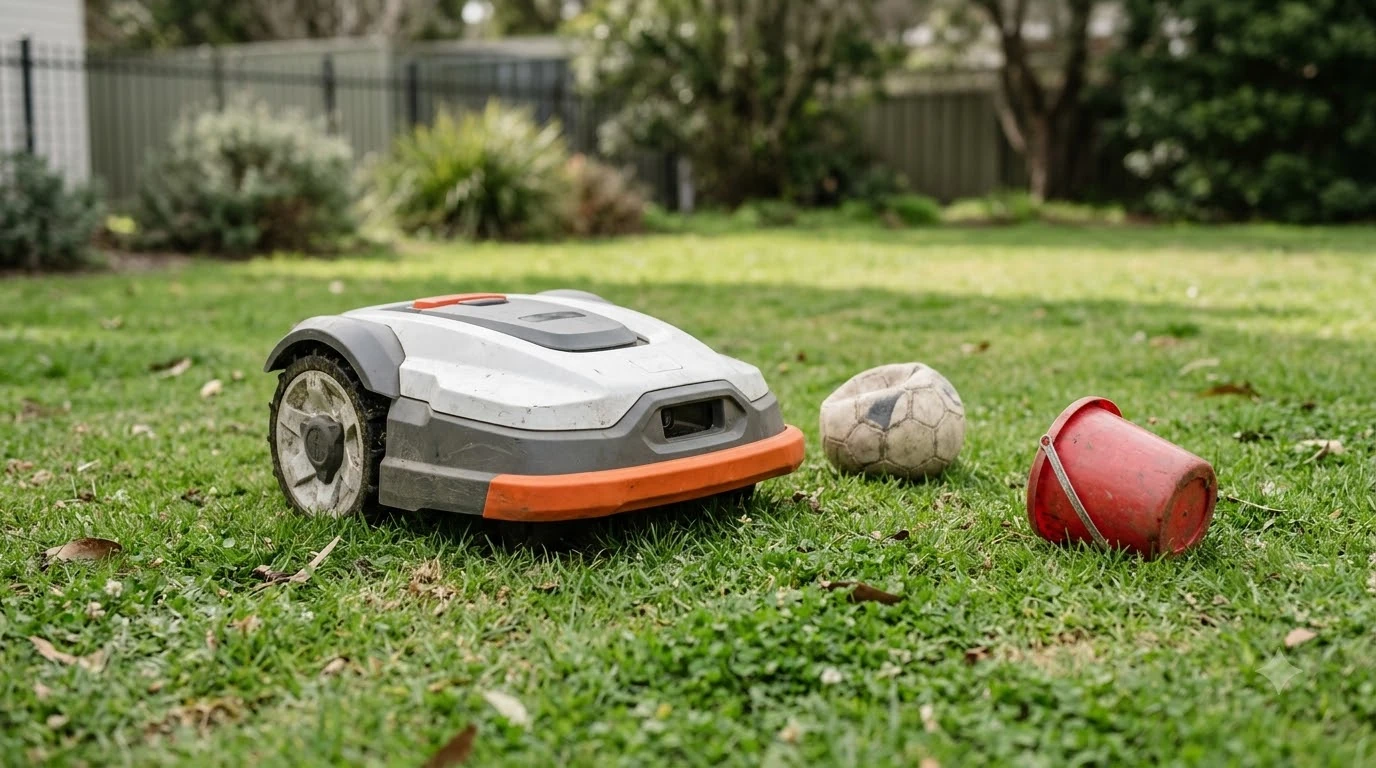

A robot mower for a lawn with a flagpole can work, but the pole and its base need a plan of their own. A flagpole is slim and rises well above the grass, which gives sensors something to read. Its concrete base is a fixed, unbending object at ground level, and the flag and rope can move in wind. The safest setup is a wire island or stay-out zone around the base, with the pole trimmed and protected from the blade.
The short answer
- Pole above grass: a sensor has a clear target to avoid.
- Base at ground level: the concrete footing is what the blade meets, and low objects are easy to miss.
- Tall grass: grass around the base can hide the footing from sensors.
- Safest setup: a wire island or stay-out zone around the base, not sensing alone.
The pole helps, but the base is the risk
A flagpole is usually a metal or fiberglass tube set in a concrete footing. Most of the pole sits well above the turf, so a sensor sees a tall object and can steer clear of it. The problem is the bottom few centimeters, where the footing and any ground fittings sit. Husqvarna’s object avoidance page says objects lying flat or very close to the ground may not be detected, and the same limit applies to a footing that barely rises above the lawn. A flagpole is a single fixture, and the mower guidance for lawns with yard structures covers others. Another narrow upright behaves much the same way, so mailbox post as a similar thin obstacle is a useful comparison.
Husqvarna also states that its avoidance system “is not a safety feature. There is no guarantee that objects will not be run over.” A flagpole base should be protected by setup, not by hope.
Sensors and the flag
A flag and its rope move with the wind, so the pole’s shape in a camera or sensor view can change from one minute to the next. Husqvarna’s AI vision page sorts objects by risk and notes that raised or legged objects are hard to assess. A flagpole is neither a toy nor a person, so it is a fixed risk the mower has to route around. The page advises a stay-out zone wherever there is a risk of the mower getting stuck. Sensor limits on low objects are explained in how sensors read low boxes.
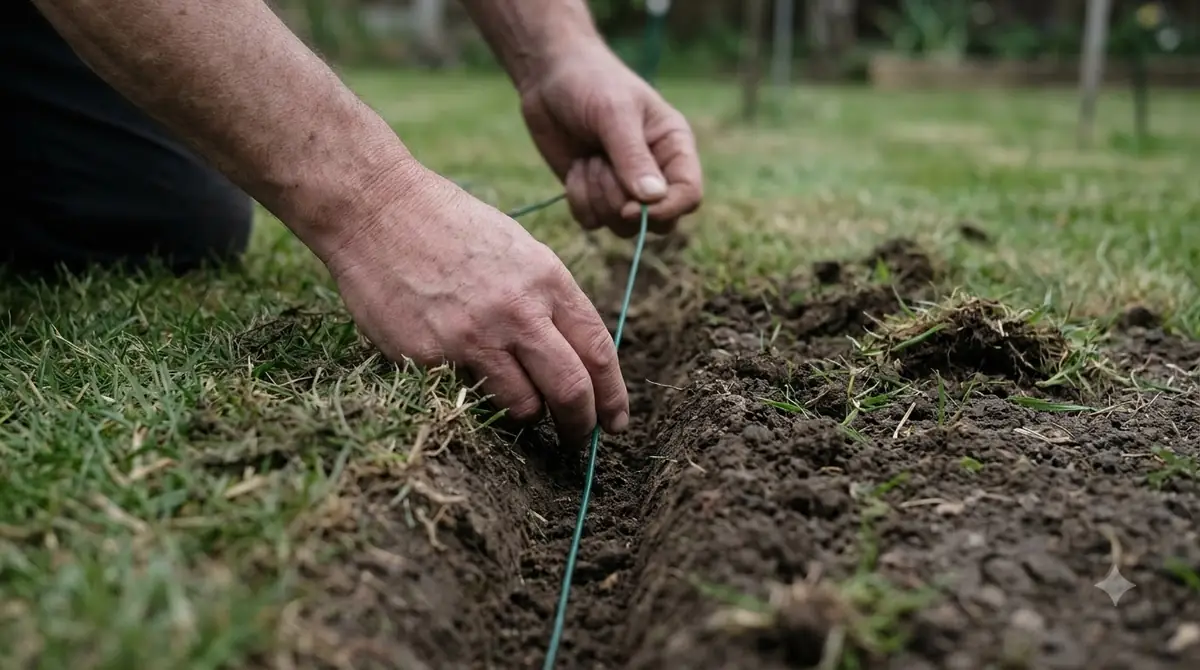
Our reading is that the pole itself is the easier part to avoid, and the footing and surrounding grass are the parts to plan for. If a flagpole sits in a flower bed or a border, the bed edge can also act as a trap, so measure the whole area the mower might reach.
Heads up
Husqvarna warns that objects hidden in high grass can be missed or can trap the mower. Keep grass cut short around the footing and along the base of any ground fittings.
Robot mower for a lawn with a flagpole: fencing the base
A wire island is a closed loop of boundary wire that the mower drives around. Husqvarna recommends islands for obstacles that cannot take a bump, such as flower beds and rockeries. A flagpole base set in concrete is a rigid fixture that cannot take a bump, so it belongs in the same group. A post with a hard base takes the same approach, as lamp post base fencing shows.
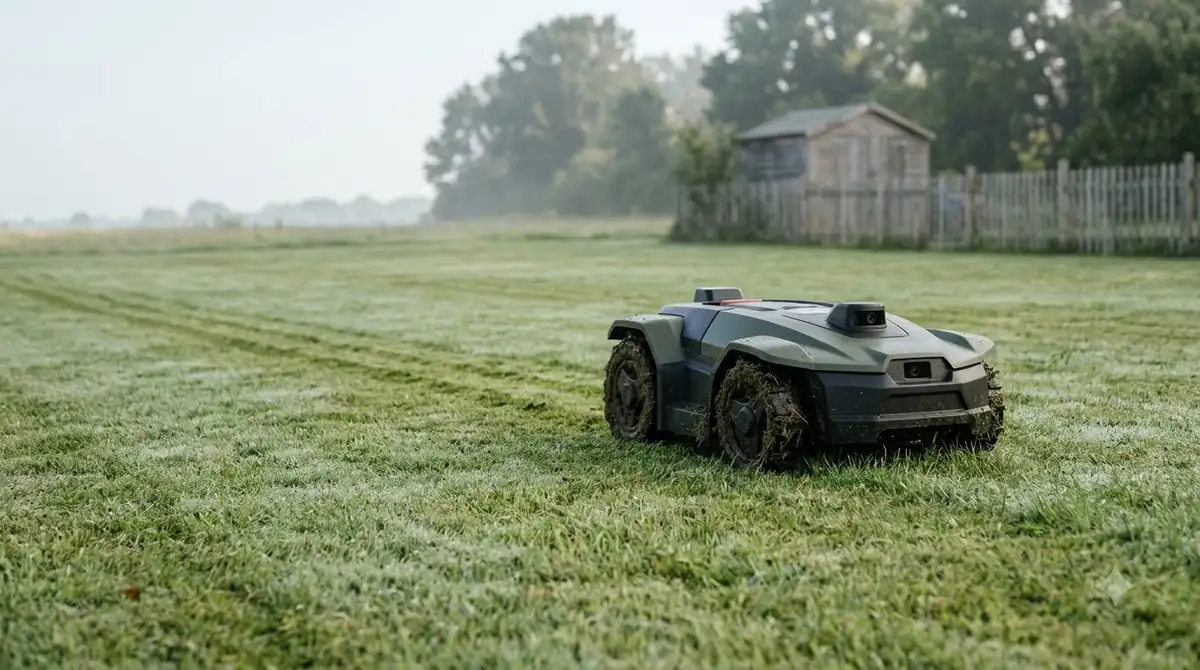
- Measure the footing. Record the diameter of the concrete at ground level, which is the part the blade reaches.
- Plan the loop. Leave room for the island wire around the footing. Worx’s island guidance uses 26 cm of clearance from the wire to the object.
- Keep the wires separate. Husqvarna says the island wires must not cross, or the mower will not recognize the island and will stop.
- Close the return path. Lay the two return wires close together so their signals cancel out.
- Watch a full pass. Confirm the mower turns before the island and does not clip the base.
When a stay-out zone works
A stay-out zone is a quicker option when the flagpole is off to the side of the lawn and the mower does not need to pass near it. Husqvarna’s EPOS guidance recommends zones around trees, roots and stones, with a minimum size of 30 x 30 cm, and says the mower will not pass through one. Poles that also carry lines overhead are covered in clothesline poles and lines, which explain how mowers handle both parts.
A zone is an app setting, not a physical barrier. Husqvarna’s AIM guidance warns that a virtual zone does not replace a physical fence. If the flagpole sits near a driveway, path or pool, add a barrier of at least 15 cm, or 6 inches, and keep the zone well clear of the fence line.
What to check before you buy
- Island support: confirm the model supports islands and check how many the app allows.
- Zone size: the minimum zone size should fit around a narrow base without covering the path the mower needs.
- Edge behavior: ask how the mower treats the boundary wire near a fixed pole.
- Trimming plan: set a regular trim around the footing, since grass grows fastest there.
Read the manual’s section on fixed objects before you install the wire. The right model is the one whose setup method fits the flagpole’s position. Objects that move around need different handling, as yards with movable play gear explains.
Related reads: Hard surfaces beside the grass are covered in patio fixtures near the lawn.
Frequently asked questions
Will a robot mower hit a flagpole?
It can, especially at the base. The pole is tall enough to sense, but the footing is low. Husqvarna says no sensor system is guaranteed, so a wire island is the safer option.
Is the concrete footing a problem?
It can be. A footing that sits flush with the grass may not be detected, and Husqvarna says objects lying flat or very close to the ground may be missed.
Can a virtual zone replace a fence near a flagpole?
Not when a pool, path or street is close by. Husqvarna says a virtual zone is not a physical barrier, and it recommends a barrier of at least 15 cm in those places.
How much grass should I trim around the base?
Trim a clear ring wide enough that the footing is visible. Husqvarna warns that objects hidden in high grass may be missed, so keep the grass short around the base.
Sources
- Husqvarna object avoidance with radar or ultrasonic sensors (KA-70110) (manufacturer): flat or low objects may be missed; no guarantee objects will not be run over.
- Husqvarna object detection and avoidance with AI vision (KA-70388) (manufacturer): raised or legged objects are hard to assess; stay-out zones where there is a risk of getting stuck.
- Husqvarna boundary wire islands (KA-01427) (manufacturer): islands for obstacles that cannot take a bump; wires must not cross.
- Husqvarna EPOS stay-out zones (KA-70385) (manufacturer): minimum zone size of 30 x 30 cm.
 Up next8 min readBy YardRobot Mower for a Lawn with a Boat TrailerUpdated Nov 13, 2026
 6 min readBy YardRobot Mower for a Lawn with a Croquet Court: What to ExpectUpdated Nov 13, 2026
 6 min readBy YardRobot Mower for a Lawn With a Mailbox PostUpdated Nov 13, 2026
 6 min readBy YardRobot Mower for a Lawn with Voles: Signs, Limits, ControlUpdated Nov 13, 2026
 6 min readBy YardRobot Mower for a Lawn With Utility BoxesUpdated Nov 13, 2026
 6 min readBy YardRobot Mower for a Lawn with a Putting Green: Fence It OffUpdated Nov 13, 2026