
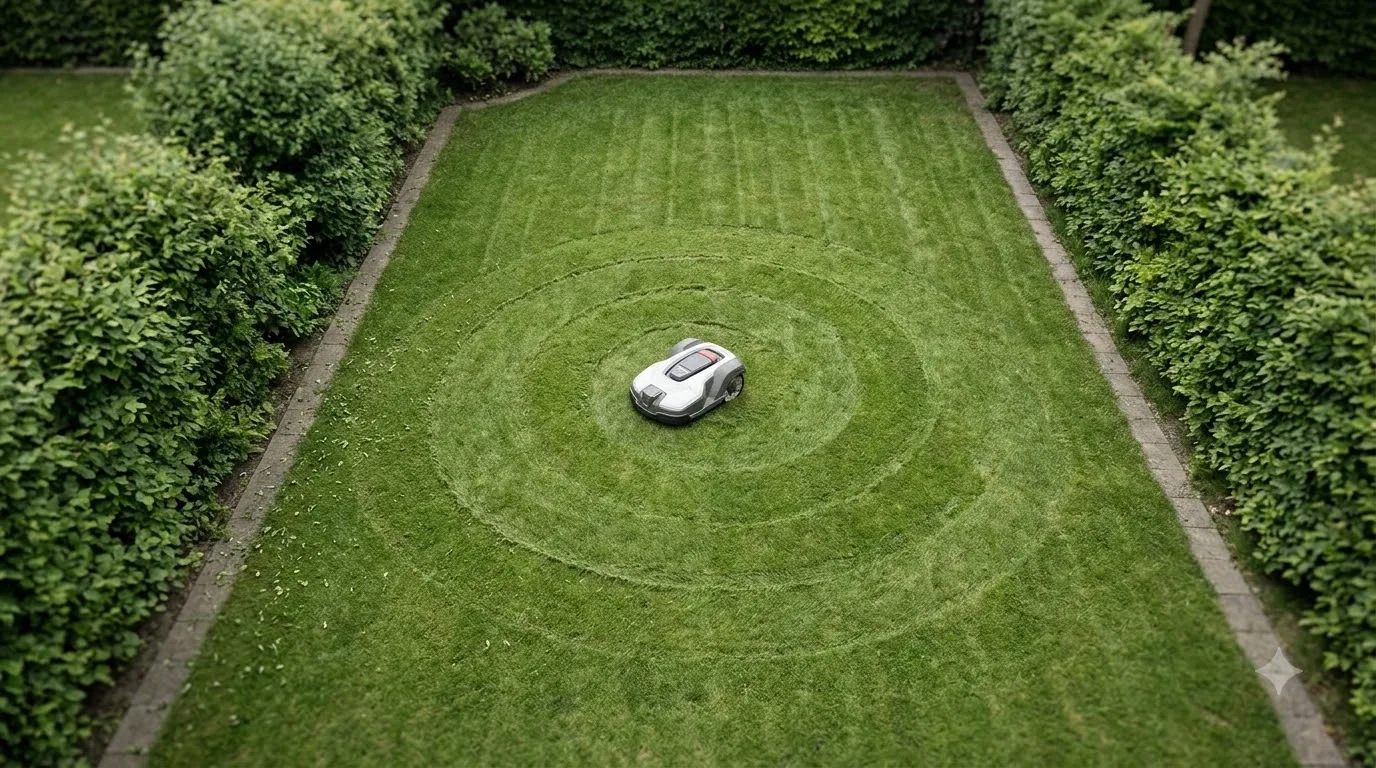

A robot mower for a lawn with a croquet court can help with general upkeep, but it is hard to match croquet-standard height and finish. Croquet surfaces are cut very short and kept even, and the pattern of mowing matters to play. Robot mowers are built for a general lawn and most cut in a set route, so a court is best kept as its own job. This guide covers what to check on the mower and how to fit it around the court.
The short answer
- Check the lowest cutting height against the height your court is kept at before you plan around it.
- Keep the court fenced off with boundary wire or a stay-out zone, so the mower works the surrounding lawn only.
- Follow the one-third rule: never remove more than one-third of the blade in a single mowing.
- Vary the mowing pattern on the court, since repeated mowing in one direction leans the grass and creates grain.
Why a croquet court needs its own approach
A croquet court is a closely cut, level surface, and the grass direction affects how a ball rolls. Extension guidance on closely clipped turf says mowing in the same direction repeatedly makes the grass lean and create grain, and that this matters most on surfaces like putting greens. A croquet court has the same concern, because grain can change the path a ball takes. A croquet lawn is a game area within a bigger yard, and lawn games on a robot-mowed yard covers the wider setup. The closest comparison is a putting surface, which putting green boundary planning describes.
A robot mower is designed for a general home lawn. It moves through its working area on its own route, and most models cut in a fixed height range that may not match a court. Our reading is that a robot is best used on the lawn around the court, with the court itself mowed by a method built for fine, level turf.
Check the lowest height first
The lowest setting decides whether a robot can keep up with a court at all. Many residential robot mowers cut only between about 20 and 60 mm, according to Robomow, and no robot on the market mows a lawn shorter than 15 mm. A court kept well below the mower’s floor is outside what the mower can do. Pole bases are another physical obstacle, as hoop and pole zones on the lawn describes.
Compare the spec sheet with the height the court is kept at. If the court sits well below the lowest setting, plan to mow the court by hand and let the robot take the rest of the lawn.
Keep the mower off the court and manage the pattern
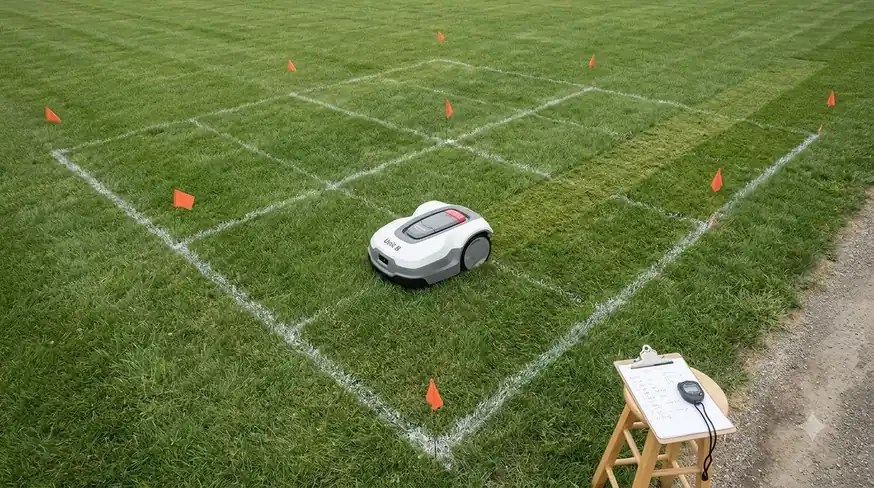
Fence the court with boundary wire or a stay-out zone on a wire-based model, so the mower follows a loop around the court rather than crossing it. Keeping wheels off the court also avoids the tracks and marks that show on a level surface. Goals and hoops need a stay-out zone like a court does, which soccer goal boundary planning explains.
K-State’s turf guidance says changing the mowing pattern each time helps grass grow more upright, and that it also shifts the position of mower wheels or rollers so the wear is spread out. On a court, the same idea applies to the hand-mowed pass. On the surrounding lawn, a robot that runs a routine pattern is still a good choice, because its route changes across runs. Check whether your model lets you change the pattern or direction in the app.
Respect the one-third rule
K-State states the one-third rule plainly: remove no more than one-third of the grass blade at any one mowing. It also warns that cutting off more than a third can stop root growth while the grass regrows. For a court, that means mowing often enough that each pass takes only a small amount of leaf, rather than letting the grass grow long and then cutting it down in one go. Height rules like the one-third rule apply to every turf, and robot mowers for thick southern grass applies them to warm-season lawns.
Set the height for the surrounding lawn
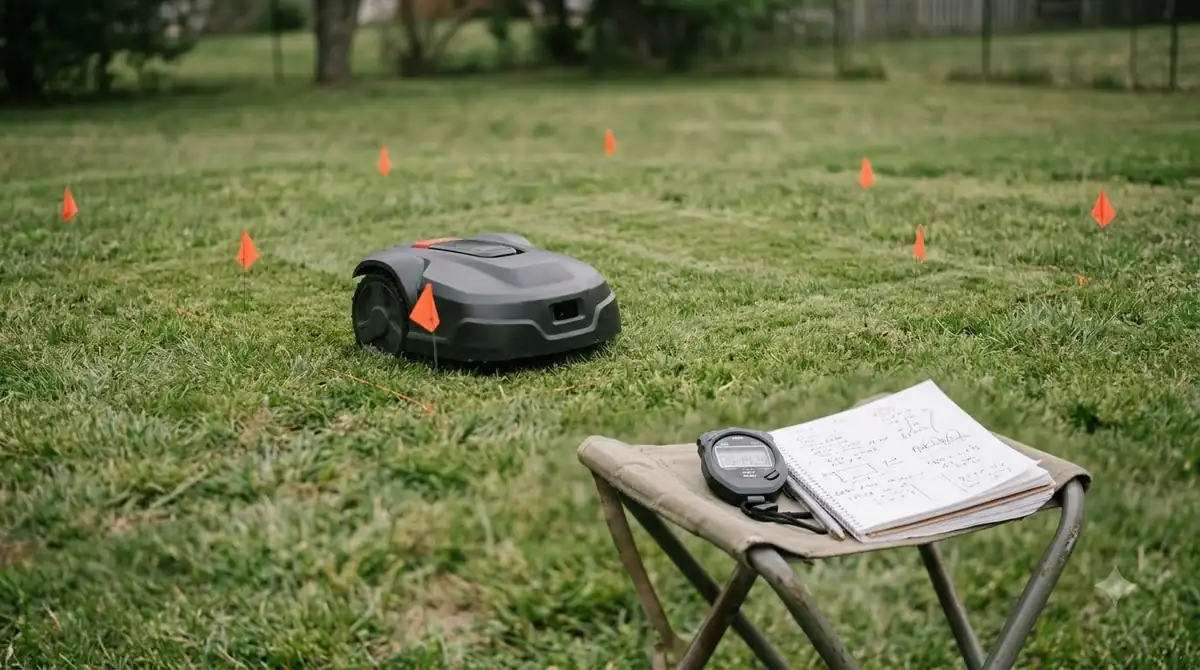
The robot’s job is the lawn around the court, where a general height is what you want. K-State’s table suggests heights for common cool-season and warm-season turf, and advises raising the height during hot, dry or stressful periods. Our reading is that the robot should follow the same rule: run it at a normal height on the surrounding lawn, and raise the setting in heat or drought. The surrounding lawn usually follows species guidance, as Kentucky bluegrass robot cutting height shows.
Timing matters as much as height. Running the robot during the hottest part of the day, or right after a hard rain, can leave the surrounding lawn stressed or muddy. Our reading is that a schedule set for cooler hours, with the robot docked on wet days, keeps the lawn in better shape and avoids tracking mud toward the court. Check that the app’s schedule lets you skip days, since many models only allow a fixed weekly plan.
Edges are the other practical point. A court is usually set in a border of planting or path, and a robot that bumps along hard edges can wear the turf there. Trim the edge by hand where the court meets the lawn, and keep the boundary wire a short distance back from that line so the mower turns before it reaches the court.
What to check before you buy
- Lowest cutting height: match the minimum setting to what the court needs, or accept hand mowing for the court.
- Fencing support: confirm the model supports boundary wire or stay-out zones.
- Pattern control: check whether the app lets you change direction or pattern.
- Court layout: plan the charging station so its route does not cross the court.
Related reads: Shared lawns need a broader checklist, which the play lawn mower shortlist for suburban yards provides.
Frequently asked questions
Can a robot mower cut a croquet court?
Most residential robot mowers cannot reach a croquet court’s height. Many cut only between about 20 and 60 mm. Check the lowest setting, and plan to mow the court by hand.
Why does mowing direction matter on a croquet court?
Repeated mowing in one direction leans the grass and creates grain. K-State notes this matters most on closely clipped turf, and that changing the pattern helps the grass grow more upright.
How much grass should I remove in one mowing?
K-State advises removing no more than one-third of the grass blade at any one mowing. Cutting more can stop root growth while the grass regrows.
Should I fence the court off from the robot?
Our reading is yes. A boundary wire or stay-out zone keeps the wheels and the route of the mower off the court, so the surface is not marked by repeated passes.
Sources
- Mowing (K-State Turf, Kansas State University): mowing height guidance, the one-third rule, root growth warning, and the effect of mowing pattern on grain.
- What is the ideal cutting height for a robotic lawnmower? (Robomow): the 20 to 60 mm range on many robot mowers and the 15 mm floor.
 Up next7 min readBy YardRobot Mower for a Lawn with Fairy Rings: What to ExpectUpdated Nov 13, 2026
 8 min readBy YardRobot Mower for a Lawn with a Boat TrailerUpdated Nov 13, 2026
 6 min readBy YardRobot Mower for a Lawn With a FlagpoleUpdated Nov 13, 2026
 7 min readBy YardRobot Mower for a Lawn With a Sundial or StatueUpdated Nov 13, 2026
 8 min readBy YardRobot Mower for a Lawn with a GreenhouseUpdated Nov 13, 2026
 6 min readBy YardRobot Mower for a Lawn With a Mailbox PostUpdated Nov 13, 2026