
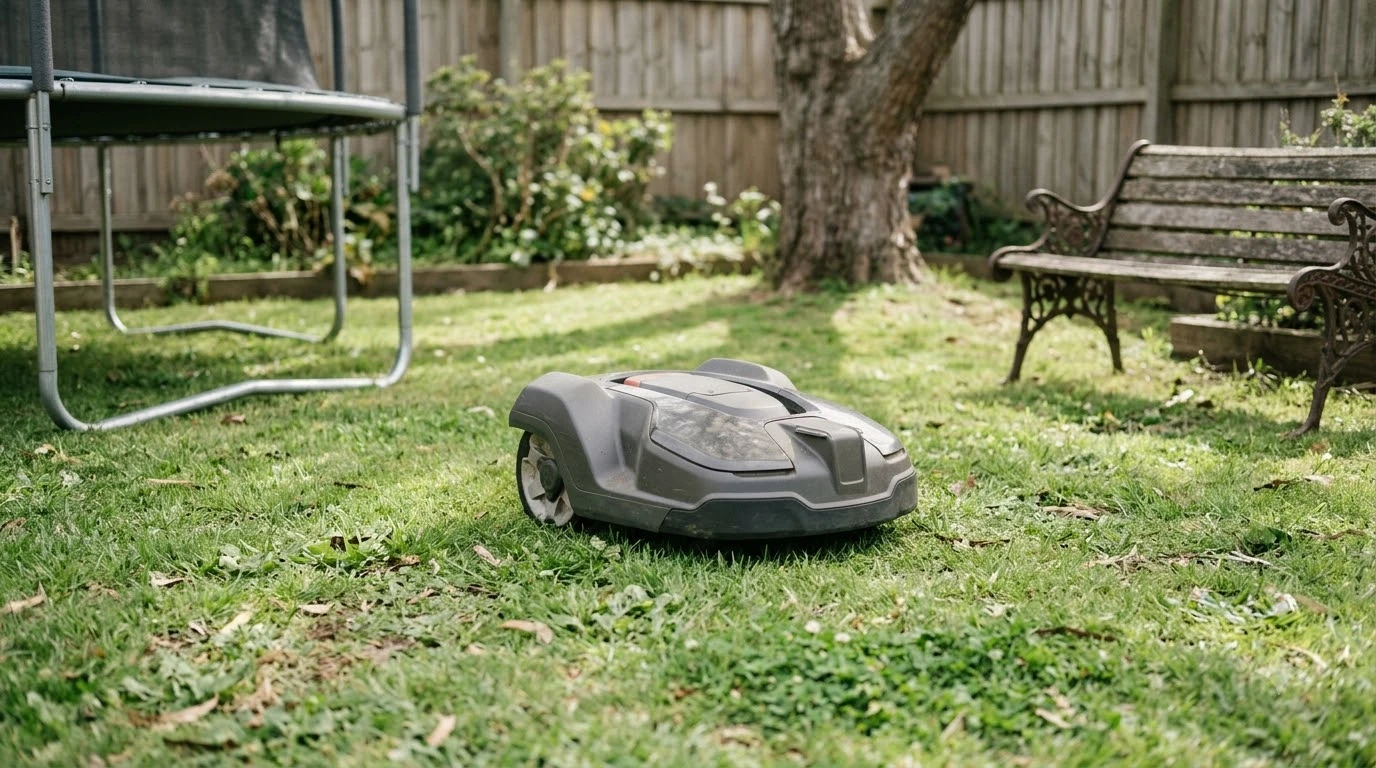

Can a robot mower work around a basketball hoop? Usually yes, if you treat the base as a fixed obstacle, either wired as an island or kept out with a no-go zone. We did not find a manufacturer that publishes a clearance for a hoop base itself, so this guide uses the manufacturer guidance written for fixed obstacles in general, and marks where it is our own reading.
The short answer
- Usually yes: a rigid hoop base is an obstacle the mower can be set up to avoid.
- Safest setup: wire the base as an island, or create a no-go zone around it, then check the model manual.
- Clearance: Worx gives 26 cm for its own island setup. No source we read gives a number for a hoop base.
- Weighted bases: no source we read covers them. Keep a clear gap and do not rely on the mower to push past them.
Can a robot mower work around a basketball hoop base?
A robot mower works inside a boundary, and inside that boundary fixed objects are things to go around. For a similar yard object, see how a robot mower handles a trampoline. Models differ in how they detect obstacles, with boundary wire, contact sensing and, on some models, radar, ultrasonic or camera sensing in the mix. The exact behavior depends on the model, so the same hoop base can be handled differently by two mowers. Our guide to robot mowers with obstacle avoidance explains the main sensing types.
Basketball hoop bases are usually rigid and sit still. That makes them the kind of obstacle a robot mower is designed to meet, as opposed to a loose hose or a toy that can move. The practical risk is less about the base itself and more about the approach: a base that sits low to the ground, a post with a wide foot, or an uneven patch of soil around it can make the mower bump, turn, or get stuck.
Two ways to handle a fixed obstacle: island or leave it alone
Husqvarna’s guidance on boundary-wire installations separates obstacles that need an island from those that do not. It recommends islanding areas the mower should not enter, with flower beds and rockeries as examples, and it says obstacles that can take a gentle bump, such as trees, do not always need fencing. The same page warns to check that a tree has no exposed roots that could reach the blades. Husqvarna’s island guide gives the wire route but no clearance numbers.
| Option | When it fits | What the sources say |
|---|---|---|
| Leave it alone | A sturdy object the mower can bump without harm | Husqvarna says obstacles that take a gentle bump do not always need an island |
| Island | An obstacle the mower should not touch, or one with a base that could be damaged | Husqvarna recommends islanding flower beds and rockeries; Worx uses a 26 cm wire clearance for its own model |
| No-go zone | A defined area the mower should stay out of | Mammotion lists trees, roots and any obstructions as zone candidates |
Our reading is that a hoop base falls closer to the island row than the leave-alone row, because a base is a fixed object sitting in the lawn rather than a bump-tolerant trunk. That is an inference, not something a manufacturer states for hoop bases.
Setting up an island around a hoop base
An island is a loop of boundary wire that keeps the mower away from one object. Worx describes its Landroid Classic island setup in a clear sequence. The wire runs from the lawn edge at a right angle toward the obstacle, goes around it while keeping a 26 cm distance until the island is closed, and then returns to the edge along the same path. Worx also says to lay the wire clockwise. Worx’s island page is written for its own model, so use the 26 cm figure as a model-specific example, not a rule for every mower.
Husqvarna adds one rule that matters with any island: the wires must not cross, or the mower stops. When the loop closes, the two wires should lie close together on the return path so the signal cancels and the mower can pass over them. Keep the wire away from the base footprint, and remember that the base also needs room for the mower to turn. So can a robot mower work around a basketball hoop with an island? Yes, on a model that supports wired islands. Our guides to laying boundary wire around obstacles and to a lawn with island beds cover the same routing.
The no-go zone option
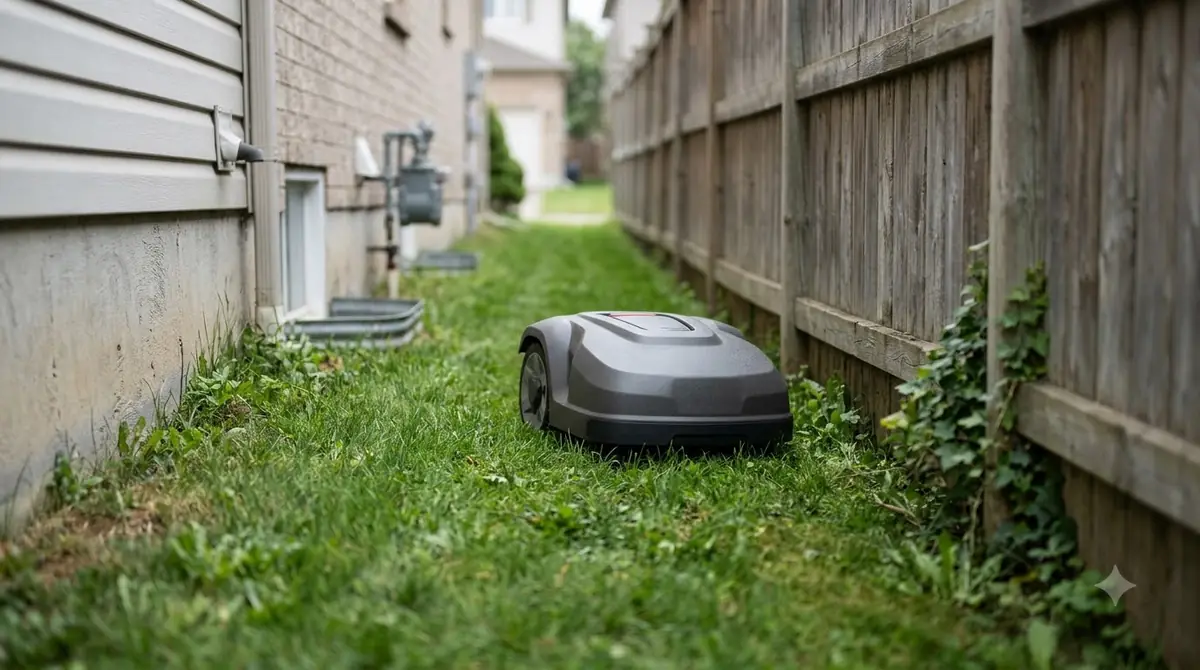
A no-go zone is a mapped area the mower should not enter. Mammotion says no-go zones are created for pools, flowerbeds, trees, roots, ditches, and any other obstructions present in the lawn. A hoop base fits that list as a stationary obstruction. Mammotion’s no-go zone article explains that you set the zone by walking its perimeter back to the start point, but it gives no size, shape or distance numbers for the zone.
That gap matters. A no-go zone tells the mower where to stay out, but it does not tell you how much room the base needs. Until you check the manual for your model, the safer assumption is to set the zone a little wider than the base footprint and to keep the mower’s turning circle in mind. Can a robot mower work around a basketball hoop with no wire at all? On a model that maps zones, yes, and our walkthrough on how to set up no-go zones shows the general steps.
Heads up
A no-go zone and an island are not the same thing. An island is wired, while a no-go zone is mapped by the mower. Some models support both, some support one, and some support neither. Check the spec sheet before you buy if you need a particular method.
What a weighted or heavy base changes
If your hoop has a weighted or portable base, it still stays put once it is set up. The sources we read about robot mowers do not describe how a mower handles a weighted base, so anything specific here would be a guess.
Can a robot mower work around a basketball hoop with a weighted base? Our reading is yes, as long as a base that stays put is treated as a fixed obstacle, whatever it is filled with. Leave a clear gap around it rather than planning on the mower to push close to the base. If the base sits on a slope or a low spot, check the manual for slope and obstacle guidance too, because those conditions can make the mower’s path less predictable.
What to check before you lay the wire
Before you decide whether a robot mower can work around a basketball hoop in your yard, use this order when you plan around the base. It is our reading of the manufacturer guidance above, not a single manufacturer’s checklist.
- Measure the base footprint. Include the foot of the post and any weight plate, not only the visible stand.
- Check the manual for your model. Look for obstacle, island and no-go zone sections, and note any clearance the manufacturer gives.
- Choose island or no-go zone. Use an island if the model supports wired obstacles and the base should not be touched. Use a no-go zone if the model maps zones and the base is a clear obstruction.
- Mark the route first. Mark the wire path on the lawn before you lay the wire, so you can see how the island will sit against the base.
- Test the loop. After the wire is connected, run the mower’s loop or boundary test and watch the first passes near the base.
What the research does not cover
We did not find a manufacturer that tests a basketball hoop base, and we did not run a test of our own. The clearance figures in this guide come from other obstacles and other models. The Husqvarna island page does not address freestanding posts or poles. For a hoop base, the honest answer is that the manual for your model is the only source that can settle the question for that mower.
One more gap is worth noting. This article depends on guidance written for fixed obstacles in general, not for hoops. If you find a manufacturer statement about hoop bases, it should override anything here.
Frequently asked questions
Will a robot mower run into a basketball hoop base?
It can, if the base is inside the mowing area and not wired or mapped out. No source we read tests hoop bases specifically, so check the manual for your model and plan an island or no-go zone.
Do I need a no-go zone around a hoop base?
Mammotion lists fixed obstructions such as trees and flowerbeds as no-go zone candidates, which covers a stationary base in general. Whether you need one depends on how close the base sits to the mowing path and what your model supports.
How far should the boundary wire stay from the base?
Worx gives 26 cm for the island setup on its Landroid Classic. That is a model-specific figure, and no source we read gives a number for a hoop base, so use the figure in your own model’s manual.
Can a robot mower cut around a portable hoop with a weighted base?
The sources we read do not cover weighted bases. Our reading is to treat the base as a fixed obstacle, leave a clear gap, and confirm the behavior in the model manual before relying on it.
Sources
- How to create islands in a boundary wire installation (KA-01427) (Husqvarna): island choice, wire route, no-crossing rule.
- How to create a no-go zone (Mammotion): list of obstructions for no-go zones, mapping method.
- Setup an island (Worx, Landroid Classic wiki): 26 cm island clearance and wire route.
 Up next9 min readBy YardCan a Robot Mower Work Around a Brick Walkway?Updated Nov 12, 2026
 7 min readBy YardCan a Robot Mower Work Around a Hot Tub?Updated Nov 12, 2026
 7 min readBy YardCan a Robot Mower Work Around a Wooden Deck?Updated Nov 12, 2026
 8 min readBy YardCan a Robot Mower Work Around a Rain Garden?Updated Nov 12, 2026
 9 min readBy YardCan a Robot Mower Mow Around a Wildflower Patch? Setup Rules That WorkUpdated Nov 12, 2026
 10 min readBy YardCan a Robot Mower Work Around a Bird Bath? Wire Setup GuideUpdated Nov 12, 2026