
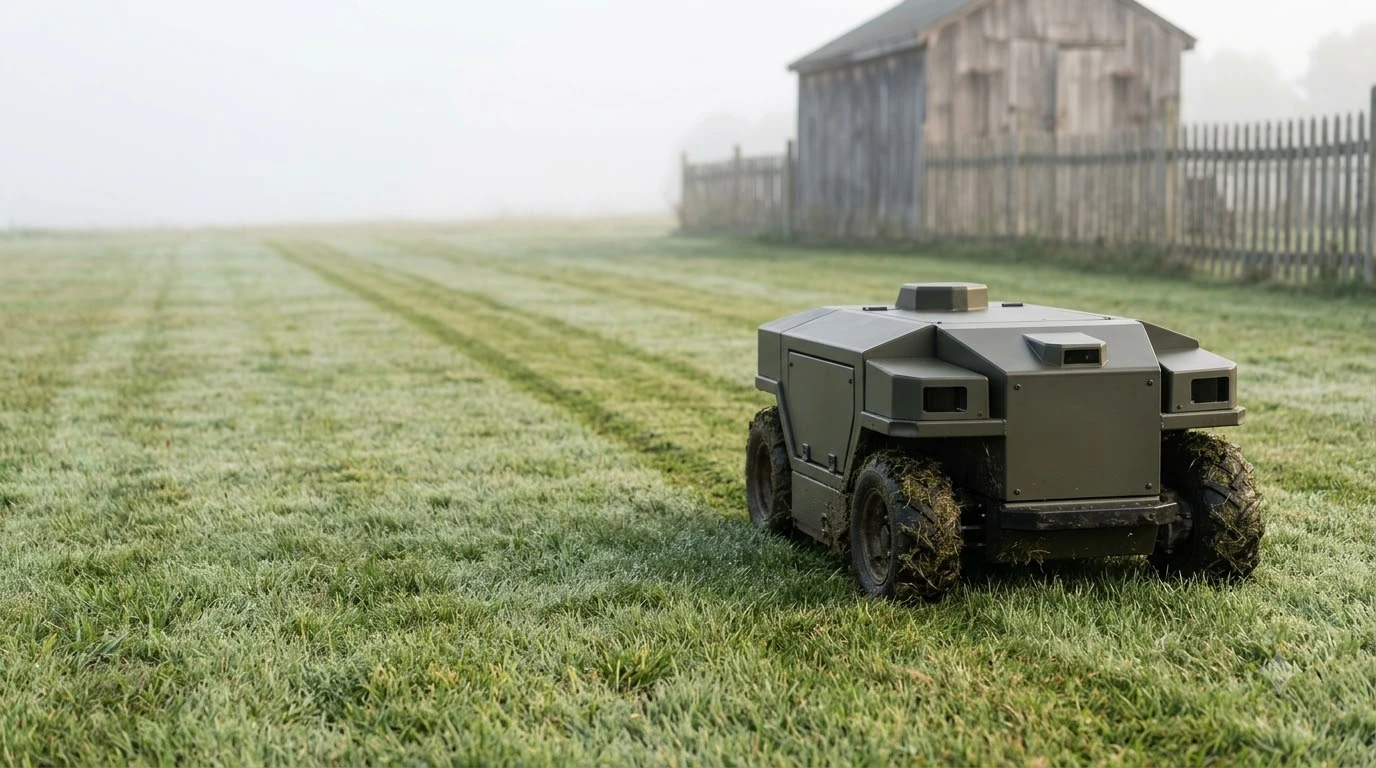

A robot mower for a lawn with a sundial or statue can run, but these decorative pieces are heavy, fixed and often low, so they need a fence rather than trust in sensors. A statue on a tall plinth may be easy to see. A sundial set on a short pedestal, or a small figure on the grass, is easier to miss. A wire island or a stay-out zone around the piece is the most reliable way to keep the mower and the ornament apart.
The short answer
- Tall statue on a plinth: the upper body is easy to sense, but the base still needs protection.
- Low sundial or small figure: treat it like a flat or low object that sensors may miss.
- Stone and heavy pieces: manufacturers recommend stay-out zones around stones.
- Safest setup: a wire island or stay-out zone, with a trimmed ring around the base.
Tall pieces and low pieces are different risks
A sundial or statue in a lawn can be a stone, metal or cast-composite piece on a pedestal, a plinth or directly on the grass. The height of the piece above the turf decides how well a sensor can read it. A statue that rises well above the lawn gives a clear target. A sundial on a short base, or a small figure on the grass, sits close to the ground, where Husqvarna’s object avoidance page says detection can fail. Decorative features usually sit within planted areas, so garden bed planning for robot mowers is a natural next read. Smaller decorations raise similar questions about sensors, and how robot mowers handle small garden ornaments gives the general guidance.
Husqvarna’s object avoidance guidance states that objects lying flat or very close to the ground may not be detected, and that the system is not a guarantee against running over an object. Our reading is that any ornament with a low profile should be fenced, even if a taller one nearby is handled well by the sensors.
What the sensors may or may not recognize
Camera and sensor systems are designed to recognize common objects, and some vendors describe garden features in their sensing claims. Navimow says its vision recognizes furniture, toys and garden features, but also that ultrasonic detection struggles with soft or thin objects. A sundial or statue is hard, so ultrasonic sensing works better than it does on a soft object, but a low or hidden base can still be missed. If your yard has many decorative pieces, mower shortlist for ornament-filled lawns lists which features help avoid collisions.
Husqvarna’s AI vision page sorts objects by risk and says raised or legged objects are hard to assess. Its advice is to use a stay-out zone where there is a risk of the mower getting stuck. A statue on legs or a sundial on a raised base is a good example of that case.

Heads up
Autohomebots notes that physical markers such as flags, stones and fencing can be combined with app no-go zones, and that detection is not infallible. Treat any ornament as something to fence, not something to detect.
Robot mower for a lawn with a sundial or statue: protecting the base
A wire island is a closed loop of boundary wire that the mower drives around. Husqvarna’s island guidance recommends islands for obstacles that cannot take a bump, such as flower beds and rockeries. A stone pedestal or a heavy statue base is that kind of obstacle, so the island is usually the sturdier choice. Large stones present a related obstacle, covered in boulders sitting inside a mowed lawn.
- Measure the base. Record the footprint at ground level, including any plinth or step.
- Plan the loop. Leave room for the island wire. Worx’s island guidance uses 26 cm of clearance from the wire to the object.
- Keep the wires separate. Husqvarna says island wires must not cross, or the mower will not recognize the island and will stop.
- Close the return path. Lay the two return wires close together so their signals cancel out.
- Check a full pass. Watch the mower turn before the island and confirm it does not clip the base.
Stay-out zones around stone and decorative pieces
When a wire island is awkward, a stay-out zone is the next option. Husqvarna’s EPOS guidance recommends zones around trees, roots and stones, with a minimum size of 30 x 30 cm, and says the mower will not pass through a zone. A stone ornament fits that recommendation well. A low stone bird bath behaves much like a statue base, as described in working around a stone bird bath. Low decorative pieces and fixtures need stay-out zones, and robot mowers around solar lights covers a similar case.
A zone is an app setting and not a physical barrier. Husqvarna’s AIM guidance warns that a virtual zone does not replace a physical fence. A statue near a pool, path or street should have a barrier of at least 15 cm, or 6 inches, in addition to the zone.
What to check before you buy
- Island and zone support: confirm the model supports both, and how many islands and zones the app allows.
- Zone size: the minimum zone size should fit around the base without covering the lawn the mower needs.
- Sensor claims: ask how the model handles low and flat objects, since most ornaments sit close to the ground.
- Trimming plan: keep the grass around the base short so the piece is visible to the mower.
Read the fixed-object section of the manual before you install the wire, and place the wire so it never runs through the ornament’s base. Hard-edged fixtures share many sensor issues, which fire pit rings on a robot-mowed lawn covers.
Related reads: Flush features such as covers are a different hazard from raised ones, and fencing a cistern lid in the lawn explains the distinction.
Frequently asked questions
Will a robot mower hit a garden statue?
It can, especially if the statue sits low or the base is hidden by grass. Husqvarna says no sensor system is guaranteed, so a wire island or stay-out zone is the safer option.
Are stone pieces treated differently?
Husqvarna’s EPOS guidance recommends stay-out zones around stones, with a minimum size of 30 x 30 cm. A stone ornament is a good candidate for that kind of zone.
Can a virtual zone replace a fence around a statue?
Not near a pool, path or street. Husqvarna says a virtual zone is not a physical barrier, and it recommends a barrier of at least 15 cm in those places.
Does a sundial on a short pedestal need an island?
Usually yes. A low pedestal sits close to the ground, where Husqvarna says objects may not be detected. A wire island keeps the mower away from the base.
Sources
- Husqvarna object avoidance with radar or ultrasonic sensors (KA-70110) (manufacturer): flat or low objects may be missed; no guarantee objects will not be run over.
- Husqvarna EPOS stay-out zones (KA-70385) (manufacturer): zones recommended around stones; minimum size 30 x 30 cm.
- Husqvarna object detection and avoidance with AI vision (KA-70388) (manufacturer): raised or legged objects are hard to assess; stay-out zones where there is a risk of getting stuck.
- Navimow: how robot lawn mowers avoid hazards (manufacturer blog): vision recognizes garden features; ultrasonic struggles with soft or thin objects.
 Up next8 min readBy YardRobot Mower for a Lawn with a GreenhouseUpdated Nov 13, 2026
 7 min readBy YardRobot Mower for a Lawn with a GazeboUpdated Nov 13, 2026
 6 min readBy YardRobot Mower for a Lawn with a Soccer Goal: Plan the SpaceUpdated Nov 13, 2026
 6 min readBy YardRobot Mower for a Lawn with a Croquet Court: What to ExpectUpdated Nov 13, 2026
 8 min readBy YardRobot Mower for a Lawn with a Boat TrailerUpdated Nov 13, 2026
 6 min readBy YardRobot Mower for a Lawn With a FlagpoleUpdated Nov 13, 2026