
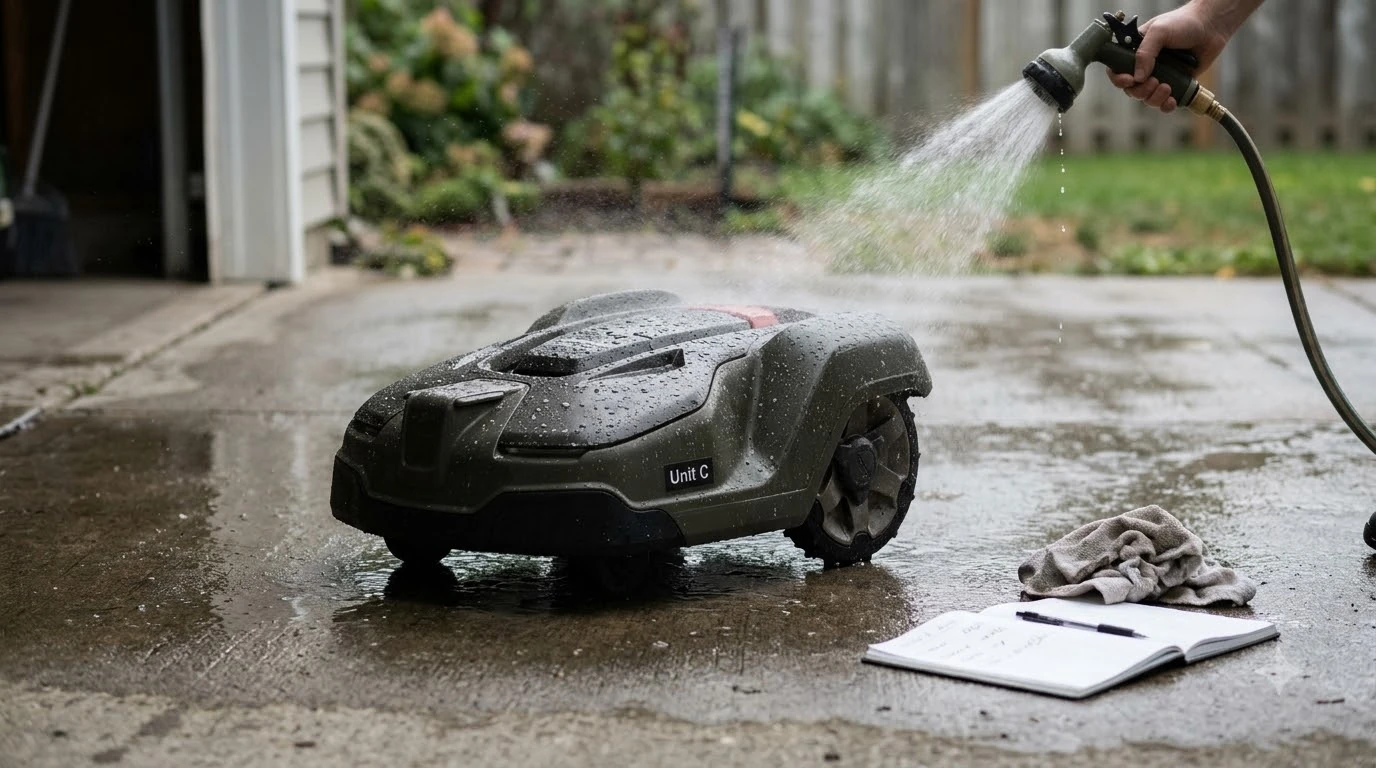

The best robot mower for a lawn with frequent thunderstorms is the one that protects its charging station and wiring, and that you can disconnect quickly before a storm: Husqvarna’s storm guidance says lightning and heavy rain can damage the electrical components of an Automower and its charging station, so the power and wiring need attention before the weather arrives. The mower itself matters less than how its base is set up.
The short answer
- Unplug first: Husqvarna’s procedure starts by unplugging the power supply from the wall outlet.
- Disconnect the base: disconnect the power supply and, on boundary-wire installs, the wire connectors from the pins.
- Check the dock cover: close the charging station cover, which protects the connections from rain.
- Mind the rod: Husqvarna says a reference station should not sit higher than a nearby lightning rod.
- Do not trust claims blindly: an automatic return-to-dock during lightning is a product claim, so confirm it in the manual.
Why storms are a different problem for a robot mower
A robot mower spends most of its life outdoors, and the charging station is the part that stays in one place, plugged into mains power. Lightning strikes and heavy rain threaten that connection more than the cutting deck. A lawn with frequent storms therefore calls for a mower and a base that can be made safe in a few minutes, not only a mower that cuts well in wet grass. Storms and steady rain overlap, so the broader page on robot mowers that work in rain is a natural next read. Water-resistance claims differ by model, so see the IPX6 weatherproof rating for mowers.
Husqvarna’s support page is direct about this. It says that before a thunderstorm you should disconnect the mower’s power and wiring, because lightning and heavy rain can damage the electrical components in the Automower and its charging station. The steps depend on the model, so the first decision is about the base you will live with.
Best robot mower for a lawn with frequent thunderstorms: the storm routine
The routine is easier to follow when it is written down. Husqvarna’s steps vary by model, but the pattern is consistent. For a typical installation, unplug the power supply from the wall outlet, disconnect the power supply from the charging station, and close the hatch. For a model with a boundary wire, also disconnect the connectors from the pins, and close the charging station cover so that rain stays off the connections.
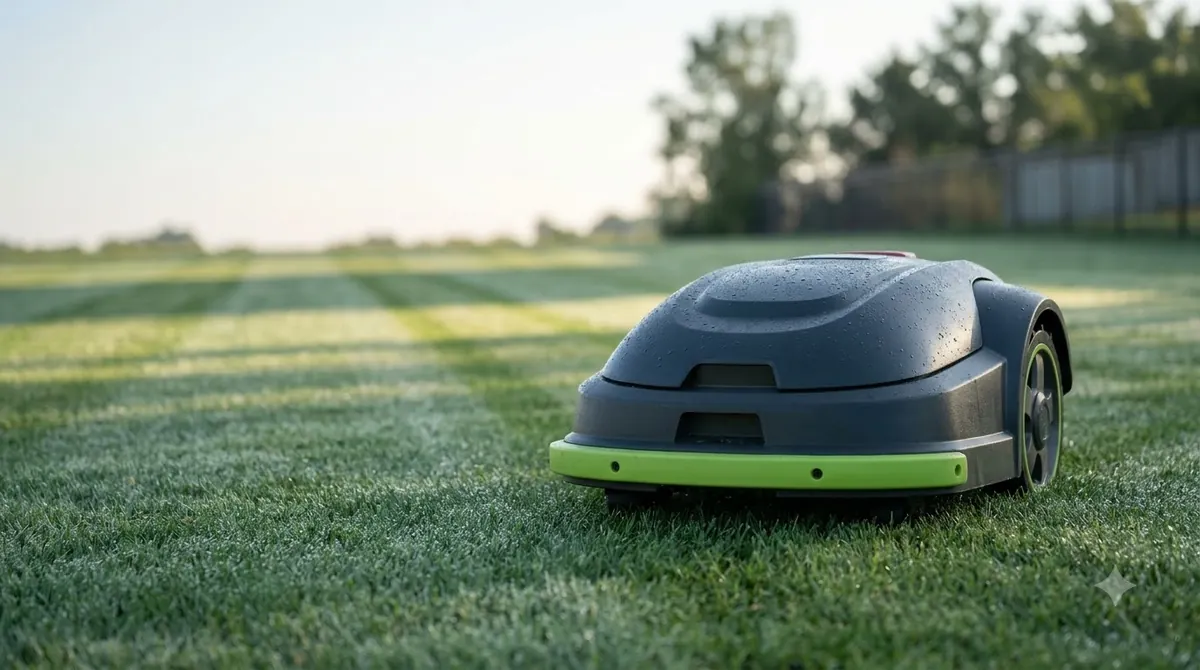
Mark the cables before you pull them. Husqvarna labels the connections AR, AL and G1, with G2 and G3 on models that support more than one guide wire. Reconnecting the wires in the wrong position is the most common way to turn a storm precaution into a fault, so a simple photo or label helps.
Charging station position and lightning rods
Where the base sits matters as much as the routine. Husqvarna’s guidance for its reference station says not to install it higher than a nearby lightning rod. That is a specific rule for that product, but it points to a general idea: keep the base and its connections low, covered, and away from anything that might draw a strike. Dock placement matters most when you understand how an IP rating explained for robot mowers applies to outdoor electronics.
Our reading is that a base under a large tree, or in an exposed corner that collects standing water, is a poor choice for a storm-prone lawn. Pick a sheltered, level spot with a cover, and check that the cover closes fully.
Does the mower return to its dock during lightning?
Some makers say their mowers return to the dock automatically when lightning is detected. Yarbo’s product blog says that if lightning is detected, its AI safety protocols pause mowing and return the mower to its docking station. The same post does not give a detection method, a threshold, or a timeframe, and it says its claims rest on user-submitted videos and trials rather than formal testing.
Treat that as a product claim, not a safety guarantee. Whatever the feature, the safe routine is still to disconnect the base before a storm. An automatic return does not disconnect the power supply, and it does not protect a base that is wired to mains and exposed to rain.
Heads up
Yarbo’s blog also claims IPX5 sealing on its motors, sensors and battery. That rating describes water jets, not lightning, and says nothing about the charging station. Check the rating for the dock itself.
Rain, schedules and wet grass
Frequent storms mean frequent wet grass, and many robot mowers can run in rain. Yarbo says its AI reduces blade speed and mowing depth when moisture is high, and that its Pro version was upgraded with rain sensors. Those features are worth asking about, but they are product claims, so check the specification before you rely on them. A rain sensor decides when the mower stays docked, as explained in rain sensor behavior during storms. A plain answer is in whether robot mowers work in rain, including what the manufacturer rating covers. Storm routines and wet-grass handling are connected, and robot mowing in Indiana weather explains how the mowing schedule should adapt to a stormy season.
A practical approach is to set the schedule so that the mower does not start just before a forecast storm. If the app supports pausing or changing the schedule, use it, and keep the routine for disconnecting the base as the backstop.
What to check before you buy
For the best robot mower for a lawn with frequent thunderstorms, look at four things. Find out how the base is powered and whether the power supply can be unplugged from the outside without opening the hatch. Confirm whether the base has a cover that closes against rain. Check whether the boundary wire, if there is one, can be disconnected in a few minutes. Read the manual’s storm section, and ask the maker to confirm any automatic return claim in writing.
Related reads: After a stormy week, a routine maintenance checklist for robot mowers keeps contacts and blades in order.
Frequently asked questions
Should I unplug a robot mower before a thunderstorm?
Yes. Husqvarna’s guidance is to unplug the power supply from the wall outlet before a thunderstorm, because lightning and heavy rain can damage the electrical components in the mower’s charging station.
Do I need to disconnect the boundary wire too?
On a boundary-wire installation, Husqvarna says to disconnect the connectors from the pins and mark the cables first, so they can be reconnected correctly after the storm.
Will a robot mower go back to its dock during lightning?
Some makers claim it does. Yarbo says its AI pauses and returns the mower when lightning is detected, but its blog gives no detection method. Treat that as a product claim and still disconnect the base before a storm.
Can a robot mower work in rain?
Some models are rated for rain and adjust cutting when the grass is wet, but ratings and features differ. Check the specification for the mower and the charging station separately.
Sources
- Husqvarna, Protect your Automower robotic lawn mower during thunderstorms (manufacturer): unplugging steps, boundary-wire connections, cover and rod guidance.
- Yarbo, storm-resistant robot mower blog (product blog, marketing claims): lightning pause and return-to-dock claim, rain sensors, IPX5 sealing.
 Up next8 min readBest Robot MowersBest Robot Mower for Idaho Lawns: Cool-Season Grass GuideUpdated Nov 18, 2026
 7 min readBest Robot MowersBest Robot Mower for a Family With ToddlersUpdated Nov 18, 2026
 7 min readBest Robot MowersBest Robot Mower for Utah Lawns: What to Check Before You BuyUpdated Nov 13, 2026
 8 min readBest Robot MowersBest Robot Mower for Minnesota Lawns: What to Check Before You BuyUpdated Nov 18, 2026
 7 min readBest Robot MowersBest Robot Mower for Missouri Lawns: Height Guide Before You BuyUpdated Nov 18, 2026
 8 min readBest Robot MowersBest Robot Mower for Nevada Lawns: Heat and Water GuideUpdated Nov 18, 2026