
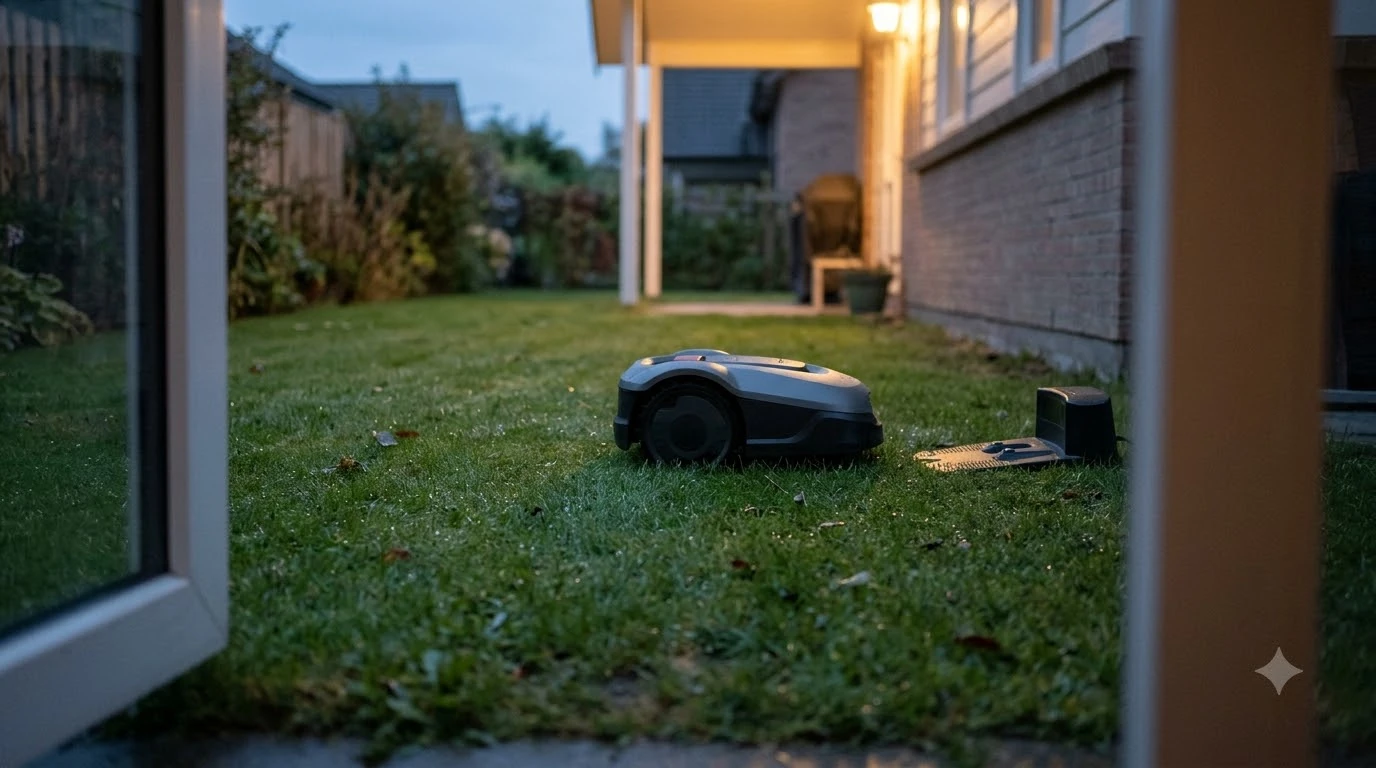

Why does my robot mower take so long to finish? Usually because the lawn is larger or more complicated than the mower’s rated run, the battery is aging, or the cutting width is narrow. Robot mowers cut in many short passes and return to the dock to recharge, so the total time depends on the lawn and the charging pattern as much as on the mower’s speed. Most slow cycles trace back to a few causes you can check.
The short answer
- Lawn size and shape: more area and more turns mean more total time.
- Charging stops: each return to the dock adds a recharge, often an hour or more.
- Battery age: an aging battery sends the mower back to the dock more often.
- Cutting width: a narrow deck covers less ground per pass.
- Slopes, obstacles, and grass: they slow the mower and drain the battery faster.
Why a robot mower works in short sessions
A robot mower does not run one continuous pass. It cuts for a while, returns to its charging station when the battery gets low, recharges, and then resumes where it left off. That pattern is intentional: it lets the mower cut a little grass often rather than a lot at once. The trade-off is that the mowing clock and the charging clock both count toward the finish time. Travel speed is compared in mowing speed by model, which is a useful companion to this section.
So a mower can seem slow even when it is working well. If you watch it come back to the dock several times in one cycle, that is normal for a larger lawn, not a sign that the mower is faulty.
Lawn size and charging stops
The larger the lawn, the more charge cycles the mower needs. Ecovacs publishes a worked example for a 600 square meter lawn. Its GOAT mower cuts until the battery drops to about 15 percent, recharges to about 80 percent, and repeats. The company estimates about 750 minutes, or 12.4 hours, for that lawn. Its figures are lab results with grass about 1 cm tall, so treat them as a guide rather than a promise. Dividing the lawn changes trips, as zone mowing and charging trips explains.
Robomow describes the same effect from another angle. Some models return to base after roughly 400 square meters, while others go to about 800 square meters before recharging. A mower with a shorter charging interval will spend more of its cycle at the dock, even if it cuts at the same speed.
Heads up
Charging time is not the same as mowing time. If your mower reports a long total time, check whether it is spending more of the cycle recharging than cutting.
Battery age and charging intervals
A battery loses capacity over its life. Robomow notes that as the battery ages, the mower heads for the charger more often, and total mowing time goes up. This is one of the most common reasons a cycle that used to finish in an afternoon starts to stretch into the next day. Weak packs lengthen jobs, as battery wear that slows cycles shows, so check it if you want the details behind this point.
Check the battery first if the change was gradual. A mower that used to run a full cycle and now comes back to the dock much sooner is showing you a battery problem. Compare the current run time with the rated run time in the manual, and note how often it returns during a single mowing session.
Cutting width and mowing pattern
Cutting width matters more than most owners expect. Robomow compares an 18 centimeter cutting width with a 56 centimeter one, and the wider deck covers far more ground in each pass. A narrow deck on a large lawn means more passes and more time, even if the mower is in good shape. Swath affects pass count, as cutting width and cycle time explains, which gives more context than this short overview can. The measure is described in mowing efficiency ratings, and it explains the reasoning in more depth.
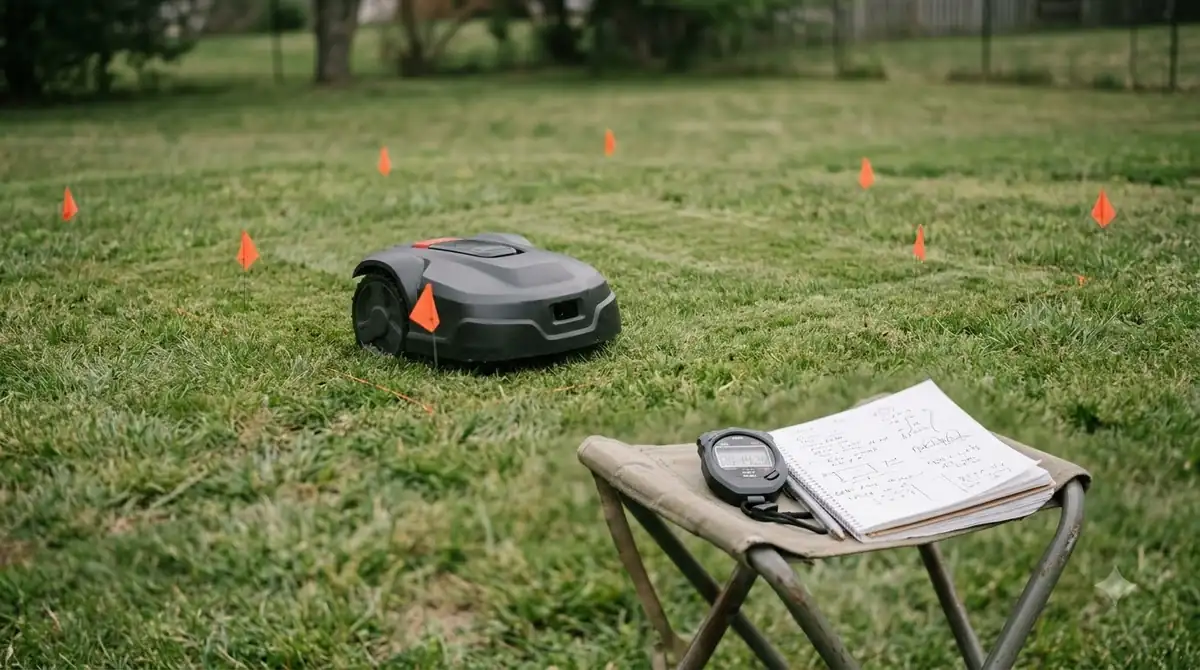
The mowing pattern also affects the total time. Robomow says random, chaotic patterns are less efficient than systematic ones, because the mower covers the same grass more than once while it misses other sections. Many models let you choose a pattern or use a mapping feature, and a systematic route usually finishes sooner.
Slopes, obstacles, and tight spaces
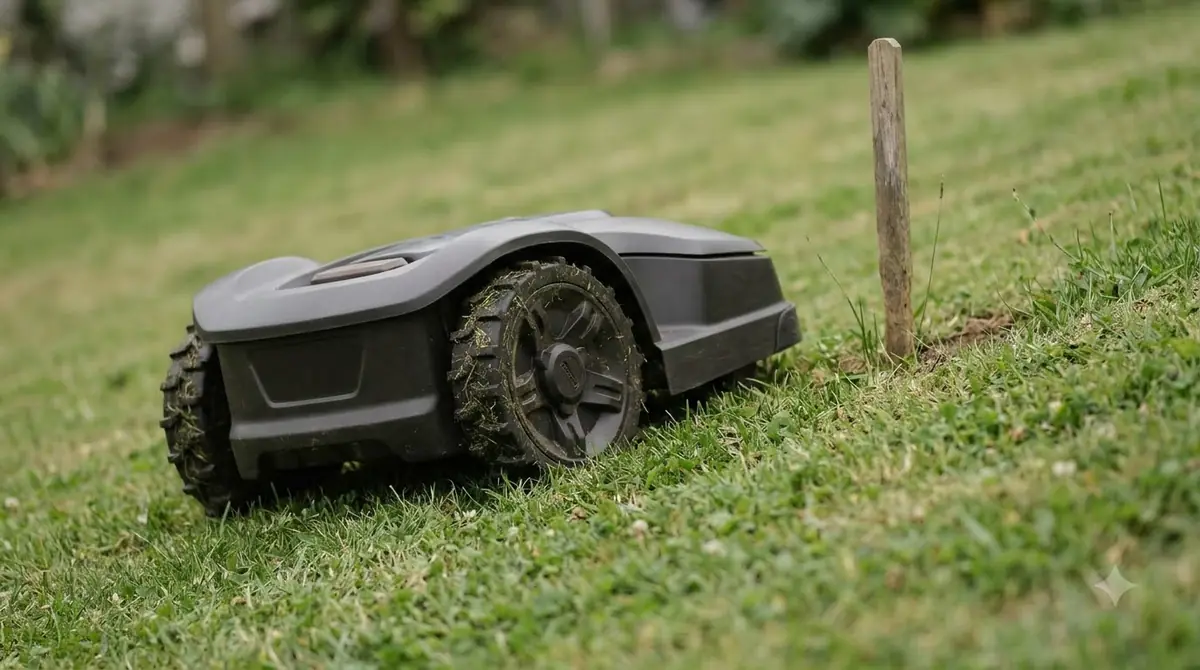
Slopes and obstacles slow a mower down because they force more turns and slower travel. Robomow says typical garden conditions can reduce area output by about 30 percent. Narrow gaps, flower beds, and tree roots add the same kind of delay, since the mower has to slow and turn at each one. Terrain adjustments are described in slope settings that affect run time, and it is worth reading before you change any settings.
If the lawn has a steep bank or many corners, expect a longer cycle. This is not a fault. It is the cost of cutting that ground, and it is worth planning for when you set the schedule. A mower that finishes a flat lawn in one afternoon may need two sessions on a hilly one.
Grass type and weather
Tough, fast-growing grass uses more battery power than soft, slow grass. Robomow says tough, fast-growing grass uses more battery power, and that rain can pause mowing on models with rain sensors. A wet lawn can also clog the blades and slow the cut, which lengthens the cycle.
In a season of fast growth, the mower may need more time than the rated figures suggest. Keep this in mind when you compare a mower’s run time with your own lawn in spring.
What to check if the cycle is too long
Work through these checks in order, from the simplest to the most involved: Upkeep affects performance, as keeping up with maintenance explains, and it explains the reasoning in more depth.
- Measure the real area. Compare the lawn’s square meters with the mower’s rated coverage per charge. A large gap means more charge cycles are expected.
- Check the battery age. If the mower returns to the dock much sooner than it used to, the battery may be the cause.
- Look at the charging stops. Count how many times the mower returns in one session. If it recharges more often than the manual suggests, check the battery and the charging contacts.
- Review the mowing pattern. If the mower cuts in a random pattern, a systematic route or a mapped zone can cut the time.
- Clear obstacles and narrow gaps. Remove loose toys, hoses, and debris that force extra turns.
- Adjust the schedule. If the lawn is too big for one session, split the work across two runs instead of expecting one long cycle.
Frequently asked questions
Is it normal for a robot mower to take 12 hours or more?
For a large lawn, yes. Ecovacs estimates about 750 minutes for 600 square meters in lab tests, and that time includes charging stops. The real figure depends on grass, slope, and obstacles, so a larger or more complex yard can take longer.
Why does my mower keep going back to the dock?
It is recharging. Robot mowers return to their station when the battery gets low, then resume. An aging battery makes these returns more frequent, and some models recharge more often than others because of their battery capacity.
Will a wider cutting deck make the mower faster?
Usually, yes. Robomow’s comparison of an 18 centimeter deck and a 56 centimeter deck shows how much more ground a wider deck covers per pass. The mower still has to charge, so the gain shows most on large, open lawns.
How can I tell if the battery is the problem?
Compare the current run time before the mower returns to the dock with the rated run time in the manual, and track it over several weeks. A steady drop in run time points to the battery. If the cycle is slow from the first day, check the lawn size and the mowing pattern first.
Sources
- How long does a robotic lawnmower need to mow the lawn? (Robomow): cutting width, slopes and obstacles, battery age, charging intervals, and grass and weather effects.
- How long does it take to mow a 600-square-meter lawn? (Ecovacs support): the 600 square meter example, the 15 to 80 percent charge pattern, and the lab-test estimate of about 750 minutes.
 Up next6 min readLearnHow Long Does It Take a Robot Mower to Map a Yard?Updated Nov 14, 2026
 9 min readLearnHow Long Does It Take to Set Up a Robot Mower?Updated Nov 11, 2026
 7 min readLearnWhy Does My Robot Mower Leave Stripes in the Lawn?Updated Nov 13, 2026
 7 min readLearnWhy Does My Robot Mower Wheels Slip on Grass?Updated Nov 13, 2026
 6 min readLearnWhy Does My Robot Mower Leave Tire Marks on the Dock Area?Updated Nov 13, 2026
 7 min readLearnWhy Does My Robot Mower Leave Clumps of Grass?Updated Nov 13, 2026