

A robot mower for a lawn with a mailbox post can work, but the thin post is one of the harder fixtures to detect. A post is tall, which helps a sensor, but it is narrow, which makes it easy to miss with ultrasonic sensing. The post is also usually set near the driveway or curb, where the mower may run close to the boundary. A wire island or a physical guard is the safer way to protect it.
The short answer
- Thin posts are harder: Navimow notes that ultrasonic detection struggles with soft or thin objects.
- Edge placement: posts near the curb sit where the boundary and avoidance gaps overlap.
- Best protection: a wire island around the post’s base, with a stay-out zone as a backup.
- Keep sensors honest: no sensor system is guaranteed, so do not rely on detection alone.
Why a thin post is harder than a box
A mailbox post is usually a single upright post, often wood, metal or masonry, with the mailbox on top. The post itself is slim, and a robot mower sees it from a narrow angle. Ultrasonic sensors work by bouncing sound off a surface, and a thin or soft surface returns a weaker echo. Navimow’s guidance on hazards says ultrasonic sensing detects before contact but struggles with soft or thin objects. A post is one of many fixed objects, and the mower picks for fixture-filled yards cover more of them. A pole in the grass faces similar sensor limits, as the slender flagpole obstacle guide explains.
The mailbox itself adds height, which can help. Our reading is that the post is detected more reliably when the mailbox sits high above the grass, but the post below it is the part that the blade meets. Do not assume the mailbox alone is enough to trigger avoidance.
Posts at the curb sit in the gap
Mailbox posts usually stand at the edge of the lawn, close to the road or the driveway. That is exactly where the boundary wire runs. Husqvarna’s object avoidance page says sensors switch avoidance off within 60 cm of a virtual boundary and within 90 cm of a boundary wire. So a post within about a meter of the wire may not get the warning a user expects.

Set the wire far enough from the post that the mower turns on its own before the blade reaches the base. If the post sits right at the edge, a wire island placed inside the cutting area is usually the cleaner fix, since it keeps the mower away from the post without relying on the edge wire.
Heads up
Mailbox posts are often set in concrete at ground level. Grass that grows up around the base can hide the post from sensors, so trim a clear ring before the first run.
Robot mower for a lawn with a mailbox post: building an island
A wire island is a closed loop of boundary wire around an object the mower should not hit. Husqvarna’s island guidance recommends islands for obstacles that cannot take a bump, such as flower beds and rockeries, and a post set in concrete fits that description. Posts near the path are similar, as lamp post island handling shows. Sensors have trouble with low boxes too, as utility box sensing limits explain.
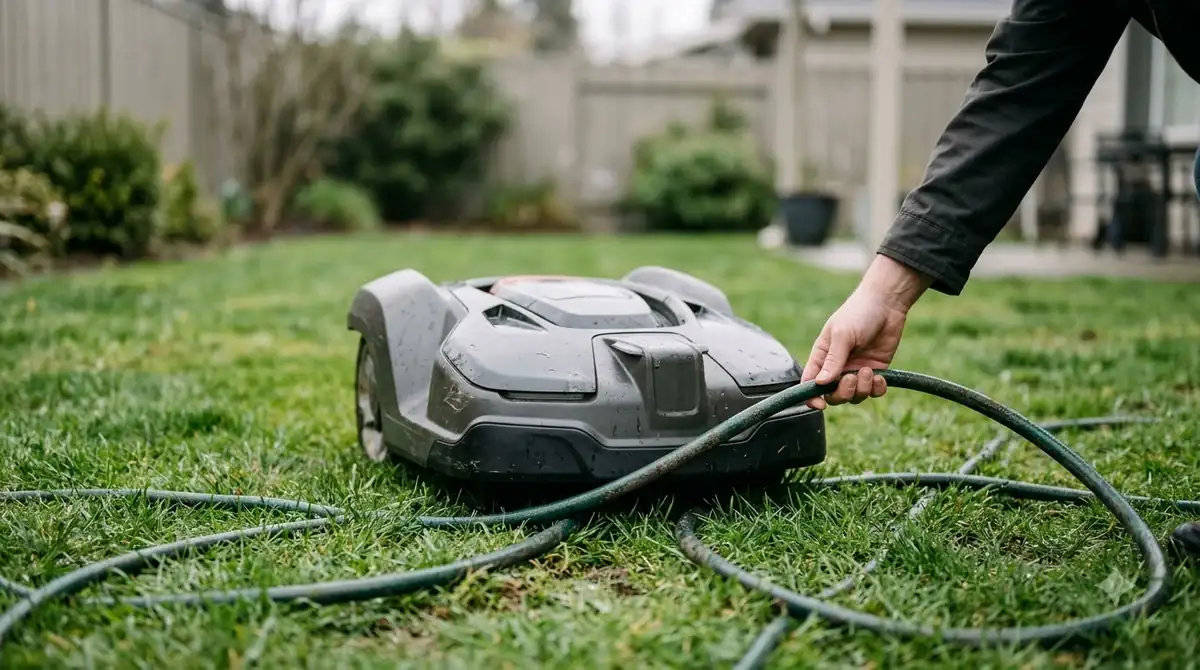
- Find the post’s base. Measure the diameter at ground level, since that is the part the blade reaches.
- Set the loop. Leave room for the island wire. Worx’s island guidance uses 26 cm of clearance between the wire and the object.
- Keep the wires apart. Island wires must not cross. If they do, the mower will not recognize the island and will stop.
- Close the return path. Lay the two return wires close together so their signals cancel.
- Test near the curb. Watch one full pass near the post and confirm the mower turns before the island.
When a stay-out zone is enough
A stay-out zone is useful when the post sits well inside the lawn and the mower never needs to pass close to it. Husqvarna’s EPOS page recommends zones around trees, roots and stones, with a minimum size of 30 x 30 cm, and says the mower will not pass through a zone. For a post that is already fenced or set in a border, a zone is a quick option. Small obstacles can also be covered with a stay-out zone, as pedestal and cap no-go zones show. A stay-out zone is often enough for fixed posts, and a stay-out zone around a sunken patio applies the same idea to a drop in the lawn.
A zone is not a physical barrier. Husqvarna’s AIM guidance says a virtual zone does not replace a physical fence, and where a hazard such as a street or a pool is nearby, a barrier of at least 15 cm, or 6 inches, is recommended. A mailbox post by a road is a reason to add that barrier.
What to check before you buy
- Edge behavior: ask how the model handles the boundary wire near a fixed post.
- Island support: confirm that islands can be set up and how many the app allows.
- Zone size: check the minimum zone size, since a narrow post needs a small but clear zone.
- Trimming plan: set a schedule to trim grass around the post’s base.
The right model is the one whose installation method fits how close the post sits to the boundary. Read the fixed-object section of the manual before you install the wire.
Related reads: A much thicker upright is covered in tree trunks as obstacles, which explains how sensors detect and avoid large trunks.
Frequently asked questions
Can a robot mower see a thin mailbox post?
Not reliably. Navimow notes that ultrasonic sensing struggles with thin or soft objects, so a post can be missed. A wire island is the safer option.
How close can the boundary wire run to a post?
Husqvarna switches avoidance off within 90 cm of a boundary wire. Keep the post well away from the edge wire, or put it inside a wire island.
Is a virtual zone enough to protect a post by the road?
Not on its own. Husqvarna says a virtual zone does not replace a physical fence, and it recommends a barrier of at least 15 cm where a street or pool is nearby.
Does grass around the post matter?
Yes. Husqvarna warns that objects hidden in high grass may be missed or may trap the mower. Keep a trimmed ring around the base.
Sources
- Husqvarna object avoidance with radar or ultrasonic sensors (KA-70110) (manufacturer): flat or low objects may be missed; avoidance switched off within 60 cm and 90 cm of boundaries.
- Husqvarna boundary wire islands (KA-01427) (manufacturer): islands for obstacles that cannot take a bump; wires must not cross.
- Husqvarna AIM stay-out zones (KA-01699) (manufacturer): a virtual zone is not a physical barrier; 15 cm barrier near pools and streets.
- Navimow: how robot lawn mowers avoid hazards (manufacturer blog): ultrasonic detection struggles with soft or thin objects.
 Up next6 min readBy YardRobot Mower for a Lawn With a Hammock and PostsUpdated Nov 14, 2026
 8 min readBy YardHow Does a Robot Mower Handle a Lawn with Lamp Posts?Updated Nov 12, 2026
 6 min readBy YardRobot Mower for a Lawn with Voles: Signs, Limits, ControlUpdated Nov 13, 2026
 6 min readBy YardRobot Mower for a Lawn With Utility BoxesUpdated Nov 13, 2026
 6 min readBy YardRobot Mower for a Lawn with a Putting Green: Fence It OffUpdated Nov 13, 2026
 6 min readBy YardRobot Mower for a Lawn With a FlagpoleUpdated Nov 13, 2026