
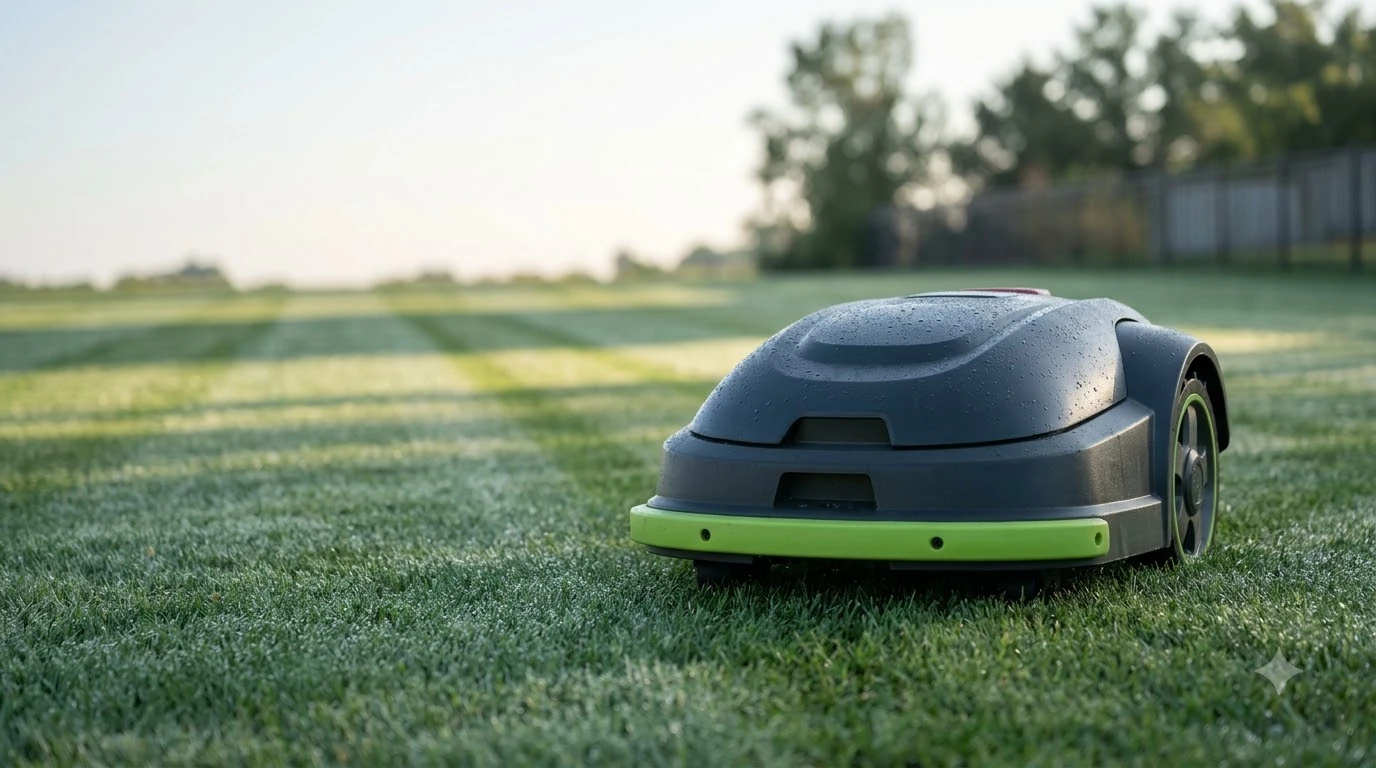

In robot mower vs gas push mower emissions, the robot mower produces no exhaust at the mower, while a gas push mower burns gasoline and releases carbon monoxide, hydrocarbons, and nitrogen oxides right where people stand. A 2005 University of Florida life-cycle study found gas mowers emit far more smog-forming pollution during use. The robot mower’s total footprint still depends on how its battery was made and what powers your home.
The short answer
- Exhaust at the mower: a robot mower has none, while a gas push mower emits during every cut.
- Smog-forming pollution: the Florida study estimated gas mowers emit far more of these during use than electric mowers.
- Battery production: the same study found battery mowers caused more airborne lead over their life cycle, mostly from mining and manufacturing.
- Power source: electric mowers are only as clean as the electricity that charges them.
- Dated evidence: the main study is from 2005 and used a small sample, so treat the exact multiples as rough.
What a gas push mower puts into the air
A gas push mower burns gasoline in a small engine, and that combustion releases several pollutants. The Florida study named carbon monoxide, hydrocarbons, nitrogen oxides, and carbon dioxide as the main emissions from gas mowers. The U.S. Environmental Protection Agency lists about 8,887 grams of carbon dioxide for each gallon of gasoline burned. Emissions are one side of the choice, and long-term cost of robot against gas mowing is the other.
Those emissions come out at the height of a person’s breathing zone. That matters most for children and anyone who spends a long time near the mower.
What the 2005 Florida study found
The University of Florida study compared gasoline, cordless battery, and corded mowers over their full life cycle, from raw-material mining through use and disposal. For smog-forming emissions during use, the study estimated that gas mowers emit as much as 1,500 times more carbon monoxide, 31 times more hydrocarbons and nitrogen oxides, and 18 times more carbon dioxide than electric mowers.
The study also found that corded mowers were the least polluting, with emissions limited to those from the power plant that supplied them. Nationally, the researchers estimated gas mowers could produce as much as one-tenth of smog-forming pollutants from all mobile sources.
Heads up
This is an older study with a small sample: 10 gas mowers, one battery mower, and one corded mower. The exact multiples depend on assumptions about lawn size, mowing frequency, and mower lifespan, so use them as a sense of scale rather than a precise figure.

Where the battery mower’s emissions come from
A battery mower has no exhaust, but its battery has a life-cycle cost. The Florida researchers found battery mowers caused more airborne lead emissions over their life cycle, mainly from mining and battery manufacturing. They concluded that this implies a greater health risk from battery mowers than from gas mowers when measured that way. Battery power changes the emissions picture, so see battery push mower trade-offs against a robot.
The researchers also pointed out a difference in where the exposure happens. Lead from battery mowers is released during manufacturing, away from people, while gas mower emissions occur near the user. The study noted that improper battery disposal could let lead leak from landfills, so recycling matters.
What the electricity behind your mower means
An electric mower is only as clean as the power that charges it. The U.S. Energy Information Administration reports that average U.S. grid electricity produced about 0.81 pounds of carbon dioxide per kilowatt-hour in 2023. That average hides a wide range, since coal produces far more CO2 per kilowatt-hour than natural gas. The grid mix affects both types, as robot mowers compared with electric lawn mowers shows. Corded machines draw power directly, which is covered in corded electric mowers against robot units.
The Florida researchers reached a similar caveat. They noted that coal-fired power plants are significant polluters, so an electric mower is not emissions-free. Where your grid leans on cleaner sources, the gap with a gas mower widens; where it leans on coal, the gap narrows.
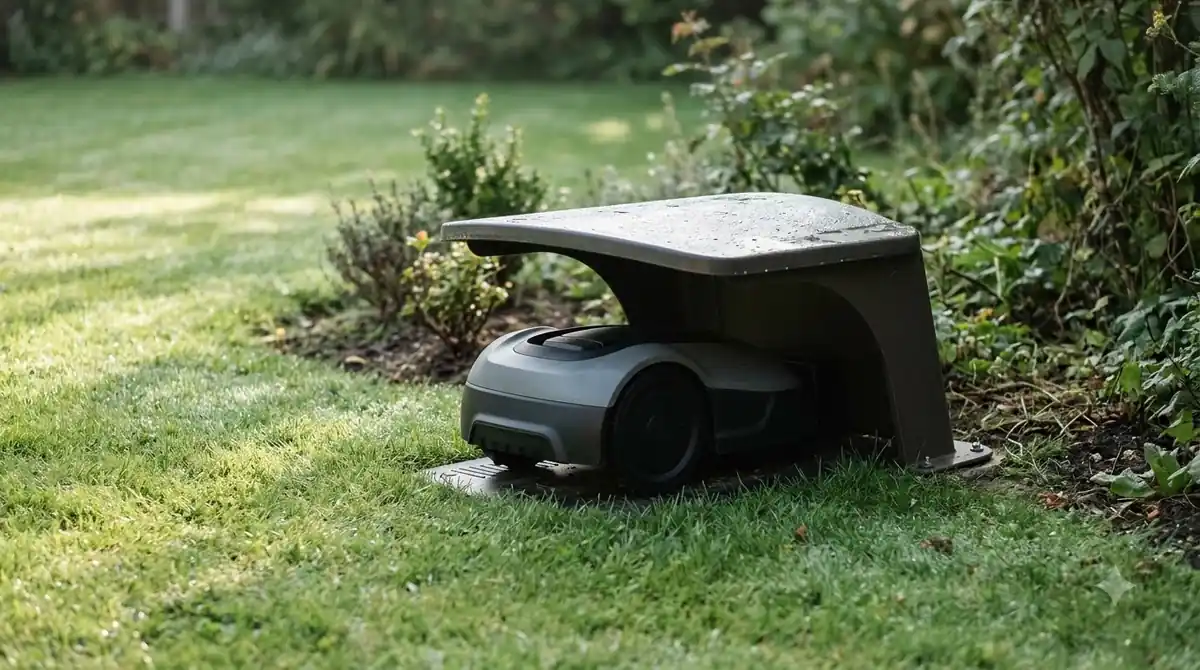
Robot mower vs gas push mower emissions: how they compare
Most of the emissions difference comes from the engine itself. A robot mower and a corded electric mower both avoid the exhaust problem at the point of use. The robot mower also adds a battery, whose manufacture and disposal the Florida study counts as part of the footprint.
| Factor | Gas push mower | Robot mower (battery) |
|---|---|---|
| Exhaust during use | Yes: CO, hydrocarbons, NOx, CO2 | None at the mower |
| Carbon from fuel or power | About 8,887 g CO2 per gallon burned (EPA) | Depends on the grid mix (about 0.81 lb CO2 per kWh average, EIA, 2023) |
| Battery or lifecycle lead | Not applicable | More airborne lead over life cycle, per the 2005 study |
| Noise and near-user exposure | Emissions and noise near the user | Quieter; no exhaust near the user |
Our reading is that a robot mower usually produces less pollution in day-to-day use than a gas push mower. Whether the total footprint is lower depends on your electricity source, battery life, and how much you mow.

When a gas push mower still makes sense
A gas push mower can still suit a large lawn that a robot mower cannot cover, or a yard with rough or steep ground that a robot mower handles poorly. It is also the easier option when you need a machine for other jobs. In those cases, keeping the engine well maintained and avoiding unnecessary idling reduces the impact. A larger lawn may need a rider, so see riding mower costs over five years against a robot.
When a robot mower is the better choice
A robot mower suits a yard with a reasonably level, defined lawn, where frequent short cuts can keep the grass neat. It removes exhaust from the mowing routine entirely, and it is quieter than a gas mower. Before buying, check the mower’s cutting range, battery life, and what the local grid mix looks like.
Related reads: A commercial-style option is covered in zero turn mowers against robot mowers for large properties.
Frequently asked questions
Does a gas push mower produce more pollution than a robot mower?
In day-to-day use, yes. A 2005 University of Florida study found gas mowers emit far more smog-forming pollution during use than electric mowers. A robot mower has no exhaust at the mower, although its battery and electricity still have an environmental cost.
How much carbon dioxide does a gallon of gasoline produce?
The U.S. Environmental Protection Agency puts it at about 8,887 grams of carbon dioxide for each gallon of gasoline burned. The exact amount for your mower depends on how much fuel it uses in a season.
Is a robot mower always cleaner than a gas mower?
Not always. Its footprint follows the local power mix, and coal-heavy electricity narrows the gap. The Florida study also found battery mowers caused more airborne lead over their life cycle, so the battery’s manufacture and disposal count too.
Why does the electricity source matter for a robot mower?
The Energy Information Administration reports that U.S. grid electricity averaged about 0.81 pounds of carbon dioxide per kilowatt-hour in 2023, and that the amount varies with the fuel used. A robot mower’s footprint is lower where the grid is cleaner.
Sources
- Engineers: in big picture, gas, cordless mowers equal polluters (University of Florida, 2005): life-cycle comparison of gas, battery, and corded mowers, pollutants, lead, caveats.
- Greenhouse Gas Emissions from a Typical Passenger Vehicle (U.S. EPA): about 8,887 grams of CO2 per gallon of gasoline.
- How much carbon dioxide is produced per kilowatthour of U.S. electricity generation? (U.S. EIA): about 0.81 lb CO2 per kWh in 2023, and variation by fuel.
 Up next8 min readReviews & CompareRobot Mower vs Gas Mower: Long-Term Cost ComparedUpdated Nov 11, 2026
 8 min readReviews & CompareRobot Mower vs Battery Push Mower: Cost, Time and Lawn SizeUpdated Nov 17, 2026
 7 min readReviews & CompareRobot Mower vs Push Reel Mower: Which Fits Your LawnUpdated Nov 17, 2026
 6 min readReviews & CompareIs the Hookii Neomow X SE Worth It? What Reviews ShowUpdated Nov 17, 2026
 8 min readReviews & CompareHusqvarna Automower 410iQ Problems and Complaints: What Published Sources ShowUpdated Nov 16, 2026
 8 min readReviews & CompareHusqvarna Automower 410iQ Review: What the Published Specs ShowUpdated Nov 16, 2026