


For a flat lawn of roughly a third of an acre or less, a battery push mower is the cheaper way to cut grass, while a robot mower is the better choice if you want the lawn trimmed without standing behind a machine. Both are battery-powered, quieter than a petrol mower, and low in running cost. The real difference in a robot mower vs battery push mower comparison is labour: one still needs you to walk the lawn, and the other does not.
The short answer
- Upfront cost: a battery push mower is usually the cheaper purchase. A robot mower costs noticeably more, with the range depending on navigation type and features.
- Time: a robot mower wins clearly. It runs on a schedule, while a battery push mower needs you for every session.
- Lot size and slope: a battery push mower suits small, level lots. A robot handles larger and sloped yards when the model’s limits allow.
- Long-term running cost: both are cheap to run. The robot adds blade and battery replacement that a push mower also needs, so the gap is smaller than the price gap suggests.
Robot mower vs battery push mower: what each one does
A battery push mower is a familiar machine with a cordless motor. You push it across the lawn, set the cutting height, and empty or mulch the clippings as you go. A battery self-propelled model adds a drive that pulls the mower forward, but you still steer it and decide when to mow. The robot mower is a different tool for the same job. It leaves its charging dock on its own, follows a boundary, cuts in repeated short sessions, and returns to charge when the battery runs low. Another power source worth considering is plug-in electric mowers versus robots for small lawns.
That difference matters more than the motor. A battery push mower gives you direct control over the cut, which helps when you want a neat stripe for a special occasion or need to trim around a bed by hand. A robot gives you back the hour you would have spent mowing, but it cuts the grass in a pattern you did not choose.

Upfront cost and the five-year picture
The purchase price is where the battery push mower is easiest to justify. Published ranges for battery push and self-propelled models sit well below robot prices, and budget robots start at a level that many people still find high. Prices change often, so check the current listing before deciding. Larger yards change the five-year math, as robot against riding mower cost shows.
Over several years, the gap narrows. Vendor guides disagree on the totals, and most of them are written by sellers of one type of machine, so treat any single five-year figure with caution. The sensible way to compare is to add the purchase price, the electricity, the blade replacements, and one battery replacement over the period you plan to keep the mower. A battery push mower’s battery is usually replaced after three to five years of regular use. A robot’s battery tends to last a similar span, and its blades need changing more often.
Heads up
Battery replacement packs are the largest recurring cost for either type. Check whether the battery is a standard pack you can buy later, because a proprietary pack can cost more and be harder to source in a few years.
Time and daily effort
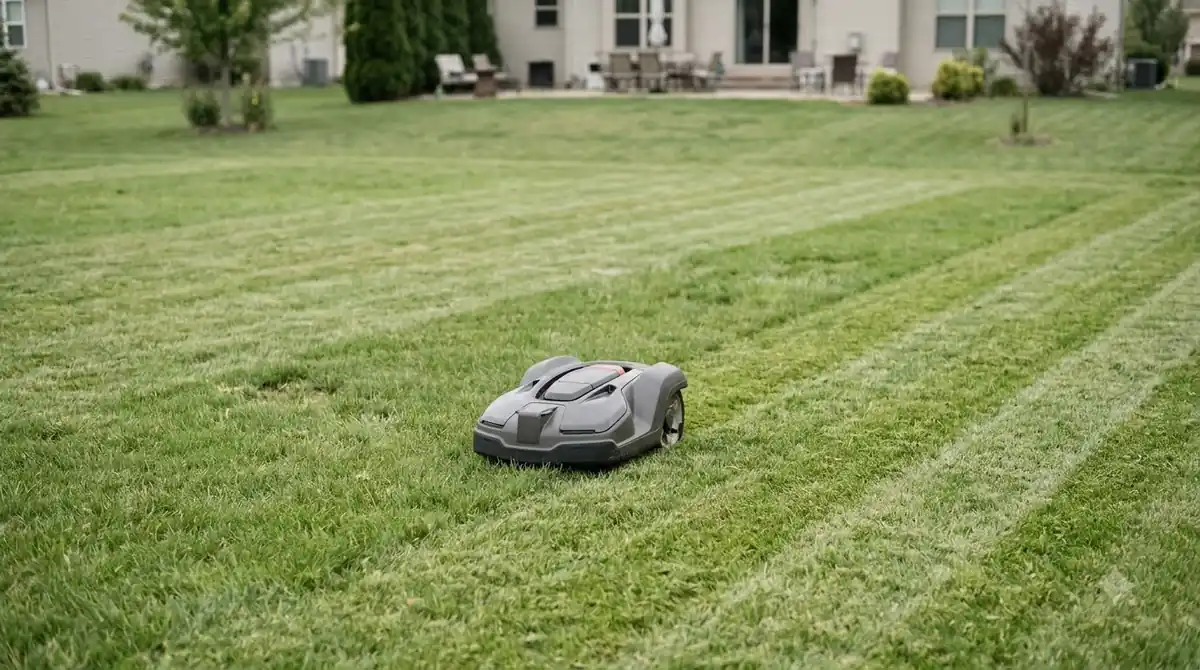
The clearest advantage of a robot mower is that it works while you are at work, asleep, or away. A battery push mower takes a set session each time: you pull the mower out, mow, clean the deck, and put it back. Even a quick session adds up over a season. Vendor estimates put a manual mowing routine at around 60 hours a year for a typical homeowner, although that figure depends heavily on lawn size and how often you mow. A robot can cut much of that time back, but only after the initial boundary setup and the occasional check. Time and daily effort also depend on whether the mower drives itself, as self-propelled mowers and physical effort shows.
Battery push mowers still have a place for people who enjoy the job or who want to mow on their own schedule. It is also simpler to get started: there is no boundary wire to lay, no dock to position, and no app to pair.
Lawn size, slope, and grass conditions
A battery push mower is at its best on small, flat, evenly kept lawns. Battery runtime is the constraint. One vendor’s figures put the practical limit at about a third of an acre, with gas ahead on larger lots. Real coverage on hills or in thick spring grass can fall well below the rated figure, so leave margin when you compare the numbers.
Robots handle bigger areas and slopes better, but only inside the limits of each model. Mid-range models commonly list a maximum slope in degrees or percent, and premium models go further. The key is to measure the steepest part of your yard and check it against the stated figure, not against the best-case number on the box.
Noise, maintenance, and everyday care
Both machines are much quieter than a petrol mower, which is one of the main reasons people switch. Vendor guides put battery push mowers at roughly 65 to 75 decibels and robots at around 60 decibels. These are seller figures, so use them as a rough guide rather than a lab result. Our reading is that the two are close enough that noise rarely decides the choice. Noise and upkeep also differ for corded machines, as corded mowers compared with robot mowers explains. Everyday care costs depend on how dependable the machine is, which a reliability ranking of robot mower brands helps you judge. Maintenance expectations are worth setting early, so review common Husqvarna Automower 410iq complaints before choosing.
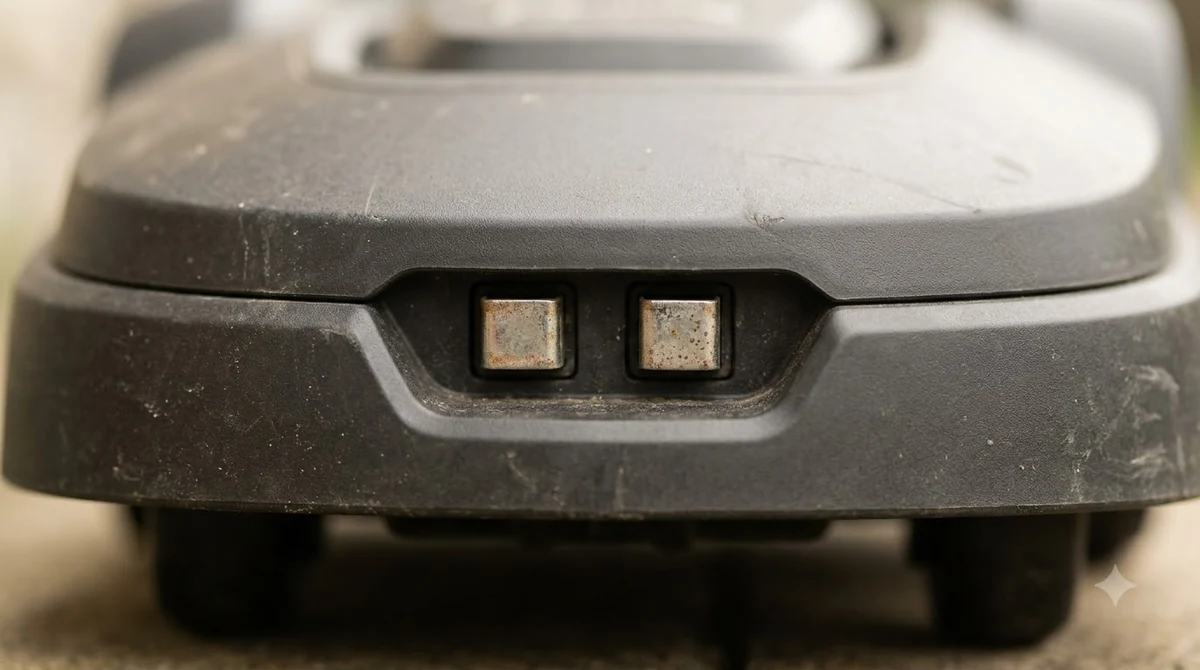
Upkeep is similar too. Both need the deck cleaned after cutting, the blades checked and replaced, and the batteries stored properly over winter. A robot also needs its sensors, charging contacts, and boundary checked. A push mower needs you to empty or manage the clippings, which a robot never has to do. If you are not comfortable with simple mechanical checks, a robot adds a little more to learn, while a push mower is easier to understand at a glance.
Who should pick which
Pick a battery push mower if the lawn is small and flat, if you enjoy mowing, and if the purchase price matters more than hands-off time. It is also a good choice for a first machine, because it is simple and easy to test before you commit to anything more complex.
Pick a robot mower if the lawn is larger or sloped, if your weekly schedule is full, or if you want the grass kept short without a fixed mowing day. Expect a higher upfront cost and a setup step, and accept that you will still do some checking and cleaning.
What to check before you buy
- Lot size and slope: measure the area and the steepest slope, then compare both with the stated limits for each type.
- Battery platform: check whether the battery is shared with other tools and whether replacement packs are easy to buy.
- Setup effort: a push mower is ready at once. A robot needs boundary and dock placement before its first cut.
- Service and parts: confirm that blades, batteries, and repair options exist where you live.
Frequently asked questions
Is a robot mower cheaper than a battery push mower?
Not at purchase. A robot mower costs more up front. Over several years the gap narrows, because a battery push mower still needs battery replacements and your time.
Can a battery push mower handle a large lawn?
It can, but runtime becomes the limit. Vendor guidance suggests battery push mowers suit smaller, flat lots, and larger yards are better served by gas or a robot.
Does a robot mower need less maintenance than a battery push mower?
It needs different maintenance. A push mower requires you to manage clippings and mow. A robot adds sensor, dock, and boundary checks, but it removes the mowing session itself.
How long do mower batteries last?
Vendor guides commonly estimate three to five years of regular use before capacity drops noticeably. Heat, deep discharge, and winter storage all shorten that span, so store the battery partly charged and cool.
Sources
- Dreame, gas vs battery lawn mower (robot mower maker): used for battery push price ranges, noise ranges, battery replacement interval and cost, and the lot-size guidance. Note it is a vendor article.
- TerraMow, is a robotic lawn mower worth it (robot mower maker): used for robot price tiers, labour hours of manual mowing, and robot blade and battery replacement figures. Note it is a vendor article.
 Up next6 min readReviews & CompareRobot Mower Battery Size Comparison: Capacity, Runtime and ChargeUpdated Nov 17, 2026
 7 min readReviews & CompareRobot Mower vs Push Reel Mower: Which Fits Your LawnUpdated Nov 17, 2026
 6 min readReviews & CompareRobot Mower vs String Trimmer Edging TimeUpdated Nov 18, 2026
 7 min readReviews & CompareRobot Mower vs Gas Push Mower Emissions: What the Data ShowsUpdated Nov 18, 2026
 7 min readReviews & CompareBoundary Wire vs RTK Installation Time: What the Guides SayUpdated Nov 11, 2026
 7 min readReviews & CompareLithium vs Lead Acid Robot Mower Battery: Which Lasts LongerUpdated Nov 17, 2026