
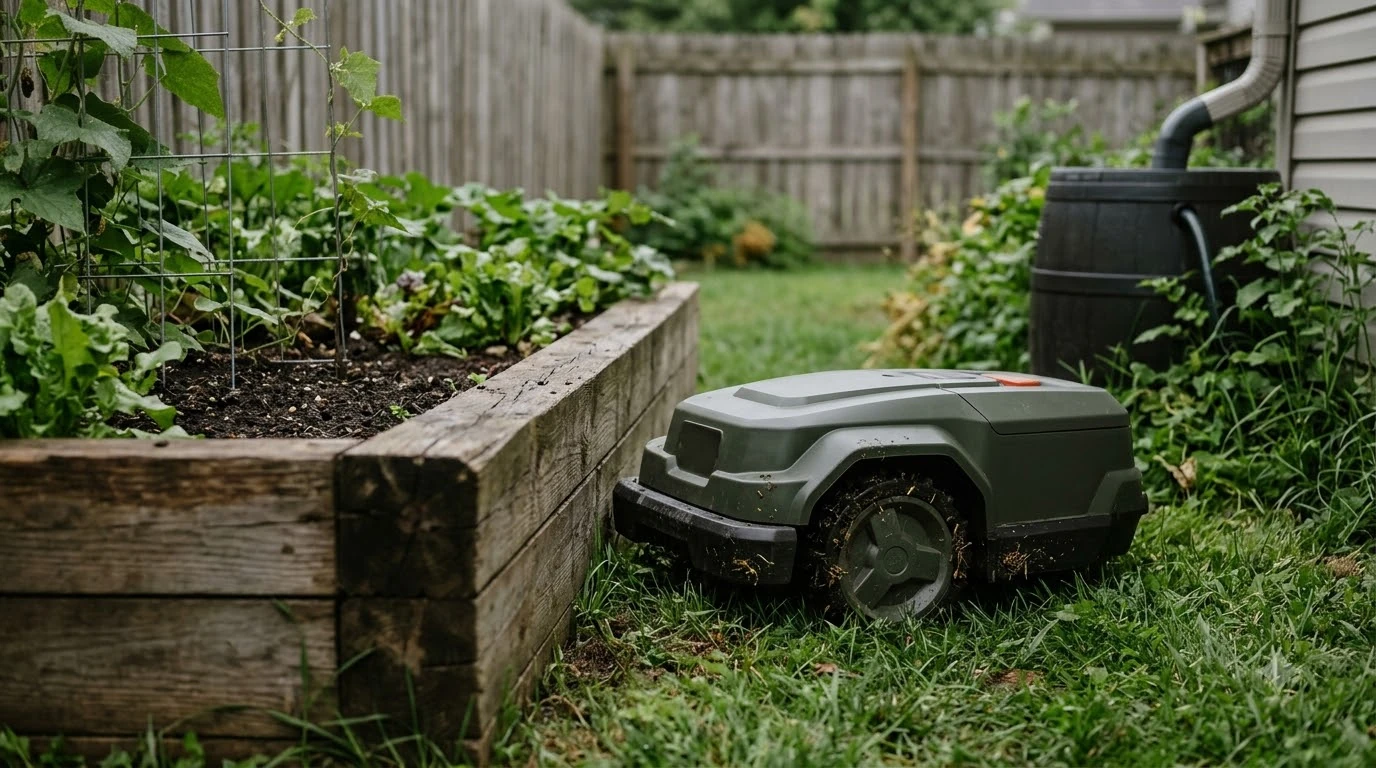

A robot mower for a lawn with a greenhouse needs a boundary that keeps the mower away from the frame, the door threshold, and the vents, with a wider margin on any soft ground beside the beds. A greenhouse is a fixed structure with glass or plastic panels, a base that may sit on a concrete or timber footing, and hoses, vents, and benches around it. Each of these can be damaged by a mower that brushes against it. This guide explains how to plan the layout, which clearances installation guides describe, and how to keep the lawn and the greenhouse working together.
The short answer
- Structure: keep the wire at least 30 cm from the greenhouse walls, which is the figure the setup guides give for fixed walls and fences.
- Hard edges: where a path or concrete base sits flush with the lawn, keep the wire about 10 cm inside the lawn edge.
- Beds and soft edges: keep the wire about 25 to 30 cm from beds, mulch, and gravel beside the greenhouse.
- Door and vents: leave a clear path to the door and check vents and hoses before each run.
Why a robot mower for a lawn with a greenhouse needs its own plan
A greenhouse is not a simple wall. It has a base that may sit above the lawn, a door with a threshold, vents that open outward, and external pipes and hoses. A robot mower for a lawn with a greenhouse has to avoid the frame, while also leaving room for people and equipment to get in and out. Those needs are different from a fence line, so the boundary should be drawn with the greenhouse’s full footprint in mind. A greenhouse is a garden outbuilding, so the mower guidance for garden shed yards covers related setup choices.
Robot mowers navigate with a boundary wire, a virtual map, or a camera and GPS system. A wire keeps the mower inside the fence it defines, and a map does the same with a drawn zone. Neither method replaces a sensible margin around a fixed structure, so the layout does that job.
Setting the wire along the greenhouse walls
The lawnmowers.com setup guide suggests keeping the wire at least 30 cm from walls, fences, and tree trunks. A greenhouse wall is a solid, fixed edge, so it falls in the same group. Robomow’s installation guide gives a similar figure of about 35 cm for walls and tall stones, and that makes 30 to 35 cm a reasonable target for the side of the greenhouse that faces the lawn. Another fixed structure takes a similar wire plan, as gazebo footing wire spacing shows. Wire along a building edge is similar to wire along a patio, as covered in mowing a lawn with a sunken patio.
Where the greenhouse base is level with a concrete path or patio, a closer margin is possible. Robomow describes about 10 cm from slabs and paths at or below lawn level, and Anker uses a similar figure where a patio sits level with the lawn. Use that tighter spacing only where the base is genuinely flush, not where a raised base or a step sits beside the mower’s path.
Heads up
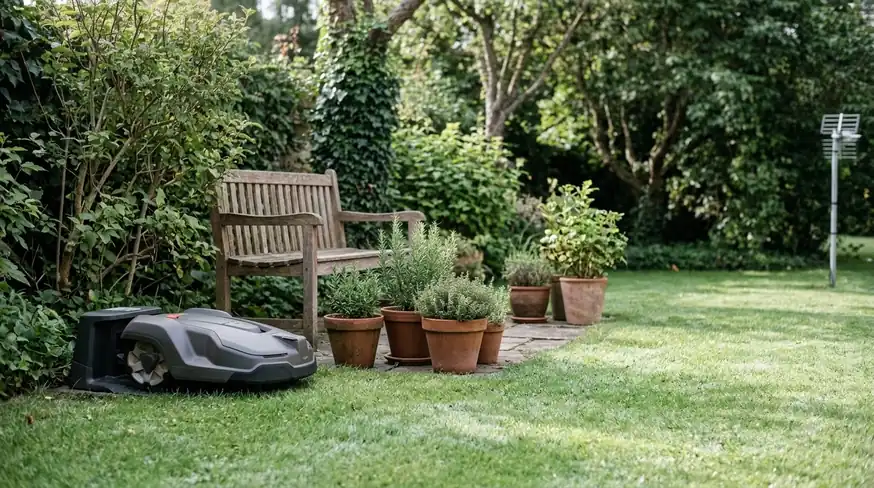
Do not let the boundary run through the gap between the base and the lawn. A mower that squeezes into that gap can strike the frame or lift a corner panel, so keep the wire on the outside of the gap.
Keeping the door, threshold, and vents clear
The door is the part of a greenhouse that gets used most, and the grass in front of it is often trampled or worn. Keep a clear path to the door in the layout, so the mower does not turn near the threshold. If the greenhouse has a ramp or a step, treat the step as a fixed edge and keep the wire outside it.
Vents and louvres can open into the lawn, and a vent that is left open at the wrong angle can catch a mower’s housing. Check every vent before a scheduled run, and close any that are open over the lawn. A short inspection takes less time than a repair.
- Door threshold: keep the mowing path clear of the step and leave room for people to stand.
- Open vents: close or move them before a run, so nothing sticks out over the grass.
- Hoses and cables: lift garden hoses and power cables off the lawn and out of the path.
Beds, soft edges, and the planting around the frame
Many greenhouses sit beside raised beds, mulch, or gravel. Soft surfaces need more room because a mower can slip or push loose material into the blades. The lawnmowers.com guide suggests 25 to 30 cm from soft edges such as beds, gravel, and mulch, and that figure is a good starting point. Planted beds around the frame need clear edges, and the flower bed edge picks compare ways to keep the mower out.
Raised beds are a special case. A raised edge can be taller than the mower’s deck can clear, so the wire should be laid well away from the bed rather than along its side. Our reading is that a 30 cm margin is a sensible minimum for any bed that rises above the lawn.
Shade, light, and the grass around the frame
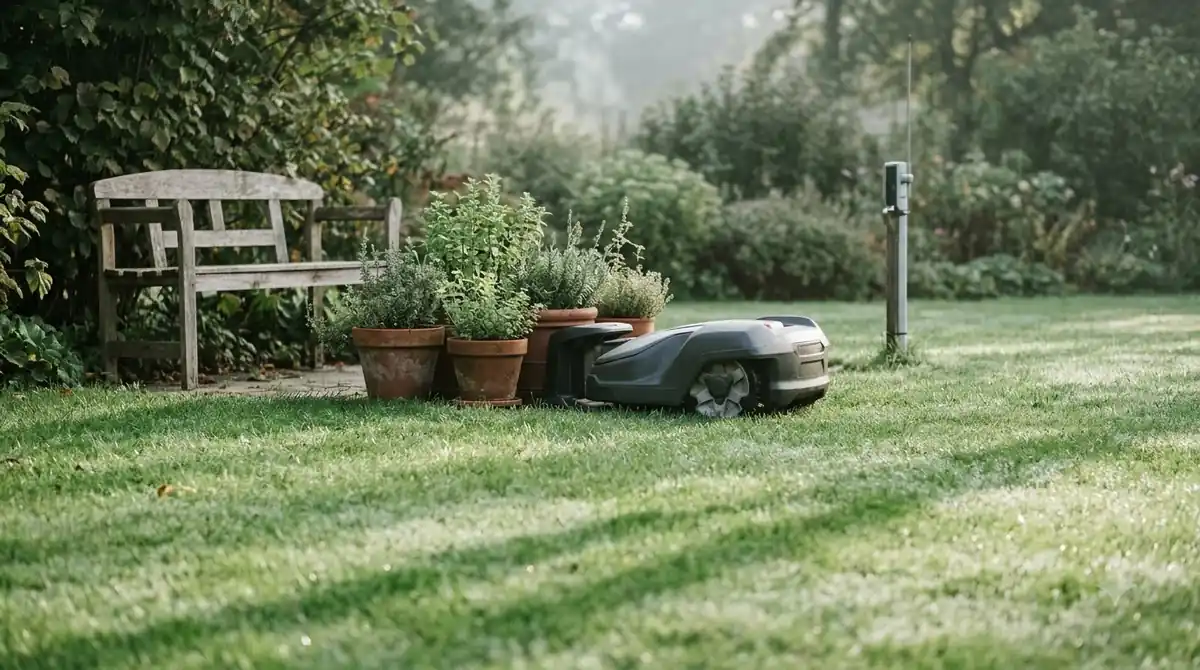
A greenhouse casts shade on the lawn beside it, and the grass in shade grows more slowly and thins over time. A robot mower that runs on the same schedule across the whole yard can leave the shaded strip looking worn. Keep the mowing height a notch higher in that zone, and reduce the number of runs there if the grass looks thin. Shade from a frame changes how the grass grows, and mowing under solar panels raises a similar shade and clearance question.
Shade also changes how the ground dries. The strip beside a greenhouse can stay damp after rain, which makes wheels slip. Skip that zone during wet weather and check it after the ground dries.
Seasonal checks for a yard with a greenhouse
A greenhouse changes with the season: vents open and close, plants move in and out, and the door sees more traffic in spring and summer. In spring, check the wire and pegs near the base after the grass has grown, and clear any cuttings from the vents. In summer, check the vents and hoses weekly, and keep the path to the door clear. In autumn, look for leaves and debris on the wire, and recheck the boundary once the grass slows down.
Winter is a good time to inspect the wire near the greenhouse base. Frost can lift pegs, and a loose wire beside a hard edge can fail without warning.
What to check before you set up or buy
Before you install a robot mower for a lawn with a greenhouse, sketch the yard and mark the base, the door, the vents, and the beds around the frame. Then match that layout to the mower’s setup method. A wire model needs a clear buffer at the walls and beds, while a map-based model needs a stay-out zone drawn around the full footprint. Check the mower’s lowest cutting height and the lawn’s slope, and confirm that the door and path stay open after the boundary is set.
Related reads: The shade near a greenhouse is covered in more detail in the shaded lawn picks.
Frequently asked questions
How far should the wire stay from a greenhouse wall?
The setup guides we read suggest at least 30 cm from fixed walls and fences, and about 35 cm in one installation guide. Check your mower’s manual for the exact spacing.
Can the mower cut right up to a greenhouse base?
Only where the base sits flush with a concrete path or lawn edge, where a tighter margin of about 10 cm is described. Keep a wider margin wherever the base is raised.
Should I close the vents before a mowing run?
Yes. Check that no vent or louvre sticks out over the lawn, because it can catch the mower’s housing or be damaged by it.
Why is the grass beside the greenhouse thinner?
Shade from the structure slows growth, and the strip can stay damp. A slightly higher cutting height and fewer runs in that zone can help the grass recover.
Sources
- lawnmowers.com boundary wire setup guide (retailer guide): clearance from walls and fences, and soft-edge spacing.
- Robomow boundary wire guide (manufacturer): spacing from walls, beds, and slabs at lawn level.
- Anker perimeter wire guide (manufacturer): distances from walls and raised beds.
 Up next7 min readBy YardRobot Mower for a Lawn With a Sundial or StatueUpdated Nov 13, 2026
 7 min readBy YardRobot Mower for a Lawn with a GazeboUpdated Nov 13, 2026
 6 min readBy YardRobot Mower for a Lawn with a Soccer Goal: Plan the SpaceUpdated Nov 13, 2026
 6 min readBy YardRobot Mower for a Lawn with a Croquet Court: What to ExpectUpdated Nov 13, 2026
 8 min readBy YardRobot Mower for a Lawn with a Boat TrailerUpdated Nov 13, 2026
 6 min readBy YardRobot Mower for a Lawn With a FlagpoleUpdated Nov 13, 2026