
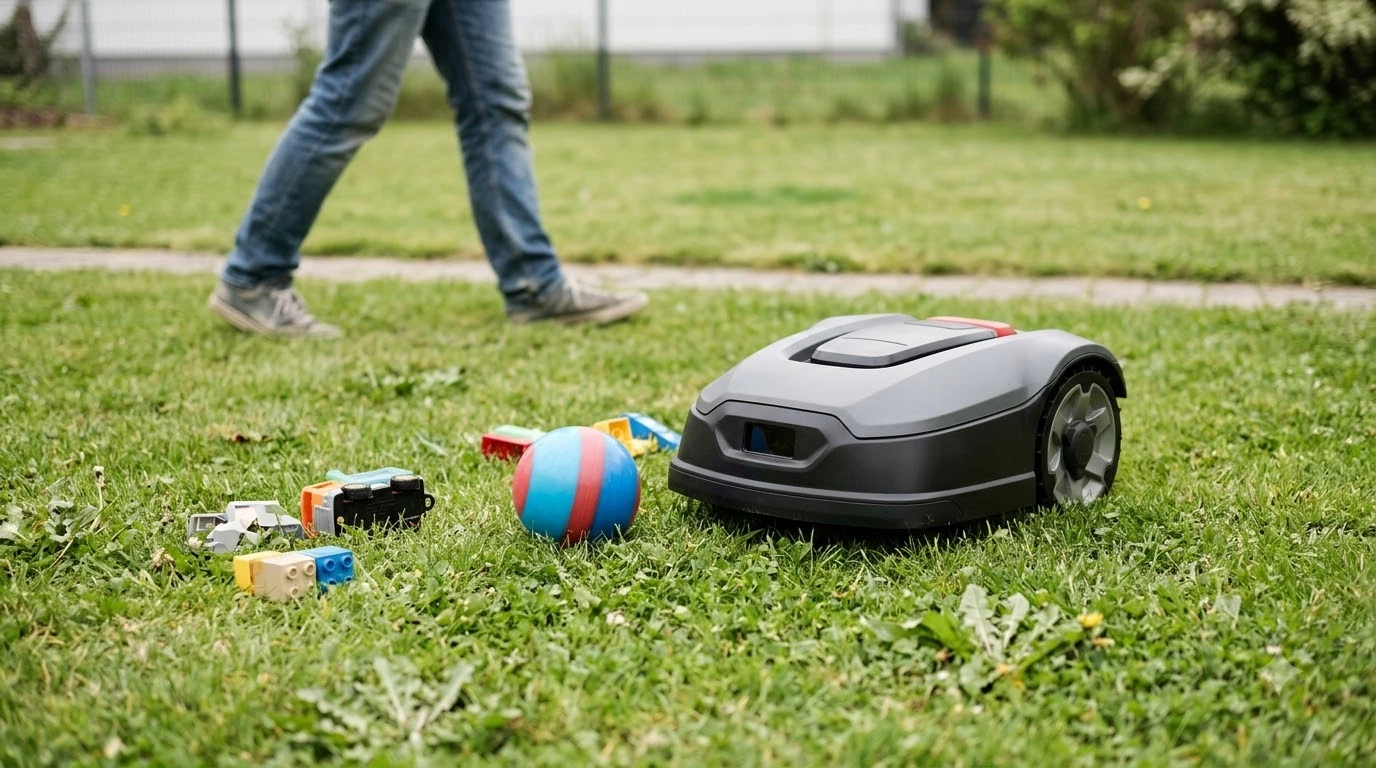

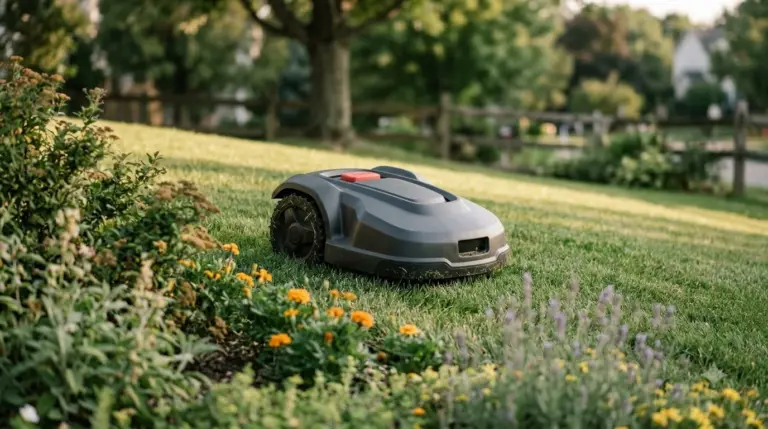
The question “how do vision robot mowers work” has a short answer: they use one or more built-in cameras and onboard image processing to recognize grass, the lawn edge and obstacles in real time. Husqvarna and Mammotion both describe the system this way. What the camera can and cannot do, especially at night and in bad weather, depends on the specific model.
The short answer
- Camera: a camera built into the mower watches the area ahead while it mows.
- Processing: Husqvarna says image processing happens on the mower, and images are not stored, transmitted or shared.
- Night: only models with infrared sensing detect objects in the dark.
- Limits: dirty lenses, rain, fog and low light reduce what the mower can see.
How do vision robot mowers work with a camera?
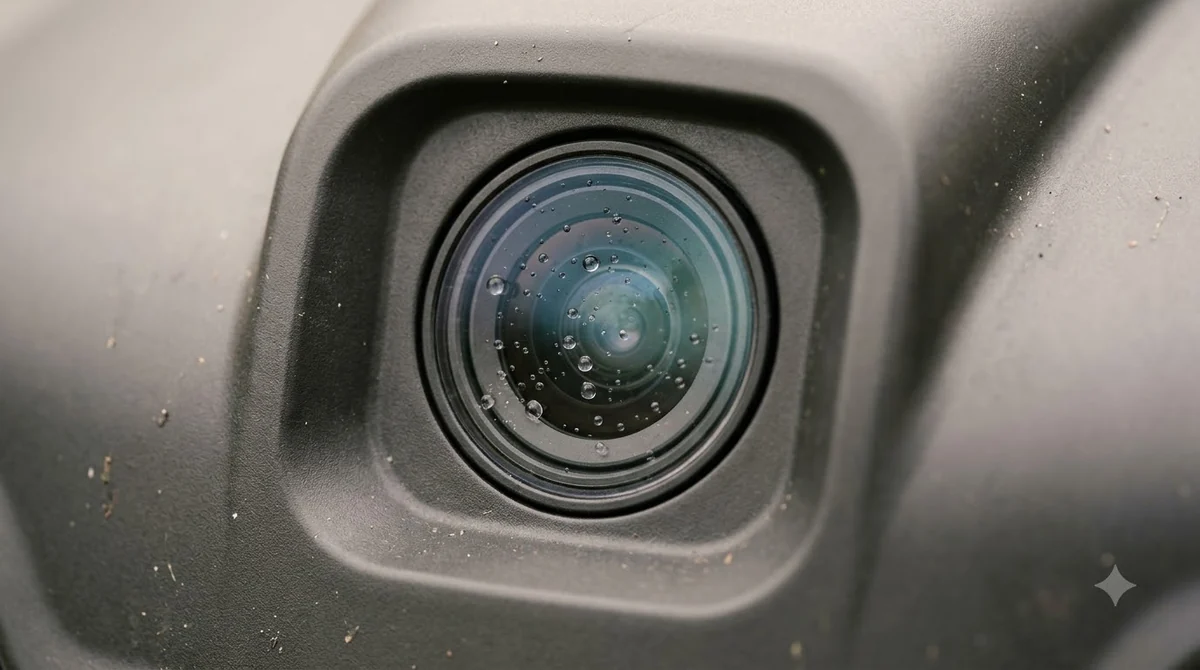
A vision mower carries a camera in its body, and that camera lets it detect objects while it cuts. Husqvarna says the camera detects objects in real time, and the processing runs locally. Images are processed in real time and then discarded, and the company says camera data stays on the mower. For owners who worry about privacy, that is the most useful point in the manufacturer’s own description.
Manufacturers describe the hardware in different ways. Mammotion says its mowers use monocular, stereo or 3D cameras aimed at the area ahead, with onboard “edge AI” so decisions do not need a cloud connection. The same blog says the system tells grass from paths and mulch using color, texture and surface pattern. These are manufacturer claims, and the page gives no accuracy figures for the vision system itself.

How vision mowers classify obstacles
Vision mowers do not treat every object the same way. Husqvarna’s vision models sort what they see into risk groups, and each group changes how far the mower keeps away.
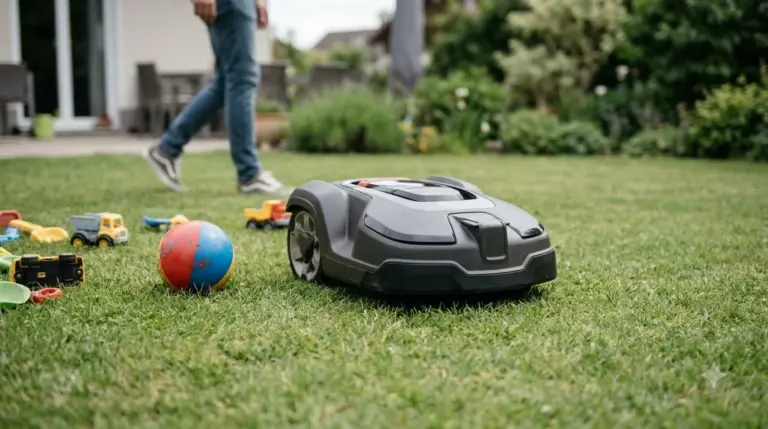
- High-risk: humans, animals and items such as water hoses. The mower keeps a larger safety distance from these.
- Low-risk: toys, garden furniture and flowerpots. The mower gets closer before it turns, which leaves less uncut grass.
The Husqvarna object detection page does not list pets or wildlife as separate categories, so animals fall under the high-risk group. Non-vision models work differently. The Aspire R6V, 308V and 312V keep the same safety distance for every obstacle, and Husqvarna says other Automower models use radar or ultrasonic sensors rather than AI vision.
Our reading is that the risk groups matter most in yards with children or pets. A camera can classify a toy, but the mower still gives it a margin, so clearing play areas before each run is a sensible habit.
Satellite, boundary and hybrid sensing
Vision is rarely the only sensor, and camera-based mapping methods such as VSLAM navigation add to it. Husqvarna’s AI vision support page describes satellite positioning as the primary method, with the camera as a backup when the signal drops. If your yard has weak satellite coverage, our page on a vision robot mower for a yard with poor satellite signal goes further. The company describes this sequence:
- Check for grass. The camera looks for grass. If it sees grass, the mower keeps mowing for a limited distance, though the page does not give that distance.
- Search by rotating. If no grass is detected, the mower rotates to look for it.
- Stop and wait for satellite. If no grass is found in any direction, the mower stops and searches for a satellite signal.
The camera also supports boundary assist. On the 405VE NERA, 410VE NERA, 430V NERA and 450V NERA, the camera detects a physical lawn edge, such as a flower bed, gravel, paving or tarmac, and adjusts the turning point. Husqvarna disables this by default. You can turn it on in Automower Connect under More, then Settings, then Operation.
Mammotion answers “how do vision robot mowers work” with a sensor mix rather than a single camera. Its blog says RTK GPS gives centimeter-level positioning but can struggle near dense tree cover, tall buildings and uneven terrain. LiDAR works regardless of lighting, but it identifies shapes without classifying them. Vision fills in the classification, and some designs combine all three. Because each maker chooses its own combination, compare the sensor set of the model you are considering, and see our RTK vs LiDAR vs vision comparison for the trade-offs.
How do vision robot mowers work at night?
Only some vision models see at night. Husqvarna says the Aspire R6V, 308V and 312V have daytime vision only. If you schedule them to mow at night they still run, but the AI vision features do not work then, and the page warns they “may collide with objects on the lawn.”
| Husqvarna model group | Camera use | Night object detection |
|---|---|---|
| Aspire R6V, 308V, 312V | Daytime vision only | Vision features do not work |
| 405VE, 410VE, 430V, 450V NERA | Day and night, infrared camera | Infrared sensors detect and avoid objects |
Mammotion adds that low light or night operation reduces recognition accuracy without supplemental lighting, and that glare, strong shadows and uneven light can confuse edge and obstacle detection. Neither company publishes a lux threshold, so there is no stated light level where the mower stops. Our reading is that a night schedule should be watched closely during the first few weeks.
Rain, dirty lenses and visibility
A camera can only classify what it can see, so dirt and weather reduce performance. Mammotion notes that rain, fog or snow can obscure visual detail, and that dirty, scratched or obstructed lenses degrade performance. For the question “how do vision robot mowers work” in bad weather, our reading is that a clean lens matters as much as the software.
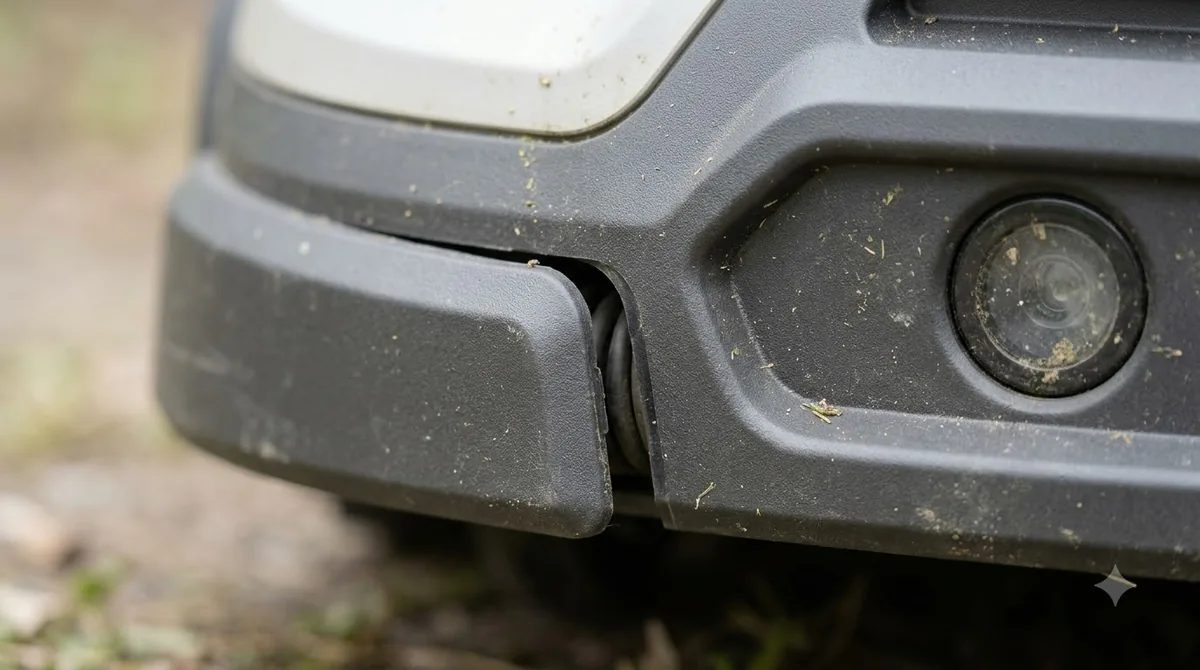
Husqvarna’s NERA models include a camera visibility setting for conditions such as heavy rain or dirt on the lens. The setting can be set to “Keep mowing” or “Pause.” To clean the lens, Husqvarna recommends using water to remove dirt, then wiping gently with a soft cloth. The page does not say how often to clean the lens, and it gives no fog limit. A robot mower camera lens cleaning kit keeps the tools in one place.
Where vision mowers still struggle
Vision systems misread some objects, and Husqvarna lists its own limits. Floating objects, such as benches with raised sections, may be misjudged, and the mower may try to pass under them. Objects hidden in high grass, such as trampoline legs, may snag the mower.
Mammotion lists more cases from the grass side. Drought or browning can reduce the contrast between grass and non-grass, and leaves, mulch or debris can be mistaken for obstacles. New or uneven landscaping may need recalibration. The company also lists fast-moving children or pets, and items that appear suddenly, as harder cases, and says its system is designed to slow or stop rather than take risks.
What to check on a spec sheet
Model differences matter more than the word “vision” on the box. Before buying, check whether the model has infrared night sensing, whether boundary assist is listed, and whether it has the satellite fallback described above. Husqvarna’s pages show these features vary across its range.
- Look for night sensing: infrared on the NERA models, and none for the R6V, 308V and 312V.
- Look for a lens visibility setting that lets you choose Keep mowing or Pause in rain or dirt.
- Check the manual for the protective barrier. Husqvarna gives a minimum barrier height of 15 cm (6 in) near the virtual boundary.
Our reading is that spec sheets rarely give accuracy figures for vision. Ask the seller for the manual and look for the features above rather than general claims about AI. Our list of the best vision AI camera robot lawn mowers applies the same checks to specific models.
Frequently asked questions
Do vision robot mowers need a boundary wire?
The Husqvarna pages cited here do not discuss a boundary wire. They describe the camera for obstacle detection and, on some NERA models, boundary assist at a physical edge. Check the manual for your exact model, because sensor sets vary across each maker’s range.
Do vision robot mowers work at night?
Only models with infrared sensing do. Husqvarna says the 405VE, 410VE, 430V and 450V NERA models use infrared sensors to detect and avoid objects at night. The Aspire R6V, 308V and 312V have daytime vision only, and neither company publishes a light threshold.
How do vision robot mowers work around pets?
They keep a larger safety distance from pets, because Husqvarna places humans and animals in its high-risk group. The page does not list pets separately. Mammotion lists fast-moving pets as a harder case for its system, so keep pets away from the mower while it runs.
Are vision mowers better than LiDAR mowers?
Neither is better in every case. Mammotion says LiDAR works regardless of lighting but identifies shapes without classifying them, while vision classifies objects but depends on light and clean lenses. Our reading is that the best choice depends on your lawn, so compare the sensor set of each model.
Sources
- How Automower AI vision technology works (Husqvarna): camera placement, local image processing, satellite backup, boundary assist, and day and night models.
- Object detection and avoidance with AI vision technology (Husqvarna): high-risk and low-risk classes, the lens visibility setting, cleaning method, and the 15 cm barrier height.
- How AI vision robot lawn mowers work (Mammotion): camera types, sensor combinations, and environmental limits. This is a manufacturer blog, so its claims are self-reported.
 Up next8 min readBest Robot MowersRTK vs LiDAR vs Vision: Which Robot Mower Navigation Fits Your YardUpdated Nov 11, 2026
 8 min readBest Robot MowersHow Do Robot Lawn Mowers Work? Wire, Sensors and Docking ExplainedUpdated Nov 11, 2026
 8 min readBest Robot MowersHow Does RTK Work on a Robot Lawn Mower?Updated Nov 11, 2026
 7 min readBest Robot MowersMulching Robot Mower Explained: How It Works and When It FailsUpdated Nov 11, 2026
 9 min readBest Robot MowersHow Do Multi Zone Robot Mowers Work?Updated Nov 11, 2026
 8 min readBest Robot MowersDo Robot Mowers Work in the Rain? Sensors, Delays and LimitsUpdated Nov 11, 2026