
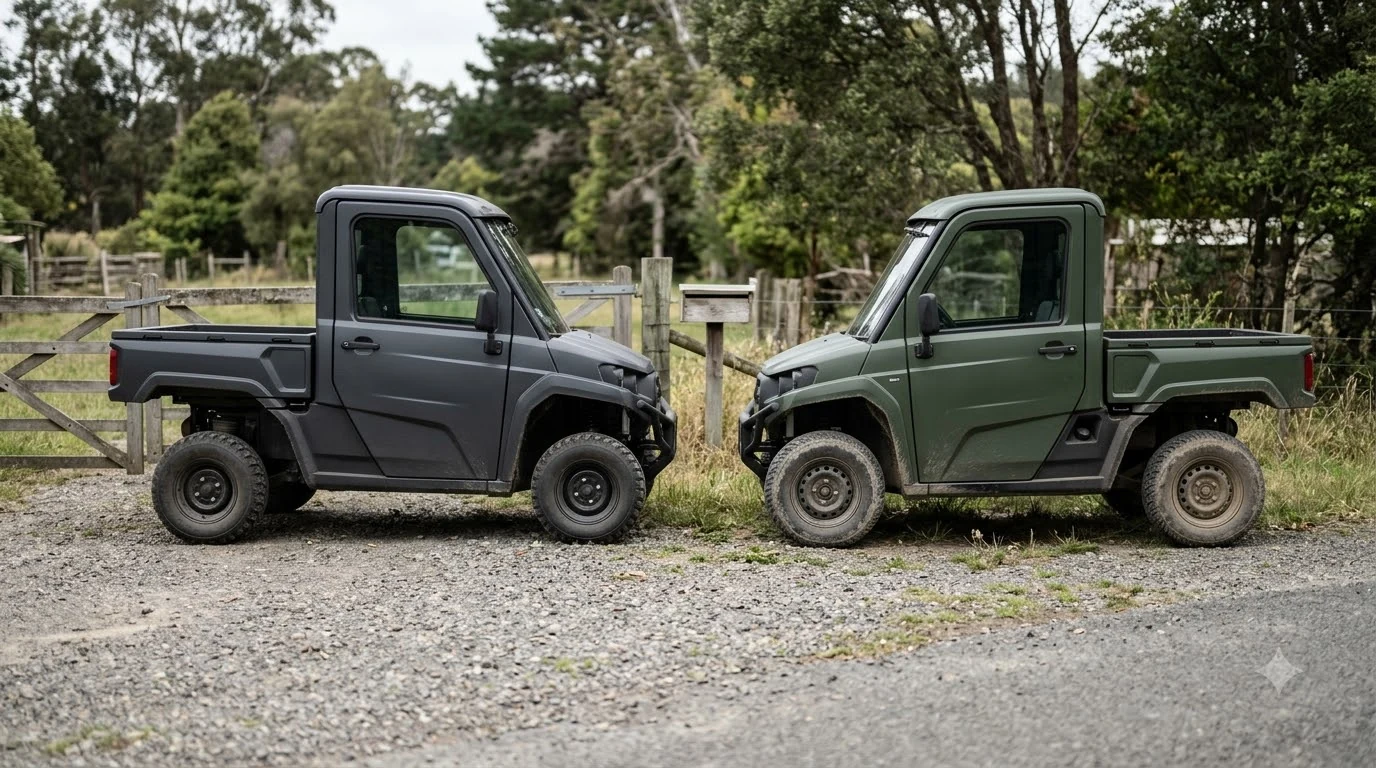

Yes, under specific conditions, can a robot mower trigger an automatic driveway gate—most often when a high-sensitivity magnetic exit wand or inductive ground loop sits right next to the lawn edge, or when the mower crosses a photoelectric safety beam while the gate is closing. However, a standard robot mower will rarely open a properly calibrated gate on its own because its compact plastic chassis and small battery pack lack the ferrous metal mass of a passenger vehicle. Understanding how your gate’s sensors detect movement and magnetic fields makes it straightforward to prevent phantom openings or stalled gates.
The short answer
- Magnetic exit wands are the main culprit: Direct-burial magnetometer wands detect moving metal disturbing Earth’s magnetic field, and a mower brushing past within a few feet on high sensitivity can occasionally trip them.
- Inductive ground loops rarely trigger: Embedded driveway loops measure inductance shifts from large steel vehicle frames, so a lightweight robot mower usually produces too weak a signal unless sensitivity is maxed out.
- Photoelectric safety beams stop closing gates: If your mower crosses the driveway threshold while the gate is closing, breaking the infrared photo-eye beam will halt or reverse the gate for safety.
- Boundary wires can cause cross-talk: Running a robot mower’s low-voltage perimeter cable directly across or parallel to a gate’s inductive loop can create electromagnetic interference for one or both systems.
- Simple spacing solves most conflicts: Keeping the mower’s mowing zone or boundary wire several feet away from buried gate sensors eliminates nearly all unintended activations.
How automatic driveway gate sensors interact with a robot mower
Automatic driveway gates rely on distinct detection technologies for opening, holding, and reversing, and each reacts differently to a small autonomous mower.
Most residential gate systems split their sensors into two jobs: activation sensors that command a closed gate to open, and entrapment protection sensors that keep a moving gate from hitting an obstacle. When homeowners ask whether a robot mower can open their driveway gate, they are almost always dealing with an activation sensor—specifically a free-exit detector installed on the inside of the property so cars can leave without a remote control.
According to manufacturer documentation for residential free-exit detectors like the Mighty Mule FM138 driveway vehicle sensor, these devices sense “metal in motion” by monitoring disturbances in the surrounding magnetic field. While engineered for cars, trucks, and ATVs, a robot mower still contains steel blades, wheel motors, magnets, and a lithium-ion battery pack. If the mower drives closely alongside a buried wand sensor at the edge of the turf, that concentrated metal mass in motion can occasionally mimic a distant vehicle.

| Gate sensor type | Primary job | How it detects objects | Likelihood of robot mower trigger |
|---|---|---|---|
| Magnetic exit wand (magnetometer) | Opens gate for exiting traffic | Senses moving ferrous metal disturbing Earth’s magnetic field | Moderate (if mower passes close on high sensitivity) |
| Inductive ground loop | Opens gate or holds it open | Measures inductance change from large metal mass overhead | Low (mower usually lacks sufficient steel mass) |
| Photoelectric beam (photo-eye) | Prevents gate from closing on obstacles | Detects interruption of an infrared light beam across the opening | High for reversing a closing gate; will not open a closed gate |
| RF remote, keypad, or smartphone | Authorized user entry and exit | Requires encrypted radio signal, PIN code, or app command | None (unless intentionally integrated via smart home relay) |
Why magnetic exit wands and inductive loops behave differently
Buried magnetic wands detect motion in Earth’s magnetic field from beside the driveway, whereas inductive loops require large metal mass directly above the pavement.
An inductive ground loop is a coil of insulated wire saw-cut into asphalt or laid beneath pavers. A detector module sends a current through the coil to create an electromagnetic field, waiting for a large metallic object—like a car undercarriage—to park or roll directly over the loop and shift its inductance. Because a robot mower has a largely polymer body, small wheels, and a narrow footprint, it typically fails to register on an inductive loop unless the detector’s sensitivity dial is turned all the way up and the mower drives directly across the pavement.
Magnetic exit wands work differently. Installed in the soil beside the driveway rather than under the concrete, a wand uses a passive magnetometer to watch for changes in Earth’s ambient magnetic field caused by moving metal. Because the wand is buried in the dirt right where grass meets driveway, a robot mower edging the border passes much closer to a wand than it ever would to the center of a concrete loop. Furthermore, a robot mower’s spinning steel cutting disc and brushless hub motors generate localized electromagnetic noise as they operate, adding to the magnetic disturbance.
The hidden issue: boundary wire and gate loop interference
Even if your mower never sets foot on the driveway, its perimeter wire can interfere with your gate’s buried sensors—and vice versa.
Traditional robot mowers navigate using a low-voltage boundary wire staked or buried around the lawn perimeter, which carries a continuous pulsed signal. Meanwhile, a driveway gate’s inductive loop also operates as a tuned electromagnetic circuit. According to Husqvarna Automower support documentation, metal structures, reinforcement steel, and nearby buried cables can interfere with a mower’s loop signal and cause erratic behavior or “no loop signal” errors.
The interference works in both directions. If you lay a robot mower’s boundary wire parallel to a gate’s buried sensor cable or across an inductive loop so the mower can cross the driveway to a second lawn zone, the overlapping electromagnetic fields can cause the gate controller to chatter, hold the gate open indefinitely, or miss actual vehicles. Wireless RTK-GPS and vision-based robot mowers eliminate perimeter cables entirely, which removes this specific wiring conflict, though their physical metal components can still interact with magnetic wands.
Heads up
Never disable or lower the sensitivity of your gate’s photoelectric beams or contact edge sensors to stop a robot mower from reversing the gate. Under the ANSI/UL 325 safety standard enforced across the United States, residential vehicular gate operators require functioning external entrapment protection devices to prevent severe crushing injuries to people and pets.
How to keep your robot mower from triggering your driveway gate
Creating physical separation between the mower’s cutting path and your gate’s detection zone solves almost every accidental trigger without compromising gate security.
- Locate your gate’s exit sensor. Walk the inside edge of your driveway between the house and the gate to find either saw-cut loop lines in the pavement or a buried exit wand alongside the grass, typically placed several feet back from the gate swing path.
- Adjust the mower’s boundary or virtual no-go zone. If you use a perimeter-wire mower, pull the wire back at least 3 to 5 feet from the buried wand or loop edge; if you use a GPS or vision mower, draw a virtual keep-out buffer over that strip of turf in the companion app.
- Cross perpendicular wires cleanly if bridging zones. If your robot mower must cross the driveway to reach another yard section, route the boundary wire as far from the gate’s inductive loop as possible and avoid running gate and mower cables parallel in the same trench.
- Dial back exit wand sensitivity if adjustable. Some third-party exit wands include a sensitivity potentiometer on the control board inside the gate operator box; lowering sensitivity slightly helps the wand ignore small lawn equipment while still catching full-size cars.
- Schedule mowing outside peak driveway hours. Set your mower to run during mid-morning or early afternoon windows when family members are less likely to be driving through the gate, reducing the chance of the mower tripping the photo-eyes mid-cycle.

Can you intentionally set up a robot mower to open a gate?
While triggering a heavy vehicular driveway gate with a robot mower is risky, dedicated smart pet-style lawn gates and home automation relays offer safer ways to let a mower pass between fenced yards.
Using a full-size vehicular driveway gate as an automated pass-through for a robot mower is generally a poor idea. Heavy swing or slide gates move slowly, consume substantial battery or AC power per cycle, and create a security gap where pets can escape or unauthorized visitors can enter while the gate waits to close. In addition, if a mower stalls inside the gate path, the gate may remain stuck open until someone intervenes.
If your robot mower needs to travel between a fenced front yard and backyard, homeowners typically choose one of two safer approaches:
- Dedicated mower portals: Purpose-built pass-through gates mount directly into a wood, vinyl, or metal fence line, unlocking via Bluetooth, RFID, or physical push-flaps sized too small for large dogs or people while keeping the main driveway gate locked.
- Smart relay integration: Advanced smart-home users sometimes connect a robot mower’s dock status or geofence webhook to a dry-contact relay on a secondary pedestrian gate, pairing it with camera verification so the gate only opens when the mower actively requests passage.
Frequently asked questions
Will a robot mower trigger an automatic driveway gate exit wand?
It can if the mower drives closely alongside the buried wand and the sensor’s sensitivity is set high. Exit wands detect moving metal disturbing Earth’s magnetic field, so keeping the mower’s boundary at least a few feet away from the wand prevents false openings.
Can a robot mower cross an inductive driveway loop safely?
Physically driving over the pavement above a buried inductive loop will not harm the loop or the mower. However, if you use a boundary-wire mower, laying the perimeter cable directly over the inductive loop can cause signal interference between the two systems.
Why does my driveway gate stop or reverse when my robot mower is nearby?
Your mower is likely rolling through the infrared beam of the gate’s photoelectric safety sensors while the gate is closing. Photo-eyes are designed to halt and reverse a closing gate whenever any object interrupts the beam, including pets, people, or a passing robot mower.
Do wireless GPS robot mowers still interfere with automatic gates?
Wireless RTK-GPS and vision mowers eliminate boundary wire cross-talk because they do not use buried perimeter cables. Even so, their steel blades, motors, and batteries can still trip a high-sensitivity magnetic exit wand or block a photoelectric safety beam if they get too close to the driveway.
Sources
- FM138 Driveway Vehicle Sensor for Easy DIY Installation (Mighty Mule): Reference for how residential direct-burial driveway exit wands detect metal in motion to trigger automatic gates.
- No loop signal—Automower error message (Husqvarna): Official support documentation detailing how buried cables, reinforcement steel, and metal fences interfere with boundary loop signals.
- Gate Operators and the ANSI/UL 325 Standard (Door & Access Systems Manufacturers Association): Technical data sheet outlining residential gate entrapment protection and photoelectric sensor requirements.
 Up next9 min readLearnHow to Pair a Robot Mower with a Smart Gate OpenerUpdated Nov 19, 2026
 9 min readLearnHow to Adjust Robot Mower Collision Sensitivity in the AppUpdated Nov 19, 2026
 8 min readLearnHow to Prevent Grass Buildup Inside Robot Mower Wheel WellsUpdated Nov 19, 2026
 9 min readLearnWhy Does My Robot Mower Stop When Crossing Patio Pavers?Updated Nov 19, 2026
 7 min readLearnHow to Stop Crows From Pecking at a Robot MowerUpdated Nov 19, 2026
 9 min readLearnHow to Prevent Rust on Robot Mower Blade ScrewsUpdated Nov 19, 2026