
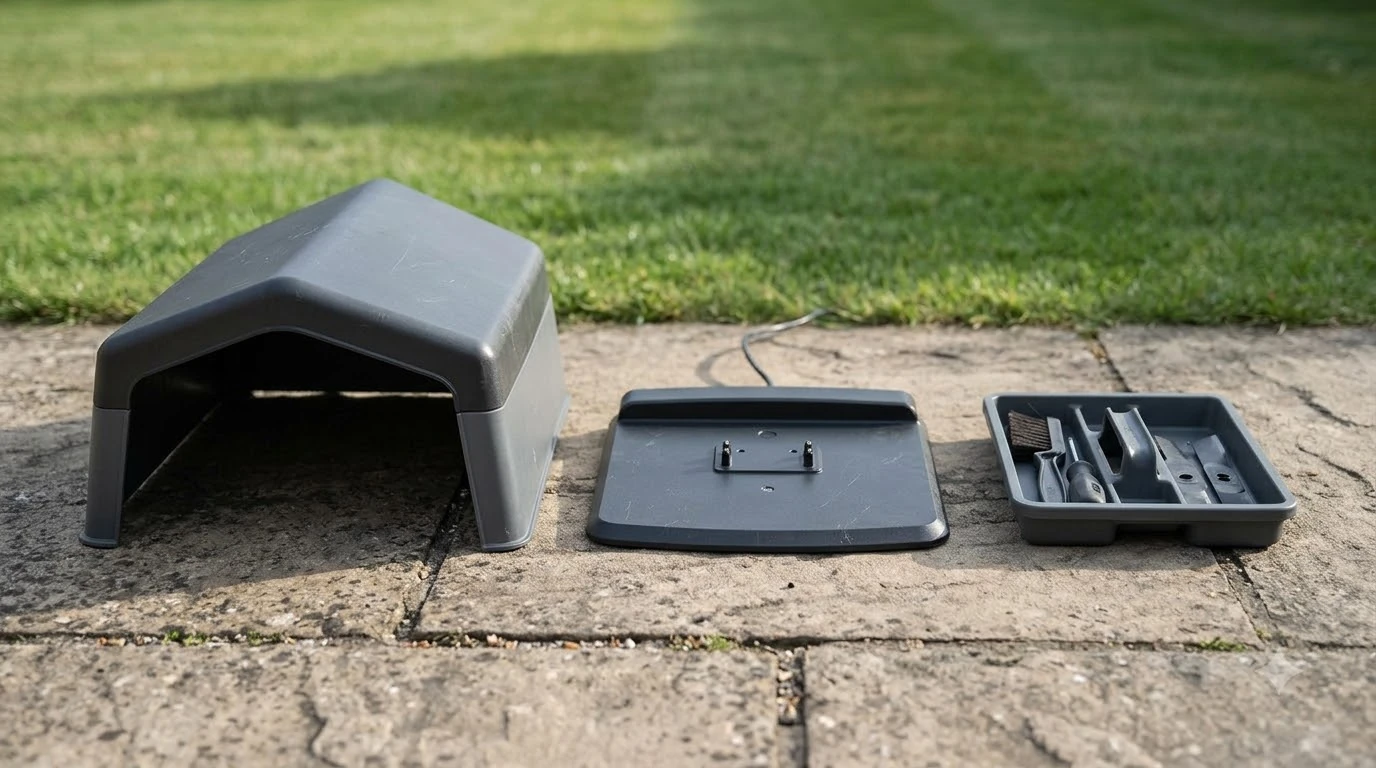

If you are wondering why does my robot mower stop when crossing patio pavers, the culprit is almost always a physical height lip that trips the lift sensor, a boundary wire routed too close to the stone edge, or an onboard camera mistaking flat stone for a non-grass boundary. Modern robotic mowers rely on strict safety and surface-recognition rules that treat sudden elevation drops or hardscape textures as hazards. Fortunately, adjusting the stone transition, tweaking your virtual map, or re-routing a perimeter cable resolves the issue without replacing hardware.
The short answer
- Height transitions trip lift sensors: Even a small lip between settled grass and raised pavers tilts the floating chassis enough to trigger an emergency stop.
- Vision cameras read pavers as walls: Camera-guided and AI-assisted mowers distinguish green turf texture from hard stone and stop when they think they have left the yard.
- Boundary wires sit too shallow or too close: Perimeter cables laid right against a stone edge or buried too deeply beneath thick slabs lose signal continuity and stall the mower.
- Missing transit paths on wire-free maps: RTK and LiDAR models refuse to cross a patio to reach a second lawn zone unless you draw an explicit transit channel in the app.
- Low cutting decks snag on uneven joints: A blade disc set near its lowest height catches on sunken joints or tilted pavers, triggering a motor-overload shutdown.
How physical paver edges trigger lift and bump sensors
Every robotic lawn mower uses Hall-effect lift sensors and floating-body bump switches that immediately cut power to the wheels and blades whenever the shell tilts or snags.
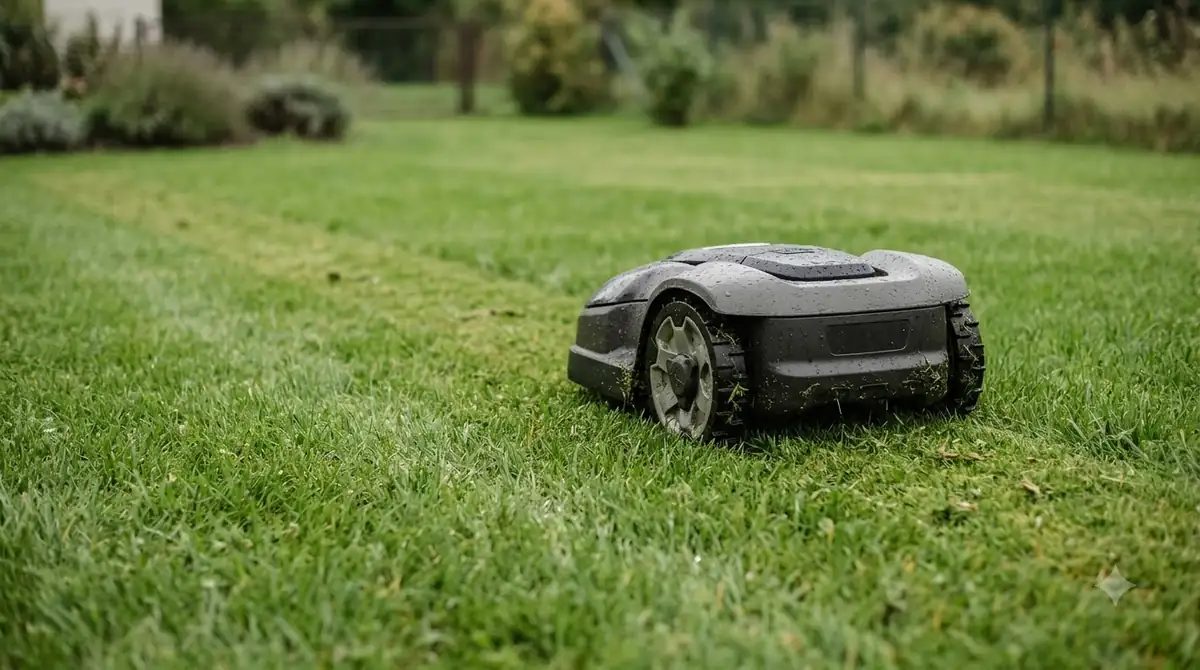
On paper, a stone walkway looks flat, yet soil settles faster than compacted paver base over a single season. When turf sinks below the stone edge, the mower’s front caster wheels drop into the seam while the rear drive wheels push forward. That sudden pitch angle lifts the outer shell relative to the internal chassis, which the control board reads as someone picking up the machine. According to LawnMaster’s troubleshooting documentation, continuous lift or bump triggers on uneven ground force the unit into a protective halt until an owner manually resets it.
The cutting deck itself can also cause a dead stop. If two adjacent slabs heave after a freeze-thaw cycle or leave a wide joint gap, a low-slung blade disc scrapes the stone edge. Current sensors detect the sudden spike in resistance on the blade motor and shut the unit down to protect the gearbox and razor blades.
| Symptom on the Patio | Likely Sensor or Navigation Trigger | Primary Fix |
|---|---|---|
| Stops dead right at the grass-to-stone seam with a “lifted” alert | Front caster drops into a sunken seam, tilting the floating shell | Top-dress the turf edge with topsoil or level sunken pavers |
| Pauses at the stone border, backs up, and turns away repeatedly | AI vision camera classifies grey or tan stone as a non-grass boundary | Enable stepping-stone mode or draw a camera-off zone in the app |
| Halts mid-patio with a “no loop signal” or “outside working area” error | Boundary wire is buried too deep under thick stone or pinched at a joint | Route wire cleanly through a shallow paver joint or adjust edge offset |
| Reaches the patio edge and refuses to cross to the far lawn zone | Wire-free RTK or vision map lacks a designated transit pathway | Create a straight connecting channel between both zones in the app |
| Grinds briefly on a slab corner and throws a blade-blocked error | Cutting height is set too low for uneven stone joints | Raise the cutting deck height and re-seat rocking pavers |
Why camera and AI vision mowers treat pavers as off-limits
Vision-based robotic mowers use forward-facing cameras and neural networks to separate green turf from hardscape, which causes them to brake automatically at patio borders.
Unlike older machines that blindly bump into obstacles, camera-equipped units analyze blade texture, color distribution, and surface glare in real time. When a mower approaches a bright concrete patio or dark slate walkway, its software flags the sudden loss of green turf as a driveway, flowerbed, or pool deck. Instead of driving across, the mower stops at the seam, reverses, and searches for grass.
Most major vision-enabled platforms address this behavior through software overrides rather than hardware changes. According to Eufy’s support guide for stepping stones, owners with level stones set into the lawn must manually configure the stone area inside the companion app so the working logic permits travel over non-grass surfaces. Other platforms call this feature a stepping-stone mode, a to-go zone, or a camera-off corridor, telling the onboard computer to temporarily ignore visual turf-edge rules while crossing that specific patch of hardscape.
Heads up
Disabling visual obstacle avoidance over a patio means the mower will rely solely on its physical bump sensor in that zone. Always clear patio furniture, planters, hoses, and pet bowls from the crossing corridor before turning off camera detection.
Boundary wire routing mistakes around stone walkways
If your mower relies on a buried perimeter cable, improper wire spacing or excessive burial depth beneath thick pavers weakens the electromagnetic loop signal until the mower stops.
Traditional boundary-wire mowers detect an alternating current running through the perimeter loop. When a patio sits flush with the grass, manufacturers typically instruct installers to place the wire roughly 10 cm (4 inches) from the stone edge so the mower’s wheels can straddle the border and trim the grass cleanly. If the wire is laid closer than that, or if a sharp corner turn exceeds 90 degrees, the mower’s front coil loses the signal right as the wheels hit the stone and halts with an “outside working area” fault.
When you want the mower to cross a stone path to reach a second lawn section, routing the wire directly underneath thick flagstones can also attenuate the signal. In its Automower 115H operator’s manual, Husqvarna specifies that a paving stone path level with the lawn must have the wire placed directly beneath the stone, with a minimum passage width of 60 cm (24 inches). Laying the cable inside a narrow sand joint rather than under three inches of solid concrete preserves signal strength and prevents mid-path stalls.
Missing transit channels on wire-free RTK and LiDAR mowers
Satellite-guided (RTK) and LiDAR mowers map lawns as closed polygons and will stop at the patio edge if you have not linked separated grass areas with a dedicated transit path.
When homeowners map a front and back yard—or two halves of a yard split by a wide paver walkway—each grass polygon acts as a self-contained boundary. Even if the mower’s GPS or LiDAR sensors have a clear view of the sky across the patio, the navigation firmware refuses to cross unmapped territory on its own. When the mower finishes one zone or needs to return to its charging dock across the stone, it stops at the virtual border.
To bridge the gap, open your mower’s app and create a straight transit pathway connecting the two mapped zones. As outlined in Anker’s practical setup guide for path crossings, the route should follow the shortest straight line across level paving with 80 to 100 cm of clearance so the robot can make minor steering corrections without clipping the edge of the corridor. During transit, the mower automatically shuts off its cutting disc and drives directly across the pavers until it re-enters the next grass polygon.
Step-by-step checklist to make your patio crossing reliable
Fixing a paver stall comes down to leveling the physical transition first and updating your mower’s navigation rules second.
- Flush up the grass-to-paver seam. Inspect the exact spot where the mower stops. If the soil has settled below the stone, spread a thin layer of screened topsoil mixed with compost along the grass edge so the transition is completely level, and re-seat any rocking or tilted pavers with polymeric sand.
- Raise the cutting deck height. Set the blade height one or two notches higher in the app or on the dial so the spinning disc clears minor stone irregularities and chamfered paver edges without striking rock.
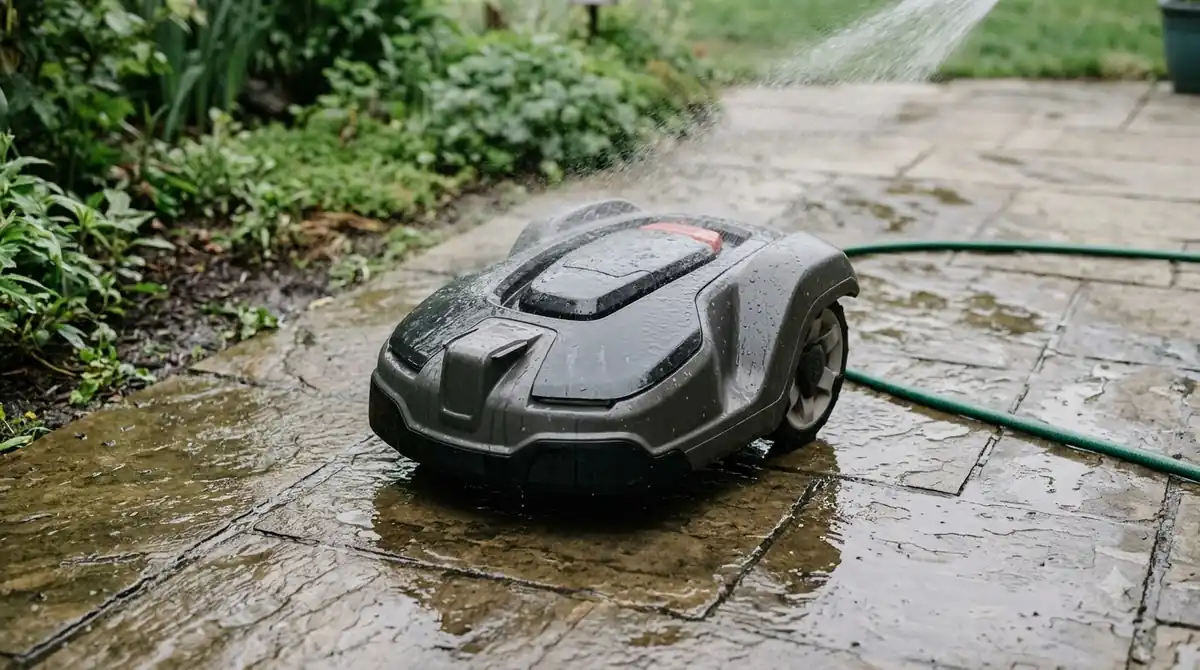
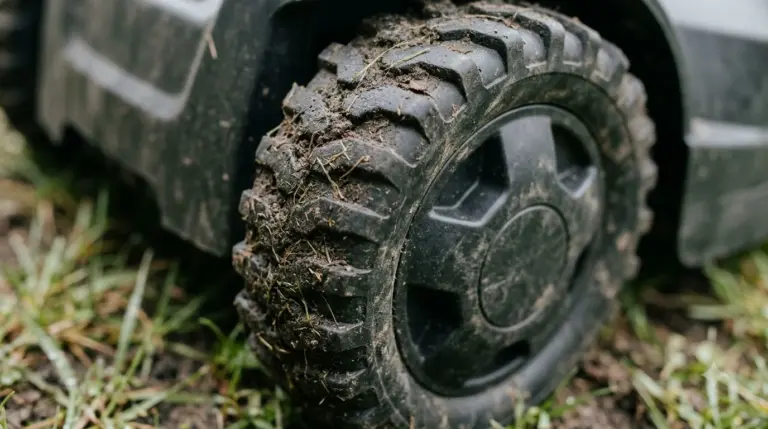
- Clean wheel treads and optical lenses. Wipe mud and dried grass off the drive wheels—hard stone offers less grip than soil, and caked treads spin easily—then clean the front camera lens and ultrasonic sensors with a soft microfiber cloth.
- Configure the crossing in your app or wire layout. For wire-free models, draw a straight transit channel or enable stepping-stone override across the patio. For wired models, verify that passage wires are spaced according to your manual and sit in a shallow joint rather than deep beneath solid slabs.
- Run a supervised test crossing in both directions. Send the mower across the patio to the far zone and then trigger a return-to-dock command, watching the front casters and chassis clearance at both the entry and exit seams.
Frequently asked questions
Can a robot lawn mower safely drive over patio pavers?
Yes, provided the pavers are level with the lawn and free of deep gaps or raised lips. Most robotic mowers automatically disengage their cutting blades when following a mapped transit path across stone, preventing blade wear while protecting the patio surface.
Why does my robot mower stop on pavers only when it is raining or dewy?
Wet stone and morning dew drastically reduce traction for hard plastic or shallow-tread drive wheels. When the rear wheels slip on damp pavers while the mower tries to turn, the wheel-speed sensors detect a stall and shut the unit down to avoid digging ruts at the grass edge.
Do I need to bury my boundary wire under the patio pavers?
If the pavers are flush with the lawn and you want the mower to cross them, you can tuck the wire into a sand joint between the stones or lay it right underneath a thin slab. If you want the mower to stay off the patio entirely, keep the wire in the grass about 10 cm (4 inches) away from a flush stone edge.
Why does my camera-guided mower stop at dark pavers or shadows?
Optical sensors rely on contrast and color recognition to identify turf. Deep shadows cast across dark slate or wet brick can resemble a drop-off or solid obstacle to the camera, causing the mower to brake until you designate that area as a traversable zone in the app.
Sources
- What should I do if there are stepping stones on my lawn? (Eufy Support): Used for vision-based terrain misjudgment causes and app configuration requirements for level stepping stones.
- Can Robot Lawn Mower Cross Path? A Practical Setup Guide (Anker): Used for level grass-to-paver transition requirements, transit corridor clearance benchmarks, and two-way crossing checks.
- Husqvarna Automower 115H Operator’s Manual (Husqvarna): Used for boundary wire placement beneath level paving stones and minimum 60 cm (24 in) passage width specifications.
- Robot Lawn Mower Common Faults & Solutions (LawnMaster / Cleva): Used for lift-sensor trigger behavior on uneven transitions and non-grass surface recognition diagnostics.
 Up next9 min readLearnWhy Does My Robot Mower Spin Its Wheels When Turning?Updated Nov 19, 2026
 7 min readLearnWhy Does My Robot Mower Lose WiFi When the Garage Closes?Updated Nov 19, 2026
 6 min readLearnWhy Does My Robot Mower Stop in the Middle of the Lawn?Updated Nov 14, 2026
 8 min readLearnWhy Does My Robot Mower Beep and Stop Mid-Cut? Common CausesUpdated Nov 14, 2026
 6 min readLearnWhen to Stop Using a Robot Mower in FallUpdated Nov 13, 2026
 8 min readLearnWhy Does My Robot Mower Leave Unmowed Circles Around Trees?Updated Nov 19, 2026