
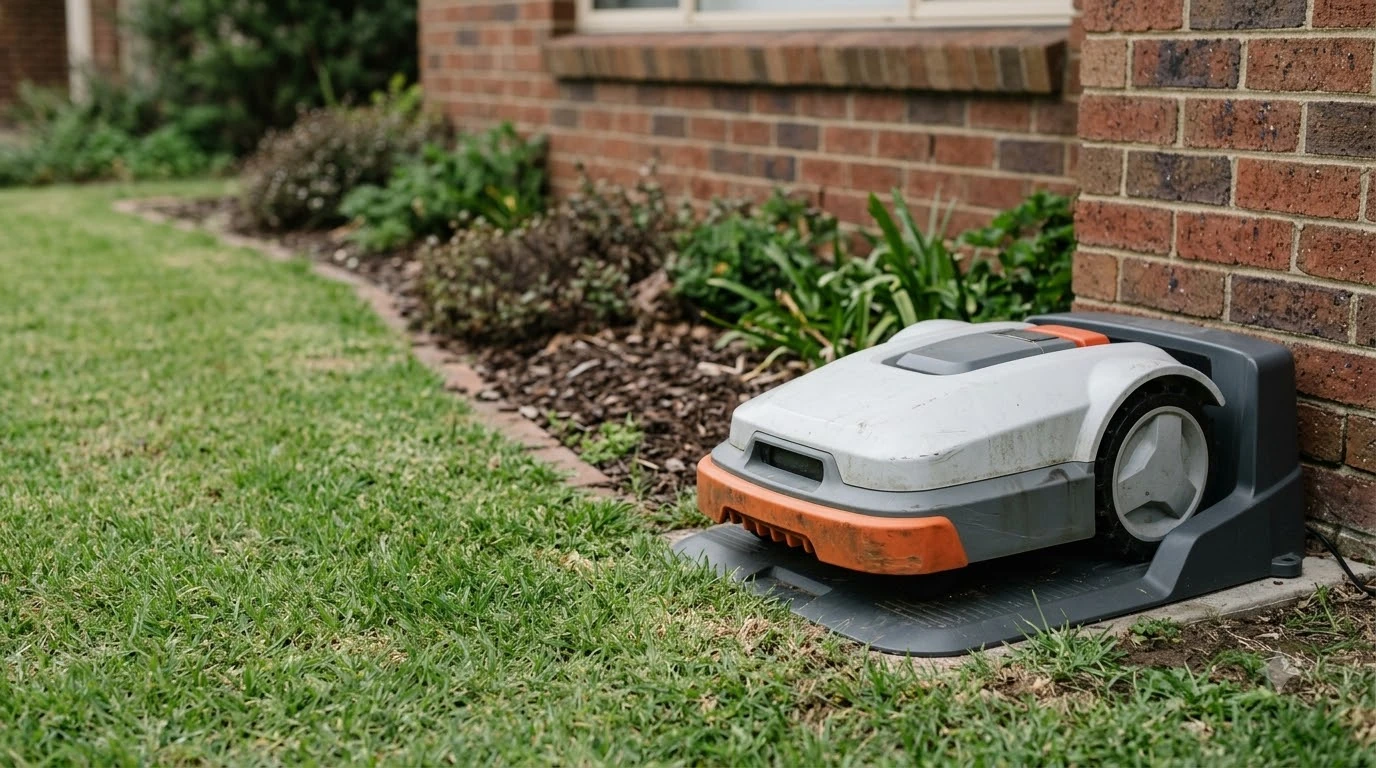

The best solar-powered security light for a robot mower dock is a split-panel, IP65-rated motion floodlight that mounts its solar collector in full sun while aiming a warm-to-neutral downward beam across the shaded charging bay. Because robot mower manuals advise parking the base station in the shade to keep battery temperatures down, an all-in-one fixture bolted directly above the dock will often starve for charge. Separating the panel from the light head solves that conflict while deterring theft and protecting your mower’s optical sensors from blinding glare.
The short answer
- Split-panel design is mandatory: Mower docks belong in shaded spots to protect lithium-ion batteries, whereas solar panels need 6 to 8 hours of direct sunlight each day to stay charged.
- Aim downward, never outward: Angling the lamp head toward the ground covers the dock apron without shining into camera-based mower sensors or neighboring windows.
- Watch the trigger zone: A passive infrared (PIR) sensor aimed too low will fire every time the mower departs or docks on a night schedule, draining the battery before an intruder ever approaches.
- Weather sealing matters at ground level: Look for at least an IP65 rating so rain, lawn sprinklers, and blown grass clippings do not foul the housing.
- Clean both lenses regularly: Pollen, dust, and mower clippings coat low-mounted panels and PIR domes fast, cutting charging efficiency and detection range.
Why robot mower docks create a tricky lighting problem
Lighting a robot mower station is harder than lighting a driveway because the dock and the solar panel want completely opposite microclimates.
According to manufacturer installation guides—including the Worx Landroid installation manual—charging bases should sit in a shaded area to prevent the mower battery and charger from overheating in direct sun. Many owners also tuck the dock under a garage cover, beside a fence, or beneath low shrubs to keep it out of plain sight from the street. Those exact conditions block the overhead sky.
Solar security lights work on the opposite rule. According to outdoor lighting placement guidelines from Linkind’s solar lighting guide, photovoltaic panels require 6 to 8 hours of unobstructed daily sunlight—ideally facing south in the Northern Hemisphere—to maintain full battery capacity. Even partial shading from eaves or tree branches reduces charge recovery and leaves the fixture weak after cloudy stretches.
Modern mowers add a second wrinkle. Vision-guided and AI-camera models rely on optical lenses to recognize yard boundaries and obstacles. As noted in GokoRobo’s overview of mower obstacle avoidance, sudden glare and harsh shadows can interfere with camera accuracy. A floodlight mounted at bumper height that blasts straight into the mower’s nose when it returns at dusk can confuse visual docking alignment.
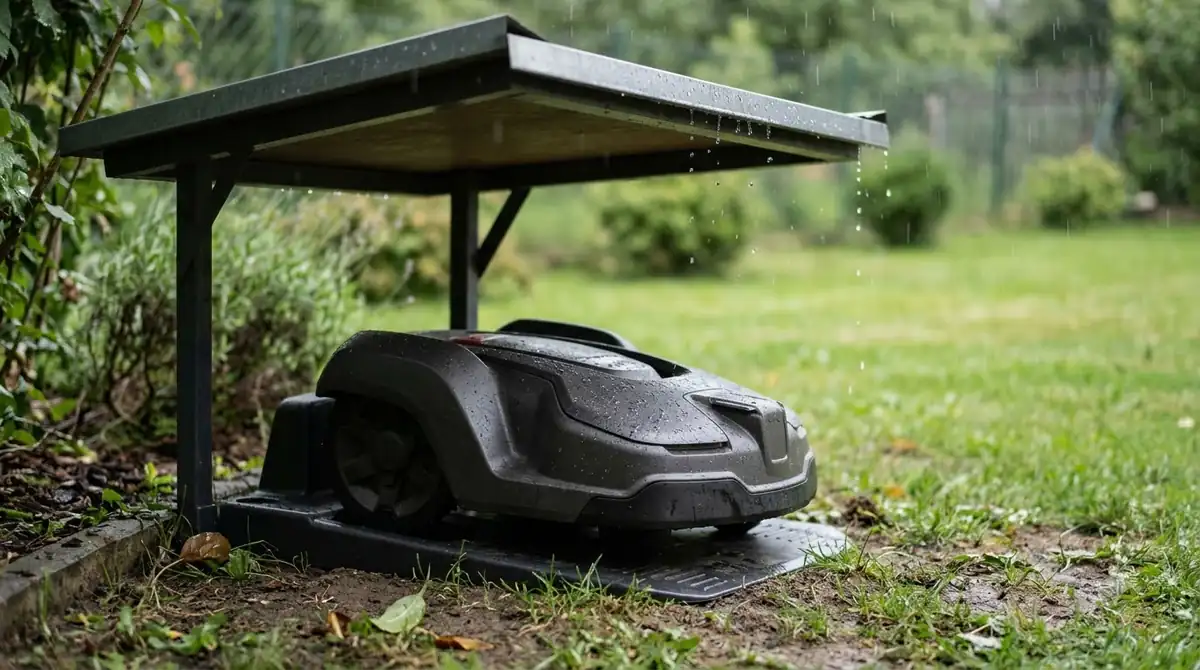
Types of solar security lights that fit a mower station
Choosing between fixture styles comes down to how far your shaded dock sits from a sunny wall, fence post, or roofline.
| Fixture type | How it works | Best dock setup | Main limitation |
|---|---|---|---|
| Split-panel motion floodlight | Light head mounts near the dock; separate solar panel connects via a low-voltage cable (often 10 to 15 feet long). | Docks tucked under garages, hedges, north walls, or deep eaves. | Cable must be clipped or buried safely away from mower blades and trimmers. |
| Integrated wall-mount floodlight | Solar panel, battery, PIR sensor, and LEDs sit in a single housing mounted 6.5 to 8 feet high. | Docks parked along a sunny south- or southwest-facing house wall or fence. | Fails if the dock sits under a roof overhang or shade canopy. |
| Adjustable multi-head spotlight | Two or three pivoting LED heads flank a central sensor and top-mounted panel. | Corner installations where one head lights the dock and another covers a side gate. | Higher lumen draw drains the cell faster if false-triggered by pets or branches. |
| Low-profile stake or path marker | Ground-level stake light with a small top solar cell and low-output LEDs. | Visual perimeter marking along a mower corridor or driveway crossing. | Too dim for real theft deterrence and easily blocked by tall grass or mower bumpers. |
For most yards, a split-panel floodlight is the only configuration that honors both the mower’s need for shade and the panel’s need for sun. Integrated wall units work well only when the base station sits out in the open along a sunny fence line, or when you mount the light high enough on an exterior wall that its solar cell clears the shadow line while its beam reaches down to the lawn edge.
Key specifications to check before buying
Ignore inflated marketing lumen claims and focus on four hardware specs that govern reliability near lawn equipment.
- Sensor coverage and sensitivity adjustment: Passive infrared (PIR) sensors detect heat differentials rather than pure movement, meaning they respond to people, warm-bodied animals, and sometimes warm mower motors. A 120-degree detection cone suits a narrow side yard or single dock bay, while a 270-degree wide-angle sensor covers an open backyard corner. Look for a sensitivity dial or physical sensor hood so you can narrow the trigger zone.
- Color temperature and beam control: High-Kelvin daylight LEDs (6000K to 7000K) throw crisp, high-contrast light, whereas warm-white output (2700K to 3000K) blends naturally with landscaping and creates softer reflections off glossy mower shells. Multi-head or gimbal-mounted lamps let you aim light strictly at the ground rather than across the yard.
- Ingress protection (IP65 or higher): Charging stations sit outdoors through summer thunderstorms and automated irrigation cycles. An IP65 rating certifies protection against dust intrusion and low-pressure water jets from any direction, which handles rain and accidental sprinkler spray.
- Operating temperature and replaceable batteries: Lithium-ion cells lose capacity in freezing winters and degrade faster in extreme summer heat. Check the manual’s rated temperature window (many outdoor units specify roughly -5°C to 60°C, or 23°F to 140°F) and favor housings that allow battery replacement rather than sealed disposable units.
Heads up
Do not mount a motion light where passing pedestrians on a public sidewalk or swaying tree branches enter its PIR cone. Constant false triggers will flatten the battery before midnight, leaving the dock dark during early-morning hours.
How to position and mount the light without confusing your mower
Proper placement keeps the dock visible to security cameras and neighbors while preventing false triggers every time your robot leaves for a cut.
- Map the mower’s approach and departure corridor. Most mower manuals require a clear, straight entry path in front of the base station—often around 2 meters (6.5 feet)—and flat ground free of obstacles. Never drive a light stake into the approach lane or let hanging cables droop near the docking apron.
- Mount the light head 6.5 to 8 feet above the ground. Placement guides for solar motion wall lights recommend mounting between 6.5 and 8 feet high (or up to 10 feet for wider yard coverage). At this height, the fixture stays well above string trimmers and mower decks while casting an even pool of light over the station.
- Angle the PIR sensor downward and slightly away from the exit path. Aiming the sensor head toward the immediate perimeter around the dock catches someone walking up to unplug or lift the mower. If your mower runs at night, test whether the robot triggers the sensor on departure; if it does, tilt the sensor higher or apply a narrow strip of black electrical tape along the bottom edge of the Fresnel lens to mask ground-level movement.
- Mount the solar panel in unobstructed south-facing sun. Run the lead wire from the shaded dock up to a fence cap, pergola beam, or sunny wall section that receives 6 to 8 hours of direct sunlight. Secure every inch of cable with UV-rated clips behind trim boards or inside conduit so neither the mower blades nor an edging trimmer can nick the insulation.
- Verify optical and radio clearance. Keep the fixture and wiring clear of RTK base antennas and boundary wire terminals. After dark, trigger the light manually and watch your mower complete a test dock to confirm that the beam illuminates the bay evenly without blinding front-facing cameras.
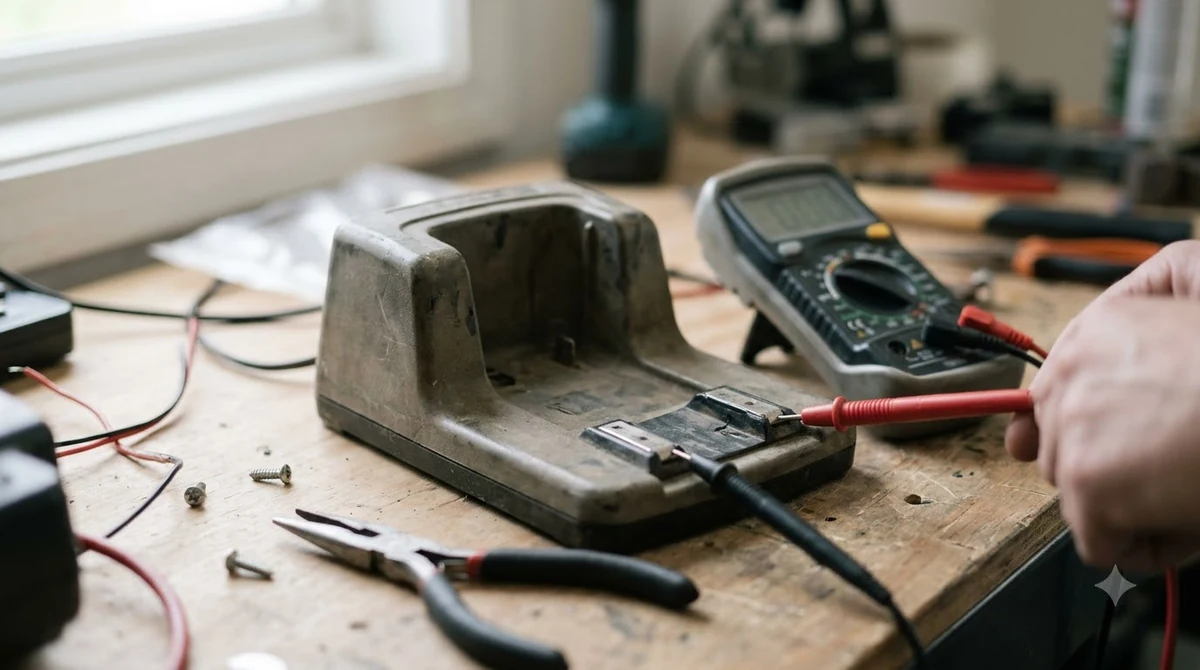
Seasonal maintenance alongside your mower routine
Most residential solar floodlights still rely on small monocrystalline panels and single-cell lithium packs that lose output quickly when neglected.
Build a two-minute lighting check into the same weekly routine you use to wipe down your mower’s charging contacts and camera lenses. Dry grass dust thrown by mulching blades settles onto horizontal solar panels and forms a crusty film after morning dew. Wiping the panel with a damp microfiber cloth restores full charging voltage, while cleaning the translucent PIR dome prevents sluggish detection.
Check cable clips and mounting brackets twice a year—once in spring when you bring the mower out of winter storage and again in mid-summer. Sun exposure and wind vibration can loosen plastic adjustment knobs, allowing the lamp head to droop or shift its detection zone toward neighboring yards. If you store your robot mower indoors over winter and unplug the charging base, switch the solar light to its off position or bring detachable units inside so freezing temperatures do not deep-discharge the battery.
Frequently asked questions
Will a bright security light interfere with my robot mower’s navigation?
Boundary-wire and RTK-GPS navigation signals are unaffected by visible LED light, though camera-based obstacle avoidance can struggle if a harsh beam shines directly into the lens at close range. Mounting the light 6.5 to 8 feet high and aiming it downward keeps glare out of the mower’s field of view.
Can I mount a solar light directly onto a wooden or plastic robot mower garage?
Only if the mower garage sits in full sun, which conflicts with manufacturer advice to keep charging stations shaded so batteries stay cool. A split-panel model lets you screw the compact lamp onto the garage fascia while mounting the solar collector several feet away in the open.
How many lumens do I actually need to secure a mower dock?
For a dock tucked beside a house wall or fence at a 10- to 16-foot range, 400 to 800 lumens provides clear visibility without excessive glare. Larger open yards or corner mounts covering 25 feet or more benefit from 1,500 lumens or higher.
Do solar motion lights work during winter or prolonged cloudy weeks?
They continue operating at reduced runtime, provided the panel receives unobstructed daylight and stays free of snow or fallen leaves. Choosing a model with a high-efficiency panel and a motion-only mode (rather than dim all-night stay-on mode) conserves stored energy during short winter days.
Sources
- Worx Landroid Installation Manual (Worx / Positec): Charging station shade, level ground, and sprinkler clearance requirements.
- 10 Solar Light Placement Ideas to Transform Your Landscape (Linkind): Daily sunlight exposure requirements (6 to 8 hours), shading impacts, and color temperature guidelines.
- Solar Motion Sensor Lights: Best Picks and Placement Guide (Top Solar Gear): PIR sensor detection angles (120° vs. 270°), mounting heights, and lumen sizing by yard zone.
- Robot Mower Obstacle Avoidance Explained: Ultrasonic vs. Vision (GokoRobo): Effects of glare, shadows, and low light on camera-based mower navigation.
 Up next9 min readGearBest Battery-Powered Handheld Blower for Cleaning Mower Decks: Buying & Use GuideUpdated Nov 19, 2026
 9 min readGearBest Grass Seed for Robot Mowed Lawn: Match Light and HeightUpdated Nov 13, 2026
 9 min readGearBest Outdoor Security Camera to Watch a Robot Mower: What to CheckUpdated Nov 12, 2026
 7 min readGearRobot Mower Base Station Solar Panel: Is It Enough?Updated Nov 20, 2026
 7 min readGearSolar Power for a Robot Mower Charging Station: What WorksUpdated Nov 19, 2026
 8 min readGearBest Heavy-Duty Turf Staples for Securing Dock Mats on Robot Mower LawnsUpdated Nov 19, 2026