
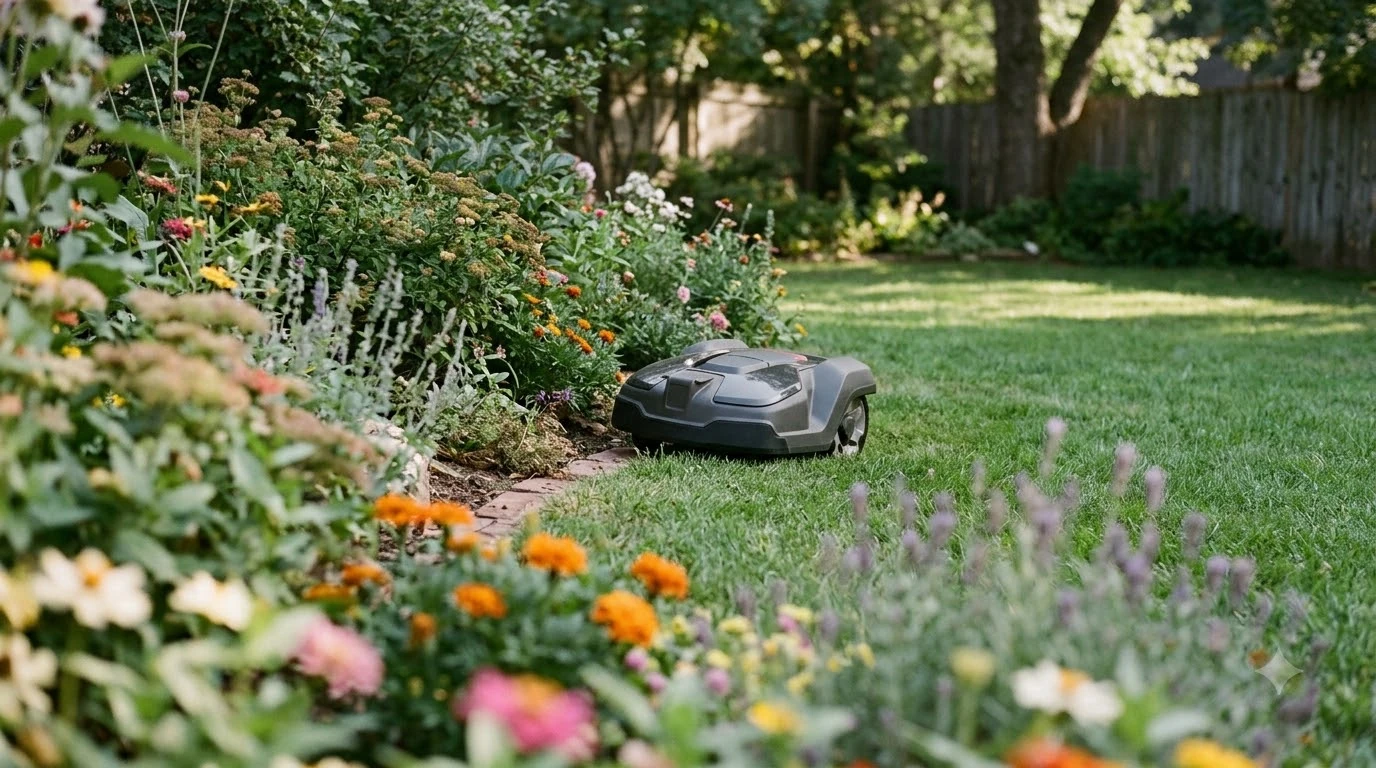

How to stop a robot mower from digging holes on turns? Keep it off wet or soft turf, widen tight boundary corners, clean packed clippings off the drive wheels, and add traction or zero-turn adjustments where your model allows. Most turf divots happen when one drive wheel brakes or reverses while the other pushes forward, shearing grass roots that are already loosened by moisture or repeated turns in the same spot. Fixing the turning geometry and soil grip stops the tearing before bare dirt spreads across your lawn.
The short answer
- Pause mowing during and after rain: Wet blades and soft soil cut wheel traction dramatically, causing drive tires to spin rather than roll cleanly through a pivot.
- Round out sharp boundary corners: Tight ninety-degree wire bends or sharp virtual map angles force the mower to stop dead and scrub one wheel in place.
- Clear mud and grass from wheel treads: Caked debris turns lugged tires into smooth rollers that skid on every turn.
- Switch on gentle or multi-point turn modes: Many systematic and vision mowers let you trade zero-radius pivots for wider three-point turns in the companion app.
- Reinforce high-traffic turn zones: Hybrid turf mesh, higher cutting heights, and coarse-tread terrain wheels protect corners where the mower reverses repeatedly.
Why robot mowers dig holes when turning
Robot mowers tear turf on turns because differential steering drags or counter-rotates one drive wheel against soft soil until the grass roots give way.
Unlike a riding tractor with a steering axle, almost every residential robot mower steers by varying the speed of two independent drive wheels while a small caster wheel pivots freely at the front or rear. When the mower reaches a boundary wire, virtual perimeter, or obstacle, it stops forward travel and pivots. On a tight turn, the inside wheel either locks in place as a pivot point or spins backward while the outside wheel drives forward. That lateral scrubbing force twists grass crowns right out of the soil.
The problem multiplies because robot mowers cut frequently and often turn in the exact same perimeter zones. According to Mammotion’s wet-grass operation guide, soil moisture matters just as much as wet grass blades because soft ground lets drive wheels sink and slip during direction changes. Conventional all-wheel-drive models that rely on skid or differential steering can actually scuff turns harder than lighter two-wheel-drive bots, whereas newer four-wheel-steered designs pivot each wheel independently so the tires roll rather than drag.
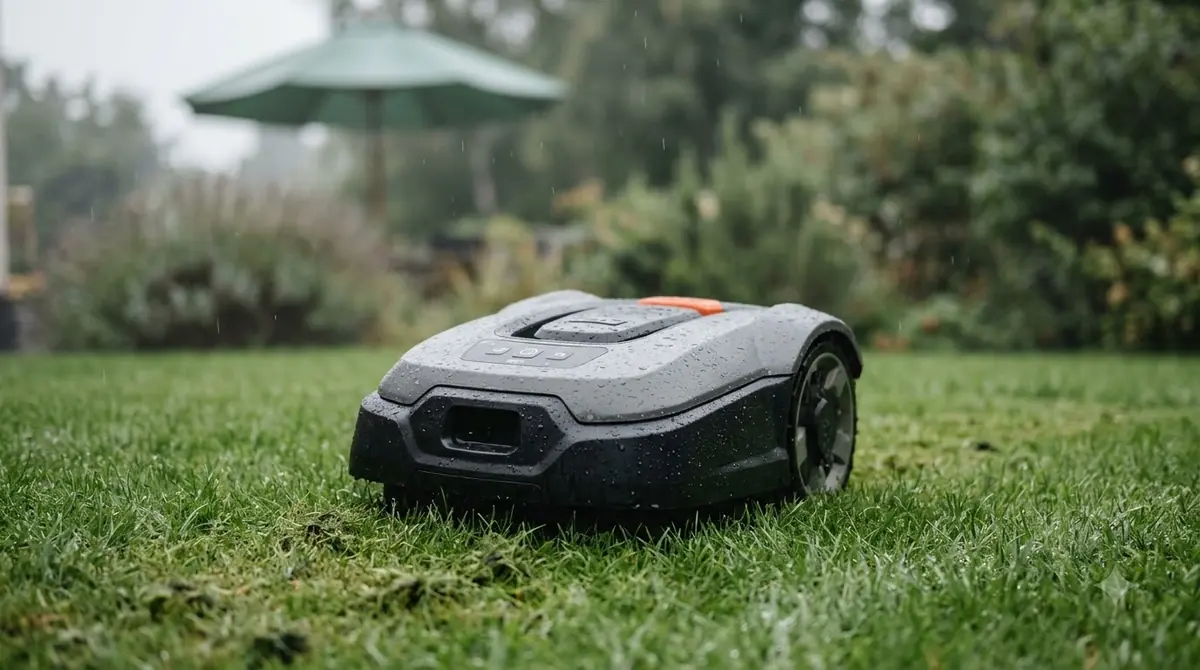
Clogged treads and dull blades make matters worse. Wet clippings pack into tire lugs and underside housings, reducing grip until the mower senses wheel slip and applies extra motor torque to free itself. Instead of climbing out, the spinning tire excavates a neat half-moon trench.
Step-by-step fixes to stop wheel spin and turf divots
Working through moisture schedules, wheel maintenance, and boundary geometry resolves most turning damage without buying a new mower.
- Enable rain delays and morning dew buffers. Open your mower app and turn on weather-based parking routines, such as Rain Guard on connected Husqvarna Automower models or physical rain sensors on boundary-free bots. Schedule the first daily run for late morning or afternoon after dew evaporates and topsoil firms up.
- Inspect and scrub the drive wheels. Power the mower off completely and flip it onto a soft surface. Peel packed grass, clay, and twigs out of the tire treads and wheel wells so the rubber lugs can bite into the turf instead of skidding across it.
- Widen sharp perimeter angles and obstacle islands. Wherever the mower makes a sharp V-turn or ninety-degree pivot, reshape the boundary wire or virtual map edge into a sweeping curve. Giving the chassis a wider arc lets both drive wheels keep rolling forward through the turn.
- Adjust turning behavior and cutting height in the app. Check your mower settings for turn-style options—often labeled gentle turn, multipoint turn, or perimeter slowdown—and raise the cutting deck slightly during wet spring or fall growth so longer grass cushions the tires.
- Upgrade traction or reinforce chronic wear spots. If slopes or sandy corners still tear up, install manufacturer rough-terrain wheel kits with deeper treads and wheel brushes, or stake down open-weave hybrid grass mesh so roots grow through a protective grid.
Heads up
Never flip your robot mower over or reach near the wheel wells and cutting disc while the power switch is on or a remote schedule can trigger a start.
Matching the fix to your yard and mower type
Different yard conditions and navigation systems trigger turning divots in distinct ways, so matching your adjustment to the exact symptom saves trial and error.
| Symptom on your lawn | Likely root cause | Primary fix |
|---|---|---|
| Half-moon mud ruts along the edge | Mowing while soil is saturated or covered in heavy dew | Delay schedules until afternoon and enable forecast or sensor rain parking |
| Worn bald spots at tight yard corners | Sharp boundary wire angles forcing zero-radius pivot turns | Re-stake the wire or edit the virtual map into a broad, rounded curve |
| Scuffed turf at the bottom of a slope | Gravity pulling the rear end downhill during boundary reversal | Install coarse-tread terrain wheels and reduce boundary overrun distance |
| Torn grass in front of the dock | Repeated alignment maneuvers on the same approach strip | Ensure level ground at the base and anchor hybrid turf protection mesh |
| Random divots in open flat lawn | Vision sensor mistaking dark bare patches or shadows for obstacles | Overseed thin spots and lower obstacle-avoidance sensitivity if supported |
Boundary-wire mowers tend to wear out the exact same perimeter band because they travel up to the wire and execute a predictable turn angle every pass. Varying the boundary overrun distance—how far the nose crosses the wire before turning—spreads those pivot points across a wider strip of turf rather than concentrating every turn on one line.
Camera- and LiDAR-guided mowers avoid buried wire limits, yet they introduce a different quirk: if a vision system mistakes a shaded dip, dark mulch spill, or small bare patch for a solid obstacle, the bot will stop mid-lawn and pivot repeatedly around it. Overseeding thin patches and keeping clear visual contrast at lawn borders prevents unnecessary mid-yard turns.
How to repair existing holes so the mower stops getting trapped
Repairing existing ruts promptly stops your robot mower from dropping a wheel into the same depression and digging it deeper on every subsequent pass.

Once a tire carves even a shallow depression, gravity pulls the mower back into that pocket whenever it turns nearby. Worse, the tilt of a sunken wheel can trick lift or tilt sensors, or leave the opposite drive wheel suspended with almost no downward weight. Before you send the bot back out, pause its schedule for that zone and level the divot properly.
Start by raking loose torn grass and dead thatch out of the hole. Fill the low spot with a blend of screened topsoil and compost—or coarse sand mixed with topsoil on heavy clay lawns—until the patch sits flush with the surrounding soil surface, not mounded above it. Tamp the soil lightly with your foot so a mower tire will not sink immediately, then scatter matching grass seed and water lightly to keep the top layer damp.
Until the new seedlings establish roots, block the mower from turning on that patch. On GPS or vision models, draw a temporary stay-out zone over the repair; on wire-guided bots, place a small physical barrier or temporary perimeter loop around the fresh seed. As noted in Husqvarna’s lawn preparation guidance, waiting until new grass reaches roughly two inches tall before letting the mower cross it keeps fragile roots from being ripped out all over again.
When hardware upgrades or weight adjustments help
If clean wheels, dry schedules, and wider curves still leave spin marks on steep or sandy yards, targeted hardware accessories add mechanical grip without tearing roots.
Manufacturers such as Husqvarna sell official rough-terrain kits that swap standard rear tires for heavier, coarse-tread wheels paired with passive wheel brushes that sweep grass clippings off the lugs as they rotate. According to manufacturer product documentation these terrain kits are specifically built to reduce wheel slip on sloping or damp lawns where standard treads lose bite.
For localized trouble spots—such as a narrow corridor between a patio and a fence, or the exit pad right in front of the charging station—open-cell turf reinforcement mats offer a low-profile fix. You peg the plastic mesh flat against the soil, and natural grass grows up through the openings. The mower tires grip the buried grid during turns while the grass blades hide it from view.
Be cautious with DIY weight mods or metal wheel spikes promoted on owner forums. While adding modest ballast over the drive axle can help lightweight rear-wheel-drive bots keep traction on inclines, excessive weight strains wheel hub motors, voids factory warranties, and increases soil compaction. Sharp metal spikes can also slice buried boundary wires or puncture drip irrigation lines beneath the turf.
Frequently asked questions
Why does my robot mower dig holes in the exact same corner every week?
Sharp boundary angles and fixed overrun settings force the mower to stop and pivot in the same spot on every pass. Rounding out the boundary wire or map corner and varying the boundary drive-past distance spreads turns over a wider area so one patch of turf does not take all the wear.
Should I turn off my robot mower when it rains to protect the grass?
Yes, pausing your mower during heavy rain and while soil remains soggy is one of the fastest ways to stop turning divots. Wet grass and soft topsoil drastically cut tire traction, causing drive wheels to spin and tear roots instead of rolling cleanly.
Do all-wheel-drive robot mowers tear up grass less than two-wheel-drive models?
Not automatically. While all-wheel drive climbs steep hills better, heavy AWD mowers that use differential skid steering still drag their inside tires sideways on tight turns unless the mower features four-wheel steering or gentle multipoint turn settings.
Can I add wheel weights or spikes to stop my robot mower from slipping?
Factory rough-terrain wheels with deeper rubber treads are much safer than DIY metal spikes, which can sever buried boundary wires and shred turf crowns. If you test added weight, keep it minimal and check your manual first so you do not overload the drive motors or void your warranty.
Sources
- Can Robot Lawn Mowers Cut Wet Grass? (Mammotion): referenced for how wet grass and soft soil reduce tire traction and cause wheel marks.
- Preparing your lawn and Husqvarna Automower for the mowing season (Husqvarna): referenced for Rain Guard scheduling, stay-out zones over newly sown grass, and recommended grass height before mowing.
- Park your mower during rain with Automower Smart Routines (Husqvarna): referenced for how weather-triggered parking routines prevent wet-turf operation.
- Husqvarna Automower Hybrid Grass (Husqvarna): referenced for how reinforcement turf mesh prevents wheel spinning and lawn wear in tight areas and slopes.
 Up next10 min readLearnWhy does my robot mower turn around before reaching the edge?Updated Nov 19, 2026
 7 min readLearnHow to Stop Crows From Pecking at a Robot MowerUpdated Nov 19, 2026
 9 min readLearnWhy Does My Robot Mower Stop When Crossing Patio Pavers?Updated Nov 19, 2026
 6 min readLearnWhen to Stop Using a Robot Mower in FallUpdated Nov 13, 2026
 6 min readLearnHow to Stop a Robot Mower from Mowing Flower BedsUpdated Nov 13, 2026
 6 min readLearnWhy Does My Robot Mower Stop in the Middle of the Lawn?Updated Nov 14, 2026