
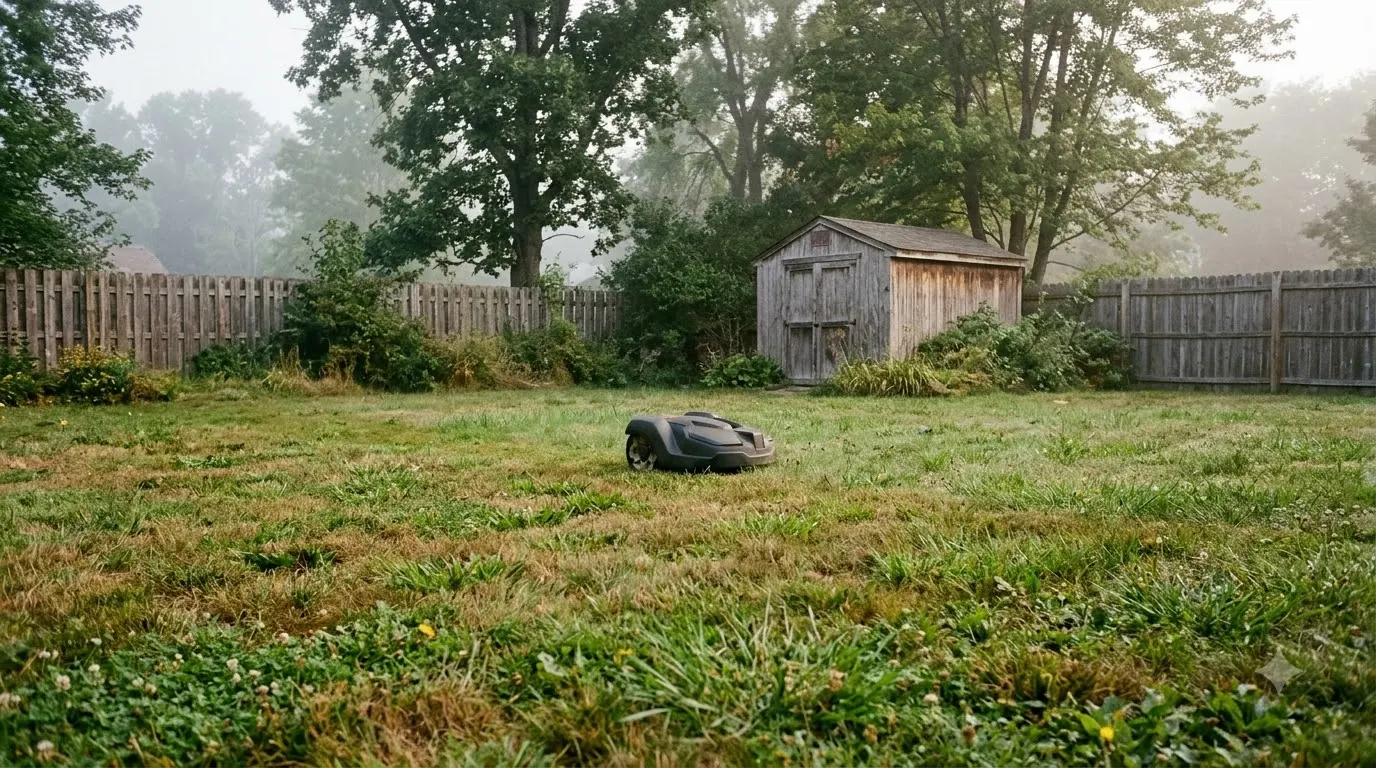

Choosing a robot mower for a yard with low-hanging weeping willow branches comes down to picking a low-profile machine with physical bump sensors and trimming the lowest frond tips above chassis height. Weeping willows present two distinct challenges for autonomous mowers: flexible hanging curtains that trigger optical obstacle avoidance and fallen twigs that can jam spinning blades. With proper canopy pruning and boundary setup, a boundary-wire or RTK-guided mower handles willow lawns reliably without constant rescues.
The short answer
- Sensor choice matters most: Ultrasonic, LiDAR, and camera-based avoidance systems often mistake hanging willow fronds for solid walls and turn away prematurely, leaving an unmowed ring around the tree.
- Bump-and-turn works under foliage: Mowers that rely on physical collision sensors push gently through soft, trailing branches and mow right up to the trunk.
- Prune to clear the chassis: Raising the lowest branch tips just above the mower deck prevents fronds from catching on top-mounted cameras, stop buttons, or rain sensors.
- Watch for woody litter: Weeping willows shed brittle twigs year-round; dual-disc or pivoting razor blades deflect small sticks better than rigid bars, though heavy branch drop still requires manual pickup.
- Root flares need a border: Shallow surface roots around mature willows can high-center a low-clearance chassis unless you mark them off with a boundary wire or no-go zone.
Why weeping willows confuse modern robot mowers
Trailing weeping willow foliage creates a vertical curtain of moving leaves that tricks non-contact obstacle sensors into treating open lawn as a blocked path.
Most newer robotic mowers use front-facing cameras, ultrasonic transducers, or 3D LiDAR to detect toys, pets, and furniture before making contact. According to Husqvarna Automower support documentation, ultrasonic and radar object detection systems are calibrated to slow down or steer around objects detected in the forward path to prevent collisions. Under a weeping willow, wind-blown fronds hang down into the sensor’s field of view, causing the mower to treat soft leaves like a brick wall and leave an unsightly unmowed halo beneath the canopy.
GPS and RTK satellite navigation also face interference beneath a dense willow crown. Thick overhead foliage attenuates satellite signals, which can cause a wire-free RTK mower to pause for signal recovery or drift slightly off its planned stripe. Machines that pair RTK with dead-reckoning wheel odometry or use a physical perimeter wire maintain steadier tracking under heavy summer leaf cover.

How different navigation and sensor systems cope
Matching the mower’s obstacle-detection hardware to your willow’s canopy density prevents false stops and missed grass patches.
Not every smart feature helps under a weeping tree. While vision-based AI helps identify garden hoses or lawn chairs in open sun, dappled shade and swaying branches reduce camera contrast and trigger frequent avoidance detours. Traditional bump-sensor designs—where the outer shell floats on springs and registers a soft push—ignore lightweight foliage and only reverse when the chassis meets genuine resistance like a tree trunk.
| Mower technology | Reaction to hanging fronds | Performance under dense canopy | Best fit for willow yards |
|---|---|---|---|
| Physical bump sensors only | Pushes right through soft leaves without stopping | Unaffected by shade or leaf cover | Strong match for low-hanging curtains |
| Ultrasonic / radar avoidance | Detects fronds as solid obstacles and turns early | Reliable tracking, frequent false turns | Works only if avoidance can be toggled off |
| AI vision cameras | Often flags swaying branches as objects to avoid | Lower accuracy in deep canopy shade | Requires pruning fronds above camera height |
| Boundary wire guidance | Follows exact buried loop regardless of foliage | Consistent signal under thick branches | Dependable perimeter and root-zone control |
| RTK satellite without wire | Depends on onboard optical or bump sensors | May lose satellite fix under heavy crowns | Needs multi-constellation or vision backup |
Many manufacturers allow owners to disable or reduce the sensitivity of ultrasonic and camera obstacle avoidance inside the companion app. If you prefer a wire-free model for the rest of your property, check the manual before buying to verify that object avoidance can be switched off or zoned out around trees.
Preparing a weeping willow yard before your first mow
A few targeted adjustments to branch height, surface roots, and twig cleanup keep your mower from getting trapped or hitting its emergency stop button.
Weeping willows grow rapidly and shed slender shoots after even mild summer breezes. According to University of Minnesota Extension guidance on weeping willows, these trees develop shallow, spreading root systems and drop frequent small branches throughout the growing season. Taking twenty minutes to prep the drip line prevents most mid-cycle error alerts.
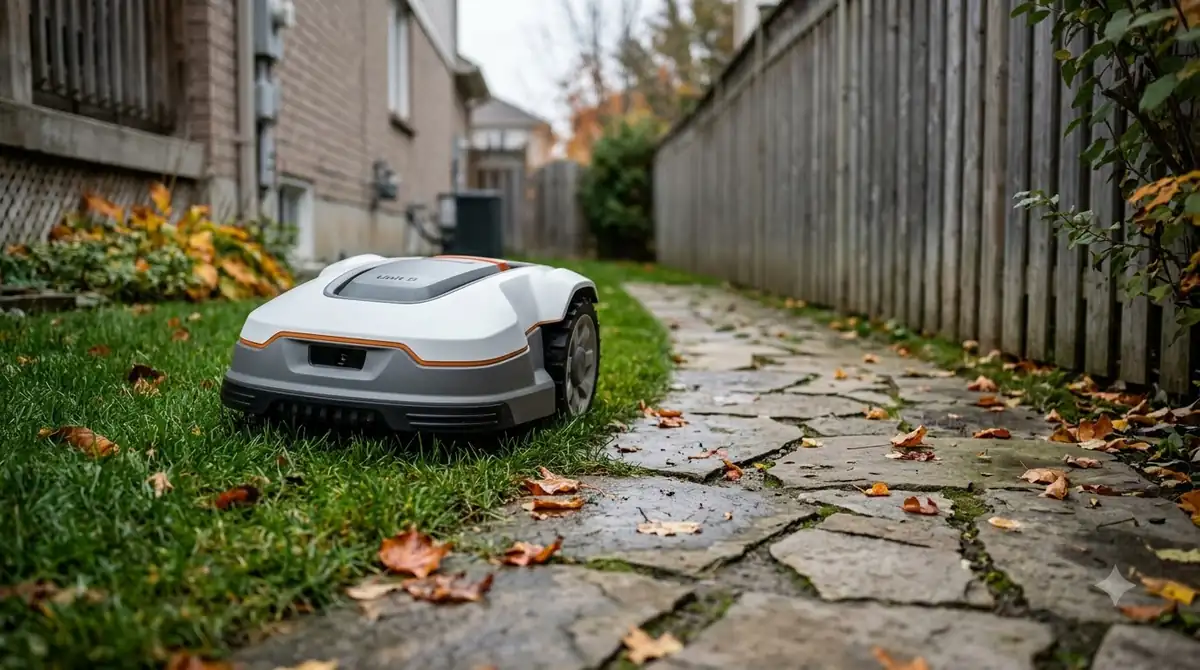
- Raise the canopy skirt above deck height. Trim trailing whip ends so they hang at least two to three inches higher than the top of your mower’s shell. This stops stiff twigs from pressing the top-mounted red stop button or snagging on exposed LiDAR turrets.
- Map out exposed surface roots. Walk the trunk zone and look for knobby roots rising above soil level. Install a boundary-wire island or draw a virtual no-go zone around tight root flares so the mower’s front caster wheels do not wedge or high-center.
- Clear woody twigs after windy days. Pivoting razor-style blades fold back when they strike a pencil-thin twig, but thicker willow shoots can wedge between the cutting disc and skid plate. Quick weekly twig sweeps protect blade life and prevent motor overload errors.
- Set a slightly higher cutting height under the shade. Grass beneath a weeping willow competes with tree roots for moisture and sunlight. Raising the deck height by one notch reduces scalping over uneven root soil and helps shaded turf stay thick.
Heads up
Avoid selecting a robot mower with a tall, exposed top-mounted LiDAR dome if you do not plan to prune your willow branches regularly. Whipping twigs can strike optical turrets directly or trigger false tilt and lift sensors as the mower pushes beneath low limbs.
Chassis features to prioritize for willow-heavy lawns
Low body clearance, protected blade discs, and strong rear-wheel traction make the biggest mechanical difference around mature willows.
When comparing models focus on physical geometry rather than maximum lawn acreage ratings:
- Low-profile shell height: A sleek, wedge-shaped chassis slips under arching branches without catching foliage on sharp corners or carrying handles.
- Floating cutting deck with skid plate: Willow roots create subtle undulations in the soil over time. A floating deck follows ground contours smoothly and shields the spinning blade hub from scraping against raised bark.
- All-wheel drive or aggressive rear tread: Damp shade beneath a weeping willow often leaves grass slick well into the morning, and fallen willow leaves turn slippery when wet. High-traction drive wheels keep the mower from digging ruts when turning near the trunk.
- App-configurable zone rules: Being able to set a low-sensitivity avoidance zone specifically under the willow canopy lets you keep full obstacle detection active across the open yard where pets and kids play.
Frequently asked questions
Will hanging weeping willow branches damage a robot mower?
Soft, leafy willow fronds will not scratch or break a mower shell, though stiff woody shoots can press top-mounted stop buttons or tangle around exposed sensors. Pruning branches just above the mower’s body height eliminates snagging while keeping the tree’s graceful shape intact.
Do weeping willow twigs ruin robot mower blades?
Small, flexible twigs usually bounce off pivoting razor blades without causing damage, though they dull blade edges faster than grass alone. Thicker fallen branches can jam the cutting disc and trigger a blade-blockage alert, so clearing heavy debris after storms is still necessary.
Is a boundary wire or GPS robot mower better under a weeping willow?
Boundary-wire mowers maintain consistent navigation under thick willow canopies because buried wire signals are unaffected by overhead leaves. GPS and RTK models work well if they include wheel odometry or vision backup to bridge brief satellite signal drops beneath dense foliage.
How high should I trim weeping willow branches for a robot mower?
Trim the lowest hanging tips so they sit roughly two to three inches above the tallest point of your robot mower. This clearance lets the machine pass freely underneath without catching branches on sensors, rain plates, or the emergency stop switch.
Sources
- Husqvarna Automower Support (Husqvarna): referenced for how ultrasonic and object-avoidance sensors respond to soft foliage and obstacles.
- Weeping willow care and growth habits (University of Minnesota Extension): referenced for shallow root spread and frequent twig-shedding behavior.
- Worx Landroid Support (Worx): referenced for ultrasonic Anti-Collision System behavior and boundary-wire island setup around tree roots.
 Up next7 min readBy YardBest Robot Mower for a Yard With Fallen Branches: What to CheckUpdated Nov 12, 2026
 7 min readBy YardHow Does a Robot Mower Handle Fallen Branches?Updated Nov 11, 2026
 7 min readBy YardWill a Robot Mower Get Stuck on a Lawn With Low Spots That Flood?Updated Nov 13, 2026
 6 min readBy YardBest Robot Mower for Fine Fescue: 1.5 Inch Low Cut GuideUpdated Nov 17, 2026
 7 min readBy YardRobot Mower for a Lawn With Low Spots That FloodUpdated Nov 10, 2026
 10 min readBy YardChoosing a Robot Mower for a Yard with a Metal Chain-Link Gate GapUpdated Nov 19, 2026