

Choosing a robot mower for a yard with a metal chain-link gate gap comes down to matching the mower’s navigation sensors and chassis clearance to both the narrow opening and the steel hardware surrounding it. A standard backyard chain-link walk gate creates two distinct challenges at once: tight physical squeeze points and electromagnetic or signal distortion caused by galvanized steel posts and mesh. With the right corridor setup, sensor fusion, or dedicated fence door, an automated mower can safely cross between front and back zones without scraping its shell or losing its bearings.
The short answer
- Measure the tightest choke point: Check both the horizontal width between gate posts (or under the bottom rail) and the vertical height of any metal threshold bar or tension wire.
- Keep metal away from wires and antennas: According to GARDENA support documentation, metallic objects within roughly 1 meter (about 3.3 feet) of a charging base or loop wire can distort electromagnetic signals, while Segway Navimow manuals warn against mounting GNSS antennas near metal gates.
- Prioritize multi-sensor navigation: Models pairing Real-Time Kinematic (RTK) GPS with onboard cameras (vision) or LiDAR handle metal-framed bottlenecks better than satellite-only units because local sensors track physical posts in real time.
- Install an automated fence portal if the gate stays latched: Purpose-built pet-safe portals like the Husqvarna Automower Fence Door or Segway Navimow MowGate cut into chain-link mesh to let the mower pass while keeping dogs contained.
- Dial in corridor width settings: On boundary-wire mowers, narrowing the corridor width setting prevents the machine from wandering into the steel posts as it tracks the guide wire through the opening.
Why a metal chain-link gate gap trips up standard robot mowers
A chain-link gate gap combines tight physical geometry with reflective, conductive steel that can confuse both buried-wire and satellite-guided mowers.
Most residential chain-link walk gates leave either a narrow vertical opening when swung open or a low horizontal gap beneath the bottom rail when closed. On top of the physical squeeze, galvanized steel posts, latches, and woven wire mesh interact with guidance signals in ways wood or vinyl fences do not. According to GARDENA USA support documentation, metallic structures within roughly 1 meter (about 3.3 feet) of a charging station or guide wire can interfere with the low-frequency loop signal, causing a mower to veer off-angle or fail to dock properly.
Wire-free mowers face a different version of the same problem. Satellite-based RTK systems rely on clean line-of-sight signals from overhead constellations and a local reference antenna. According to Segway Navimow installation guidelines, placing a GNSS antenna or base station immediately next to a metal gate can degrade positioning accuracy due to signal reflection (multipath interference). When a mower relies solely on satellite coordinates to thread a tight steel opening, even a slight signal bounce can push the chassis into a gate post or snag a wheel on a drop rod.
How different navigation systems cope with steel gate bottlenecks
Mowers that pair satellite positioning with local optical or laser sensors handle metal-framed passages far more reliably than single-sensor machines.
Residential robot mowers fall into three main navigation categories, and each reacts differently when crossing a metal chain-link threshold:
| Navigation type | How it handles metal gate gaps | Key installation requirement |
|---|---|---|
| Boundary wire + guide wire | Tracks a physical copper loop; steel posts within 1 meter can weaken or skew the electromagnetic field if wires sit too close. | Center a dedicated guide wire through the gate opening and lower the corridor width setting in the app. |
| RTK GPS only | Achieves centimeter-level accuracy in open sky, but metal mesh and nearby house walls can bounce satellite signals into float mode. | Keep the RTK reference antenna at least 1.5 meters high and well clear of the metal gate frame. |
| RTK GPS + Vision or LiDAR | Uses onboard cameras or laser pulses to see the physical steel posts and open gap directly, bridging brief GPS dips. | Map a clean virtual channel straight through the threshold and trim tall grass around the posts. |
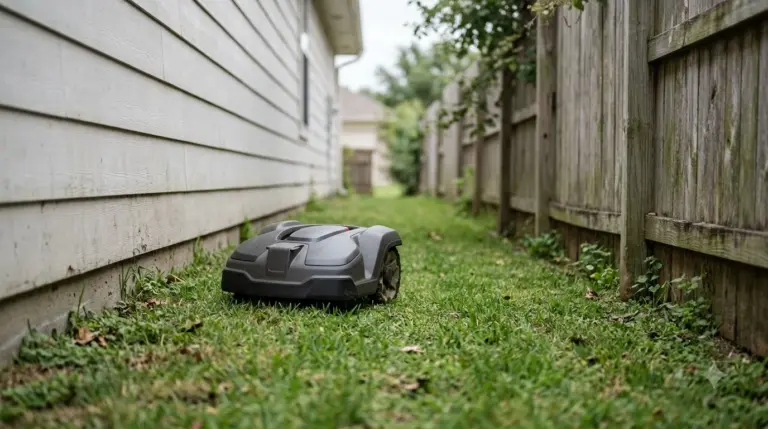
For yards with a narrow side gate tucked between a house wall and a chain-link fence, a hybrid system combining RTK with vision or LiDAR offers the strongest margin of safety. While RTK handles broad lawn striping, the forward-facing camera or laser array actively identifies the vertical metal posts and centers the mower through the gap without scraping the housing.
Heads up
Watch out for bottom tension wires, protruding cane bolts (drop rods), and uneven concrete gate sills. Even if the horizontal gap is wide enough, a raised metal threshold or sagging bottom tension wire can catch a mower’s front caster wheels or trigger its lift sensor.
Measuring and preparing your chain-link gate gap before buying
Taking four quick measurements around your gate frame prevents buying a mower that physically cannot clear the opening.
Before comparing models, walk out to the gate with a tape measure and check the passage in the exact state the mower will use it:
- Measure the narrowest horizontal clearance. If you plan to leave the gate latched and have the mower pass beside a post or through an adjacent gap, measure between the innermost metal hardware—including latch plates and hinges—rather than post-to-post. Husqvarna support documentation notes that wider all-wheel-drive models like the Automower 435X AWD require up to 2 meters (6 feet 6 inches) of passage width for optimal cutting, whereas compact models can thread much tighter corridors when guided properly.
- Check vertical ground clearance if passing underneath. Some homeowners raise a chain-link walk gate on its post collars so a low-profile mower can drive right underneath while the gate stays locked. Measure from the turf or paver surface to the lowest point of the bottom horizontal rail and any overhanging chain-link knuckles, leaving at least 2 inches of extra headroom above the mower’s stated height.
- Inspect the ground surface through the threshold. Chain-link gates often sit over worn dirt paths, exposed roots, or gravel. Lay flush pavers or level soil across the gate threshold so the drive wheels maintain steady traction and the cutting deck does not scalp the ground.
- Trim grass growing through the diamond mesh. Robot mowers keep their spinning blades inset from their outer bumpers for safety, meaning they cannot cut grass blades poking through chain-link fabric. Clear weeds and runners along the bottom edge manually so dangling vines do not fool optical obstacle sensors into thinking the gate is blocked.
Setting up a boundary-wire or wire-free path through the gate
Routing a centered guide wire or mapping a straight virtual channel keeps the mower from pinballing between metal posts.
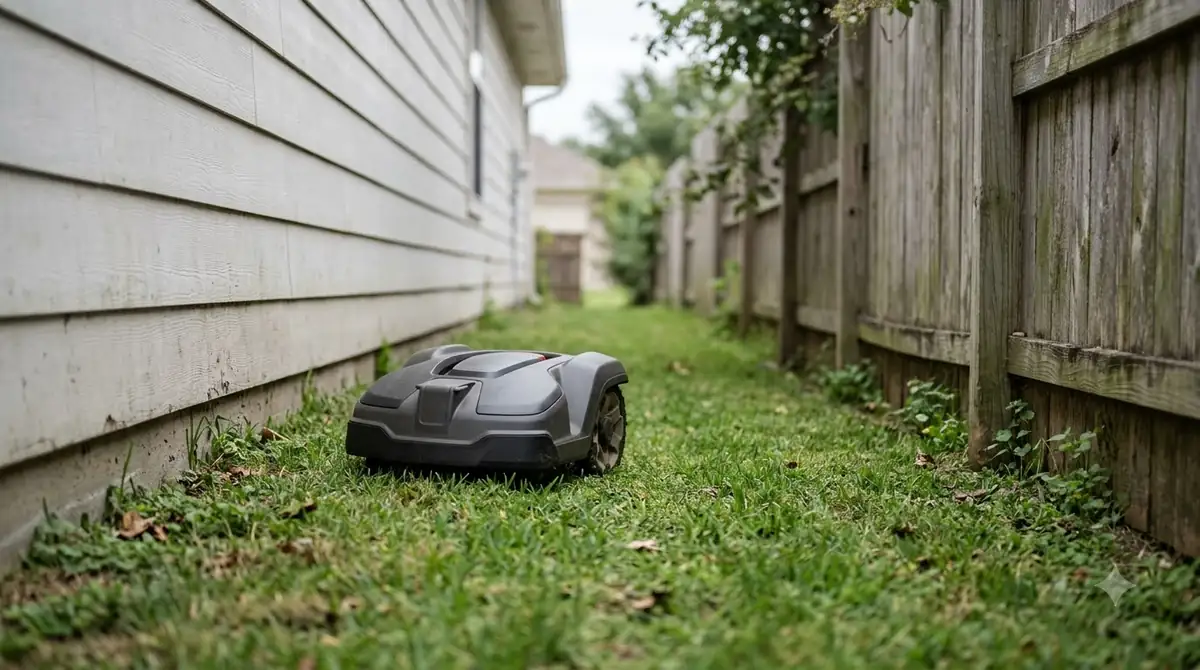
If you choose a traditional boundary-wire mower, laying a dedicated guide wire straight down the center of the gate opening is essential. According to Husqvarna’s installation guides, boundary-wire Automowers always travel to the left of the guide wire when facing the charging station, so offsetting the wire slightly gives the chassis maximum clearance from the steel post on its left flank. Once the wire is staked down, open the mower’s settings and reduce the Corridor Width value (which defaults to 6 for boundary wires and 9 for guide wires on Husqvarna models) down to a lower setting so the robot hugs the guide path instead of weaving wide into the fence.
If you choose a wire-free RTK or LiDAR mower, drive the unit manually via the smartphone app to create a dedicated connecting channel between your front and back mowing zones. Keep the channel path straight for at least 3 to 5 feet before and after the gate so the mower lines up square with the opening rather than turning sharply mid-gap. Also avoid placing your charging dock within 1 meter of the chain-link fence; position the base station against a non-metallic wall or open lawn border with clear sky overhead.
When to install an automated fence door for pet owners
If leaving your chain-link gate propped open is not an option because of pets or kids, a sensor-activated mower portal solves the access problem.
Leaving a walk gate ajar defeats the purpose of fencing in a yard, and manually opening the gate on mowing days quickly becomes a chore. Two major manufacturers offer purpose-built automated doors designed to mount directly into residential wire-mesh and chain-link fences:
- Segway Navimow MowGate: Built with a high-strength steel frame (inner opening of 33.46 by 17.72 inches) and IPX6 weather resistance, this battery-powered portal pairs with Navimow series mowers (including the i-Series, H2, X3, X4, and Terranox). When the mower approaches, its magnetic sensor triggers a 360-degree scan to confirm no pets are nearby before unlocking the swinging panels, then automatically relocks once the mower clears the threshold.
- Husqvarna Automower Fence Door: Designed for compatible Automower models (such as the 410iQ, 415X, 420iQ, 430X, 440iQ, and 450X), this powder-coated steel door runs on standard D-cell batteries, uses bumper rollers to guide the chassis smoothly through, and requires setting the mower’s corridor width to 5 or less.
Both units include cutting templates so you can snip a clean rectangular opening in the chain-link fabric, weave or bolt the rigid frame to the surrounding mesh, and let the mower cross between zones autonomously while keeping dogs safely inside.
Frequently asked questions
Will a metal chain-link fence block or break a robot mower’s boundary wire signal?
A chain-link fence will not physically break a buried boundary wire, but large amounts of metal within about 1 meter (3.3 feet) of the wire or charging base can distort the electromagnetic loop signal. Keeping the charging station away from the metal gate and centering a guide wire through the opening prevents erratic turning or docking errors.
How wide does a gate gap need to be for a robot lawn mower to pass through?
It depends on the specific mower’s deck width and navigation system. Compact models can often pass through corridors around 24 to 36 inches wide when centered on a guide wire or virtual path, while larger all-wheel-drive models like the Husqvarna Automower 435X AWD recommend up to 6 feet 6 inches (2 meters) of passage width.
Can an RTK GPS robot mower drive through a narrow metal gate without losing signal?
An RTK-only mower may experience brief satellite signal reflections near tall metal gates or adjacent house walls. Choosing an RTK model that also includes onboard vision cameras or LiDAR allows the mower to visually track the gate posts and pass through cleanly even if satellite accuracy temporarily drops.
How do I let a robot mower through a chain-link fence without letting my dog out?
You can either raise the bottom of a walk gate enough for a low-profile mower to slip underneath while keeping the gap too tight for your dog, or install an automated sensor-activated fence portal like the Segway Navimow MowGate or Husqvarna Automower Fence Door directly into the chain-link mesh.
Sources
- Robot mower parks at an angle (GARDENA USA Support): Used for the 1-meter metallic object interference radius around charging bases and guide wires.
- Navimow robotic lawnmower installation guide (Segway Navimow): Used for GNSS antenna placement clearance and avoiding metal gate signal interference.
- How to create a passage in an Automower boundary wire installation (Husqvarna Support): Used for guide wire offset rules and passage width requirements.
- How to adjust the corridor width in a boundary wire Automower (Husqvarna Support): Used for factory default corridor width numbers and narrow-passage adjustments.
 Up next9 min readBy YardCan a Robot Mower Work in a Yard With a Gate Between Zones?Updated Nov 11, 2026
 7 min readBy YardCan a Robot Mower Cut a Lawn With Metal Edging Strip?Updated Nov 12, 2026
 7 min readBy YardRobot Mower for a Lawn With a Narrow Side Gate: Width RulesUpdated Nov 14, 2026
 7 min readBy YardChoosing a Robot Mower for a Yard With Low-Hanging Weeping Willow BranchesUpdated Nov 19, 2026
 9 min readBy YardChoosing and Setting Up a Robot Mower for a Yard With Flagstone Walkways Set in GrassUpdated Nov 19, 2026
 7 min readBy YardChoosing a Robot Mower for a Yard with a Sloped Walkout Basement PatioUpdated Nov 19, 2026