
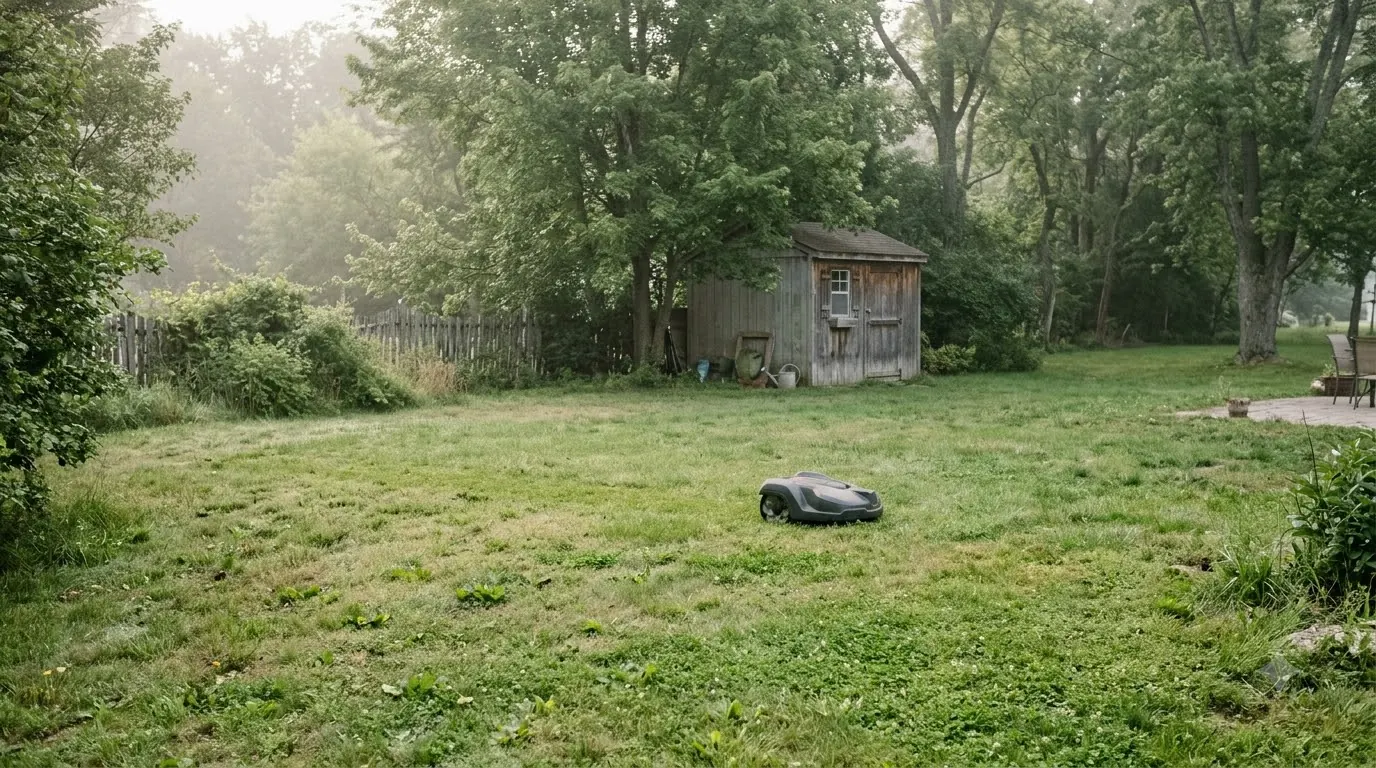

A robot mower for a lawn with steep culvert ditch banks is viable only when the bank incline stays within the machine’s rated boundary slope and the culvert opening is physically or virtually blocked off. Most standard two-wheel-drive models lose traction or slide at the edge of a drainage ditch, making all-wheel-drive units with higher edge-slope ratings the primary contenders. Getting a reliable cut without losing the mower into a stormwater pipe depends on measuring the grade accurately and setting strict perimeter buffers.
The short answer
- Edge limits matter more than peak ratings: A mower rated for steep middle-of-the-yard hills often has a much lower slope limit along its outer boundary where it must brake and turn.
- All-wheel drive is usually required: Standard rear-wheel-drive bots typically max out around 25% to 50% (14 to 26 degrees) inside a lawn, whereas AWD platforms like the Husqvarna Automower 435X AWD and Mammotion LUBA 2 AWD reach 70% to 80% (35 to 38.6 degrees).
- Culvert pipes need hard exclusion zones: Open pipe ends, concrete headwalls, and soggy ditch bottoms must be fenced out with boundary wire or virtual no-go zones so the chassis cannot drop in or submerge.
- Wet turf cuts traction drastically: Even high-traction tires slip sideways on dewy or rain-soaked ditch banks, so rain sensors and dry-afternoon schedules are essential.
Why culvert ditch banks challenge standard robot mowers
Roadside and yard drainage ditches combine severe pitch changes, damp soil, and open pipe hazards that quickly overwhelm standard residential robot mowers.
Unlike a gentle backyard hill that rolls smoothly into flat grass, a culvert ditch drops sharply from the yard or road shoulder down to a narrow trough before rising again. According to University of Wisconsin–Madison road drainage guidance, engineers generally recommend 4:1 side slopes (a 25% grade) for easier mowing and erosion control, while a 2.5:1 slope (40% grade) is considered near the practical maximum for conventional maintenance. Many residential driveway culverts, however, are cut even steeper to save yard space, pushing grades past 50%.
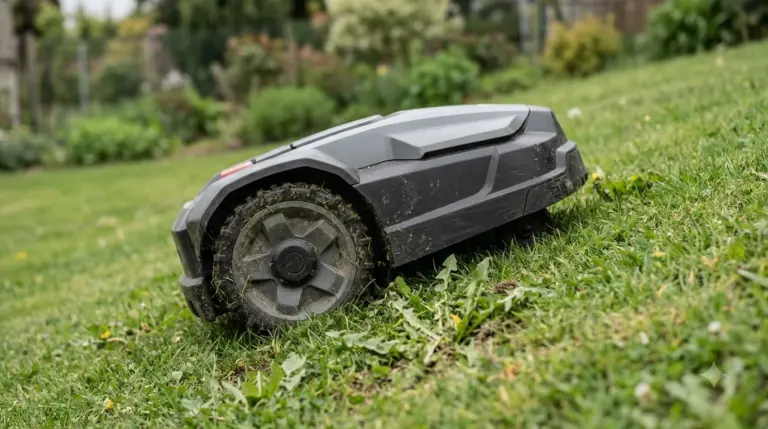
When a lightweight, two-wheel-drive robot mower approaches that breakover point, its caster wheels can lose ground contact, causing the unit to beach on its belly pan or skid sideways into the trough. Once at the bottom, standing water, silt, or exposed culvert headwalls present immediate mechanical risks. Open circular or box culvert ends can trap a mower’s front wheels or expose the chassis to pooling runoff after a storm.
Interior slope limits vs. boundary slope limits
Manufacturers publish two different incline ratings for steep terrain, and overlooking the lower boundary figure is the most common mistake on ditch-lined properties.
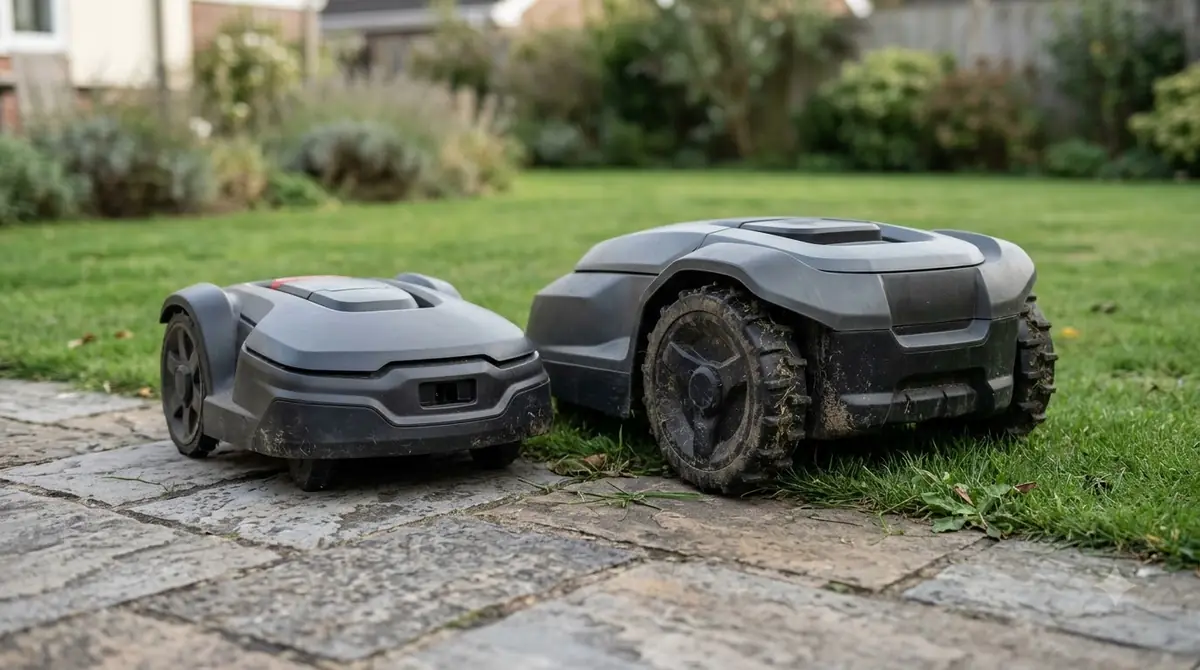
When a robot mower climbs straight up a slope in the middle of a lawn, gravity works predictably along its drive wheels. When that same mower reaches a perimeter wire or virtual border on a hillside, it has to decelerate, pivot 180 degrees, and accelerate back uphill without sliding past the boundary. Because turning sideways on an incline breaks tire grip, manufacturer manuals specify a separate, lower maximum incline for the outer edge of the work area.
Before selecting a machine, measure your ditch bank by placing a level board horizontally from the top edge and measuring the vertical drop down to the bank. Divide the vertical drop by the horizontal distance and multiply by 100 to get the slope percentage. Manufacturer specifications show a wide gap between standard models and heavy-duty AWD units:
| Mower category / example | Max slope inside work area | Max slope at boundary / edge | Drive system |
|---|---|---|---|
| Entry-level standard (e.g., Husqvarna Aspire R4) | 25% (14 deg) | 10% | Two-wheel drive |
| Mid-to-upper standard (e.g., Husqvarna 430X NERA) | 50% (26 deg) | 25% | Two-wheel drive |
| Articulated AWD (e.g., Husqvarna 435X AWD NERA) | 70% (35 deg) | 50% | All-wheel drive |
| Wire-free RTK AWD (e.g., Mammotion LUBA 2 AWD) | 80% (38.6 deg) | 45% (24 deg) | All-wheel drive |
If your culvert bank measures 45%, a standard mower rated for 50% interior slopes will still fail if you put the perimeter line along the ditch bank, because its edge limit is only 25%. In that scenario, you must either step up to an all-wheel-drive model or keep the mower strictly on the flat upper lawn.
How to map and wire a culvert ditch safely
Setting up a perimeter around a drainage ditch requires leaving level transition zones and isolating the culvert mouth completely.
According to Husqvarna’s steep-slope installation guidelines, AWD units operating on extreme grades between 50% and 70% need at least 50 cm (1.6 feet) of level ground as a transition zone between flat turf and the steep bank, plus a 1.5 m (5 feet) buffer between the bottom of the slope and the boundary wire. For boundary-wire installations, laying the guide wire straight or diagonally across the slope rather than horizontally prevents the mower from crabbing sideways while returning to the dock.
- Measure the steepest section of both banks. Check the grade on both the yard side and the road side of the ditch, since road shoulders are frequently steeper than the lawn side.
- Set the perimeter on flat ground if the bank exceeds edge limits. If the ditch side is steeper than your mower’s boundary rating, place the wire or virtual border back on the level lawn before the drop-off begins, then finish the ditch manually with a string trimmer.
- Create a hard exclusion zone around culvert openings. Wrap a boundary-wire island or draw a virtual no-go zone at least 1.5 to 2 feet clear of concrete headwalls, flared metal aprons, and open pipe mouths so a wheel cannot drop off the edge.
- Keep the ditch trough out of the mowing zone. Exclude the very bottom center of the drainage channel where water collects, soil stays soft, and gravel or washout debris accumulates.
- Angle systematic mowing patterns across the grade. For wire-free RTK or vision mowers that mow in straight lines, orient the cutting stripes diagonally (around 45 degrees) to the ditch bank rather than parallel to the trough so the mower climbs and descends at a controlled angle.
Heads up
Never rely on camera-only obstacle avoidance to detect a drop-off into a culvert pipe or an overgrown ditch edge. Tall grass often hides the lip of a concrete headwall, and once a front wheel drops over a vertical concrete edge, no software tilt sensor can pull the chassis back onto level turf.
Traction, weather, and maintenance on steep banks
Keeping a robot mower from sliding into a culvert requires managing turf moisture, tire tread, and mowing frequency throughout the season.
Damp grass acts like a lubricant on steep grades, dramatically reducing rubber tire grip even when the dry slope is well within the mower’s spec sheet. Enable automatic rain detection so the mower docks at the first sign of precipitation, and schedule ditch-bank zones for mid-afternoon when morning dew has evaporated. After heavy rainstorms, wait until the bank soil firms up before resuming automated runs, as soft mud causes aggressive lugged tires to tear out turf roots and create ruts.
Routine upkeep also directly affects climbing stability. Grass clippings packed into deep wheel treads turn high-traction tires into smooth slicks within a few wet cycles. Inspect and brush off the drive wheels weekly, and consider adding manufacturer terrain kits—such as weighted rear wheels or wheel brushes—if your model supports them. Finally, run the mower frequently enough to trim only the top fraction of the grass blades; letting ditch grass grow tall forces the cutting disc motors to work harder and increases the chance of the chassis high-centering on thick clumps.
Frequently asked questions
Can a standard two-wheel-drive robot mower handle a culvert ditch bank?
Only if the ditch has very gentle, engineered side slopes of around 25% (4:1 grade) or less and has no sharp breakover edge. Most residential culvert banks are steeper than 25% and require an all-wheel-drive robot mower or must be excluded from the mowing map.
Should a robot mower drive up and down a ditch bank or side-to-side across it?
Climbing straight up and down or at a 45-degree diagonal provides far better stability and traction than driving parallel along the side of the bank. Driving sideways across a steep culvert slope shifts weight onto the downhill wheels, increasing slippage and turf damage.
Do RTK GPS robot mowers lose satellite signal inside deep culvert ditches?
A shallow roadside ditch with an open sky view rarely blocks RTK satellite signals, though dense overhanging trees or tall roadside hedges above the ditch can cause positioning drift. Hybrid models that combine RTK with onboard AI vision or VSLAM handle brief sky obstructions along tree-lined ditches more reliably than pure-GPS units.
How far back from an open culvert pipe should I place the boundary?
Leave at least 1.5 to 2 feet of buffer outside any concrete headwall, metal end section, or drop-off opening, and ensure the perimeter line sits on stable, level ground rather than on the sloping lip of the pipe opening.
Sources
- Optimising an Automower installation for steep slopes (Husqvarna Support): Used for interior vs. boundary slope limits across standard and AWD models, transition zone clearances, and guide-wire routing rules.
- LUBA 2 AWD Series Specifications (Mammotion Support): Used for AWD maximum climbing slope (80%) and edge slope (45%) specifications.
- Road Drainage Bulletin (University of Wisconsin–Madison Transportation Information Center): Used for standard roadside ditch side-slope ratios (4:1 desirable, 2.5:1 maximum) and culvert drainage design context.
 Up next9 min readBy YardChoosing and Setting Up a Robot Mower for a Lawn with Steep Roadside Drainage SwalesUpdated Nov 19, 2026
 9 min readBy YardChoosing and Setting Up a Robot Mower for a Yard With a Wooden Boardwalk PathUpdated Nov 19, 2026
 9 min readBy YardChoosing and Setting Up a Robot Mower for a Yard With an Outdoor AC Condenser UnitUpdated Nov 19, 2026
 8 min readBy YardChoosing and Setting Up a Robot Mower for a Lawn with Creeping Thyme Between PaversUpdated Nov 19, 2026
 8 min readBy YardChoosing and Setting Up a Robot Mower for a Yard With Decorative River Rock BordersUpdated Nov 19, 2026
 9 min readBy YardChoosing and Setting Up a Robot Mower for a Yard With Flagstone Walkways Set in GrassUpdated Nov 19, 2026