

The answer to how do lidar robot mowers navigate is laser mapping. The mower fires laser pulses, times each return, and builds a 3D map of the yard, then follows that map instead of a buried boundary wire. LiDAR models generally work this way, as of 2026-11-09.
LiDAR is one of three common positioning approaches, next to RTK GPS and camera-based AI vision. Each has different strengths under trees, in shade, and around obstacles, so the right fit depends on your yard.
The short answer
- Sensing: a rotating LiDAR head measures distance in every direction.
- Mapping: a guided pass around the yard creates the map and any no-go zones.
- Positioning: the map gives relative position, and RTK GPS can be added for absolute position.
- Obstacles: LiDAR sees shape, while a camera with AI vision can tell what the object is.
How do lidar robot mowers navigate, starting with the sensor
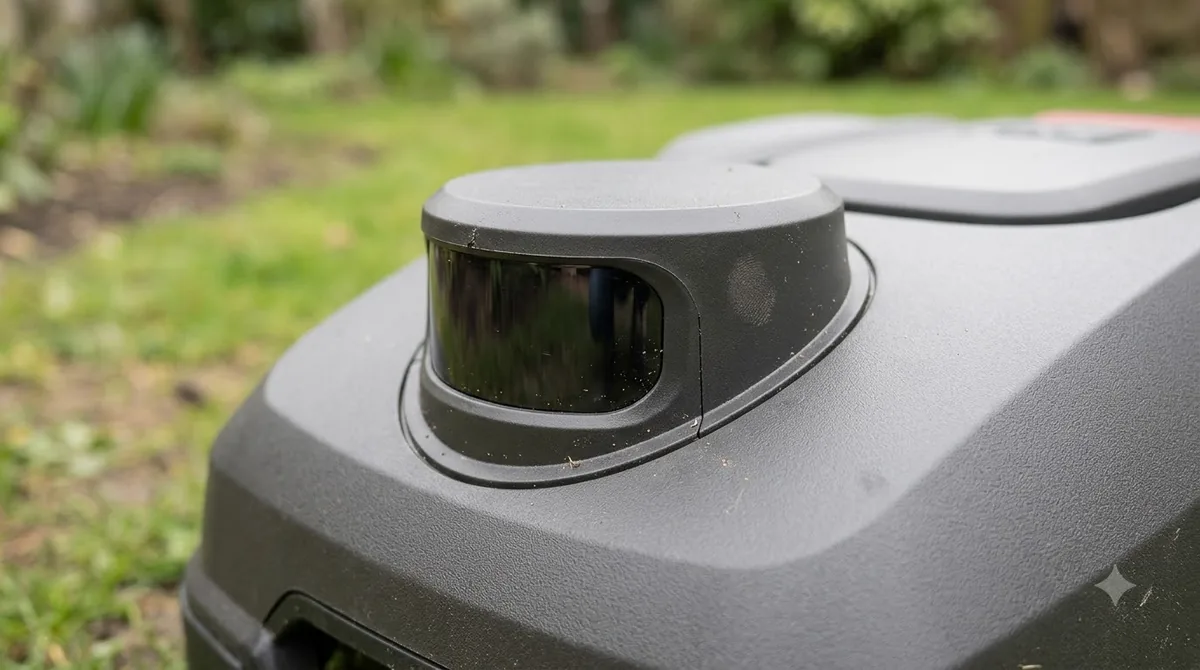
A LiDAR robot mower sees its surroundings by firing laser pulses and timing how long each one takes to bounce back, then turning those returns into a 3D picture. Resident’s LiDAR explainer describes the sensor as sitting on top of the mower and rotating to scan a full 360 degree view.
The same article describes the sensor firing hundreds of thousands of pulses per second. That speed is what lets the mower measure the distance to the grass edge, a fence, a tree trunk, or a garden bed as it moves.
Because the sensor brings its own light, it does not depend on daylight the way a camera does. That is the main reason LiDAR is pitched for shaded yards and dusk mowing, although the claims come mostly from manufacturers.
Building the map from a guided perimeter pass
A LiDAR mower builds its map during setup, usually by following or driving the yard boundary once in a guided pass, then stores the boundary, fixed obstacles, and working area. Mapping is the first half of the answer to how do lidar robot mowers navigate, and this setup pass shapes everything the mower does later.
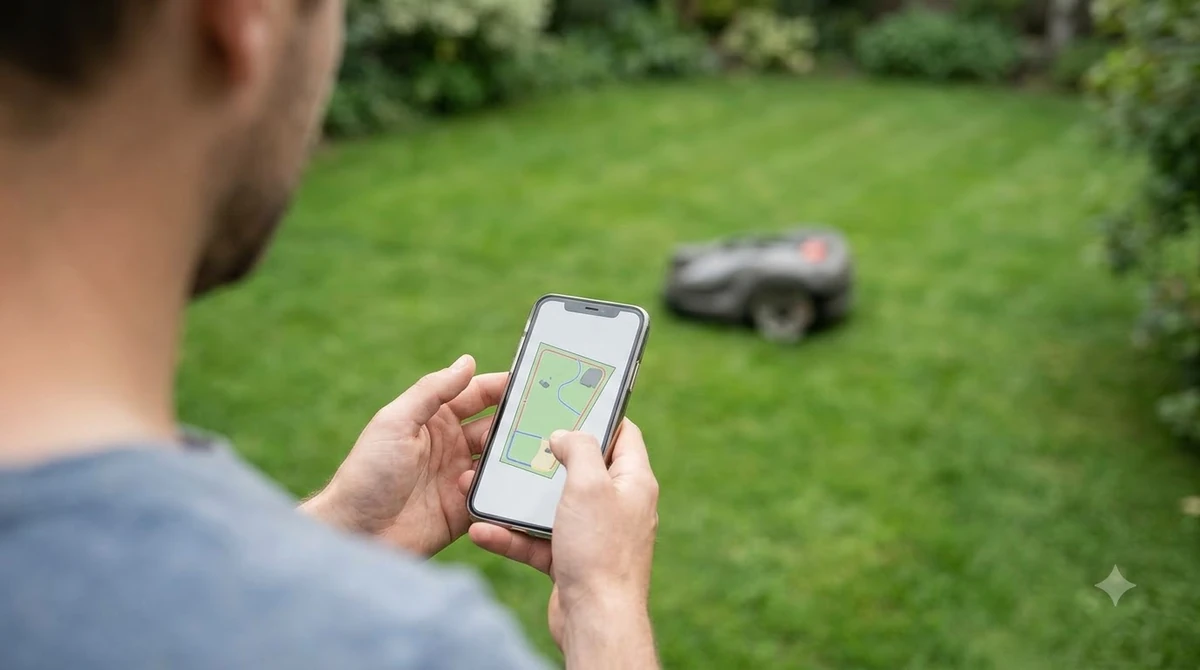
Depending on the model, you either walk the mower along the edge in follow mode or drive the perimeter in manual mode. The app then saves the outer shape of the lawn, the trees, beds, and posts inside it, and the area the mower is allowed to cut. Our explainer on virtual boundary mapping covers that idea in more detail.
- Start the mapping pass. Choose follow or manual mode, as the app describes for your model.
- Trace the perimeter. Keep the mower on the outer edge so the boundary is recorded in one loop.
- Mark obstacles and zones. Add beds, trees, and no-go areas in the app.
- Check the saved map. Look for gaps or odd shapes before the first full cut.
From the stored map, the mower plans coverage paths. Resident says this reduces redundant passes and handles corners more efficiently than random or simple parallel patterns. Our reading is that a clean, slow perimeter run is worth the extra minutes, because a poor map shows up as missed strips in the cut.
Heads up
Re-map after big changes to the yard, such as a new flower bed or a moved shed. A stale map can send the mower into areas you no longer want it to cut.
Localization: LiDAR, RTK, or both
LiDAR gives the mower a position relative to its own map, while RTK GPS gives an absolute position by correcting satellite signals, and some mowers combine both to cover each other’s gaps. Positioning is the second half of the answer to how do lidar robot mowers navigate, because a map is only useful if the mower can tell where it sits on it.
Mammotion describes LiDAR as giving relative, local accuracy without global positioning on its own. It says RTK is often within 1 to 2 cm, and that RTK performance can degrade under dense trees or near tall structures. Those are brand claims, so treat them as the maker’s view.
| Method | Strength | Weak spot |
|---|---|---|
| LiDAR mapping | Works from the yard map, with no satellite signal needed | Knows the shape of objects, not what they are; relative position on its own |
| RTK GPS | Absolute position, often within 1 to 2 cm according to Mammotion | Needs a clear view of satellites; the reference station needs an open spot at least 6.56 feet from buildings and trees, per Ecovacs |
| LiDAR plus RTK | Ecovacs describes LiDAR-enhanced RTK, which it says reaches 0.8 inch positioning precision | Costs more, since it carries two positioning systems; Resident describes LiDAR models as premium mowers |
The hybrid approach is one option for yards with partial tree cover, and our RTK vs LiDAR vs vision robot mower comparison lays the three side by side. The 0.8 inch figure is a brand number, and the sources we read do not include an independent test of it.

Obstacles: shape detection versus recognition
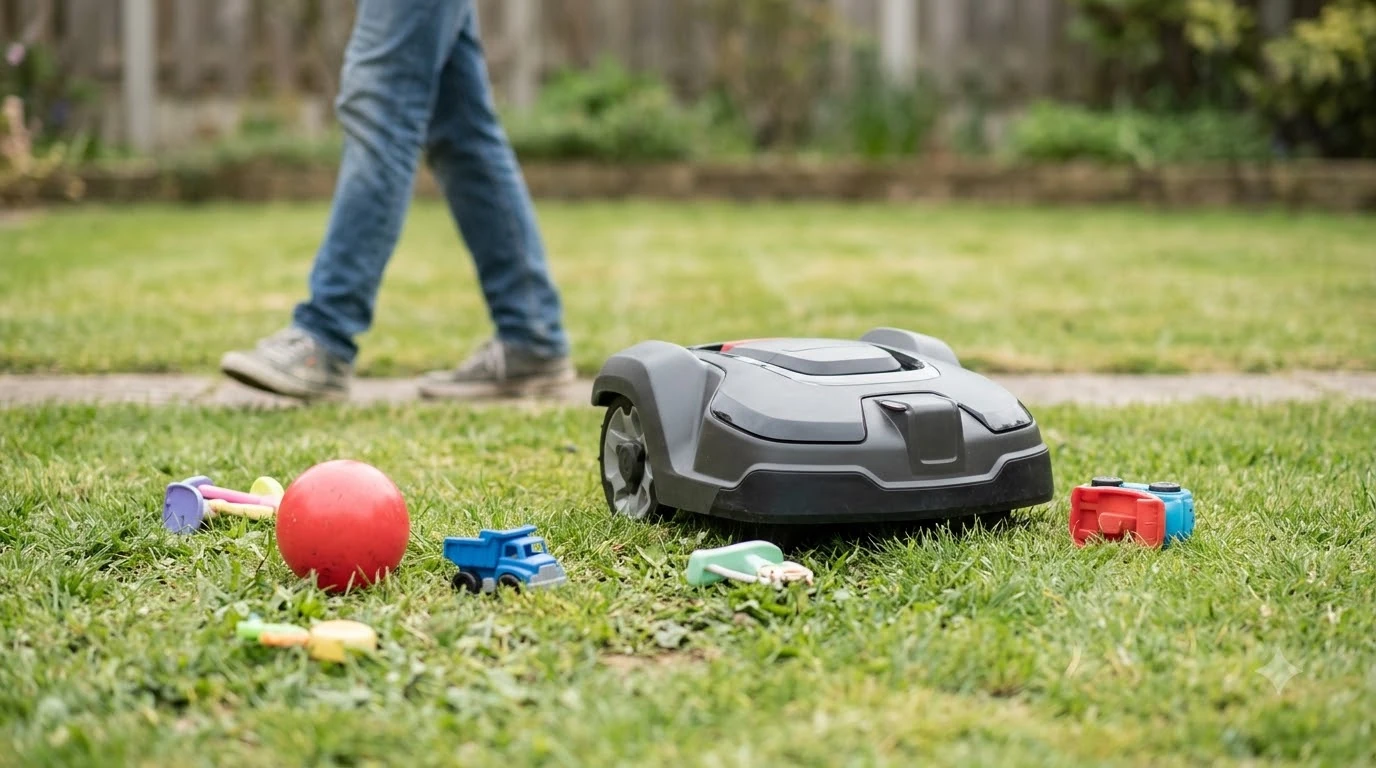
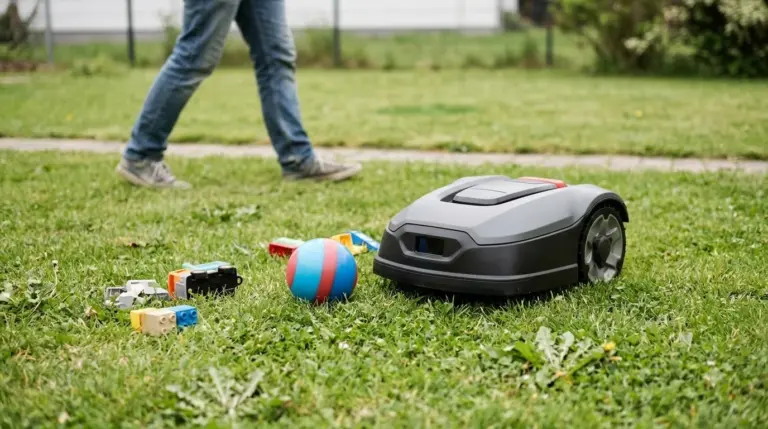
A LiDAR sensor detects that something is in the path and roughly what shape it has, but it cannot tell a garden hose from a branch unless a camera and AI vision add recognition. In a busy yard, this is the hardest part of how LiDAR robot mowers navigate.
Mammotion states the limit plainly: LiDAR detects shapes but does not understand what those objects are unless it is paired with AI vision. That matters for toys, hoses, pets, and branches, which are common on family lawns.
Ecovacs describes its GOAT A3000 LiDAR model as rerouting automatically when it detects an obstacle. Its AIVI 3D system combines a 150 degree fisheye camera, AI algorithms, and 3D time-of-flight LiDAR, and the article says it handles over 200 obstacle types in real time. Those are the maker’s figures, and no independent test backs them up.
Our reading is that a yard with many small items suits a model with both LiDAR and camera sensing. A clear lawn with few objects can often get by with LiDAR alone. For more on the detection side, see how robot mowers avoid obstacles.
Heads up
Obstacle claims come from manufacturers. Ask for the detection range and the test conditions before you rely on them.
Where LiDAR works well and where it struggles
LiDAR is marketed as working the same in shade, low light, and under tree cover, but the sources we read do not settle how it handles rain, dust, glass, or tall grass. Weather and light change how LiDAR robot mowers navigate in practice. The table below separates what is claimed from what is unknown.
| Condition | What the sources say | Our reading |
|---|---|---|
| Under tree cover | Mammotion says RTK can degrade there, while LiDAR performs consistently | LiDAR is the safer starting point where satellites are blocked |
| Shade and low light | Mammotion says LiDAR does not depend on daylight | Likely to help in dim yards, but confirm with owner reports |
| Rain | Ecovacs cites an IPX6 rating, and rain sensors pause operation; heavy rain is not covered | Mowing pauses in rain, but check the manual for heavy-rain behavior |
| Dust and glass | Not covered in the sources we read | Check the manual before buying |
| Tall grass | Not covered in the sources we read | Check the cutting height range and the grass height the manufacturer lists |
Wet grass is a separate concern. Ecovacs warns that wet grass can damage both the lawn and the mower, so most owners should plan to mow when the grass is dry, even with a weather-resistant model.
Heads up
Almost all of the sources here come from manufacturers and retailers. We could not find an independent university or government test that compares LiDAR, RTK, and boundary wire under the same conditions.
What to check before you buy
Before you buy a LiDAR mower, check the slope rating, the mowing area per charge, and how the model maps the yard. Those specs decide whether a model suits your lawn, not the sensor name alone.
- Slope rating. Navimow lists a 55 percent (29 degree) moderate slope rating for its i210 and i220 LiDAR Pro models. Compare that figure with the steepest part of your yard.
- Mowing area. Match the rated area per charge to your measured lawn, and leave headroom for slopes and obstacles.
- Mapping method. Confirm the setup pass, and whether you can add no-go zones in the app.
- Positioning backup. Ask whether the model needs an RTK reference station, or works with LiDAR alone. Our picks of the best LiDAR robot lawn mower with no RTK antenna cover the second kind.
- Return policy. Use the return window to check mapping and obstacle behavior in your own yard.
Frequently asked questions
How do lidar robot mowers navigate without a boundary wire?
They map the yard during setup and follow virtual boundaries and no-go zones, so no buried wire is needed. Some models still offer RTK or wire options, so check the spec sheet for the model you are considering.
Does a LiDAR mower work under trees?
Manufacturers say it does, and Mammotion contrasts LiDAR with RTK, which can degrade under dense trees. The sources we read do not include an independent test, so look for owner reports from yards with similar tree cover, such as those behind our LiDAR robot mower for a wooded lot page.
Can a LiDAR mower tell a toy from a branch?
Not by LiDAR alone. LiDAR sees the shape of an object, so it needs a camera and AI vision to identify it as a toy, pet, or hose. Ecovacs describes this kind of combined system in its AIVI design.
Is LiDAR better than RTK GPS?
Neither is better in every yard. LiDAR does not depend on satellite signals, while RTK needs a clear sky and an open reference station. Some models combine both, as Ecovacs describes with its LiDAR-enhanced RTK.
If your yard has heavy tree cover, compare LiDAR and RTK options side by side and look for independent test results before you pay the premium. Measure your slopes and lawn area first, then check each spec against those numbers.
Sources
- LiDAR in Robot Lawn Mowers: What It Is and Why It Matters (Resident): sensor, pulses, mapping pass, and no-go zones.
- AI Vision vs. RTK vs. LiDAR of Robot Lawn Mower (Mammotion, brand blog): LiDAR and RTK accuracy claims, tree and shade behavior, and obstacle limits.
- How Do Robot Lawn Mowers Work? A Simple Guide (Ecovacs, brand blog): reference station distance, LiDAR-enhanced RTK, rerouting, and rain behavior.
- How do robot lawn mowers navigate (Navimow, brand blog): slope rating for the i210 and i220 LiDAR Pro models.
 Up next8 min readBest Robot MowersRTK vs LiDAR vs Vision: Which Robot Mower Navigation Fits Your YardUpdated Nov 11, 2026
 8 min readBest Robot MowersHow Do Vision Robot Mowers Work?Updated Nov 11, 2026
 8 min readBest Robot MowersRobot Mower vs Push Mower: Which Fits Your Lawn?Updated Nov 11, 2026
 9 min readBest Robot MowersAre Robot Lawn Mowers Worth It? Who Benefits and Who Should SkipUpdated Nov 11, 2026
 7 min readBest Robot MowersRobot Mower vs Riding Mower: Which Fits Your LawnUpdated Nov 11, 2026
 8 min readBest Robot MowersHow Do Robot Lawn Mowers Work? Wire, Sensors and Docking ExplainedUpdated Nov 11, 2026