
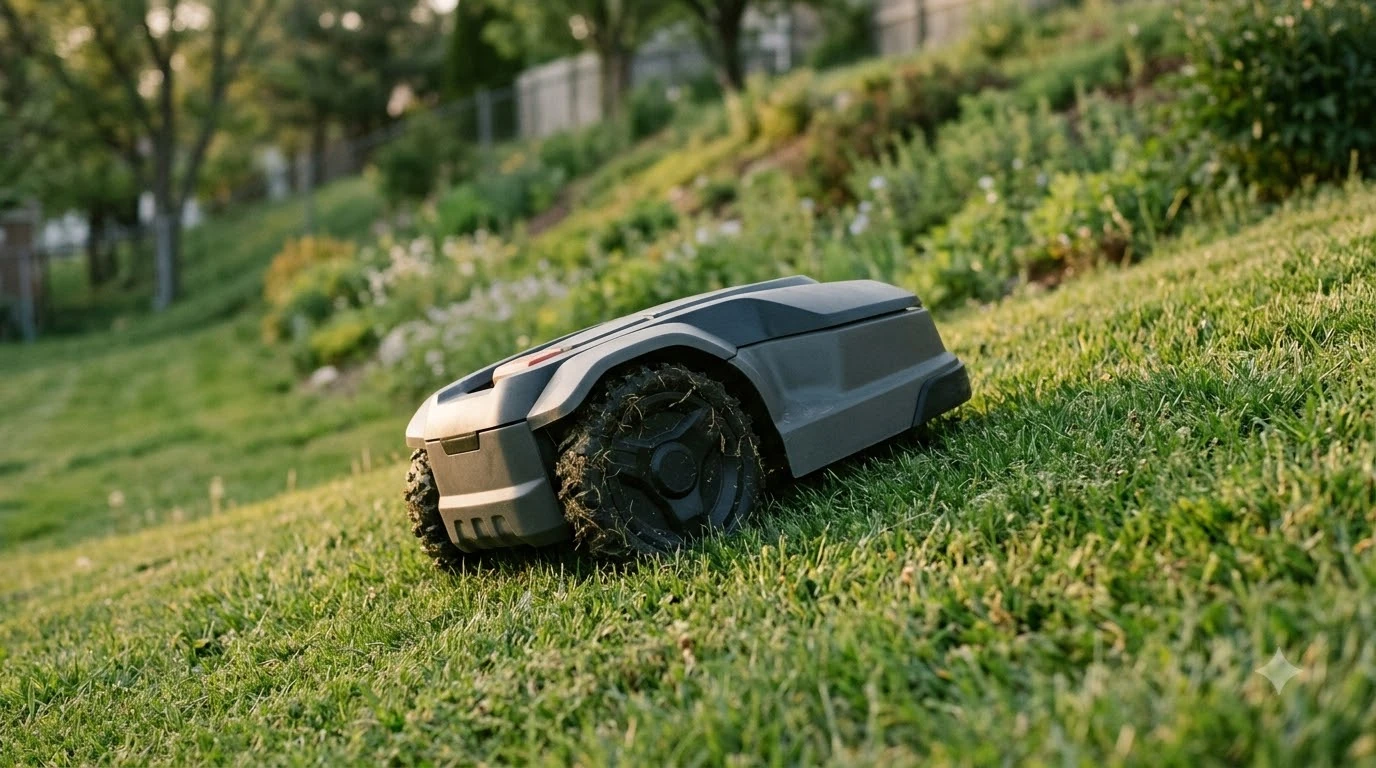

Do robot mowers work on bumpy lawns? Yes, most can handle small dips and bumps. Holes deeper than about 2 inches, ruts and wet grass are the conditions that cause trouble. Manufacturers describe mildly uneven ground as workable, and their published limits are mostly about slope, traction and lawn preparation.
The short answer
- Small bumps: usually fine, especially with large wheels and a floating or suspended cutting deck.
- Holes and ruts: the main risk. Fill holes deeper than about 2 inches before the first mow.
- Slope: compare ratings in percent, not only in degrees, because brands publish different figures.
- Wet grass: slipping is often a bigger problem than the bumps themselves.
Do robot mowers work on bumpy lawns with small dips?
Small, rounded bumps are the kind most robot mowers handle without trouble, because the wheels and cutting deck follow the ground. Robomow says its large wheels can maneuver over small holes and depressions, and that a pendulum-suspended cutting deck continuously adapts to the ground surface. Robomow’s guide to uneven surfaces describes these features in general terms, without bump sizes.
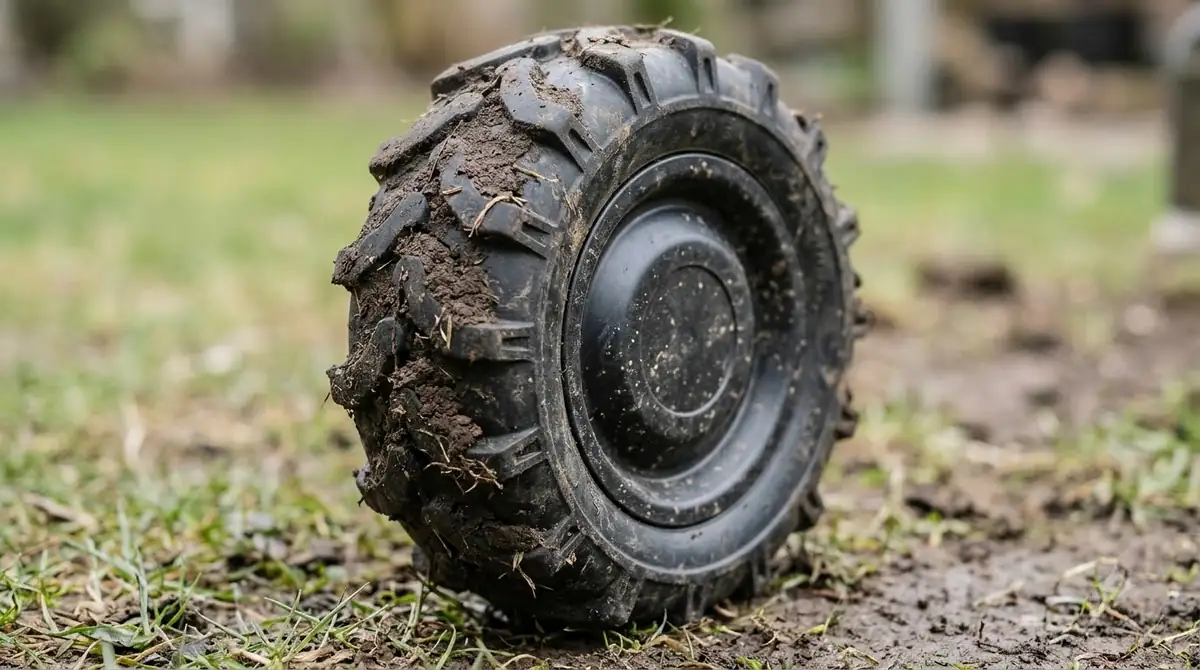
The limit is the shape of the bump. A gentle rise or a shallow dip is a different problem from a sharp drop. Robomow notes that lift and tilt sensors should cut the blade when ground contact is lost, which is the safety behavior to expect when the ground falls away sharply.
Holes, ruts and drop-offs cause most of the trouble
Do robot mowers work on bumpy lawns with deep holes and ruts? Only after you fix them, because those are the conditions that most often interrupt a robot mower. Anker’s guidance on uneven lawns lists deep holes, ruts, exposed roots, sharp drops near borders, loose stones and waterlogged ground as the main problem areas. Yarbo’s lawn advice sets one number: fill holes deeper than 2 inches so the blades can reach the grass.
- Holes deeper than about 2 inches: fill before the first run (vendor guidance).
- Ruts and sunken patches: level them, or set them as no-go zones. Ruts can also come from the mower itself, as explained in wheel ruts and brown patches from a robot mower.
- Exposed roots and loose stones: clear them, or they can damage blades and hardware.
- Sharp drops near borders: keep the boundary wire on flat ground, not on the edge of a bank.
Honda’s guidance on slopes and uneven gardens advises keeping very steep, heavily rutted areas out of the mowing zone and maintaining them separately. That advice fits a bumpy yard where one corner is much worse than the rest.
Slope ratings in percent and degrees
A slope rating in degrees and one in percent describe the same incline, and a 25-degree slope is about 47 percent. Sunseeker’s slope guide gives a conversion table, and its figures match the standard tangent calculation: 25 degrees is about 47 percent, and 35 degrees is about 70 percent. For hills rather than bumps, see how steep a hill a robot mower can handle.
| Degrees | Percent (approx.) |
|---|---|
| 15 | 27% |
| 20 | 36% |
| 25 | 47% |
| 30 | 58% |
| 35 | 70% |
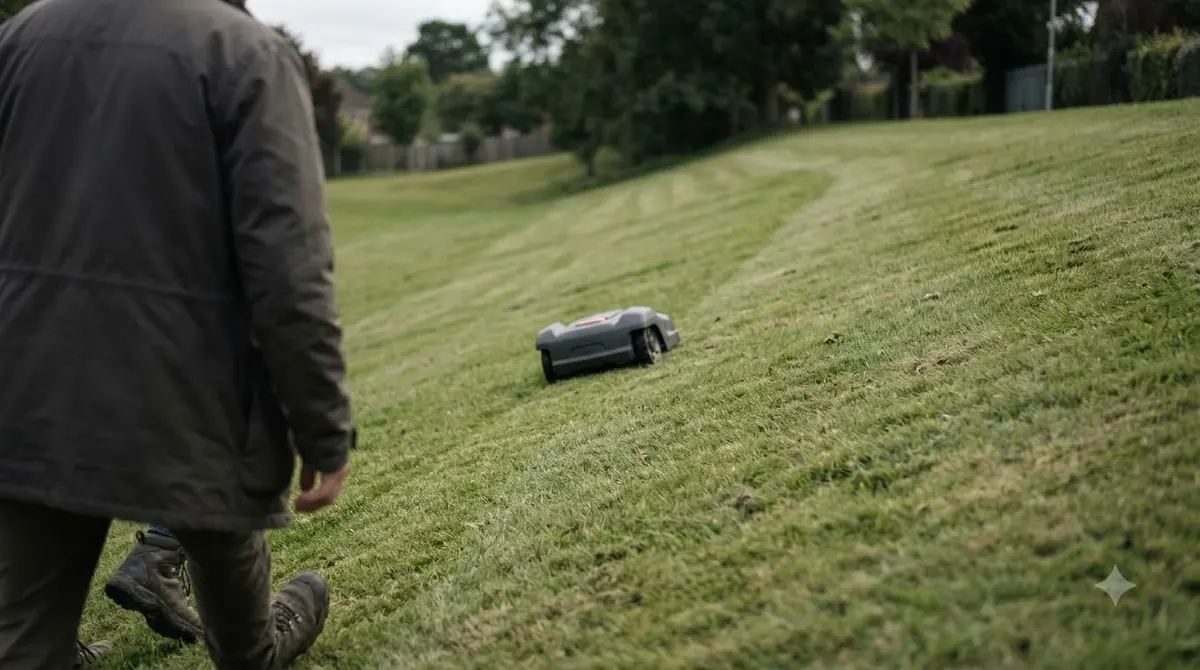
The ratings for different robot sizes also vary. Robomow notes that smaller robots are often rated for about 20 to 25 percent, while larger models can handle 45 percent or more. Sunseeker says gentle lawns typically stay under 15 percent, and that slopes of 20 to 30 percent need better traction and upgraded wheels. Honda lists its HRM models at up to 47 percent, which is 25 degrees.
Brands do not agree on the top figure. Yarbo claims up to 68 percent (35 degrees), while Anker’s table lists 40 to 70 percent for its premium models. Treat these as vendor claims, and compare the rating on the spec sheet with the steepest slope in your yard. For a wider explanation, see robot mower slope ratings explained.
Hardware that helps on uneven ground
Do robot mowers work on bumpy lawns with the right hardware? Wheel design, drive type and the cutting deck are the features manufacturers name for uneven ground. None of these removes the need to prepare the lawn, but each one changes how the mower handles bumps and slopes.
- Large wheels and deep tread: Anker advises deep-tread tires for outdoor terrain, and Robomow says coarse tread or spikes help on damp slopes.
- All-wheel drive: Anker calls AWD arguably the most important feature for slope performance. See AWD robot mowers explained.
- Floating or pendulum deck: keeps the cut height more even as the ground changes.
- Suspension: Yarbo describes shock-absorbing suspension for a smoother ride on uneven ground.
- Rubber tracks: Anker notes some premium models offer them for extreme conditions.
Not every model has all of these. A basic two-wheel-drive robot with a fixed deck can still manage a gently bumpy lawn, but it has less margin on slopes and in wet grass. Our reading is that the drive system matters most once the lawn has both bumps and inclines.
How to prepare a bumpy lawn before the first mow
Fill dips and holes deeper than about 2 inches with topsoil or a soil-and-sand mix, and clear stones before the first run. Anker and Yarbo both give lawn preparation steps that fit this approach, and neither publishes a target height for the first cut.
- Walk the lawn. Mark deep dips, sunken patches and ruts before setup.
- Fill low spots. Use topsoil or a soil-and-sand mix, and firm it down.
- Clear the surface. Remove stones, fallen branches, toys and loose edging.
- Start high, then lower. Begin at a higher cutting height and lower it once the lawn is even.
- Aerate and drain. Aerate compacted soil and fix puddled areas so the ground stays firm.
- Set no-go zones. Use the app or boundary wire to keep the mower away from the worst spots.
Wet grass is a bigger risk than most bumps
Wet grass, loose soil and steep inclines make wheels slip, and manufacturers advise pausing hillside mowing during heavy rain. Robomow warns that the device is in danger of slipping, particularly in wet weather. Honda suggests avoiding mowing in wet conditions where possible, especially early in the morning when dew is present.
Heads up
None of the pages we read gives a moisture threshold or a wet-ground slope limit. Do not assume a model that handles a dry slope will handle the same slope after rain. For more on rain and dew, see mowing wet grass with a robot mower.
What to check before you buy
Do robot mowers work on bumpy lawns like yours? Check the slope rating in percent, the drive type and the deck design against your lawn’s worst bump and steepest slope. Our reading is that these three checks matter more than any single headline number.
- Slope rating: compare the percent figure with your steepest measured slope.
- Drive type: two-wheel drive is usually enough for gentle bumps, while AWD gives more margin on inclines.
- Deck design: a floating or suspended deck helps when the ground changes height across the cut.
- Yard prep: budget time to fill holes and clear stones before the first run.
Frequently asked questions
Can a robot mower handle a lawn with small bumps?
Yes. Most modern robot mowers handle mildly uneven lawns, especially with large wheels and a floating or suspended cutting deck. Problems tend to start with deep holes, sharp drops and ruts rather than gentle undulation.
How deep can a hole be before a robot mower struggles?
Yarbo’s lawn guidance says to fill holes deeper than 2 inches so the blades can reach the grass. That is a vendor recommendation, not an independent test, so check your model’s manual for its own guidance.
Do I need all-wheel drive for a bumpy lawn?
Not always. Anker calls AWD arguably the most important feature for slope performance, which matters more when the bumps sit on a slope. For gentle bumps on flat ground, wheel design and the deck usually matter more.
Do robot mowers work on bumpy lawns after rain?
Yes, with caution. Wet grass, loose soil and steep inclines make wheels slip, and manufacturers advise pausing hillside mowing during heavy rain. Mowing in wet conditions adds risk on any uneven ground.
Sources
- Can a robotic lawnmower mow well on uneven, difficult surfaces? (Robomow): smaller and larger robot slope ratings, wheels, deck, sensors, wet-weather slip.
- Can robotic lawn mowers handle slopes and uneven gardens? (Honda UK): HRM slope rating, passage width, exclusion of steep rutted areas, dew advice.
- Robot lawn mowers on uneven or sloped lawns (Sunseeker): degree-to-percent conversion, typical lawn slopes, traction notes.
- Do robot mowers work on uneven lawns? (Anker, formerly the Eufy blog): problem areas, AWD, deck, tread, lawn preparation.
- Do robot mowers work on uneven lawns? (Yarbo): 2-inch hole guidance, suspension, lawn prep steps.
 Up next8 min readBy YardRobot Lawn Mower for Bumpy Uneven Lawn: What to Check FirstUpdated Nov 11, 2026
 9 min readBy YardHow Do I Know If a Robot Mower Will Work in My Yard?Updated Nov 11, 2026
 7 min readBy YardCan a Robot Mower Cut Mixed Weedy Lawn? What to KnowUpdated Nov 11, 2026
 10 min readBy YardWhen to Mow New Sod: First Cut Height and Root TestUpdated Nov 11, 2026
 9 min readBy YardWhen to First Mow New Grass Seed (Height, Not Calendar)Updated Nov 11, 2026
 9 min readBy YardRobot Mower for Terraced Yard: What to Check FirstUpdated Nov 11, 2026