
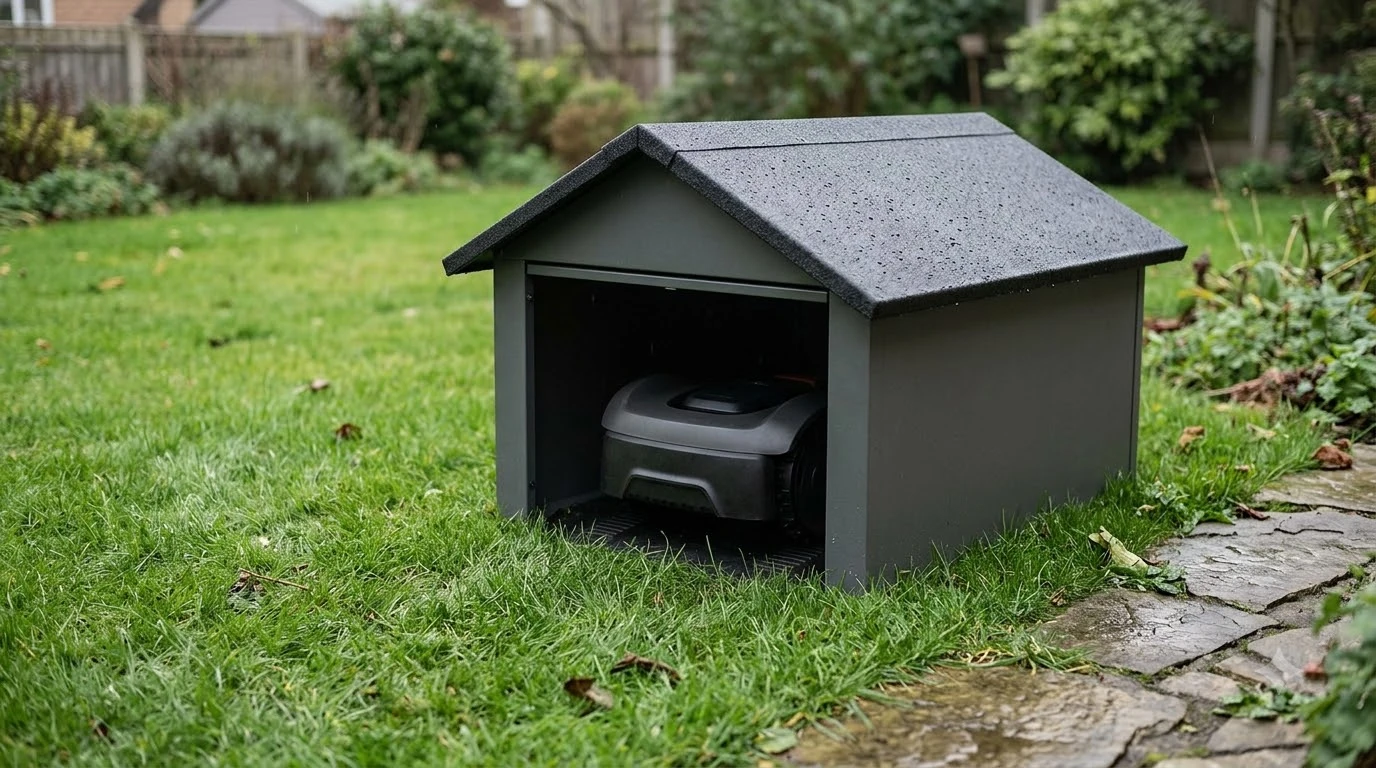

Can a robot mower work in a yard with a detached garage? Yes, in most yards. The building is treated as an obstacle that the boundary wire goes around. Manufacturer guidance puts the wire about 30 to 35 cm from solid walls, so the garage does not block the mower by itself. What matters is whether the lawn route between the garage and the charging station is open and wide enough.
The short answer
- The garage itself: it does not block the mower, because the wire routes around the building.
- Wall clearance: keep the boundary wire 30 to 35 cm from walls, fences and raised beds.
- Narrow gaps: passages narrower than 2 m need a guide wire, according to Husqvarna.
- Station: the wire should run straight for at least 2 m in front of the charging station.
- Shelter: a garage over the charging base is optional, but helpful where the base sits in full sun and rain.
Can a robot mower work in a yard with a detached garage?
So can a robot mower work in a yard with a detached garage? Yes. A detached garage does not stop a robot mower, because the boundary wire is laid around the building like any other solid obstacle. The mower works the lawn inside the wire and turns away when it reaches the wire. The garage only becomes a problem if it cuts off the route between the lawn and the charging station, or if the gap beside it is too narrow to drive through.
A detached garage is not the same thing as a mower shelter. The shelter is a small cover over the charging base, while the garage is the building on the property. Anker’s guidance on robot mower garages calls a shelter “not essential, but definitely helpful,” which means the detached building and the mower’s cover are separate questions. Our reading is that you should plan the wire around the building first, then decide whether a shelter is worth buying. For the shelter question on its own, see whether a robot mower needs a garage.
How far should the boundary wire stay from a garage and paths?
Keep the wire away from hard edges so the blades do not strike the building and the mower does not clip raised beds. Anker’s boundary wire guide gives specific clearances for each type of obstacle, and these are the numbers to use when you lay the wire around a detached garage.

| Obstacle or edge | Clearance from the wire |
|---|---|
| Walls, fences, raised beds | 30 to 35 cm (12 to 14 in) |
| Flower beds, hedges, paths level with the grass | 10 to 15 cm (4 to 6 in) |
| Ponds | 35 cm (14 in), with a physical barrier |
The guide does not give a clearance for trees, and it notes that not every sturdy tree needs wire around it. The guide gives no driveway figure, so check the model manual before you set a driveway gap. A useful rule is to keep the wire outside the garage wall, not hugging it, because a wall-hugging wire leaves no room for the mower to turn.
Heads up
Anker’s guide says the wire can be pegged above ground every 1 meter if you do not bury it. Pegging is one option around a garage where digging is awkward.
When does a guide wire help reach a detached garage?
A guide wire helps when the mower must pass through a narrow gap or follow a long route to a separate area. Husqvarna recommends a guide wire for any passage narrower than 2 m, and says its guide wires can handle passages as narrow as 60 cm. If the path between the house and the garage is tight, this is the setting that decides whether the mower gets through.
- Passage width: 2 m or more needs only the boundary wire, and under 2 m calls for a guide wire.
- Spacing: keep at least 30 cm between the guide wire and the boundary wire.
- Loop length: a guide wire loop over 400 m, or 150 m on the Aspire R4, may make navigation difficult.
- Joints: connect the guide wire to the boundary wire with an Automower coupler, and do not let the two wires cross.
- Wire type: use the same wire type throughout the installation.
- Angles: avoid sharp bends above 45 degrees, because the wire needs a smooth path.
Husqvarna’s guide notes that a wire running on a slope should go diagonally for better traction. If the route to the garage climbs a bank, that tip matters more than the distance itself. Our reading is that a guide wire is a better choice than a wide detour when the direct route is tight, because the detour adds wire length and makes the loop harder to maintain. Laying boundary wire around trees and obstacles covers the routing in more detail.
Where should the charging station sit for a detached garage?
Getting the station right decides whether the setup works day to day. For more on siting the base, see where to put a robot mower charging station. Place the charging station where the boundary wire can run straight in front of it for at least 2 m, and straight behind it for about 1 m. Anker gives those lengths for its boundary wire, and Husqvarna gives the same 2 m minimum for a straight run from its station. The station needs a clear approach path, so the mower can line up and dock without a sharp turn.
- Find a level spot. Anker advises a stable, level surface for the base.
- Leave room in front. Keep the 2 m straight run clear of trees, edging and garden beds.
- Check the sensors. Make sure nothing blocks the mower’s sensors when it approaches.
- Consider sun and rain. Anker says a garage placed directly over the base helps where the base sits exposed to direct sun and rain.
- Watch the temperature. Anker lists 0 to 45 C (32 to 113 F) as the range where most systems work best.
Do wire-free robot mowers need a boundary wire near a garage?
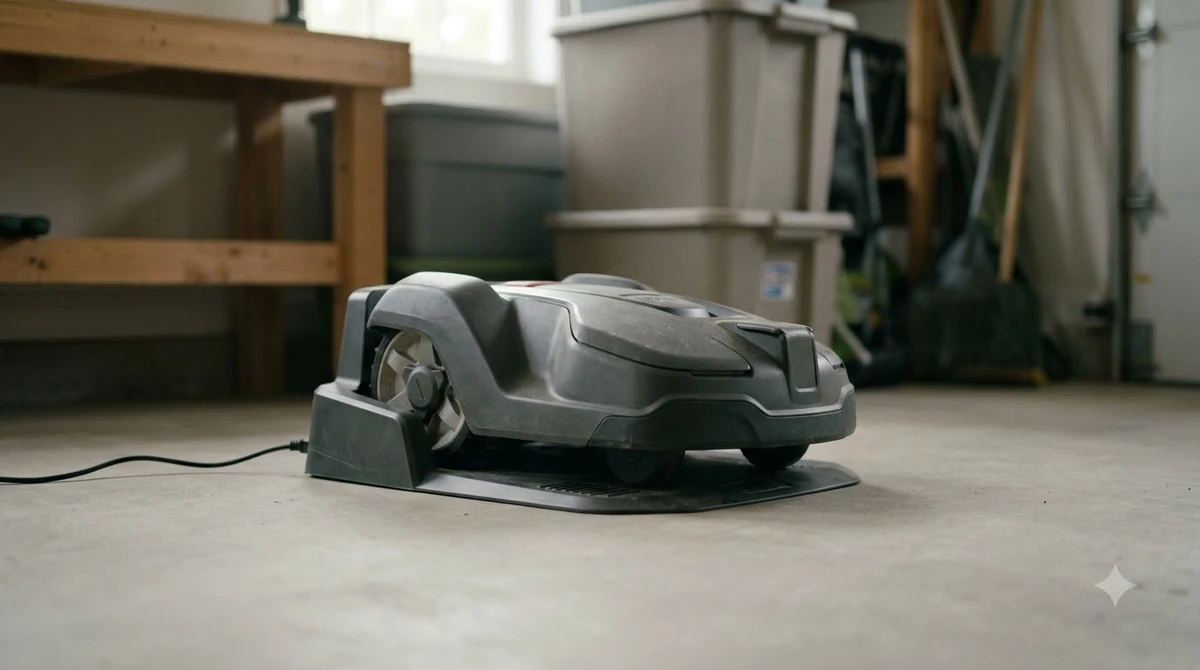
Wire-free models handle a detached garage without any buried wire around the building. The app zones do the job the wire does. Husqvarna describes its wire-free systems as using satellite-based virtual boundaries, with stay-out zones that you set in the app. A zone around the garage replaces the wire loop. If you are weighing the two approaches, wire-free versus boundary wire robot mowers compares them.
Husqvarna’s page does not give sizes or distances for these zones, so you cannot compare them with the wire clearances above from that source alone. Check the specific model’s app and manual for the minimum zone size and how close the zone can sit to the building. Our reading is that a wire-free model suits a garage in an awkward spot, but it still needs a clear route for the mower to reach its charging station.
What to check before you install near a detached garage
Before you decide whether a robot mower can work in a yard with a detached garage like yours, measure the route between the garage and the charging station. The steps below turn the clearances above into a short checklist you can run in the yard.
- Measure the narrowest gap. If it is under 2 m, plan a guide wire, and keep the gap at 60 cm or more.
- Mark the wall line. Leave 30 to 35 cm between the wire and the garage walls.
- Check the station run. Confirm you have 2 m of straight wire in front and about 1 m behind the station.
- Read the model manual. Clearances for driveways and the minimum size of a stay-out zone differ by brand, so take those numbers from the manual.
- Plan for weather. If the base sits in full sun and rain, budget for a shelter placed directly over it.
Frequently asked questions
Can a robot mower work in a yard with a detached garage if the gap between them is narrow?
Yes, if the gap is wide enough for the mower and the boundary wire can route around the buildings. Husqvarna recommends a guide wire for passages narrower than 2 m, so a tight gap usually needs one.
Can a robot mower work in a yard with a detached garage without buried wire?
Yes. Anker’s guide says the wire can be pegged above ground, with pegs every 1 meter, instead of buried. Keep the wire straight in front of the charging station either way.
Can a robot mower work in a yard with a detached garage and no shelter for the base?
Yes. Anker’s garage article calls a shelter not essential, but helpful when the base sits exposed to direct sun and rain. A detached building on the property is a different thing from the mower’s shelter.
Can a robot mower work in a yard with a detached garage using a stay-out zone instead of wire?
On wire-free models, yes, using stay-out zones set in the app. Husqvarna does not publish zone sizes on its install page, so check the model manual for the minimum size and spacing before you draw a zone close to the garage.
Sources
- How to lay a guide wire in a boundary wire Automower installation (Husqvarna): guide wire length limits, 2 m straight run, 60 cm passage, 30 cm spacing, coupler and angle rules.
- How to install a robotic lawn mower (Husqvarna): wire-free virtual boundaries and stay-out zones, and the shelter FAQ.
- Robot lawn mower boundary wire installation (Anker, eufy brand): clearances from walls, flower beds and ponds, station wire runs, peg spacing.
- Robotic lawn mower garage: do you need one (eufy): garage necessity, placement over the base, approach path and operating temperature range.
 Up next8 min readBy YardCan a Robot Mower Work in a Yard With Gravel Path Crossings?Updated Nov 11, 2026
 9 min readBy YardCan a Robot Mower Work in a Yard With a Gate Between Zones?Updated Nov 11, 2026
 9 min readBy YardCan a Robot Mower Work in an L-Shaped Yard?Updated Nov 11, 2026
 8 min readBy YardRobot Mower for Narrow Side Yard Passages: What Widths Work?Updated Nov 11, 2026
 9 min readBy YardHow Do I Know If a Robot Mower Will Work in My Yard?Updated Nov 11, 2026
 7 min readBy YardCan a Robot Mower Work in a Long Narrow Yard?Updated Nov 11, 2026