
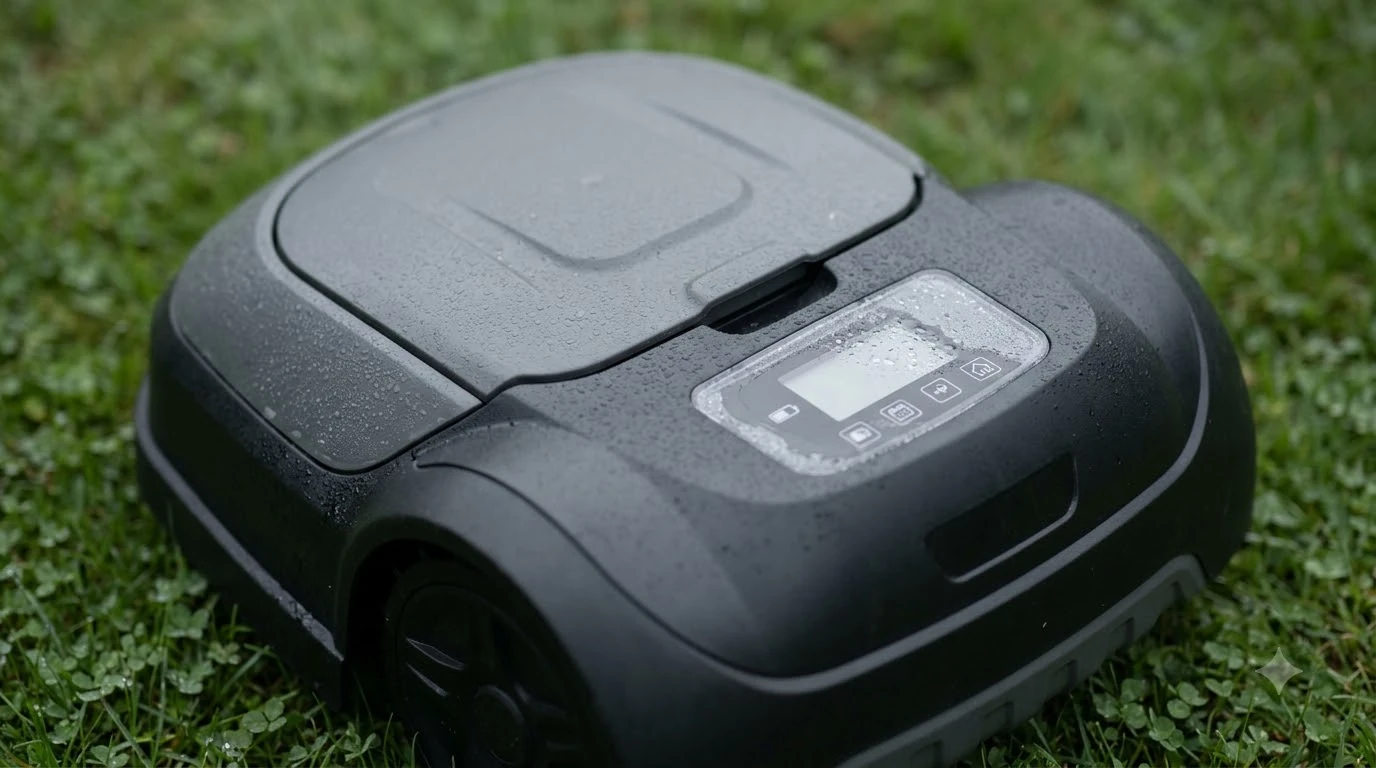

A robot mower IP rating explained in one line: it is a two-digit code from the IEC 60529 standard that shows how well the mower resists dust and water. For lawn use, the water digit matters most, and the common outdoor ratings are IPX4, IPX5 and IPX6. A higher number means tougher tests, but none of them make a mower a reason to cut in the rain.
The short answer
- The code: the first digit covers solid objects and dust, and the second covers water.
- IPX4: water splashing from any direction, which our reading treats as the minimum for light outdoor exposure.
- IPX5: low-pressure water jets from a 6.3 mm nozzle.
- IPX6: powerful water jets from a 12.5 mm nozzle, the top of the common outdoor range.
- What is not covered: wet grass, salt water, chemicals and condensation.
What the IP code means
An IP code has two digits after the letters “IP”. The first digit rates protection against solid objects such as dust, and it runs from 0 to 6. The second digit rates protection against water, and it runs from 0 to 9. The standard that sets these levels is IEC 60529, and it is the same system used for electronics of all kinds, not only lawn equipment.
An “X” in place of a digit means that criterion was not rated. So a mower marked IPX6 with no digit before the X gives no dust rating at all. Ratings are not cumulative beyond IPX6, and a combined result is written with a slash, such as IPX5/IPX7. The IP Code entry on Wikipedia summarizes the full table of levels.
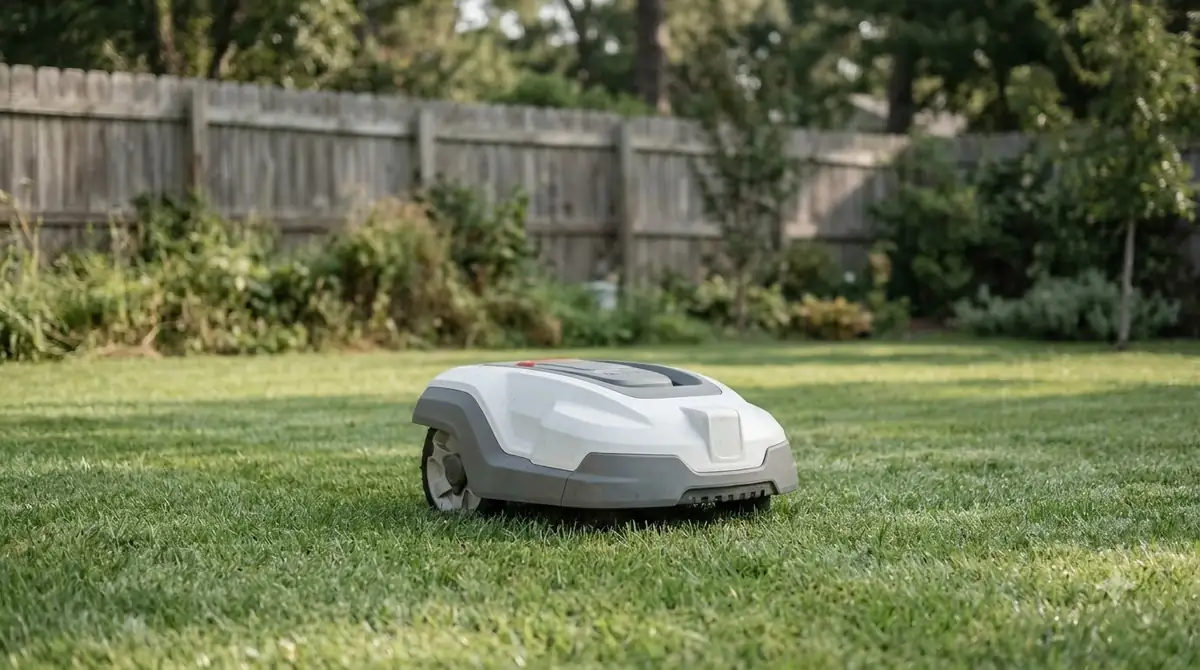
Robot mower IP rating explained: IPX4 to IPX6 test conditions
The three ratings most robot mowers quote for outdoor use differ mainly in how much water hits the housing and how hard it hits. The test numbers below come from the standard as summarized by an independent testing lab and by the IEC table.
| Rating | Water test | What it means on a lawn |
|---|---|---|
| IPX4 | Splashing water from any direction | Our reading: fits splashes and light, short rain |
| IPX5 | 6.3 mm nozzle, 12.5 L/min, 30 kPa from 3 m, at least 3 minutes | Our reading: a step up for regular rain |
| IPX6 | 12.5 mm nozzle, 100 L/min, 100 kPa from 3 m, at least 3 minutes | Our reading: the stronger choice for a mower that stays outside |
The jump from IPX5 to IPX6 is large. The IPX6 test uses a nozzle about twice the diameter and roughly eight times the flow of the IPX5 test, according to the test values in the standard. Our reading is that IPX6 is the more useful rating for a mower that will sit outside in wet weather, while IPX4 is only a minimum.
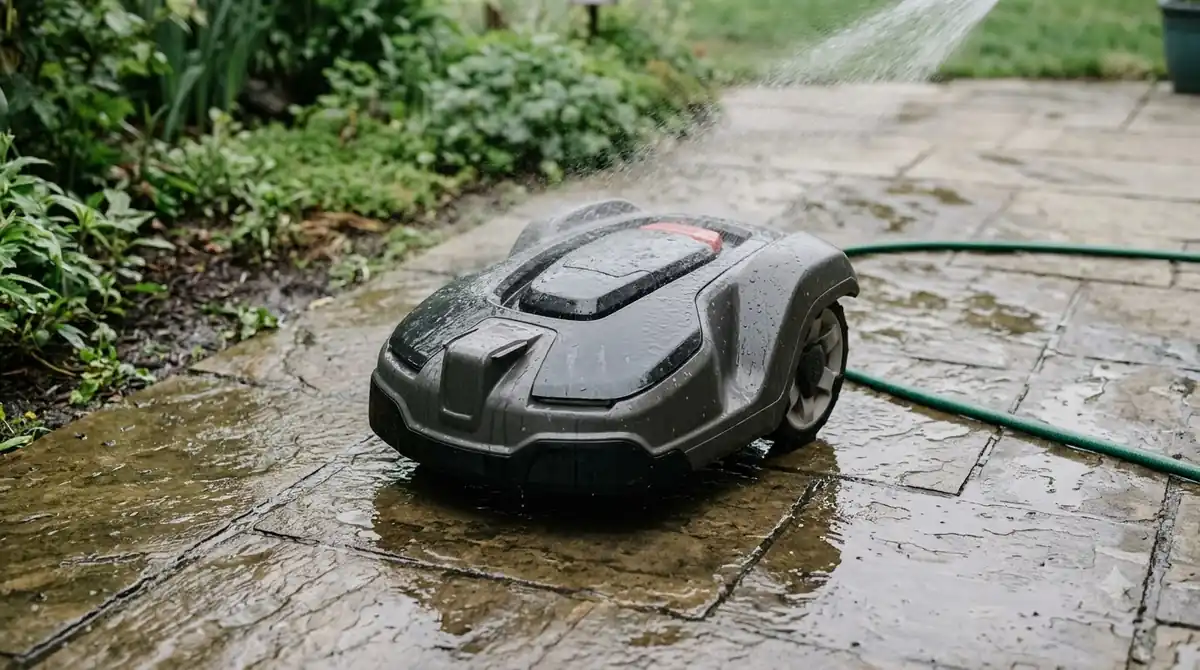
The lab summary also notes that the standard tests a sealed enclosure with a fixed nozzle at a fixed distance. A garden hose or a pressure washer held close to a seam is a different case, and the rating does not describe it.
Where IPX7 and IPX8 fit
IPX7 means the enclosure can be immersed in water up to 1 m deep for 30 minutes. IPX8 means immersion deeper than 1 m, under conditions the manufacturer sets. Both are immersion ratings, not spray ratings.
IPX9 is a different test again: close-range, high-pressure jets of water at 80 °C and 8 to 10 MPa. Our reading is that this test rarely matters for a garden mower, and its presence on a spec sheet says little about rain performance.
Our reading is that a robot mower does not need an immersion rating for normal lawn use. It needs protection from rain, splashes and wet grass, which are the conditions IPX4 to IPX6 address. An IPX7 or IPX8 label on a mower is a sign of a stronger seal, but it does not replace the spray ratings, because IPX7 does not guarantee IPX5 or IPX6 compliance. Whether a mower can stay on the lawn all season is a separate question, covered in leaving a robot mower outside.
What the rating does not cover
The robot mower IP rating explained so far describes one lab test. It does not describe every condition a mower meets in a yard. The main limits are listed below.
- Fresh water only. The test uses fresh water. Salt water, oils and solvents need separate chemical resistance testing.
- Chemicals and condensation. The lab summary does not say whether the rating covers chemicals, salt water or condensation inside the housing.
- Some ingress may be allowed. The lab summary notes that some water may get in without failing the test, as long as the device keeps operating.
- Wet grass. The rating says nothing about how the mower cuts damp grass, which can clog the blades and leave a ragged cut.
The last point matters most. A mower can pass every IP test and still struggle on a wet lawn, which is the question behind how robot mowers handle rain. The rating protects the housing, but it does not promise a clean cut on damp grass.
Real models: Ecovacs GOAT and Husqvarna
The Ecovacs GOAT is rated IPX6, and its support FAQ says the mower is “able to withstand rain.” The same FAQ warns that wet grass can block the blades and that rain on the camera interferes with visual localization and obstacle avoidance. It advises turning on the rain sensor so the mower starts only after the lawn has dried. Ecovacs’ FAQ on rain use gives the full wording.
Husqvarna gives its R200iX ride-on mower an IPX4 rating, which is a useful reminder that the same code appears on machines that are not robots. Its support page also advises against mowing a wet lawn or mowing during rain. Our reading is that the rating tells you the enclosure can take splashes, while the advice tells you when to keep the machine parked. That is the practical lesson of this robot mower IP rating explained across two real models: the code describes the housing, and the maker’s advice describes the weather.
How to read a robot mower spec sheet
Find the IP code on the spec sheet. For a robot mower IP rating explained in buyer terms, check the second digit first, because it covers the water exposure that matters outdoors. Then check the manual for rain and hosing advice, since the rating alone does not answer those questions. Our guide to reading a robot mower spec sheet covers the other lines worth checking.
- Find the code. Look for a two-digit IP code. If the spec sheet says “waterproof” without a code, treat that claim as unverified.
- Check the water digit. Our reading is that IPX4 is the minimum for light rain, and IPX5 or IPX6 is better for a mower that stays outside.
- Read the rain advice. Look for guidance on rain, wet grass and the rain sensor, since the cutting result depends on those settings.
- Ask about hosing. If the manual does not mention hosing, assume the mower should not be rinsed with a hose or pressure washer. Routine cleaning is covered in how to clean a robot mower.
Frequently asked questions
Is IPX6 waterproof?
In this robot mower IP rating explained guide, IPX6 means the enclosure resists powerful water jets from a 12.5 mm nozzle, not full immersion. Ecovacs rates the GOAT IPX6 and says it can withstand rain. Immersion would need an IPX7 or IPX8 rating, which is a different test.
Can I hose down a robot mower?
The sources checked here do not give hosing advice for robot mowers. An IP rating tests a fixed nozzle at a fixed distance, which is not the same as a garden hose used close to seams. Check the manual before rinsing the housing with water.
Is IPX4 enough for rain?
IPX4 covers splashing from any direction, so it fits light, short rain. Our reading is that it is a minimum. The Husqvarna FAQ advises against mowing in rain or on a wet lawn, whatever the rating.
Does an IP rating mean my mower can cut wet grass?
No. The rating covers the housing against water, not the cutting result. Wet grass can block the blades, and Ecovacs advises a rain sensor so the mower waits until the lawn has dried.
Sources
- IP Code (Wikipedia): the IEC 60529 levels, test values and the rules for combined ratings.
- IEC 60529 and EN 60529 testing (DLS EMC): the IPX4 to IPX7 test descriptions and the limits of the rating.
- Ecovacs support FAQ on rain use (Ecovacs): the GOAT IPX6 rating, wet grass and rain sensor advice.
- Can I use my battery-powered ride-on mower in the rain (Husqvarna): the R200iX IPX4 rating and the wet lawn advice.
 Up next8 min readBest Robot MowersWhat to Look for in a Robot Mower With an IPX6 RatingUpdated Nov 11, 2026
 9 min readBest Robot MowersRobot Mower Coverage Rating Explained: What the Number MeansUpdated Nov 11, 2026
 9 min readBest Robot MowersWhat Does AWD Mean on a Robot Mower?Updated Nov 11, 2026
 8 min readBest Robot MowersRobot Mower Slope Rating Explained: Percent vs DegreesUpdated Nov 11, 2026
 9 min readBest Robot MowersHighest Rated Robot Lawn Mower: What Ratings Can and Cannot Tell YouUpdated Nov 11, 2026
 9 min readBest Robot MowersBest Robot Lawn Mower for 3 Acres: What the Ratings Really CoverUpdated Nov 11, 2026