
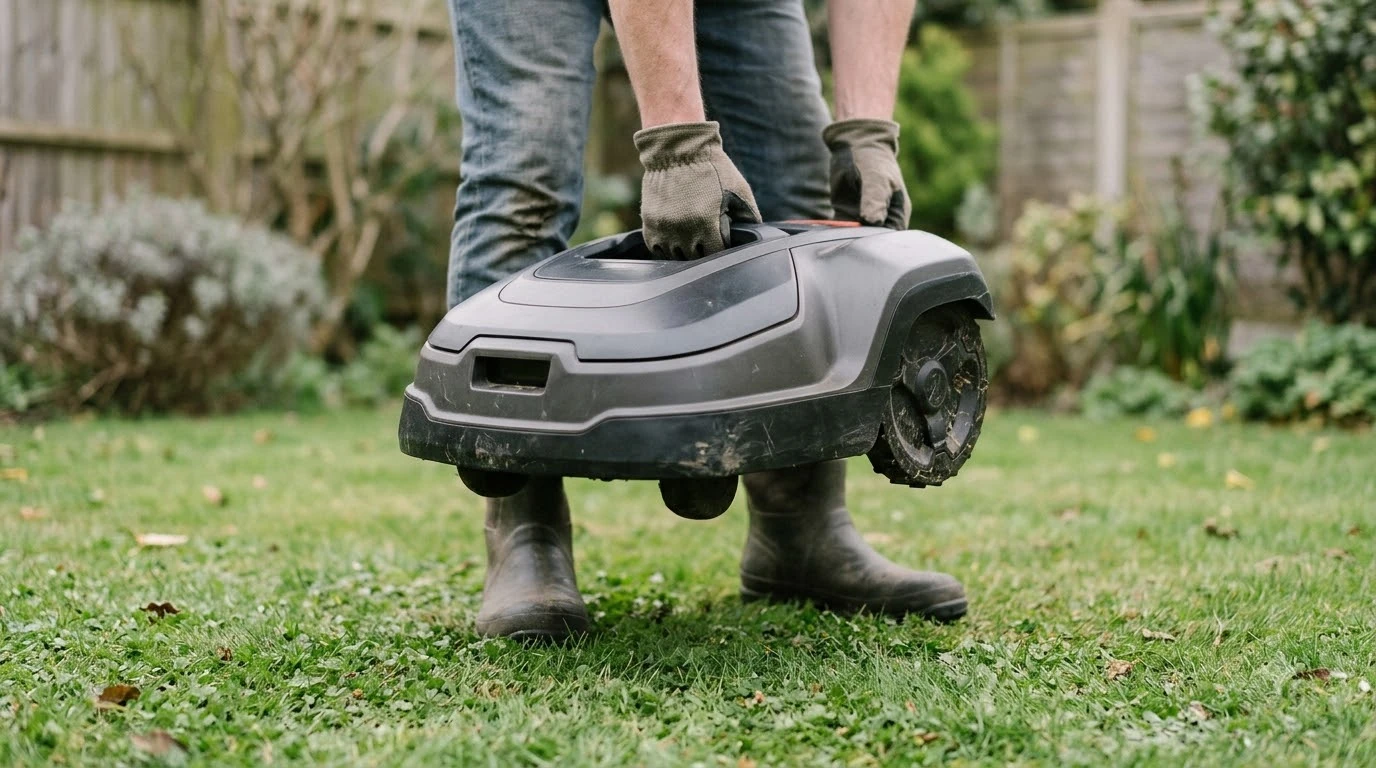

The best robot lawn mower for elderly parents depends less on the brand than on three things: lawn size, how much setup help is available, and whether the mower can be checked and controlled without much walking or lifting. Start with the yard, then compare lift weight, boundary setup and control methods before you narrow the list. This guide sets out what to check, using manufacturer and extension sources, as of Nov 2026.
The short answer
- Lawn size: match the mower to your measured lawn with a margin. Husqvarna lists capacities from 0.5 acre to 2 acres across its range.
- Setup: wired models need a boundary wire placed around the lawn, while wire-free models skip that step but need a clear sky view over the base station.
- Control: confirm that your parent can start, stop and check the mower with a simple control, and treat a phone app as optional until you read the manual.
- Slopes: Husqvarna gives 25% to 50% as the general range for standard models, and its AWD model is rated up to 70%.
What makes a robot mower easier for older owners
A robot mower removes the pushing and walking that a traditional mower requires, but it still needs someone to set it up, lift it when needed and check on it. Those three tasks decide how much help your parents will need, and they are the first filter for the best robot lawn mower for elderly parents. A mower that runs on a schedule with little attention suits most people better than one that depends on frequent manual steps.
Some robot mowers connect to a smartphone app that shows status and lets you start or pause the mower from another location. Husqvarna describes its Automower Connect app as a way to link the mower to a smartphone, though its product page does not say whether the app is required to operate the mower. Our reading is that a family member should confirm this in the manual before assuming an app is needed.
If your parents find walking or pushing hard, a riding or zero-turn mower may be a better fit than a robot. That alternative is covered later in this guide.
Lift weight and handling
Robot mowers often need to be lifted to clean the blades, move them off the lawn or free them from a stuck spot, so the weight matters. The sources we read did not give a verified weight for the robot models compared here, so check the spec sheet for each model you consider before you assume your parent can lift it.
A lightweight reference point comes from a Family Handyman list of accessible lawn mowers. It includes the WORX WR165, a push mower that weighs 21 pounds and is intended for yards of one-eighth acre or less, and the article notes that a wide base makes some mowers heavier and harder to lift. That is a push mower, not a robot, but it shows how much weight changes the handling experience.
Heads up
Many robot mowers stop their blades when they are lifted or tipped, according to an Anker/eufy vendor claim, but not all models do. The Husqvarna safety Q&A we read does not explain blade behavior when the mower is lifted, so ask the seller for this detail in writing before buying.
Setup effort: wired versus wire-free
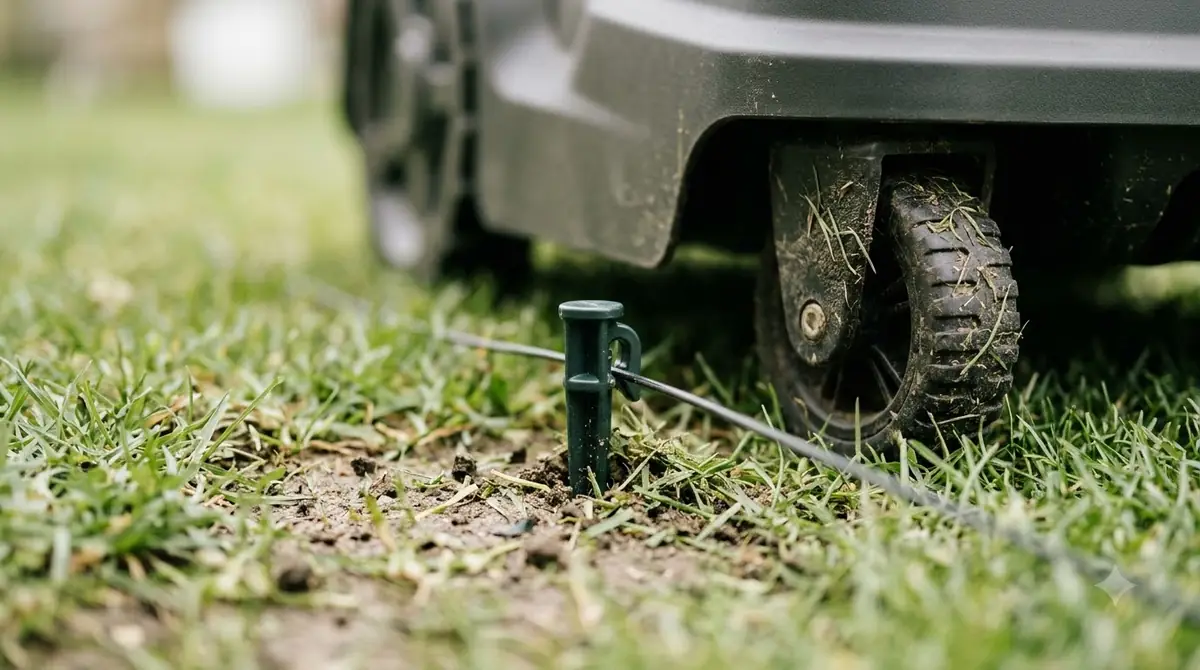
Wired models need a boundary wire laid around the lawn, which is the biggest setup task for most owners. Lawnmowers.com says burying the wire 2 to 5 cm deep takes about an afternoon with an edger or a wire-laying machine. A faster, reversible option is pinning the wire with stakes every 50 to 80 cm, and grass grows over pinned wire within three to four weeks. Our guide on how to install a robot mower boundary wire walks through the job.
Wire-free models remove the buried wire, which is the main reason many families choose them for older owners. Lawnmowers.com notes that wire-free models need a clear view of the sky above the base station and can struggle under heavy tree cover. It also reports that premium wire-free models cost 30 to 50 percent more than wired models, a figure that can change as the market moves.
Mammotion, a maker that favors wire-free designs, describes wired installation as labor-intensive and rates wire-free setup as low to moderate. Treat that as a vendor view. Mammotion also describes hybrid setups, with short wire sections for flower beds, ponds and steep slopes, as a middle path.
App control and remote checks
For the best robot lawn mower for elderly parents, remote checks are useful when a family member lives nearby but cannot visit daily, yet they should not be the only way to control the mower. Husqvarna lists its Automower Connect app as the link between the mower and a smartphone, and it does not state that the app is needed for basic operation. If you want to compare apps, see which robot mower brand has the best app.
Boundary type also varies by model. Husqvarna lists the 435X AWD and 560 EPOS with only one boundary option, either wire or virtual, so the setup you choose may be fixed by the model. Check the boundary type on the product page before you commit, since it changes how much installation work is involved.
Slopes and terrain
Slope rating is the first filter for a sloped yard, because standard Husqvarna models are rated for 25% to 50% slopes while the AWD model is rated up to 70%. Husqvarna’s installation support page describes the 50% to 70% zone as one to keep free of obstacles, which is a useful detail when planning the yard layout.
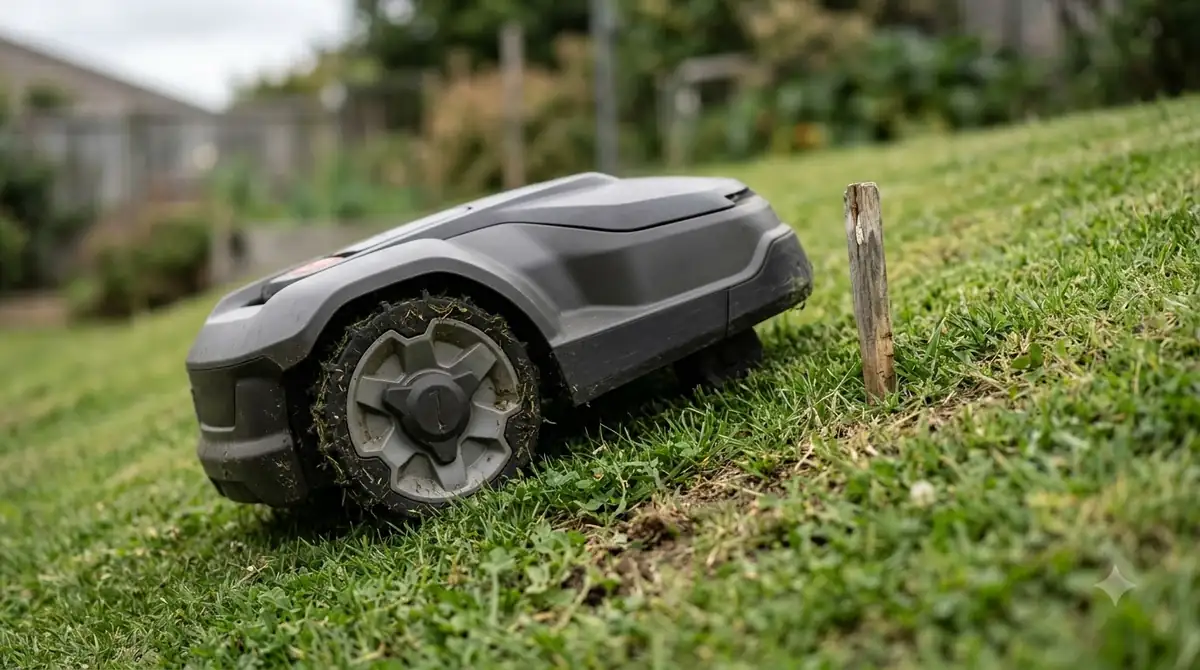
Slope ratings are absolute limits rather than targets for daily use. Eufy’s retailer blog states that the maximum slope is a hard limit, and it adds that wet grass reduces tire grip, so a lawn that is steep and damp may be harder for any model. Our reading is that a parent’s yard should be checked in its wettest season before a model is chosen. For more on drive layouts, see our comparison of AWD versus 2WD robot mowers for hills.
Lawn size and model match
For the best robot lawn mower for elderly parents, lawn size sets the minimum capacity, and Husqvarna lists its capacities as a guide. Use the table to compare the models that match your lawn area.
| Husqvarna model | Listed capacity | Slope note |
|---|---|---|
| Automower 410 iQ | About 0.5 acre | Standard model range |
| Automower 420 iQ | About 1 acre | Standard model range |
| Automower 435 iQ AWD | About 1.3 acre (plus or minus 20%) | Up to 70% |
| Automower 440 iQ | About 2 acres | Standard model range |
Our reading is that a lawn should sit comfortably below a model’s listed capacity rather than at its edge, since the shape of the yard, obstacles and trees all change how much area the mower covers in practice. Measure the lawn first, then choose a model with some margin.
When a riding or zero-turn mower may fit better
A riding mower can suit a parent who has trouble walking or pushing, because there is no walking or pushing involved. Family Handyman quotes an expert who says riding mowers “make it way easier” for people with mobility issues, and who says zero-turn mowers with dashboard controls are good choices for the same reason.
Riding mowers bring their own trade-offs, including storage space, the need to get on and off the seat and the cost of a larger machine. A robot mower may still suit a small, flat yard if the main problem is pushing, but a riding mower is the stronger option when the parent can sit and steer but cannot walk the lawn. We compare the two types in our guide to a robot lawn mower versus a zero-turn mower.
Checklist for the best robot lawn mower for elderly parents
Work through these checks with your parent present, so the decision reflects what they can comfortably do.
- Measure the lawn. Compare your area with the listed capacity and leave margin for obstacles.
- Read the lift weight. Ask the seller for the mower’s weight in the spec sheet, since the sources we read did not give verified figures for the robot models.
- Choose the setup type. Decide whether a family member can lay a wire, or whether a wire-free model with a clear sky view is the better fit.
- Confirm the slope rating. Check the slope limit against the steepest part of the lawn and the wet-season conditions.
- Check the lift-stop behavior. Ask whether the blades stop when the mower is lifted or tipped, and get the answer from the manual.
No robot-specific accessibility certification appeared in the sources we read, so a manufacturer’s claim about ease of use should be checked against the manual and the spec sheet. For a wider look at safety, see our guide on whether robot mowers are dangerous.
Frequently asked questions
Can an older adult lift a robot lawn mower?
It depends on the model. For the best robot lawn mower for elderly parents, the sources we read did not give verified weights for the robot models compared here. Check the spec sheet for each model. If lifting is hard for your parent, plan for a family member to handle cleaning and moving the mower, and choose a model that does not need frequent lifting.
Does a robot lawn mower need a smartphone?
Not necessarily, and for the best robot lawn mower for elderly parents this is a key point to confirm. Husqvarna describes its Automower Connect app as a way to connect the mower to a smartphone, but its product page does not say whether the app is required to run the mower. Read the manual for the model you choose, and confirm that the mower can be started and stopped without an app.
Who installs the boundary wire?
For wired models, the wire is usually laid by hand, and lawnmowers.com says burying it takes an afternoon with an edger or wire-laying machine. If your parent cannot do this work, a family member may need to help, or you can choose a wire-free model that skips the buried wire.
Are robot lawn mowers safe to handle around people?
An Anker/eufy vendor claim says many models stop the blades when lifted or tipped, but not all models do. The Husqvarna safety Q&A we read does not explain blade behavior when lifted. Confirm this for the exact model in its manual before use, and keep hands away from the blades when handling the mower.
Sources
- Husqvarna robotic mowers (manufacturer): capacities, slope rating for the 435 iQ AWD, and app connection.
- Husqvarna installation support for steep slopes (manufacturer): standard and AWD slope ratings.
- Lawnmowers.com boundary wire setup guide (publisher): wire burial time, stake spacing and wire-free trade-offs.
- Family Handyman, accessible lawn mowers (publisher): push mower weight and riding mower comments for mobility issues.
- Eufy robot lawn mower slope limits (retailer blog): slope limit as an absolute value and grip on wet grass.
- Mammotion, do robot lawn mowers need a boundary wire (vendor): wired installation effort, labeled as a vendor view.
 Up next8 min readBest Robot MowersBest Robot Mower with Mulching Blades: What to Check Before You BuyUpdated Nov 11, 2026
 9 min readBest Robot MowersBest Robot Lawn Mower for Townhouses: What to Check Before You BuyUpdated Nov 11, 2026
 8 min readBest Robot MowersBest Robot Mower With Ultrasonic Sensors: 5 Checks Before You BuyUpdated Nov 11, 2026
 8 min readBest Robot MowersBest Robot Mower That Works in the Rain: What to Check Before You BuyUpdated Nov 11, 2026
 10 min readBest Robot MowersBest Robot Lawn Mower for Busy Families: What to Check Before You BuyUpdated Nov 11, 2026
 8 min readBest Robot MowersBest Robot Lawn Mower for 5 Acres: What to Check Before You BuyUpdated Nov 11, 2026