
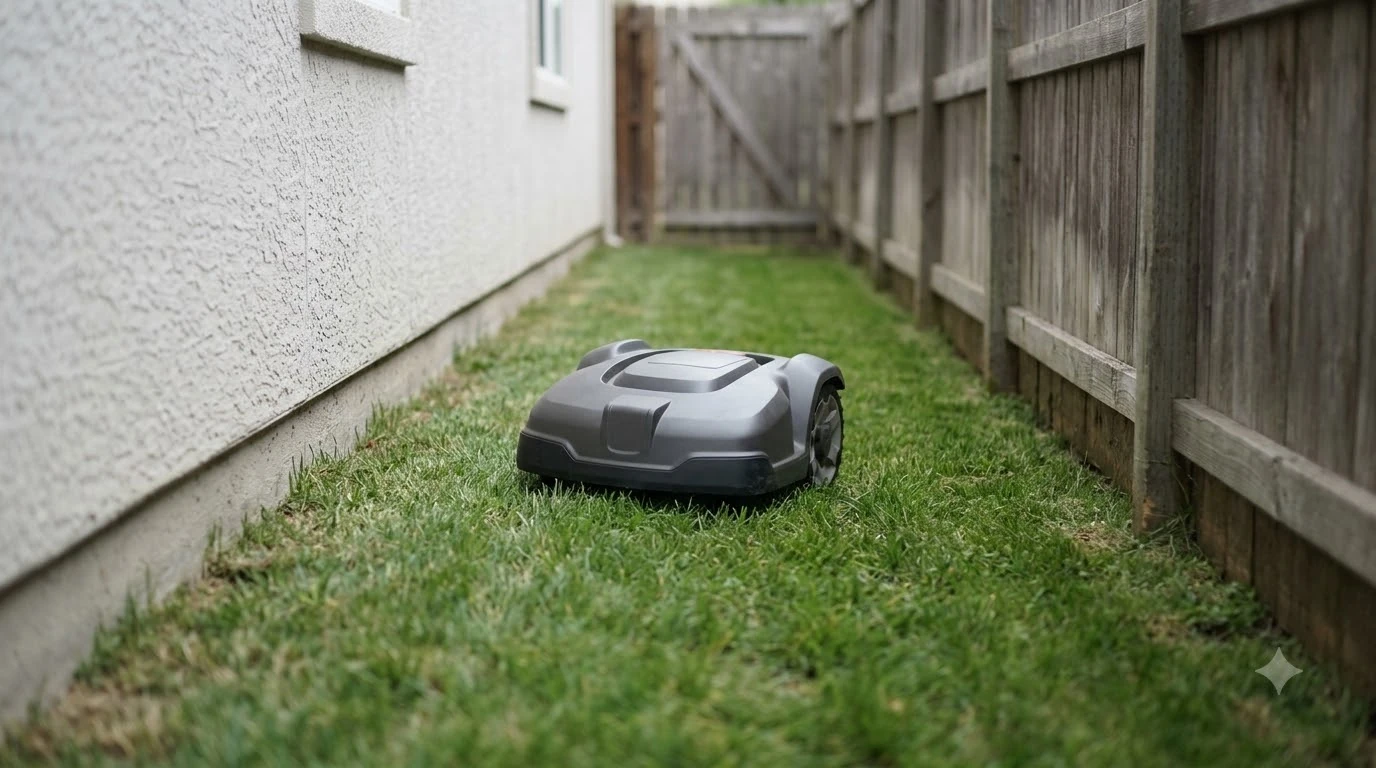

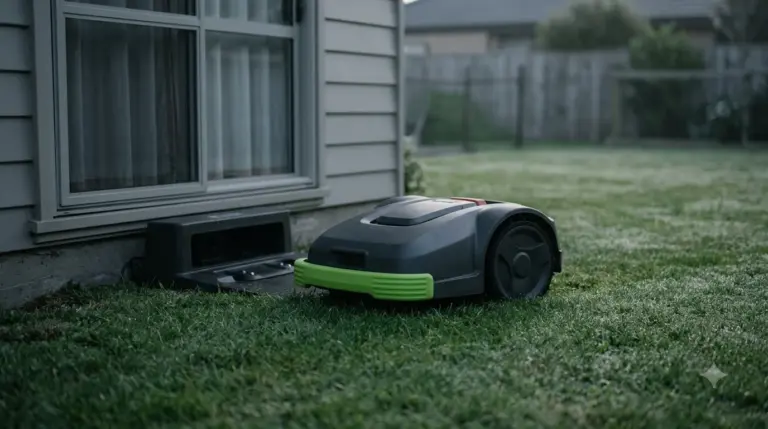
A robot mower for lawn next to a two-story house can work well, but the house wall and eaves decide which navigation method holds up best. Satellite RTK is the most exposed on the house side, while LiDAR and vision mowers rely less on sky view. Check the side yard layout before you choose a model.
The short answer
- Satellite positioning: RTK needs enough clear sky, and walls, roof overhangs and heavy tree cover weaken its accuracy.
- Base placement: keep the RTK base in open sky, away from house corners, eaves and narrow passages.
- Sensor choice: LiDAR and vision mowers navigate with onboard sensors, so the house is a smaller factor, though each has its own limits.
- Layout check: map which sides of the lawn are shaded or walled before you buy.
Robot mower for lawn next to a two-story house: what changes
A two-story house matters because its wall and roof block part of the sky and cast shade across the lawn edge. A robot mower uses one of three main positioning methods: satellite RTK with a base station, LiDAR, or a camera-based vision system. The house affects each one differently, so the same lawn can suit one design and not another.
Our reading is that, for a robot mower for lawn next to a two-story house, a taller roofline blocks more sky on the side of the house than a single-story wall does. That makes the side yard the first place to test. Do not judge the whole lawn by the open back yard.
In our reading, a yard next to a two-story house often splits into three zones: the open back lawn, the narrow side strip between the house and a fence, and the front lawn near the driveway. Each zone can have a different satellite view. A mower that works well across the back lawn may still struggle in the side strip, so a robot mower for lawn next to a two-story house should be checked zone by zone during setup. Our guide to narrow side yard passages covers that strip in more detail.
Why walls and eaves weaken RTK on the house side
RTK depends on seeing enough satellites at once. According to Trimble’s positioning documentation, obstructions limit the satellites a receiver can see and can cause multipath errors, which are reflected signals that distort the position. The same page lists a minimum of 4 continuously tracked satellites for an RTK solution, with 5 common satellites needed to initialize.
Sunseeker’s RTK guide says walls, roof overhangs and heavy tree cover weaken accuracy, and that the base should not sit near them. Mammotion’s support article gives the practical symptoms: a fixed solution is accurate to under 10 cm, while a Float solution is roughly 50 to 200 cm. Its Luba models will not mow automatically in Float, Single or None positioning states.
Where to place the RTK base near a tall house
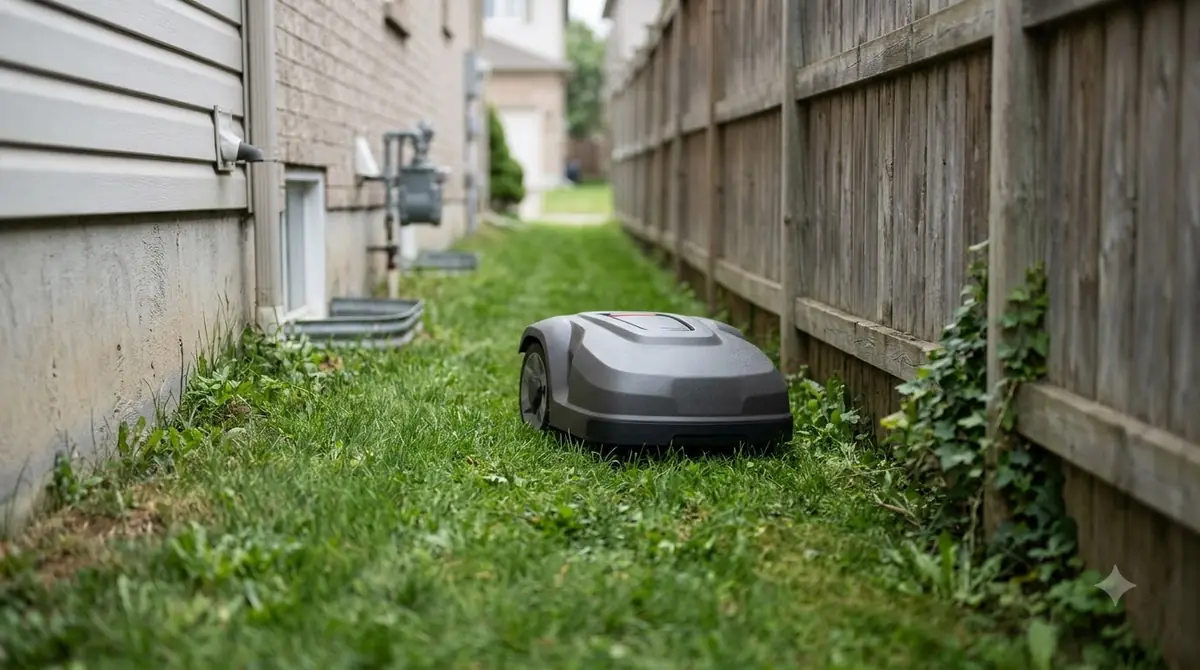
Base placement is the setting you can most easily change, and it is the first fix for a robot mower for lawn next to a two-story house that loses its position fix. Sky view is the key factor, as our guide on whether robot mowers need a clear view of the sky explains. Mammotion’s installation guide says not to put the reference station at the corner of an L-shaped building, or on a narrow path between two structures or under a tree. The guide allows flat open ground, or an unobstructed wall or roof, and recommends a wall or roof for O-shaped, U-shaped or multi-lawn layouts.
Sunseeker’s guide adds that the base needs a clear view of about 160 degrees of sky. Mammotion’s support article also gives a minimum distance for the reference station, so confirm the exact rule in the manual for your model. In practice, pick the spot with the fewest walls inside that sky cone, and see where to mount the RTK base station for mounting options.
| Base position | What the vendor sources say | Our reading |
|---|---|---|
| Flat ground in the open yard | Acceptable when the area is open and clear of trees and roofs | Best option when the back lawn has open sky |
| Unobstructed wall | Acceptable on a clear wall face; walls near the base weaken accuracy | Only if the wall is not beside a corner or narrow passage |
| Roof | Acceptable when nothing obstructs the satellites | Check that eaves and roof edges do not block the sky cone |
LiDAR and vision mowers next to a house
LiDAR mowers do not need satellites to navigate, and Ecovacs states that LiDAR is unaffected by shade or structures. That makes it worth considering for shaded side yards (our reading). The trade-off is weather: Ecovacs notes that fog and heavy rain can scatter the laser beams.
Anker’s LiDAR guide adds that sensors may need cleaning after rain, mud or dust, and that LiDAR has fewer reference points on very open lawns. Ecovacs also notes that LiDAR is generally more expensive than basic RTK or vision designs.
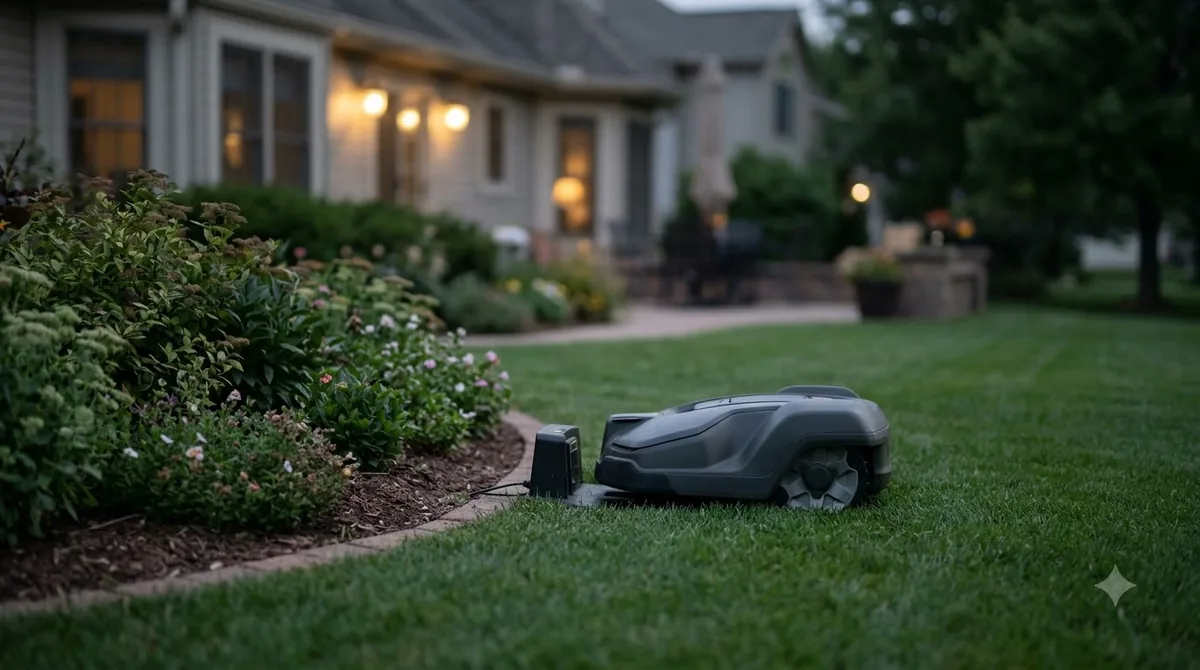
Vision mowers use cameras and a visual mapping method. Lymow states that its vision system takes over for up to 10 minutes when GPS weakens. That is a vendor claim without independent test data, so treat it as a design target rather than a guarantee. Lymow’s guide also notes that the obstacle system may not always trigger on smaller branches.
Wire or wire-free for a narrow side yard
A boundary wire avoids satellite limits, but it adds installation work. Lymow puts a wired install at 4 to 8 hours, including trenches and wire routing; see how to install a robot mower boundary wire for the steps. Wire can break from landscaping equipment, burrowing animals or frost heave, and it is hard to run on steep ground.
Shade is also a grass question. The MSU Extension guide on turfgrass for shade notes that tree roots compete with turf and that foot traffic stresses shaded grass. A narrow side strip that stays shaded may need more care than the open lawn (our reading); the mowing height in shade guide covers the turf side.
Our reading: a wire layout is a sound option when the satellite view is poor, provided the wire can run cleanly along the wall. It is a weaker option where the lawn is steep or the side strip is too narrow for a safe loop.
What to check before you buy
Before you buy a robot mower for lawn next to a two-story house, measure the side yard and note which walls, eaves and trees shade each edge. This takes less time than a failed install, and it tells you which navigation method fits the lawn.
Ask for the manufacturer’s current positioning guidance in writing, because the setup rules for a base station are product-specific. Mammotion’s support pages, for example, describe the Float and Single states in detail, while other vendors publish different thresholds. Use the vendor’s own manual for the model you are considering, and treat third-party blog figures as background only.
- Map the house-side zones. Mark each wall, eave and tree line that touches the lawn edge.
- Check the sky view. From the proposed base spot, look for a clear cone of about 160 degrees.
- Confirm the fallback. Ask the vendor what the mower does in Float or Single positioning, and whether it stops or keeps mowing.
- Compare install effort. If RTK looks marginal, price out a wire layout against a LiDAR model, using the manufacturer’s own specifications.
Frequently asked questions
Can a robot mower cut a lawn next to a two-story house?
Yes, in many yards. The house side is where satellite positioning is most likely to weaken, so the navigation method matters more than the house itself. Check the side yard layout before you choose.
Does a house wall block the RTK signal?
Sunseeker says walls, roof overhangs and heavy tree cover weaken RTK accuracy. In our reading, the practical fix is usually moving the base station to a clearer spot rather than changing the mower.
Where should the RTK base station go near a house?
Mammotion’s install guide allows flat open ground or an unobstructed wall or roof. It advises against the corner of an L-shaped building and narrow paths between two structures.
Is a LiDAR mower a better fit next to a house?
LiDAR does not depend on satellites, which removes the main house-side problem. Ecovacs notes that fog and heavy rain can scatter its beams, and Anker notes that sensors need regular cleaning after mud or dust.
Sources
- Trimble positioning modes and RTK factors (manufacturer): satellite count, obstructions and multipath.
- Sunseeker RTK guide (manufacturer): walls and eaves, 160-degree sky view.
- Mammotion RTK station installation guide (manufacturer): placement rules for L-shaped buildings, narrow passages and lawn shapes.
- Mammotion positioning status support article (manufacturer): accuracy ranges and base station distance note.
- Ecovacs LiDAR vs RTK guide (manufacturer): LiDAR in shade, weather limits, cost.
- Anker LiDAR robot lawn mower guide (manufacturer): sensor cleaning and open-lawn reference points.
- Lymow RTK vs wire guide (manufacturer): vision fallback claim and wired install time.
- Mississippi State Extension, turfgrass for shade (university extension): root competition and foot traffic in shade.
 Up next9 min readBy YardCan a Robot Mower Work in a Lawn on Both Sides of the House?Updated Nov 11, 2026
 9 min readBy YardRobot Mower for Terraced Yard: What to Check FirstUpdated Nov 11, 2026
 8 min readBy YardLiDAR Robot Mower for a Wooded Lot: What Works and What to CheckUpdated Nov 11, 2026
 8 min readBy YardRobot Mower for Yard With Retaining Walls: What to CheckUpdated Nov 11, 2026
 7 min readBy YardCan a Robot Mower Cut Fine Fescue? Heights and What to CheckUpdated Nov 11, 2026
 8 min readBy YardBest Robot Mower for a Mobile Home Lot: What to Check Before You BuyUpdated Nov 11, 2026