
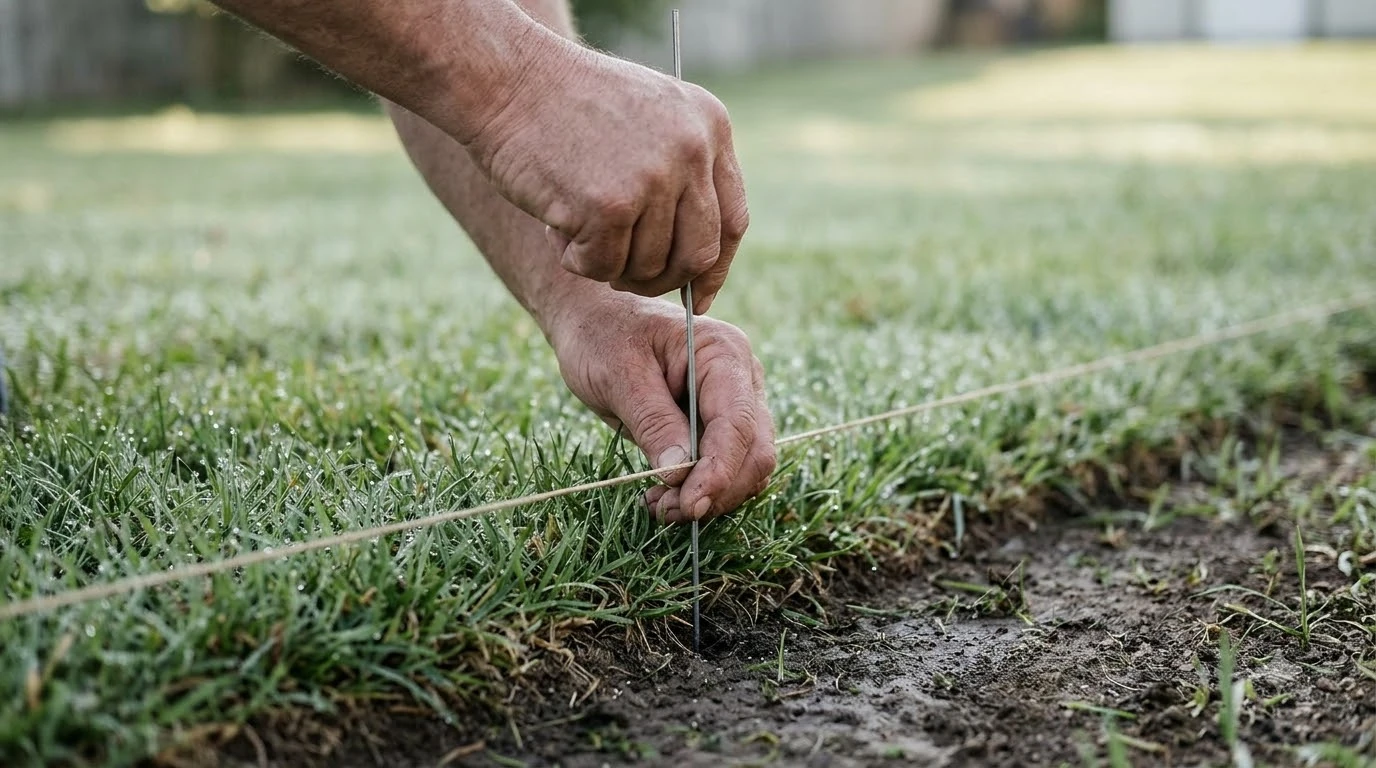

Lawn flags are a practical way to mark a robot mower boundary before the wire goes in, but none of the manufacturer or extension pages we read requires them. If you are searching for the best lawn flags for marking robot mower boundary, the more useful question is what the route needs to look like on the lawn. The sources agree on what to mark and how far to keep the wire from edges, walls and paths. They do not name a flag product, so the flag advice below is our reading.
The short answer
- Mark the route first. lawnmowers.com recommends marking the wire path with landscape paint before work starts, and Robomow suggests a tight, straight string to form the furrow.
- Flags are a visual aid. Our reading: tall, bright flags help you see the route during the above-ground test, which Robomow puts at 2 to 3 weeks.
- Keep distances. The sources give about 30 to 35 cm from walls and fences, and 10 to 15 cm from a path or patio that sits level with the lawn. Brands differ, so check your manual.
- Bury at 2 to 5 cm, and only after the mower runs well on the surface route.
What a boundary marker does and does not do
A marker shows where the wire will go. It does not replace the wire, and it does not set the mowing area by itself.
The mower follows the wire, not the flags. Robomow describes above-ground wire as fastened with lawn hooks at regular intervals, so the pegs hold the route and the flags only help a person see it. Anker’s UK guide advises sketching the garden layout before covering the wire, which is the same planning job a marker does on the lawn itself. Once the route is set, the markers have done their work. For the full installation, see how to install a robot mower boundary wire, and for what holds the wire down, see the best robot mower wire pegs.
The best lawn flags for marking robot mower boundary routes are, in our reading, tall, bright and easy to remove once the wire is down.
Best lawn flags for marking robot mower boundary, compared with string and paint
Each option marks the route. They differ in how long they stay put and how well they show from across the yard.
| Option | What the sources say | Where it helps | Limits |
|---|---|---|---|
| Landscape paint | lawnmowers.com: mark the wire path with landscape paint first, before aerating or dethatching. | A route that stays visible on the turf while you work. | Fades with weather. Our reading: it marks the surface only. |
| String | Robomow: draw a tight, straight string to create the furrow. | Straight runs and a clean furrow shape. | Needs stakes to hold it, and it moves if bumped. |
| Flags or stakes | None of the pages we read names flags. lawnmowers.com describes stakes every 50 to 80 cm to hold the wire. | Seen from a distance during the test period. | Our reading: flags guide the eye but do not hold the wire, so pegs still do that job. |
Distances to set before you mark the route
The sources agree that walls need the most room and hard edges need the least, but the numbers differ by brand. Use the middle of the range as a starting point, then follow your model’s manual.
| Obstacle | Robomow | Anker UK | lawnmowers.com |
|---|---|---|---|
| Walls, fences, tall stones or tree trunks | About 35 cm | 30 to 35 cm | At least 30 cm |
| Flower beds or soft edges | About 10 cm (beds or hedges) | 30 to 35 cm (raised beds) | 25 to 30 cm (beds, gravel, mulch) |
| Patio, slab or path | About 10 cm if level with or below the lawn | 10 to 15 cm if level | About 10 cm (4 in) inside a hard edge |
| Pond | About 35 cm | Not stated | Not stated |
Robomow advises trimming the edges and mowing the lawn short before you lay anything, as its first step. Its guide also says a narrow passage to a secondary zone should be wider than 70 cm. Where the sources disagree, pick the wider distance for walls and the closer one for a level patio, then check it on the mower’s own test run. If the route passes obstacles, laying boundary wire around obstacles shows how to handle them.
Marking the route for the test period
Test on the surface before you bury anything. Robomow advises leaving the wire above ground in test mode for 2 to 3 weeks and burying it only once the mower works as you want. Anker gives the same advice: test with the wire laid on the surface before burying it permanently. The test period is where flags earn their place, because they keep the planned route visible while you check corners and clearances.
Our reading is that the turns deserve the most markers, since the route changes most there. Robomow says to lay the cable in a curve at corners, and to lay it diagonally on inclines.

- Mark the route. Use landscape paint or string along the planned path, as the sources describe.
- Flag the turns. Our reading: one flag at each corner, curve and obstacle entry.
- Check clearances. Measure from walls, beds and paths using the distances above.
- Run the test. Keep the wire on the surface for 2 to 3 weeks, as Robomow advises, and watch for docking and edge errors before you bury it.
Burial depth and how long the route stays visible
Most sources put burial at 2 to 5 cm. lawnmowers.com says the wire should go about 2 to 5 cm down, and that within three to four weeks the grass grows over the wire and it disappears. Robomow gives 4 to 5 cm as the optimal depth and says the signal can still be received at up to 7 cm. Anker gives 3 to 5 cm, and notes that some systems allow up to 7 to 10 cm.
The grass hides the wire within weeks, so the flags have a short job. Our reading: once the loop test passes and the wire is buried, remove the flags so they do not stay in the lawn or get mown over. If you are unsure whether to bury or peg the wire, burying or pegging boundary wire compares the two.
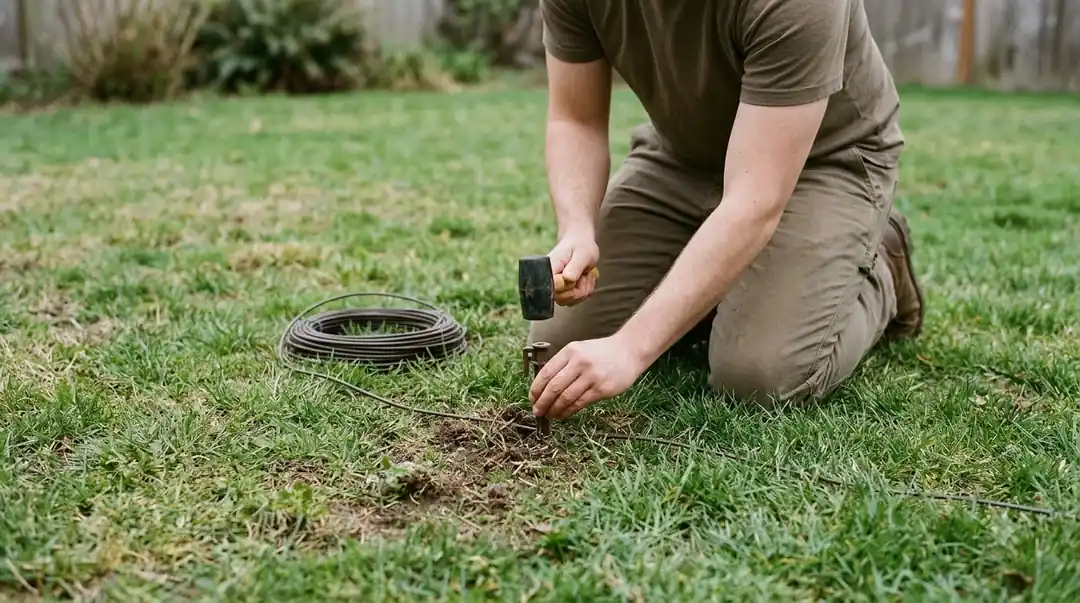
What to check before you buy markers
Choose markers by how well they show and how well they hold. None of the sources we read ranks products, so these criteria are our reading rather than a verdict on any brand. In practice, the best lawn flags for marking robot mower boundary work are the ones that show well and come out cleanly.
- Height above the grass. Tall enough to see from across the yard, so you can check the whole route in one walk.
- A stiff shaft. It should stay upright in wind and not bend when pushed into soil.
- A colour that stands out from the lawn and from the wire you are laying.
- Enough for the turns. Plan at least one marker at each corner, curve and obstacle entry.
- Something you can remove. Markers should come out cleanly once the test passes.
Check the wire spacing for your model before you buy anything, because the sources differ and the mower’s own manual has the final say. To work out how many markers the route needs, see how much boundary wire you need.
Frequently asked questions
Do I need lawn flags to install a robot mower boundary?
No. None of the manufacturer or extension pages we read requires them. The wire and pegs define the area, so even the best lawn flags for marking robot mower boundary routes are only an aid. Flags are a useful aid for seeing the planned route during the test period.
How far should the boundary wire stay from a wall?
The sources give about 30 to 35 cm for walls and fences, with Robomow at about 35 cm and lawnmowers.com at least 30 cm. Check your model’s manual because the figure can vary by brand.
Can I bury the wire right after I mark the route?
The sources say to test first. Robomow advises leaving the wire above ground in test mode for 2 to 3 weeks, and Anker advises testing on the surface before burying it permanently.
How deep should the wire go?
Most sources give 2 to 5 cm. Robomow says 4 to 5 cm is optimal and that the signal can be received at up to 7 cm. Anker gives 3 to 5 cm, and says some systems allow up to 7 to 10 cm.
Sources
- Laying the lawn boundary wire (Robomow, manufacturer): distances to walls, beds, paths and ponds; test mode for 2 to 3 weeks; curves and diagonal runs on inclines; optimal burial depth.
- Robot lawn mower perimeter wire (Anker UK, manufacturer): sketching the layout, peg spacing around curves, burial depth, surface test before burying, and distances from walls and paths.
- Robotic mower boundary wire setup guide (lawnmowers.com, independent guide, 12 Oct 2026): marking the route with landscape paint, stake spacing, burial depth, and edge distances for hard and soft edges.
 Up next7 min readGearBest Outdoor Mesh Wi-Fi for a Backyard Robot Mower: What to CheckUpdated Nov 11, 2026
 7 min readGearWhat a Robot Mower Apple AirTag Mount Can and Cannot DoUpdated Nov 11, 2026
 9 min readGearBest Outdoor Security Camera to Watch a Robot Mower: What to CheckUpdated Nov 11, 2026
 8 min readGearBest Robot Mower Garage With Opening Roof: Clearance RulesUpdated Nov 11, 2026
 9 min readGearRTK Antenna Wall Mount Bracket: What to Check Before You BuyUpdated Nov 11, 2026
 10 min readGearRTK Base Station Power Cable Outdoor: What to Check FirstUpdated Nov 11, 2026