
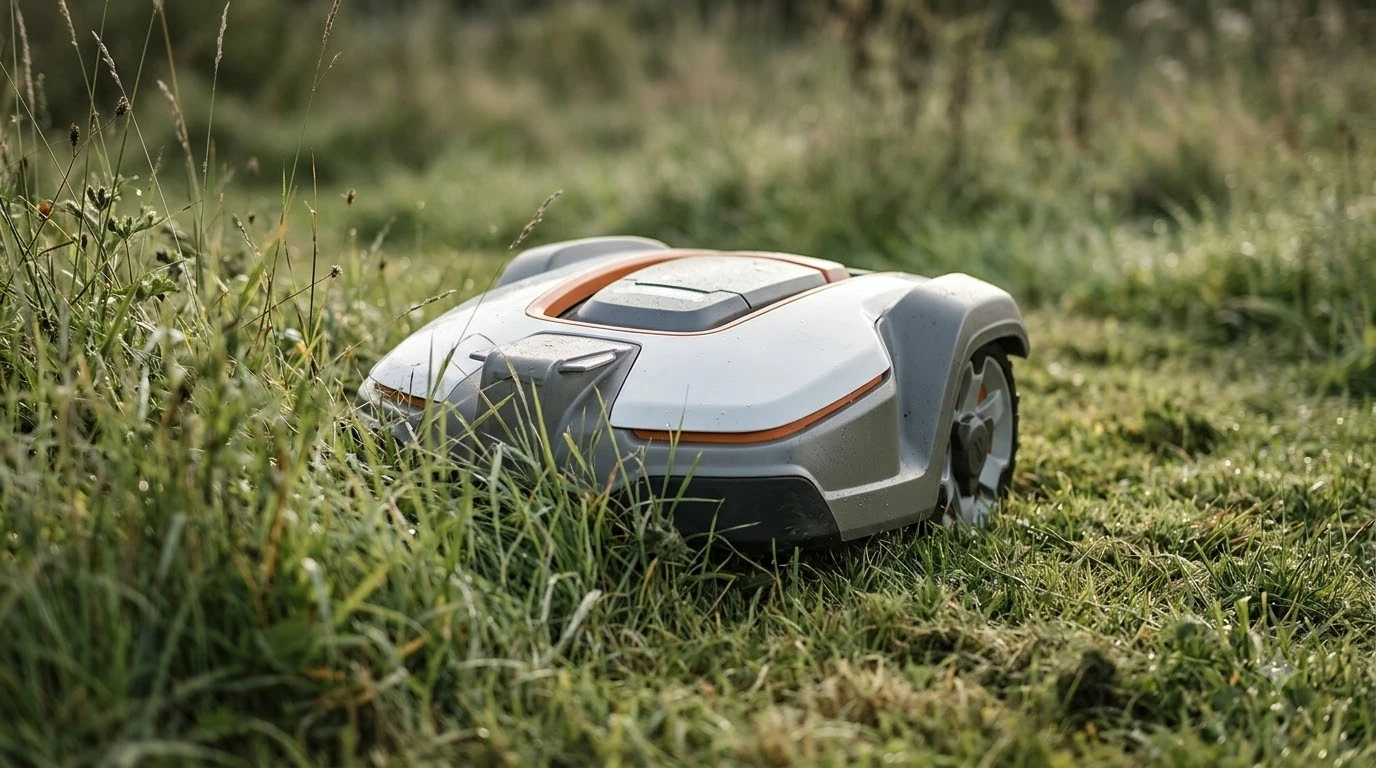

There is no single best robot mower that handles tall grass, so the first thing to check is its cutting height range. Typical robot mowers cut between about 15 and 60 mm, while models designed for taller grass can go up to about 100 mm. Extension guidance also says a single pass should never remove more than one-third of the grass height. As of Nov 2026, this guide explains how to read those numbers before you buy.
The short answer
- Read the cutting height range first. For the best robot mower that handles tall grass, standard models usually stop around 60 mm, while taller-grass models can go up to about 100 mm.
- Apply the one-third rule. Remove no more than one-third of the grass height in one mowing, so very tall grass needs a higher setting first.
- Trim or raise the cut when grass is overgrown, then lower it in steps over several mowings.
- Check blades and the mowing schedule. Dull blades tear tall grass, and a frequent schedule keeps it from getting that tall in the first place.
What a tall-grass limit means on a robot mower
Tall grass is a question of two numbers: how tall the grass is when the mower arrives, and how high the mower can cut. A robot mower is built to trim small amounts often. It works best when the grass stays inside its normal range, and it struggles when the grass is far taller than that range.
Robomow’s blog describes the problem in its own words. Meadow grass “often grows 4 to 6 centimeters longer than a commercial lawn would.” The same page says some robot mowers are “specially designed for taller grass,” and that a cutting length of up to 10 centimeters can handle tall grass well. Those statements come from the manufacturer, so treat them as the brand’s claim rather than independent test data.
Check the cutting height range first
The cutting height range is the most useful number on a spec sheet when you look for the best robot mower that handles tall grass. It tells you the highest setting the mower can reach, and that setting limits how much grass it can remove at once. A Robomow blog post gives two reference points that show the spread across the market.
| Mower type | Cutting height range (mm) | What it means for tall grass |
|---|---|---|
| Typical robot mower | About 15 to 60 | Grass much taller than 60 mm needs a manual pass or a higher setting first. |
| Robot mower designed for taller grass | Up to about 100 | Gives more room to start high and lower the cut over several mowings. |
These are general ranges from one manufacturer, not figures for any named model. Brand spec sheets vary, so the range printed for the exact model you are considering is the number to use when you shortlist the best robot mower that handles tall grass. We did not read a manufacturer spec for a specific model in this guide, so no model is named here as the right choice for tall grass.
Apply the one-third rule to tall grass
Extension guidance gives a simple limit: never remove more than one-third of the grass height at any single mowing. The University of Arizona Cooperative Extension states it directly, and Clemson’s Home and Garden Information Center repeats it. A higher setting is how you stay inside that limit when grass is long.
Clemson also warns that cutting more than that can stop root growth and may mean more frequent watering in dry summers. Its height table shows why one setting does not fit every lawn: tall fescue is listed at 2 to 3 inches in winter and 3 to 3.5 inches in summer, while common bermudagrass is listed at 1 to 2 inches. Our fescue cutting height guide goes into the range for one grass type.
Our reading is that the rule is easy to apply with a little arithmetic. If the grass is 4 inches (about 100 mm) tall, one-third of that is about 1.33 inches (about 33 mm), so the lowest sensible cut for a single pass is about 2.67 inches (about 67 mm). A mower set below that line takes more than the rule allows in one go.
Handle grass that has grown too tall
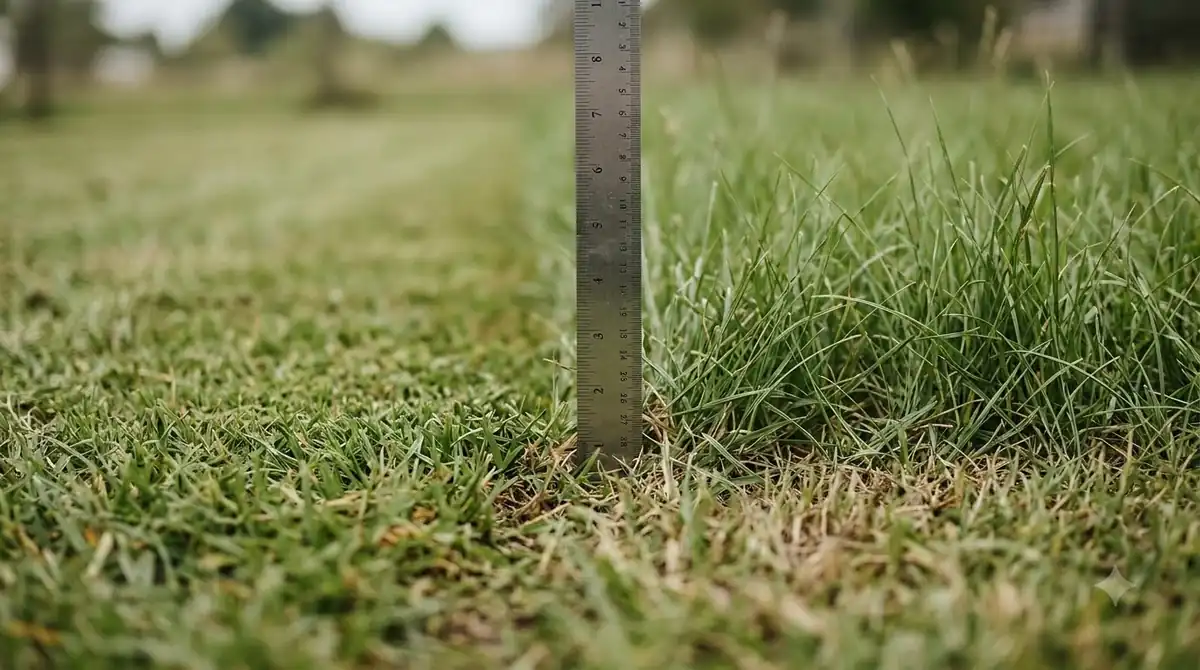
When grass is well above the mower’s normal range, the safer approach is to bring it down in steps. Clemson’s guidance says that if grass gets too tall between mowings, you should raise the cutting height first and then lower it gradually to the recommended height. The University of Kentucky gives the same advice: raise the mowing height so you do not cut off too much grass at once, then mow every two to three days while lowering it gradually. If you would rather trim first, see our guide to cutting an overgrown lawn before the robot starts.
Robomow notes that its mowers’ cutting height can be adjusted with a lever or a display, depending on the model, and our guide to robot mowers with adjustable cutting height explains the options. Some robot mowers also raise the cut automatically and lower it over later cycles, but that feature varies by brand, so check the manual for the model you are considering. Shade and summer heat matter too. The Arizona extension guide says to raise the height in summer heat and to let grass grow taller in shade or on the north side of a building.
Blades, clippings and wet grass
A mower’s blades matter as much as its height range when you pick the best robot mower that handles tall grass. The Arizona guide warns that dull blades cause scalping and leave torn, shredded leaves, which makes a lawn look damaged. Keep blades sharp and set correctly, and check them after cutting heavy grass. Our guide to how to replace robot mower blades shows when and how.
Wet tall grass is harder on any mower. The same extension guide says to avoid mowing wet turf because wet grass balls up and clogs the blades and deck. For rain rules on a robot, see whether robot mowers work in the rain. Clemson adds that a dense turf keeps weeds out by competing for light and nutrients, so a steady height that keeps the lawn dense is the goal, not cutting as hard as possible.

What to check before you buy the best robot mower that handles tall grass
Use this checklist to compare models for tall grass. Each item is our reading of the sources above, not a ranking.
- Cutting height range. Find the minimum and maximum setting on the spec sheet and compare the maximum with how tall your grass gets between mowings.
- Height adjustment. Check whether the height is set with a lever, a display or an app, and whether it can be raised and lowered in steps.
- Blade type and replacement. Confirm the blade can be replaced and that replacement blades are sold for the model.
- Mowing schedule. A mower that runs often keeps grass short, so it rarely has to handle tall grass. Check the run time and charging cycle in the manual.
- Wet-weather rules. Read whether the brand advises against mowing in wet grass, and plan for dry-day mowing if it does.
Frequently asked questions
Can a robot mower cut tall grass in one pass?
Not always. The one-third rule says to remove no more than one-third of the grass height per mowing. For grass much taller than the mower’s range, raise the cut first and lower it over several passes.
What cutting height range is common for robot mowers?
Robomow describes typical robot mowers as cutting between about 15 and 60 mm, and taller-grass models up to about 100 mm. Check the printed range for the exact model.
Should I trim tall grass with a regular mower first?
That is often the simplest way to bring very long grass into range. Our reading is that a manual pass first lets the robot start from a height it can cut within the one-third rule.
Does wet grass make tall grass harder to cut?
Yes. The Arizona extension guide says wet grass balls up and clogs blades and the deck. Wait for dry grass when you can.
Sources
- Robomow blog: Can the robotic lawnmower cut tall grass? (robot mower manufacturer): cutting height ranges, taller-grass models, height adjustment.
- University of Arizona Cooperative Extension, AZ1681 (university extension): one-third rule, scalping, blades, wet grass, shade and heat.
- Clemson Home and Garden Information Center, mowing height (university extension): one-third rule, raising then lowering the cut, dense turf.
- University of Kentucky, mowing grass for best results (university extension): raise the mowing height when grass is too tall.
 Up next7 min readBest Robot MowersBest Robot Mower for Thick Grass: 5 Things to CheckUpdated Nov 11, 2026
 8 min readBest Robot MowersBest Robot Mower With Ultrasonic Sensors: 5 Checks Before You BuyUpdated Nov 11, 2026
 8 min readBest Robot MowersBest Robot Lawn Mower for 5 Acres: What to Check Before You BuyUpdated Nov 11, 2026
 9 min readBest Robot MowersBest Robot Mower That Mows in Straight Lines: 6 ChecksUpdated Nov 11, 2026
 8 min readBest Robot MowersBest Robot Mower That Works in the Rain: What to Check Before You BuyUpdated Nov 11, 2026
 9 min readBest Robot MowersBest Robot Mower That Does Not Get Stuck: What to Check Before You BuyUpdated Nov 11, 2026