
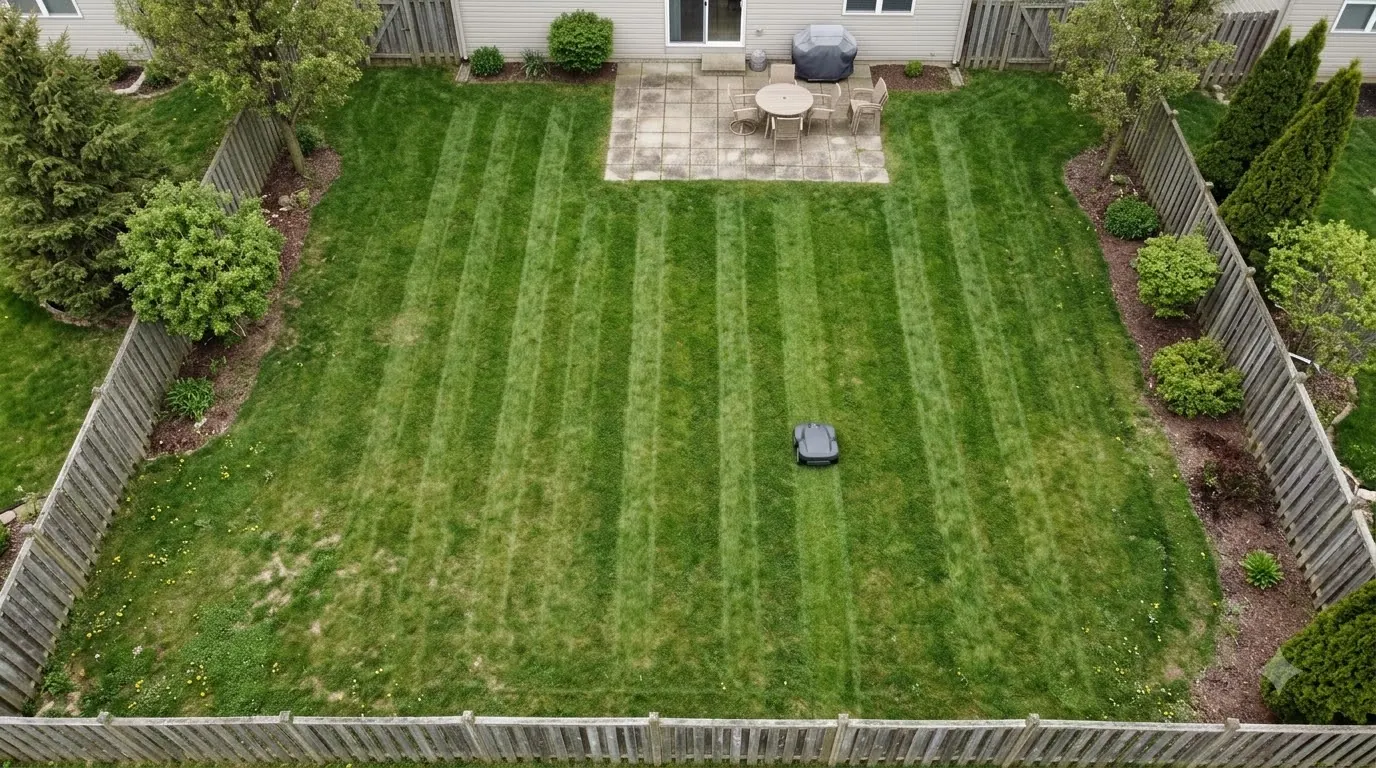

The best robot mower for straight stripe patterns is one that runs a systematic parallel mode backed by positioning that keeps rows straight. Random-path mowers change direction at every boundary and obstacle, so they do not form the parallel rows that make stripes.
The short answer
- Pattern mode: stripes need a parallel (zigzag) pattern, which Husqvarna describes as the mode that creates stripes.
- Navigation: Mammotion says RTK or GNSS positioning is what makes precise straight lines possible, and it names limits for camera and LIDAR systems.
- Lawn shape: parallel suits flat, open lawns with few obstacles, and it can leave edges uncut.
- Before you buy: confirm the parallel mode in the spec sheet or app, not just a generic “smart” pattern name.
- No ranking here: we found no independent test data on stripe quality, so this guide does not name a single model.
Why straight stripes depend on the pattern mode
Stripes appear when the mower runs parallel passes in one direction, not when it wanders. A buyer looking for a best robot mower for straight stripe patterns should start with that mode. Husqvarna’s systematic mowing page says the parallel pattern starts every session in a designated corner and keeps the same direction each time, which is what creates the striped effect on the lawn. Without that mode, the mower has no fixed direction to repeat from one session to the next.
The random pattern works differently. Mammotion describes it as running straight until it meets a boundary wire, an obstacle or a sensor alert, then turning. That gives full coverage over repeated sessions, but with more overlap and an unpredictable path, so the rows do not line up into stripes.
Our reading is that a “smart” or “AI” label alone does not tell you whether a mower can stripe. Look for a parallel, zigzag or systematic mode in the manual or the app’s pattern menu.
Which navigation systems hold straight rows
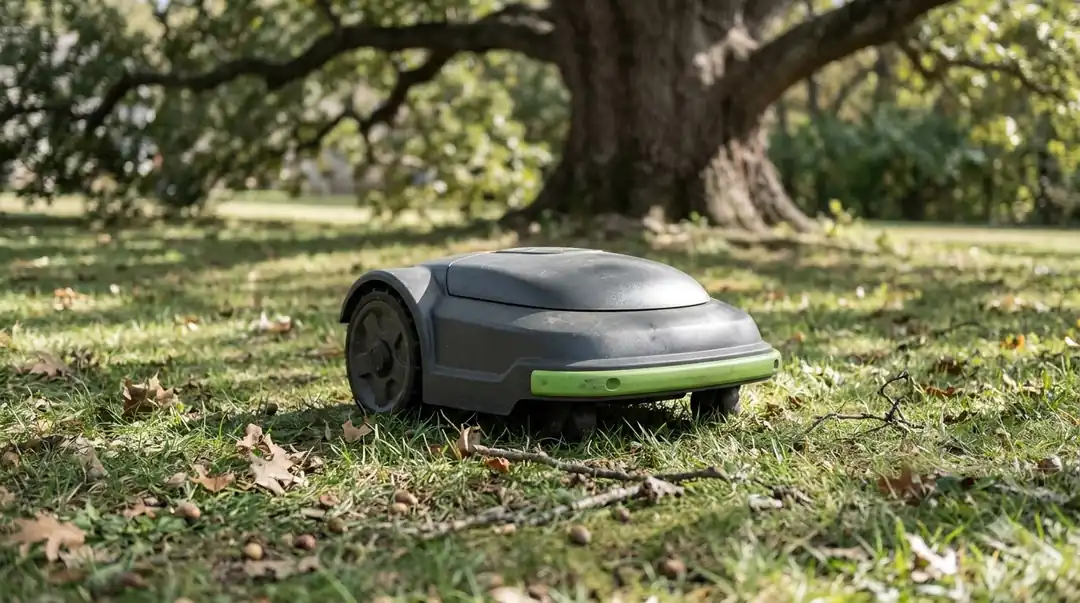
RTK or GNSS positioning is the strongest source of straight rows among the sources we read, while camera and LIDAR systems each have a stated limit. For a deeper comparison, see RTK vs LiDAR vs vision robot mowers. Mammotion says RTK/GNSS gives centimeter-level positioning and that its systems “excel at producing precise straight lines.” Its page also warns that using only one or two technologies “can limit reliability in complex terrains.”
| Navigation | What the source says | Stated limit |
|---|---|---|
| RTK or GNSS | Centimeter-level positioning for straight, repeatable paths (Mammotion) | One or two technologies alone “can limit reliability in complex terrains” (Mammotion) |
| AI vision camera | Adjusts routes dynamically (Mammotion) | “May struggle under low-light conditions or with uniform grass textures” (Mammotion) |
| LIDAR | Good at obstacle detection (Mammotion) | “May still lack the consistency needed for perfectly straight mowing lines in large yards” (Mammotion) |
| Husqvarna systematic mowing | Requires wire-free installation with EPOS technology (Husqvarna) | A model-specific requirement, so check the model’s own page |
For a best robot mower for straight stripe patterns, the positioning question is practical. Mammotion’s page does not say RTK is mandatory for systematic patterns, and how an RTK robot mower works explains the positioning side. It says RTK-enabled models “excel at producing precise straight lines,” which is a different claim. Eufy’s E18 and E15 use AI visual navigation and auto-mapping “without the need for wiring or RTK,” but the eufy page does not say those models produce stripes, so do not assume they do.
Parallel, checkerboard or triangle: which pattern gives stripes
Parallel mode gives the clearest stripes, checkerboard makes a crosshatch, and triangle makes stripes the least visible. Husqvarna’s systematic mowing page gives the session angles: each checkerboard session runs 90 degrees to the previous one, and each triangle session runs 60 degrees from the previous one.
| Pattern | How each session runs | Look on the lawn | Fit, per the sources |
|---|---|---|---|
| Parallel (zigzag) | Same direction every session, starting in the designated corner | Clear stripes | Large, flat, open lawns (Husqvarna, Mammotion) |
| Checkerboard (crosshatch) | 90 degrees to the previous session | Crosshatch pattern | Smaller or irregular yards (Mammotion) |
| Triangle | 60 degrees from the previous session | Stripes less visible | Irregular yards and corners (Mammotion) |
Check which patterns your model offers before you decide (our robot mower mowing patterns guide lists them), since a best robot mower for straight stripe patterns must have the mode you need. Mammotion lists only zigzag (parallel) and checkerboard for its systematic modes, and it does not list triangle, so a triangle option is a model-specific feature to confirm.
Lawn shape, edges and slopes
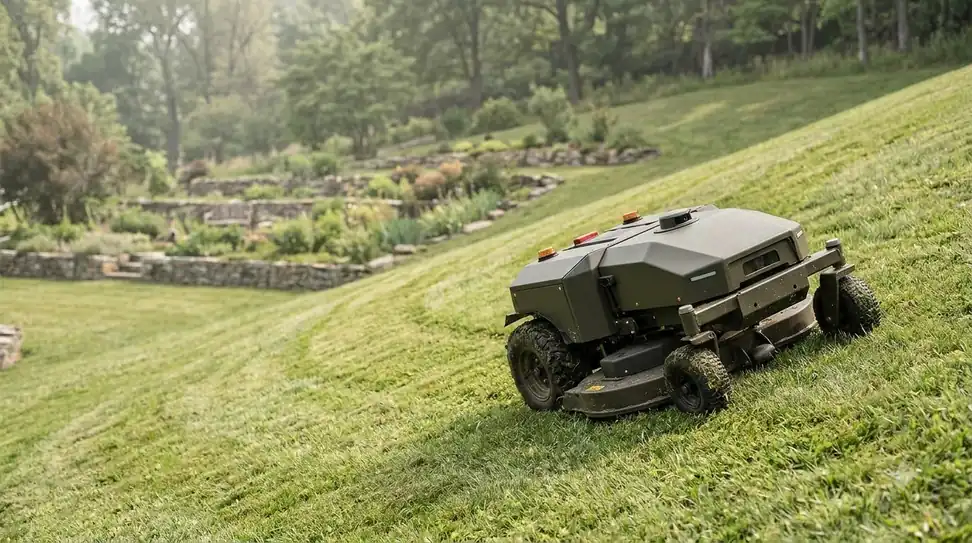
Parallel rows suit open lawns, and they can leave edges uncut, so lawn shape matters as much as the mode. Anyone choosing a best robot mower for straight stripe patterns should measure the lawn first. Husqvarna says systematic mowing is best for flat, open areas with few obstacles, and it recommends irregular mowing for slopes, complex areas and yards full of obstacles.
- Edges: Husqvarna says a parallel pattern can leave edges uncut, while checkerboard or triangle cover edges from several angles.
- Perimeter pass: a final pass along the boundary removes uncut grass there, according to Husqvarna.
- Obstacles: uncut strips narrower than 1 meter between an obstacle and the virtual boundary stay uncut.
- Slopes: the general advice is to mow straight up the slope. A checkerboard pattern can make the mower cross the slope sideways, which may wear the lawn or cause slipping.
Mammotion adds that complex patterns may need higher battery capacity or more frequent charging, which matters on larger yards. If your lawn is hilly, robot mower slope rating explained shows how to read the limits. Our reading is that a large, open, flat lawn is the case where a parallel mode is easiest to justify.
How to set the direction and keep stripes sharp
Set the direction in the app’s pattern settings, then change it over time so the grass does not lean one way; how to get stripes with a robot mower walks through the setup. Menu names vary by model and region, so check your own app.
- Select the work area. Open the pattern settings for that area and choose parallel, checkerboard or triangle.
- Set the direction. Move the orange dots to define the direction, then save. Husqvarna notes that changing the pattern or map settings interrupts a session in progress.
- Use different patterns per area. Husqvarna says the pattern can differ between areas in its Automower Connect app.
- Alternate the direction. Mammotion says robotic mowers often run several times a week or daily, and recommends changing the pattern direction about weekly.
- Mind the grass height. A manual striping guide from eufy gives 2.5 to 3.5 inches for cool-season grass and 1.5 to 2.5 inches for warm-season grass, and says taller grass gives more visible stripes. That guide covers manual mowing, so treat these figures as general, not robot-specific.
Best robot mower for straight stripe patterns: what to check before you buy
When you compare any model, confirm a parallel mode, the positioning behind it, the edge plan and the slope fit before you compare models. These are the checks the sources support, and none of them depends on a brand ranking.
- Pattern list: parallel or zigzag appears in the spec sheet or the app, not only as a generic smart mode.
- Positioning: RTK or GNSS is the strongest source of straight rows in the sources we read, so check how the model handles the terrain at your home.
- Installation: Husqvarna says systematic mowing needs wire-free EPOS installation on its models, so check the model’s own requirement.
- Edges: plan on a perimeter pass or a hand trim where a parallel pattern leaves edges uncut.
- Battery: complex patterns may need more battery capacity or charging, according to Mammotion.
Frequently asked questions
Can any robot mower make straight stripes?
Not every model can. Husqvarna says its parallel pattern is what creates stripes, and random-path mowing changes direction at each boundary or obstacle. Check the spec sheet or manual for a parallel, zigzag or systematic mode before you buy.
Do I need RTK for straight stripes?
The sources we read do not state RTK as a requirement for systematic patterns. Mammotion says RTK or GNSS gives precise straight lines, and that using only one or two technologies can limit reliability in complex terrain. Husqvarna’s systematic mowing needs wire-free EPOS installation.
Which pattern gives the clearest stripes?
Parallel mode gives the clearest stripes. Husqvarna says the triangle pattern makes stripes less visible than parallel or checkerboard, and checkerboard produces a crosshatch look instead of single stripes.
Why do my edges look uncut after a parallel pattern?
A parallel pattern can leave edges uncut, according to Husqvarna, because it keeps one direction. Checkerboard or triangle cover edges from several angles, and a final perimeter pass removes uncut grass along the boundary. Our reading is that a hand trim may still be needed at the edges.
Sources
- What is systematic mowing? (Husqvarna): parallel, checkerboard and triangle patterns, session angles, edges, slopes and setup steps.
- How to get stripes on your lawn (Husqvarna): EPOS wire-free requirement and per-area patterns.
- Systematic pattern for robotic mower (Mammotion): RTK/GNSS strengths, camera and LIDAR limits, and pattern guidance.
- Lawn mowing patterns for robotic lawn mowers (Mammotion): random pattern behavior and weekly direction changes.
- How to mow stripes (eufy): E18 and E15 navigation, and grass height guidance for manual striping.
 Up next9 min readBest Robot MowersBest Robot Mower That Mows in Straight Lines: 6 ChecksUpdated Nov 11, 2026
 7 min readBest Robot MowersRobot Mower Mowing Patterns: Random vs Striped ExplainedUpdated Nov 11, 2026
 7 min readBest Robot MowersBest Wireless Robot Mower for 1/3 Acre Lawn: What to CheckUpdated Nov 11, 2026
 8 min readBest Robot MowersBest Robot Lawn Mower for Texas Lawns: 4 Specs to CheckUpdated Nov 11, 2026
 9 min readBest Robot MowersBest Robot Lawn Mower With Theft Alarm: Features to CheckUpdated Nov 11, 2026
 9 min readBest Robot MowersBest Robot Lawn Mower With Best Customer Support: What to CheckUpdated Nov 11, 2026