
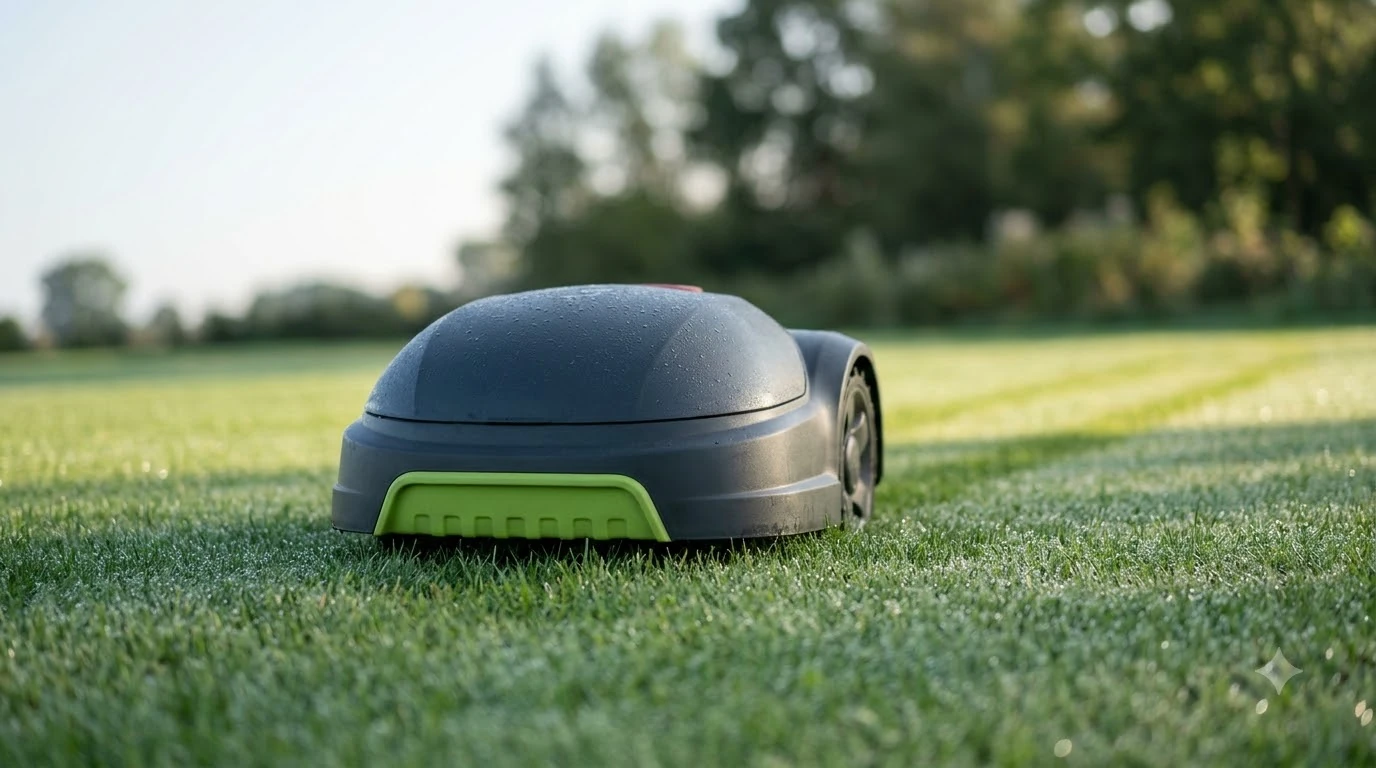

A robot mower for a hot humid climate works best when its heat limit, rain response and charging spot match your local weather. Husqvarna and Navimow both publish temperature ranges for their mowers, and those ranges set the hours when a mower can run. As of November 2026, the figures below come from the manufacturer and university pages named in the sources.
The short answer
- Heat limit: Husqvarna’s Automower lists 0 to 50°C (32 to 122°F) for operation. Navimow’s H2 and X4 list 0 to 40°C (32 to 104°F).
- Heat setting: Navimow’s default max mowing temperature is 35°C (95°F), and you can change it in the app.
- Rain: choose a mower with on-site rain sensing and an adjustable rain delay, not a forecast alone.
- Cutting height: cut higher when turf is stressed by heat, and never remove more than one-third of the blade height at once.
- Charging spot: put the dock in shade, because Husqvarna advises protecting the charging station from the sun.
What temperature range does a robot mower for a hot humid climate need?
A robot mower needs local temperatures to stay inside its operating range, or it will not start. Husqvarna’s support page lists 0 to 50°C (32 to 122°F) for operation and storage, and 0 to 45°C (32 to 113°F) for charging. The page also says the mower’s sensor sits inside the chassis, so its reading can differ a little from the air around the lawn.
Navimow’s guide to sunny, rainy and frosty mowing describes a narrower band for its H2 and X4 models, 0 to 40°C (32 to 104°F). Outside that band, the mower pauses a cut or delays a charge to protect its internal parts. The same guide says this range is an operating boundary set for reliability and turf health, not the hardware ceiling. It also says the default max mowing temperature is 35°C (95°F), and that the mower holds at the dock when a forecast passes your threshold until it cools. Husqvarna says its mower will not start outside its own limits.
For a robot mower for a hot humid climate, our reading is that the setting matters as much as the hardware limit. A default of 35°C may send the mower back to the dock on hot afternoons that are still within its hardware range. Check the setting before the first summer and decide whether you want mowing in cooler hours. If you live in Florida or a similar region, our guide to robot lawn mowers for Florida lawns applies the same checks to a specific market.
The sources we read give temperature limits but no humidity limit. Ask the maker for a humidity figure in writing before you buy, rather than assuming one.
How rain and wet grass change the mowing schedule
A rain response that reacts to actual rain matters more than a forecast alone, because a forecast can miss a short storm. Navimow’s H2 and X4 combine a capacitive rain sensor with weather sync. If either one reports rain, the mower docks and runs its rain protection. After the weather clears, a rain-delay timer, adjustable up to 12 hours, controls when mowing restarts.
Wet grass is a separate problem from rain. The University of Missouri’s proper mowing guide says mowing when the lawn is wet produces clumps of clippings that can lead to lawn deterioration. It also advises raising the deck when mowing has been delayed by wet weather.
Our reading is that the rain delay is a trade-off. A short delay can run the mower on soaked turf, while a long delay lets the grass grow past the one-third rule between sessions. Pick a delay you can change for each season, and watch the first wet week after setup. For a wider look at wet-weather running, read about robot lawn mowers mowing in the rain.
Why heat changes how high a robot mower should cut
Cut higher when turf is stressed by heat, drought or shade. Clemson’s Home and Garden Information Center advises mowing turfgrass under stress at a higher level of cut, and it names heat, drought and shade as the stresses to watch. The University of Missouri adds that mowing a lawn under drought or heat stress can injure grass plants. Our page on mowing a lawn in summer heat and drought goes deeper on the lawn side.
The one-third rule still applies in summer. The Missouri guide says grass should be mowed when it has grown one-third taller than the desired height. Clemson gives an example: a centipede lawn kept at 2 inches should be mowed when it is about 3 inches high, and cutting off more than one-third at once can stop the roots from growing.
Warm-season and cool-season grasses use different ranges. The Missouri guide lists zoysiagrass at 1.5 to 2.5 inches and advises raising warm-season lawns to 2 to 2.5 inches by September. Bluegrass, tall fescue and perennial ryegrass are generally mowed at 2.5 to 4.0 inches. The same guide warns that mowing too low, which breaks the one-third rule, stresses grass at a time when disease susceptibility runs high.
Where to put the charging station in a hot yard
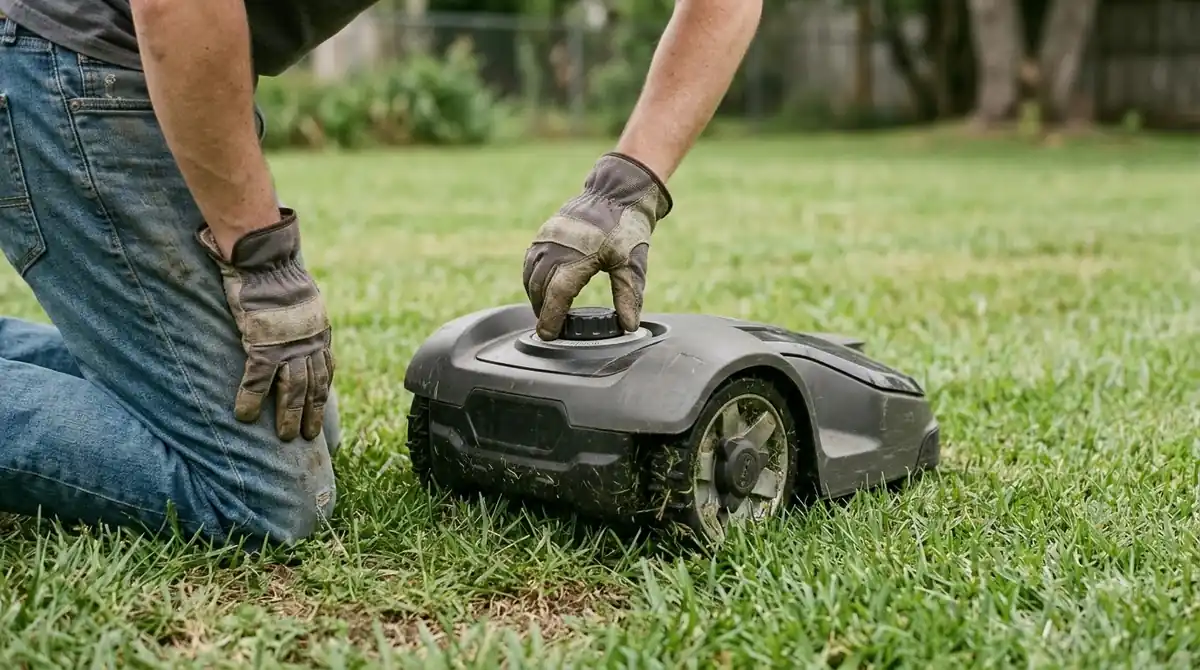
Put the dock where it gets shade, because Husqvarna’s support page says to make sure the charging station is placed in an area with protection from the sun. The same page lists 0 to 45°C (32 to 113°F) as the charging range, so a dock in full afternoon sun leaves less margin on a hot day. Our guide on where to put a robot mower charging station covers the layout side, and robot mower garages for hot sun are one way to add shade.
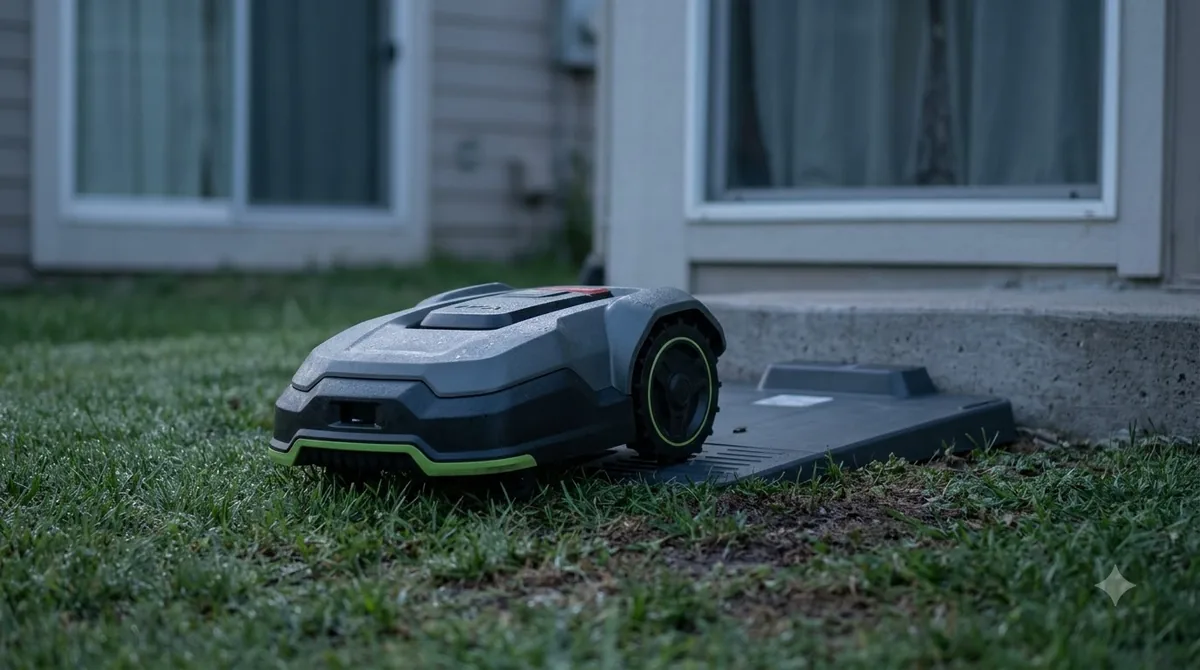
Our reading is that a shaded dock suits a robot mower for a hot humid climate, because shade from a roof, a wall or a tree can help, but the spot still needs a clear path to the boundary wire or the mowing zone. Trace the route from the dock to the far side of the lawn before you commit to a location.
Power and signal also matter at the dock. Keep the charger close to a protected outlet, and check the mower’s Wi-Fi or GPS reach from the dock position before you fix it in place.
What to check in a robot mower for a hot humid climate before you buy
Before you buy a robot mower for a hot humid climate, check five specifications against your local weather and your grass type. Each one comes from the sources above or from the manufacturer’s own manual.
- Operating range. Compare the maker’s upper limit with your typical summer highs, and check whether the figure is for operation, charging or storage.
- Heat setting. Confirm the max mowing temperature can be changed in the app and see what the default is.
- Rain sensing. Prefer on-site rain sensing with an adjustable rain delay over a forecast-only feature.
- Cutting height range. Make sure the lowest and highest settings cover your grass, using the ranges given above.
- Dock location. Find a shaded spot with a clear route to the lawn and a reliable power and signal connection.
Heads up
The sources we read publish temperature limits, but none gives a humidity limit. Get the maker’s humidity figure in writing before you buy.
Frequently asked questions
Can a robot mower work in a hot humid climate?
Yes, if your typical temperatures stay inside the mower’s operating range and the heat setting suits your yard. Husqvarna’s Automower lists 0 to 50°C for operation, while Navimow’s H2 and X4 list 0 to 40°C. Check the exact figure for the model you plan to buy.
What happens when it gets too hot for the mower?
The mower pauses a cut or delays a charge to protect its internal parts when temperatures leave its range. Navimow says the mower holds at the dock when a forecast passes the max mowing temperature you set, and it stays docked until conditions cool.
Does rain always stop a robot mower?
Not by default for every model, so check the settings. Navimow’s H2 and X4 use a capacitive rain sensor plus weather sync, and they restart after a rain-delay timer that you can adjust up to 12 hours.
Should I cut the grass higher in summer?
Often yes. Clemson’s Home and Garden Information Center advises cutting turf stressed by heat, drought or shade at a higher level, and the one-third rule still applies. Check the height range for your grass type before you set the mower.
Sources
- Husqvarna Automower temperature guidance (Husqvarna): operating, storage and charging temperature ranges, and sun protection for the charging station.
- Navimow guide to sunny, rainy and frosty mowing (Segway Navimow): H2 and X4 temperature range, default max mowing temperature, rain sensor and rain delay.
- Proper Mowing Practices for Your Lawn (University of Missouri IPM): one-third rule, cutting heights for cool-season and warm-season grass, and wet-grass mowing.
- Clemson HGIC mowing guidance (Clemson Cooperative Extension): higher cut for turf under heat, drought or shade, and the centipede example for the one-third rule.
 Up next8 min readBy YardRobot Mower in Cold Climates: Frost, Snow and Battery LimitsUpdated Nov 11, 2026
 8 min readBy YardBest Robot Mower for a Duplex Yard: What to Check Before You BuyUpdated Nov 11, 2026
 9 min readBy YardBest Robot Mower for a Cottage Garden Lawn: What to CheckUpdated Nov 11, 2026
 9 min readBy YardBest Robot Mower for a Condo Common Lawn: What to CheckUpdated Nov 11, 2026
 8 min readBy YardRobot Mower for Compacted Soil Lawn: 4 Checks FirstUpdated Nov 11, 2026
 9 min readBy YardBest Robot Mower for a Small Backyard in the City: What to Check FirstUpdated Nov 11, 2026