
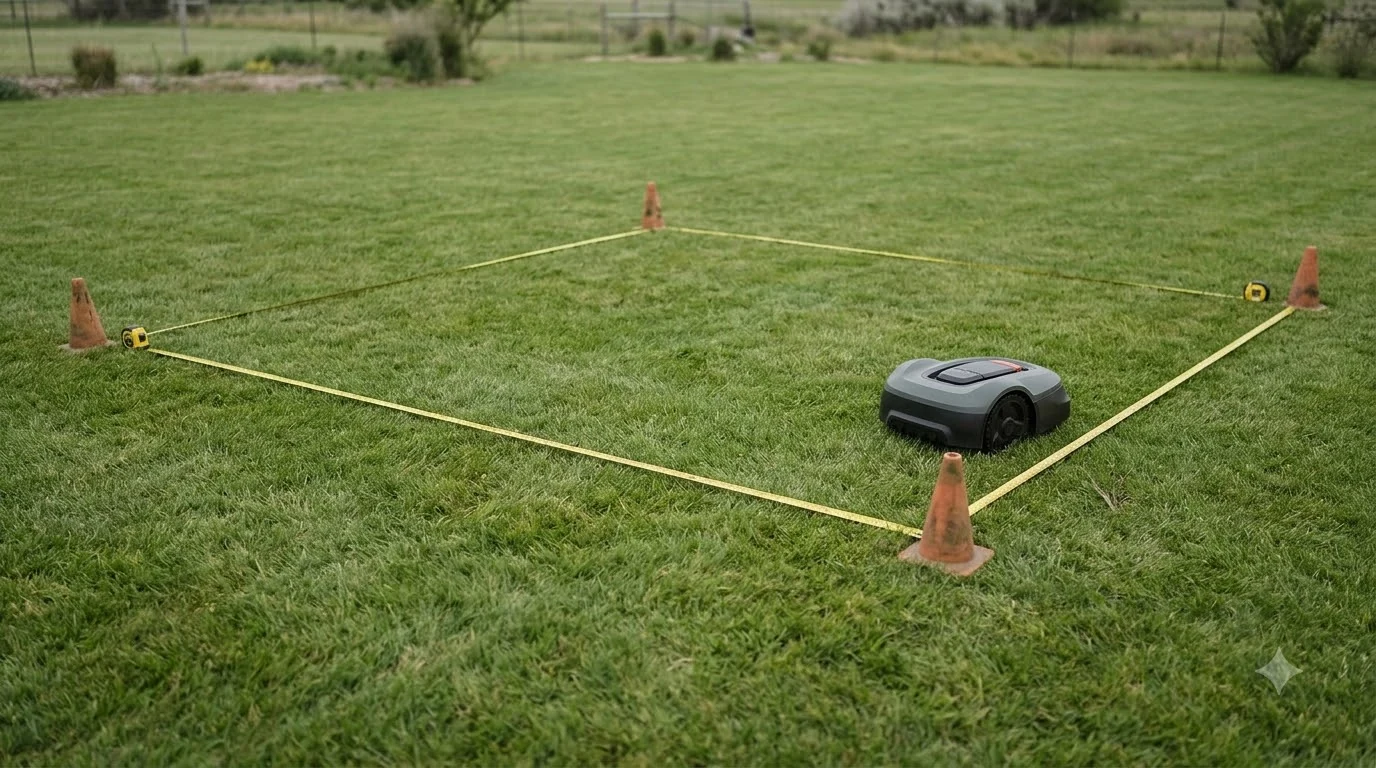

There is no single best lawn measuring wheel for robot mower sizing. What matters more is using a wheel to get accurate edge lengths, then turning those lengths into an area that you can compare with a mower’s rated lawn size. A measuring wheel records distance, so it helps most along long edges, fence lines and the outer perimeter. Area still has to be worked out with a shape formula, and the result should be checked against the margin a mower maker builds into its ratings. This guide explains what to measure, how to do the math and what to check before you buy.
The short answer
- Measure area, not just length. Mower makers list rated lawn sizes in acres or square feet, so your final number has to be an area.
- Use the wheel for the edges. A measuring wheel suits long runs and uneven ground. For small or complex shapes, a tape measure is often enough, according to a mower maker’s sizing guide.
- Convert with shape formulas. Split the lawn into rectangles, triangles and circles, or use the offset method that Clemson HGIC describes for irregular lawns.
- Leave margin. Husqvarna lists its lawn-size figures with a plus or minus 20 percent tolerance, so we recommend choosing a model rated above your measured area rather than one that matches it exactly.
What a robot mower sizing number actually means
A robot mower’s sizing number is a rated lawn area. Husqvarna’s US robotic mower page lists its residential models at about 0.5 acre for the Automower 410 iQ, 1 acre for the 420 iQ, 0.9 acre for the 435X AWD, 1.3 acre for the 435 iQ AWD and 2 acres for the 440 iQ. The same page states that these lawn sizes carry a plus or minus 20 percent tolerance. Our reading is that a model rated at 1 acre could be suited to a lawn anywhere from roughly 0.8 to 1.2 acres, which is why the margin in the last section matters.
Ratings are also written in different units across brands. Some listings use square feet, some use square meters and some use acres. Convert every number to one unit before you compare two models. For the wider decision, see this guide to choosing a robot mower by lawn size. As a common reference, 1 acre equals 43,560 square feet, and 1,000 square meters is about 10,764 square feet.
Why a measuring wheel helps with the perimeter
A measuring wheel is a hand-pushed wheel with a counter that records distance as you roll it along a line. Mammotion’s lawn-measuring guide names a tape measure or a measuring wheel for small or complex areas, and GPS or laser distance meters for larger properties. Our reading is that a wheel works best on long straight edges, fence lines and the outer boundary, where a tape is hard to keep taut on uneven ground. In practice, the best lawn measuring wheel for robot mower sizing is the one that gives you a clean perimeter reading, because perimeter is the one thing a wheel measures well.
A wheel does not give you area by itself. Perimeter alone does not fix the shape. As a simple check, a 400-foot perimeter encloses 10,000 square feet if it forms a 100 by 100 foot square, but only 7,500 square feet if the same length forms a 150 by 50 foot rectangle. That is our arithmetic, and it shows why the wheel reading needs a width or a shape formula to become a usable area.
Step by step with a measuring wheel
The process below is our suggested workflow for getting the most from the best lawn measuring wheel for robot mower sizing, not a method taken from a single source. It works with any measuring wheel and a notepad.
- Clear the lawn. Pick up toys, hoses and garden tools so the wheel can roll in a straight line along each edge.
- Mark a start point. Choose a corner, set the counter to zero and walk the boundary in one direction.
- Record each side. At every corner, write down the reading for that side. Keep the sides in order so you can sketch the outline later.
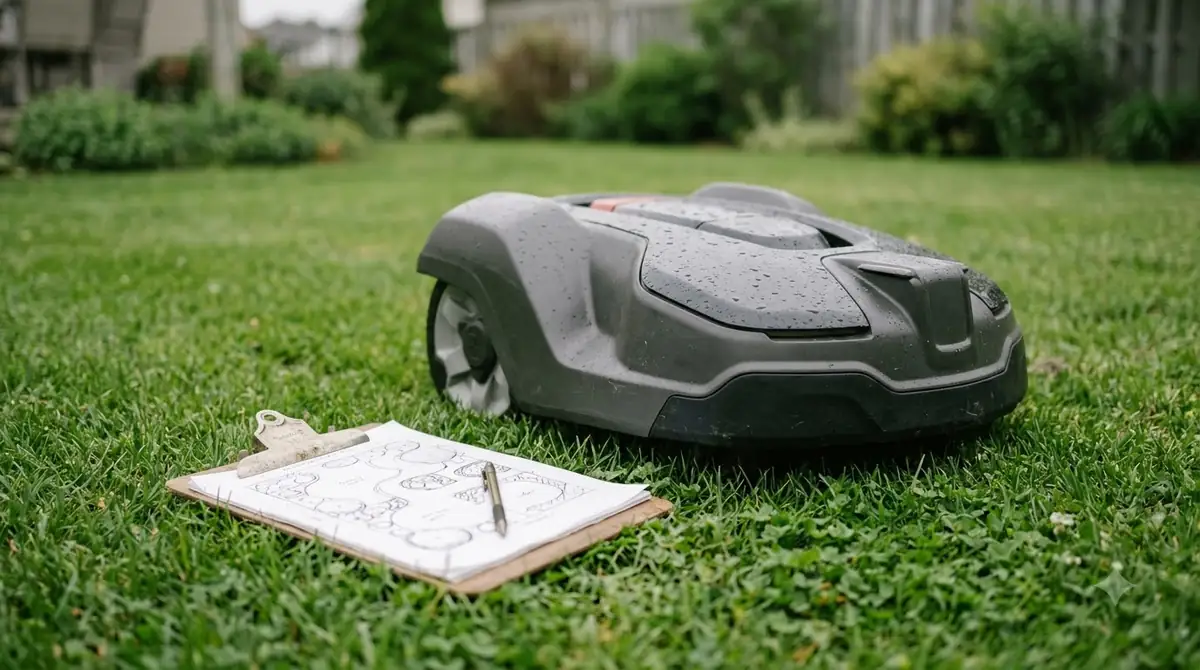
- Sketch the shape. Draw the lawn on paper with the side lengths. Mark bends, islands and beds you need to subtract.
- Calculate area. Split the sketch into simple shapes, calculate each one and add them up. Subtract patios, driveways, flower beds and other areas the mower will not cut.
- Check the total. Compare the result with a satellite estimate, then compare it with the model’s rated area.
Turning the readings into square feet
Once you have a sketch, the shape formulas do most of the work. For a longer walkthrough of the same task, see how to measure yard square footage. Clemson HGIC’s lawn-area factsheet gives the basic formulas: a rectangle is length times width, a circle is pi times radius squared, and an oval is length times width times 0.8. Iowa State University Extension gives the same core shapes and adds that a triangle is base times height times 0.5, a semicircle is half of a circle, and an ellipse is pi times the two semi-axes.
For a lawn with an irregular edge, Clemson describes the offset method. Choose the longest straight line across the lawn, measure the width at evenly spaced points along that line, add the widths and multiply the total by the distance between the measurement points. The closer the points are, the more accurate the result. For a typical yard we suggest spacing of about 10 feet, which is our own suggestion and not a figure from the source.
Here is a worked example using our own arithmetic. Five width readings of 18, 26, 31, 29 and 24 feet, taken 10 feet apart, add up to 128 feet. Multiply 128 by 10 and the estimate is 1,280 square feet. A real lawn would need more readings, but the method is the same. Beds and patios still need to be subtracted from the total.
Checking your numbers with satellite and GPS tools
Satellite tools are a quick cross-check. Google’s measuring tool in Google Earth on the web lets you place points on a top-down view and reads area and perimeter from the outline you trace. Google’s documentation treats the result as an estimate, not a replacement for an on-site survey, and the tool does not account for elevation, so a sloped lawn can read differently from how it feels on foot.
Mammotion says online tools are generally accurate within 2 to 5 percent for most home lawns. That is a claim from a mower maker, and we did not find an independent check of it. Our reading is to use the satellite figure to check your wheel and formula numbers, and to trust the on-site measurement if the two differ by a lot.
Best lawn measuring wheel for robot mower sizing: what to look for
We did not find an extension publication or independent test that compares measuring wheels, and we have not tested any. The features below are our reading of what matters for mapping a lawn, not a ranking. Look for a counter you can reset to zero, a wheel that rolls straight without wobbling, a handle that keeps the wheel upright on slopes and a clear unit display. Check the stated unit and reset behavior in the maker’s manual before you buy.
How much margin to leave when choosing a model
Even the best lawn measuring wheel for robot mower sizing cannot remove uncertainty about a rated lawn size. Because Husqvarna’s lawn-size figures carry a plus or minus 20 percent tolerance, we recommend choosing a model rated above your measured area rather than one that matches it exactly. Lawn area is only one filter. Husqvarna’s 435 iQ AWD specifications list a slope limit of up to 70 percent inside the installation area and 50 percent at the boundary, so check slope separately from area, for example by measuring your yard’s slope.
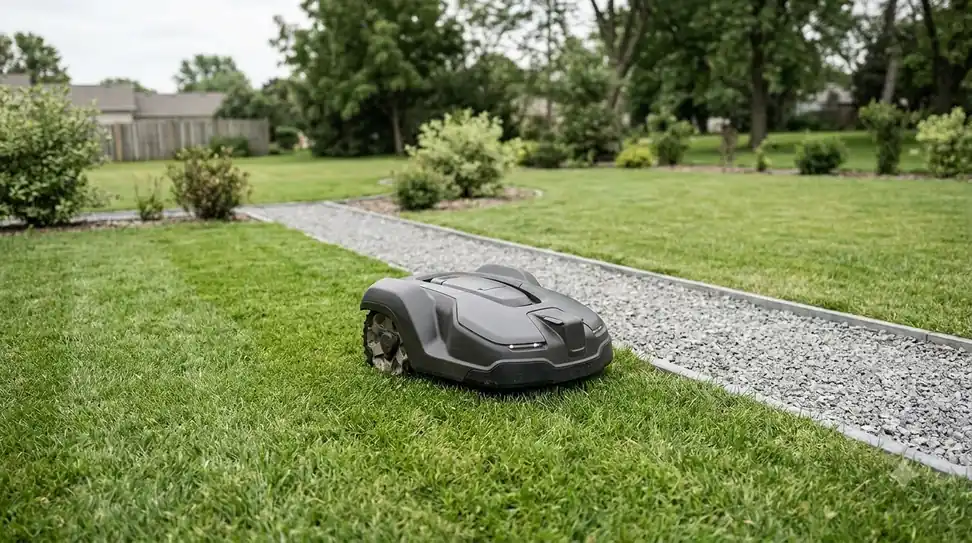
Brand-listed coverage can also vary inside one range. Ecovacs lists its GOAT O1000 RTK for coverage up to 1/4 acre and its A2500 RTK for up to 1/2 acre, or 27,000 square feet. Those are the maker’s own figures, so compare numbers from the same source and treat them as a starting point before you check your measured area.
Frequently asked questions
Is a measuring wheel accurate enough for robot mower sizing?
Our reading is that even the best lawn measuring wheel for robot mower sizing gives a usable perimeter for sizing, but it does not give area by itself. Combine it with a shape formula, check the result against a satellite estimate and leave margin. We did not find an independent accuracy test of measuring wheels.
Should I measure in square feet or acres?
Use the unit the mower maker uses in its listing, and convert your own number to match. One acre equals 43,560 square feet, so a 10,000 square foot lawn is about 0.23 acres. A quarter acre lawn in square feet is a handy reference point.
Can satellite tools replace walking the lawn?
Google describes its measuring results as estimates and not a replacement for an on-site survey. Satellite tools are useful for a quick check, but they do not account for elevation, so walk the lawn if it has slopes or obstacles.
What if my lawn falls between two model sizes?
We recommend choosing the model with the larger rating, since the stated tolerance can work in either direction. Then check slope, obstacles and the boundary setup before you buy, because lawn area alone does not describe how a mower will handle the site.
Sources
- Measuring the Area of a Home Lawn (Clemson Home and Garden Information Center): rectangle, circle and oval formulas, and the offset method for irregular lawns.
- How do I determine the size of my garden bed or lawn in square feet (Iowa State University Extension): triangle, semicircle and ellipse formulas.
- Measure distances and areas in Google Earth (Google): how the web measuring tool works and its limits.
- Robotic lawn mowers (Husqvarna US): rated lawn sizes and the plus or minus 20 percent tolerance.
- Automower 435 iQ AWD (Husqvarna US): slope limits for the installation area and boundary.
- How to measure your lawn area (Mammotion, a mower maker): tape and wheel guidance and its accuracy claim, which is a vendor claim.
- GOAT A2500 RTK (Ecovacs): listed coverage of up to 1/2 acre.
 Up next8 min readGearRobot Mower Wheel Brushes: What to Use and What to AvoidUpdated Nov 11, 2026
 7 min readGearRobot Mower Wheel Replacement: When to Swap and What to CheckUpdated Nov 11, 2026
 9 min readGearSmart Sprinkler Controllers and Robot Mowers: What to Check Before You Sync ThemUpdated Nov 11, 2026
 8 min readGearBest Lawn Edger to Use With Robot Mower: 6 Points to CheckUpdated Nov 11, 2026
 8 min readGearBest Soil Moisture Sensor to Pair With Robot Mower: What Actually Controls MowingUpdated Nov 11, 2026
 8 min readGearRobot Mower Cover for Charging Station: What the Manuals SayUpdated Nov 11, 2026