
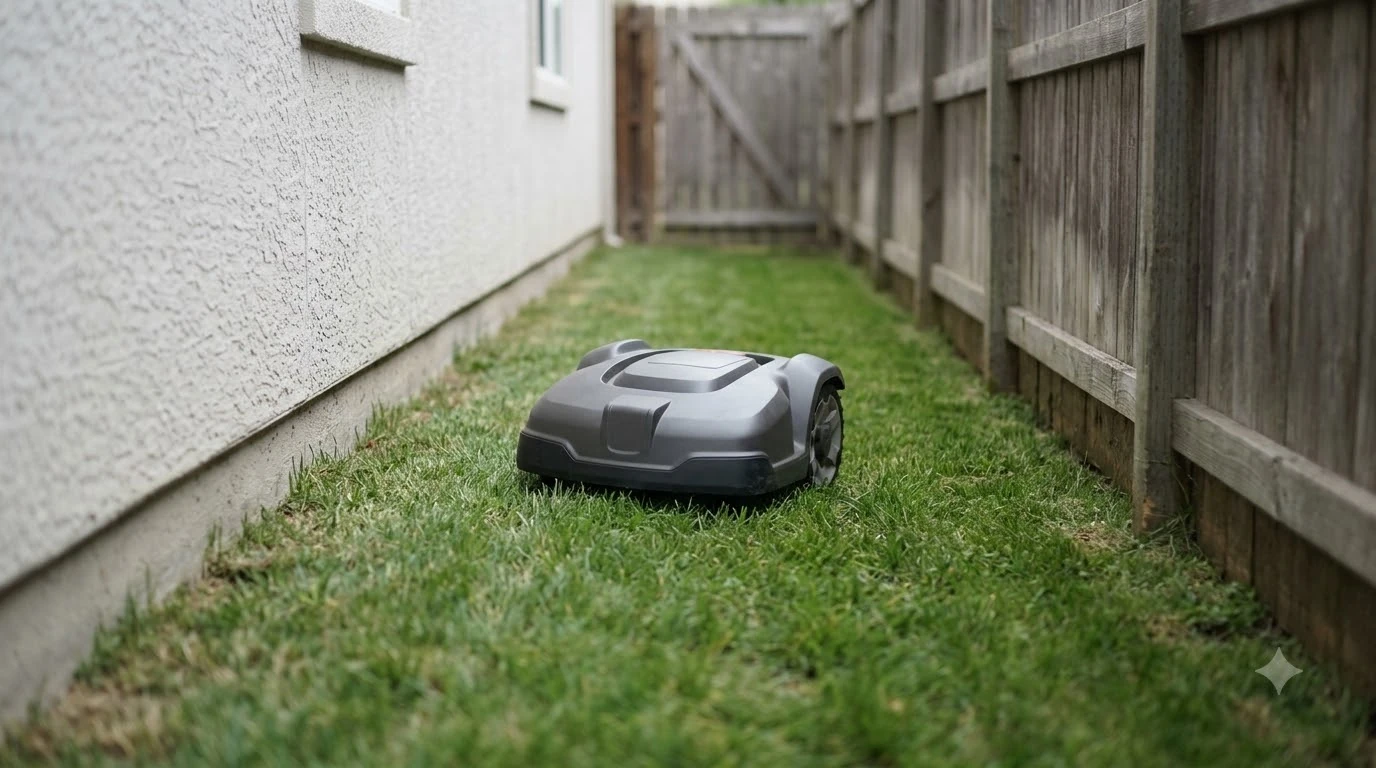

How narrow can a robot mower passage be? With a guide wire, Husqvarna recommends at least 60 cm (24 in) between boundary wires. Without a guide wire, it recommends 2 m (6 ft 6 in), and Gardena gives 1.5 m. Those are the figures as of 2026-11-09.
The short answer
- With a guide wire: 60 cm (24 in) between boundary wires is the minimum in the guidance reviewed here.
- Without a guide wire: plan for 1.5 m (Gardena) to 2 m (Husqvarna) between boundary wires.
- Obstacles: add the clearance you need from each wall or fence to the minimum.
- Guide wire: keep it at least 30 cm (12 in) from the boundary wire.
Passage widths with a guide wire
With a guide wire, Husqvarna recommends at least 60 cm (24 in) between the two boundary wires that form the passage. The guide wire is a separate wire connected to the boundary loop. It runs down the middle of the passage and leads the mower through, so the mower does not have to find its own way. In Husqvarna’s wording, a passage is a narrow section of the work area with boundary wire on each side that connects two parts of the lawn. If the wire is not down yet, start with how to install a robot mower boundary wire. Husqvarna’s support page lists every boundary-wire Automower model as supporting Automatic Passage Handling, except the Automower 105.
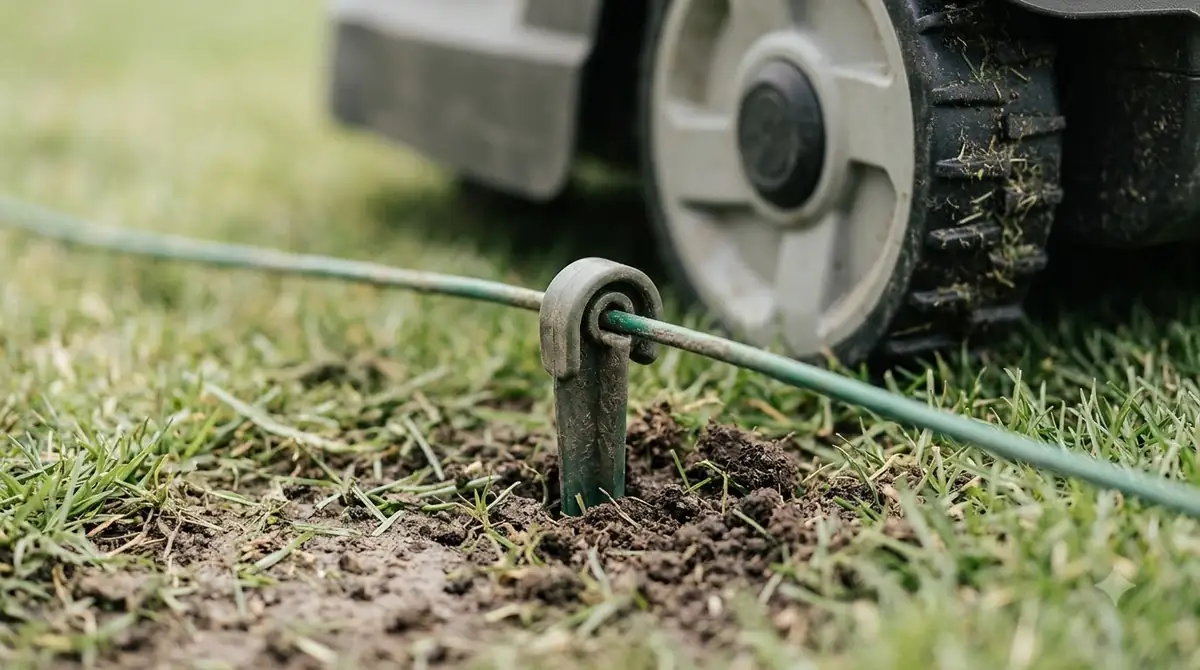
The guide wire itself must stay at least 30 cm (12 in) from the boundary wire on each side. Husqvarna’s support page gives both distances in the same instructions, so the passage has to be wide enough to hold the guide wire in the middle with clearance on both sides. The mower always runs to the left of the guide wire when facing the charging station, so leave as much free space as you can on that side. Read the full steps in the Husqvarna passage guide.
Gardena describes the same kind of setup as CorridorCut. Its FAQ says long narrow passages 60 cm wide, measured boundary wire to boundary wire, can be mowed easily when a guide wire is installed. Our reading is that 60 cm is the tightest width these two manufacturers support, and it leaves almost no room for error, so treat it as a floor rather than a target.
How narrow can a robot mower passage be without a guide wire
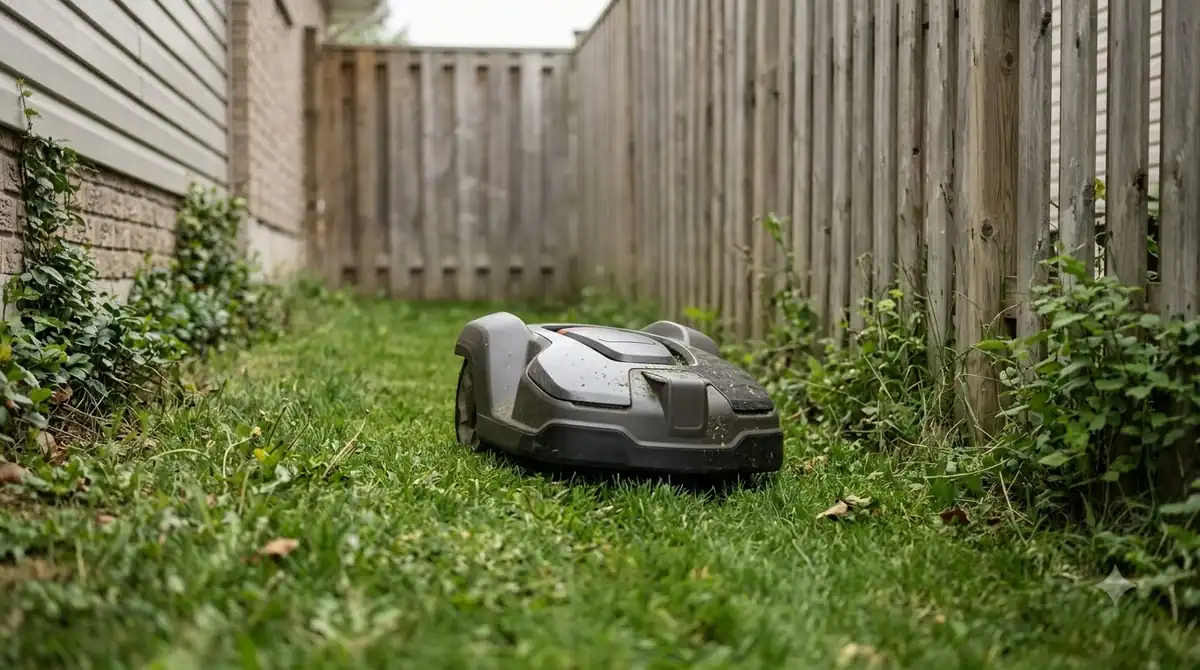
Without a guide wire, the required width grows. Gardena’s FAQ asks for a passage of at least 1.5 m for narrow passages that have no guide wire, while Husqvarna recommends at least 2 m (6 ft 6 in) between the boundary wires on each side of the passage. The gap between those two figures is large, so the brand and model in your hands matter.
| Brand | With guide wire | Without guide wire |
|---|---|---|
| Husqvarna Automower | 60 cm (24 in) between boundary wires; guide wire 30 cm (12 in) from boundary wire | 2 m (6 ft 6 in) between boundary wires |
| Gardena robotic mowers | 60 cm between boundary wires (CorridorCut) | At least 1.5 m |
Because the two figures disagree, check the owner’s manual for your model before you lay wire. A manual figure overrides general guidance, and a passage that meets 1.5 m may still fall short of 2 m for another model. Husqvarna’s page also recommends a 2 m passage for the Automower 435X AWD and 535 AWD to get a good cutting result. Where the width sits between 60 cm and the no-guide-wire minimum, a guide wire is the practical way to make the passage work.
Gardena words its own 60 cm figure two ways. The specification lists for the SILENO Minimo 250 and 500, City 500 and Life 750 say a narrow passage needs at least 60 cm “from wall to wall”, while the FAQ measures 60 cm from boundary wire to boundary wire and adds obstacle distances on top. The page does not reconcile the two, so the manual for your model decides. Whether you need that wire at all is a separate question, covered in our guide on whether robot mowers need a boundary wire.
How obstacles add to the width
When you ask how narrow can a robot mower passage be, the answer is measured between boundary wires, not between walls, which is why laying boundary wire around obstacles matters before you measure. Gardena’s FAQ says the distance to any obstacle is added to the 60 cm figure, so a passage between two walls needs extra room on each side. The FAQ gives a worked example: 35 cm from one house wall to the boundary wire, plus 60 cm of passage, plus 35 cm from the other side, for a total of 130 cm.
Obstacle clearances differ by type, so the owner’s manual gives a distance for each kind of obstacle. A fence, a wall, a flower bed and a garden bed each may need a different distance. Gardena’s example is a starting point, not a rule for your yard.
Side yards in practice
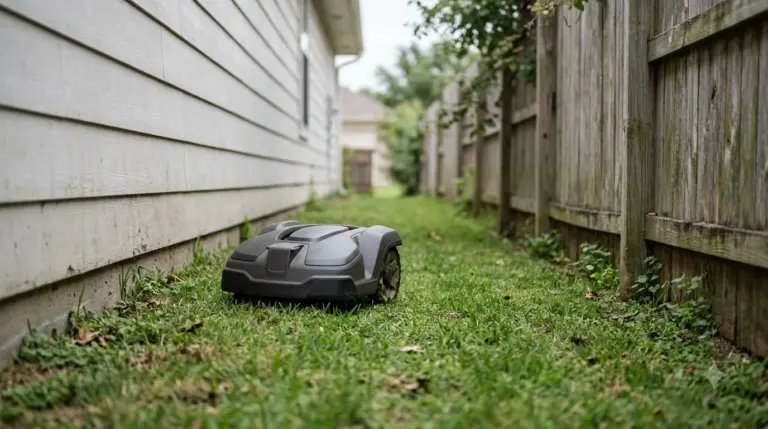
A side yard is usually the narrowest passage a robot mower has to enter, and a robot mower for a narrow yard still follows the same wire rules. It is the strip between the house and a fence, often with a downspout, a gas meter or an air-conditioning unit along one wall. To learn how narrow can a robot mower passage be in your yard, measure the gap between the two surfaces, then subtract the clearance each obstacle needs.
In the example above, a side yard about 130 cm wide between the wall and the fence can fit the 60 cm passage with clearance. A side yard narrower than the minimum for your brand is outside the range these manuals describe, so the mower may not be able to enter it reliably. In that case, plan a different route, or mow the strip by hand with a trimmer.
Measure with a tape held straight across the gap, at both the front and the back of the strip. A gap that narrows toward the back is limited by the narrowest point.
When the mower gets stuck
Some Husqvarna models let you adjust the corridor width, and the support material recommends this when the mower keeps getting stuck in a passage. Husqvarna also lists a Systematic Passage Mowing option on some models. It needs a guide wire and switches the mower from random to systematic mowing in narrow passages, and the page warns to use a low frequency so the grass in the passage does not wear. The setup starts by measuring the distance along the guide wire from the charging station to the start of the passage, so where you put the charging station matters here.
- Check the wire layout first. Confirm the guide wire sits at least 30 cm from the boundary wire.
- Measure the real gap. Compare it with the 60 cm or 2 m figure for your setup and with the answer to how narrow can a robot mower passage be for your brand.
- Adjust the corridor width in the mower’s settings if your model offers the option, then watch a few runs.
The practical answer to how narrow can a robot mower passage be is the figure in your own manual, with the clearance for every wall or fence added on top.
Frequently asked questions
How narrow can a robot mower passage be with a guide wire?
With a guide wire, Husqvarna gives 60 cm (24 in) between boundary wires as the minimum, and Gardena gives the same 60 cm for its CorridorCut setup. Without a guide wire, the figures are larger, at least 1.5 m from Gardena and 2 m from Husqvarna.
Does a guide wire make a narrow passage possible?
Yes, according to both manufacturers’ guidance. A guide wire lets the mower follow a narrower path, but the guide wire must stay at least 30 cm (12 in) from the boundary wire on Husqvarna’s setup.
How much room do I need beside a wall?
Gardena’s FAQ adds the clearance for each obstacle to the 60 cm minimum. Its example uses 35 cm from each house wall, which gives a total width of 130 cm. Check the owner’s manual for the clearance your model needs.
What should I do if the mower keeps getting stuck?
Check that the guide wire is at least 30 cm from the boundary wire, then measure the real gap. Some Husqvarna models let you adjust the corridor width in the settings, which may help.
Sources
- How to create a passage in an Automower boundary wire installation (Husqvarna): minimum distances with and without a guide wire, and the guide wire spacing.
- Robotic Lawnmower FAQs (Gardena): 60 cm CorridorCut passage, 1.5 m without a guide wire, and obstacle clearance.
 Up next8 min readBy YardRobot Mower for Narrow Side Yard Passages: What Widths Work?Updated Nov 11, 2026
 8 min readBy YardHow Small Can a Yard Be for a Robot Mower?Updated Nov 11, 2026
 8 min readBy YardOne Third Rule for Mowing Grass: How It Works and Why It MattersUpdated Nov 11, 2026
 9 min readBy YardWhere to Put a Robot Mower Charging Station (Placement Rules)Updated Nov 11, 2026
 9 min readBy YardWhat Is the Minimum Passage Width for a Robot Mower?Updated Nov 11, 2026
 7 min readBy YardCan a Robot Mower Work in a Long Narrow Yard?Updated Nov 11, 2026