
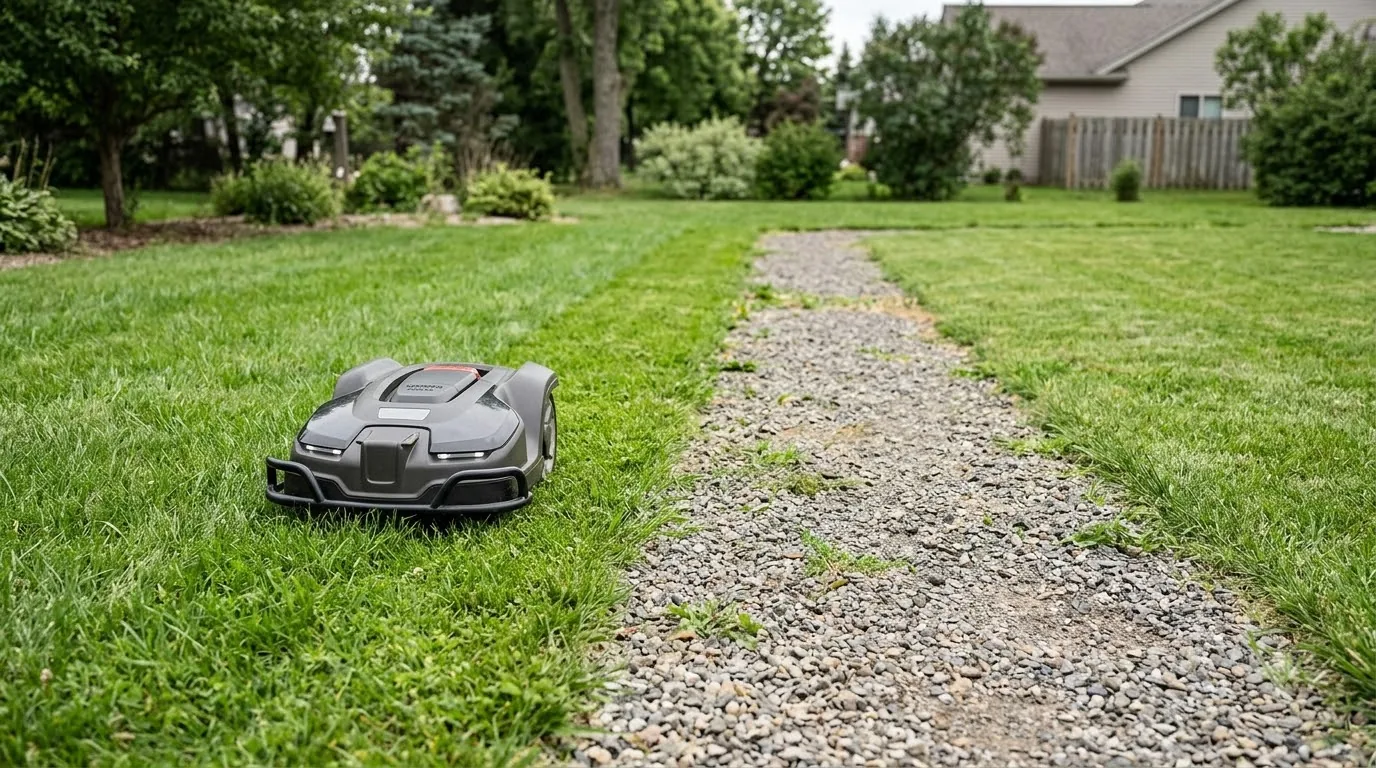

A robot mower under trees can still do the job, but dense canopy changes how it navigates and how the grass grows. Tree cover can weaken the satellite signals that RTK systems depend on (see how RTK works on a robot lawn mower), and heavy shade thins turf over time. The sections below cover what changes and how to set up a yard with trees.
The short answer
- GPS: canopy can block, weaken and reflect satellite signals, so an RTK-only mower may lose its fix.
- Fallbacks: vision sensors and boundary wire depend less on satellites, according to vendor sources.
- Grass: UF/IFAS Extension advises mowing shaded turf at the highest recommended height for the species.
- Test first: watch a robot mower under trees in the shadiest spot before you rely on it.
Why a robot mower under trees loses GPS signal
Tree canopy can block, weaken and reflect satellite signals, which can cause RTK-based mowers to lose their fix under dense cover. Mowrator, a vendor blog that sells remote-control mowers, explains that trees block, weaken and reflect satellite signals, and that reflected signals, called multipath, make it harder for the mower to judge its position. The page gives no measured error figures, so read it as an explanation rather than a test result. Mowrator’s RTK signal loss article is the main source for this section.
The same page says wet leaves, humidity and dense summer growth can make things worse, and that a continuous canopy is “much more likely to reduce accuracy” than light or broken cover. Those are general observations without data. Our reading is that the open sky above the dock and the property edges matters most, because those are the places where a mower needs a clean signal to start and finish each run.
A user test posted to the Open Robotics forum is a useful caution. It logged one GNSS unit on a short baseline and reported 88.5% fixed under trees in one record group, compared with 83.3% in half sky. The author says canopy, baseline and weather changed together, so the result does not isolate the effect of trees, and a fixed flag does not prove that the position was correct. The forum thread shows why open-sky results cannot be assumed to carry over to a shaded yard.
What a robot mower does when the signal drops
When the fix is lost, a robot mower under trees may pause, slow down, correct its route or mow unevenly, and it may have trouble returning to the dock. Mowrator also says problems that repeat in the same shaded spot point to a signal issue rather than random behavior. Some systems recover quickly, while others stop until the signal improves. These are the symptoms the vendor describes, not measured results, and the exact behavior depends on each model’s fail-safe logic.
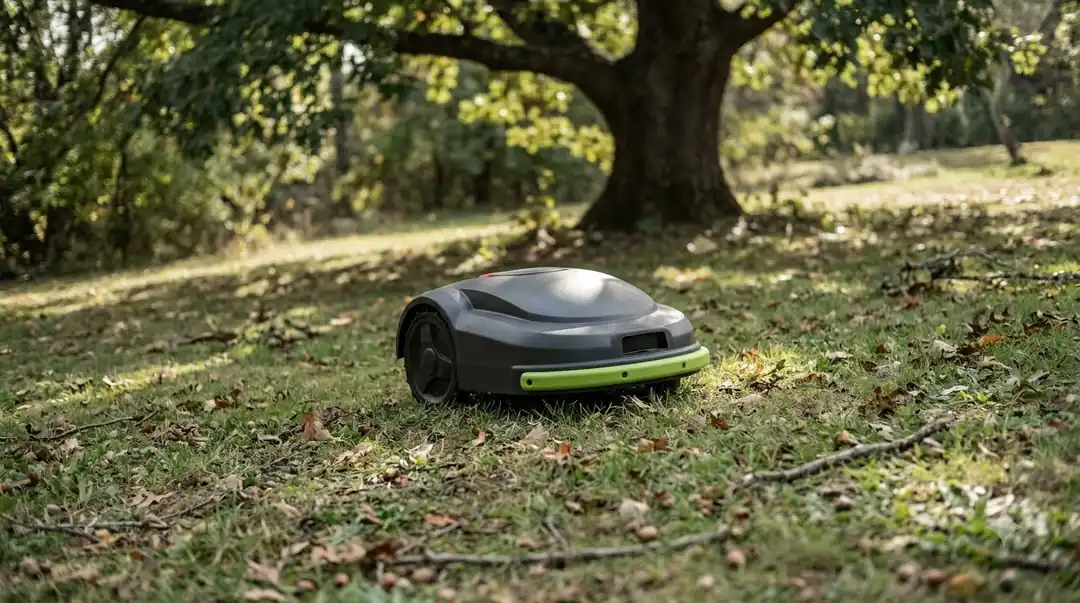
Vendor sources point to a few ways to reduce the problem. The table below summarizes them. Every row is a vendor claim, not an independent test.
| Approach | What the vendor says under trees |
|---|---|
| RTK only | Can lose its fix under dense canopy, and the result depends on the fail-safe logic |
| RTK plus vision | Can keep navigating visually when RTK fails, and may reduce disruption, though it will not remove the effect of trees |
| Boundary wire | Offers consistent performance when satellite signals are unreliable |
| Remote control | Does not depend on satellite signals, and is rated a good fit for dense cover |
For a comparison of the sensor types, see RTK vs lidar vs vision robot mowers. Because Mowrator sells remote-control mowers, its ranking favors that approach. The vision row is the most carefully worded, since Mowrator says the combination “may minimize disruptions” rather than eliminating them. We did not find independent figures that compare these approaches under canopy.
Shade, roots and the grass under the canopy
Under heavy shade, turfgrass is weak, and UF/IFAS Extension says it is generally not recommended. Its publication on growing turfgrass in the shade, EDIS EP072, advises using other ground covers, shade-tolerant plants or mulch in heavily shaded areas. Shaded grass stretches its blades toward light, which uses up energy reserves, thins the lawn and leaves bare spots where weeds can take hold. The UF/IFAS guide covers the management steps below.
- Raise the height: mow at the highest recommended height for the species. More leaf area absorbs more light, and higher mowing promotes deeper rooting.
- Feed less: shaded turf needs less fertilizer than full-sun turf, and a slow-release nitrogen source avoids growth surges.
- Water less: shaded grass needs less water, and watering on a full-sun schedule can increase disease.
- Limit traffic: traffic in shade can injure grass slowly and may damage tree roots.
Species choice matters as much as management. The guide lists zoysia as a good option for moderate shade and centipedegrass as fair. It says bahiagrass, bermudagrass and seashore paspalum are not recommended for shady landscapes. Among St. Augustinegrass cultivars, Floratam is significantly less shade tolerant than CitraBlue, Classic and Palmetto.
Tree roots add a second problem. Mississippi State Extension says trees compete with turf for water, sunlight and nutrients, and that turf under shade may need extra water because of root competition. The same publication warns that under many shade trees, the wheels of riding lawn mowers are a main cause of turf decline, and that mowing counts as traffic that should be cut back when possible. The Mississippi State guide suggests combining higher mowing heights with string-trimming, and using mulch under the drip line of trees that force a tight turning pattern.
If you are still choosing a model for a wooded yard, compare picks in the best robot mower for a lawn with trees. The extension guides do not address robot mowers. For a robot mower under trees, our reading is that the mower makes many light passes over the same ground, so a tight mowing loop under one tree adds repeated traffic to thin turf. Widening the boundary around the tree can spread that traffic out, and a mulched ring at the drip line keeps the mower off the most stressed grass.
Setting up a robot mower under trees
Start by mapping the shadiest areas and the most open ones, then decide where the mower can rely on satellites and where it needs another method. Mowrator treats base station placement, a review of the dock area and map adjustments as the first practical steps.
- Place the dock in the most open spot. Mowrator says the base station needs a clear, stable view of the sky, so check that first.
- Watch the shadiest zones. Over several runs, note any pauses, slow stretches, repeated route corrections or docking trouble under the canopy.
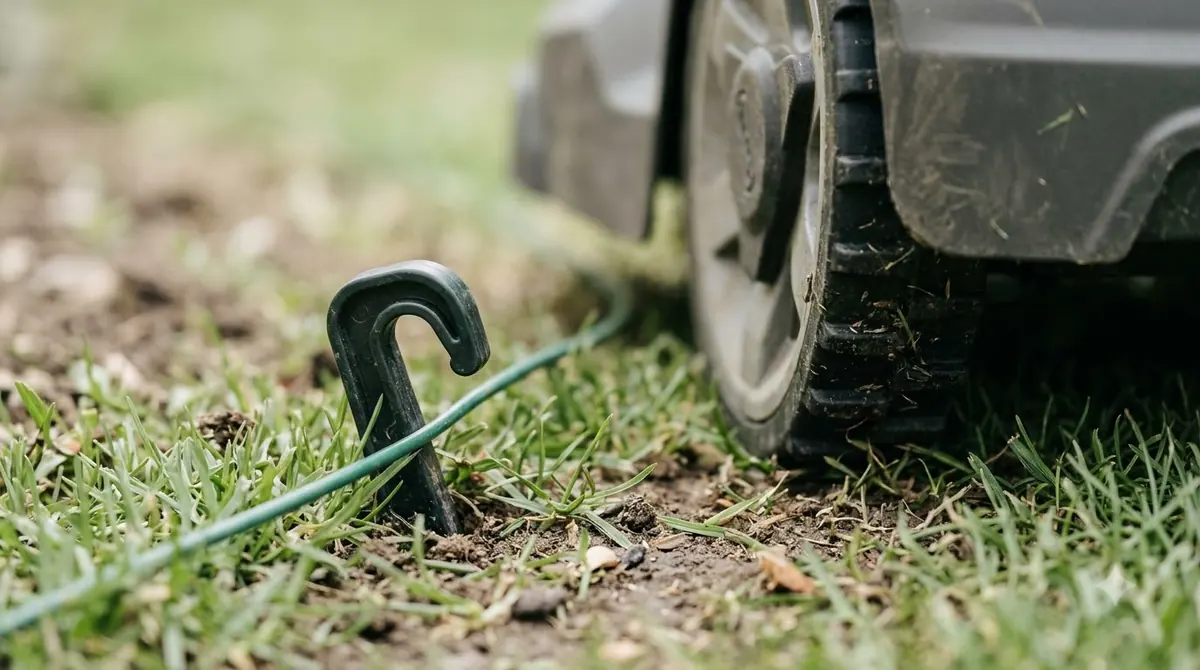
- Consider boundary wire for dense canopy. Vendors describe wire as steadier when satellites are unreliable. It adds installation work, so weigh that against the size of the shaded area, and see how to lay boundary wire around trees and obstacles.
- Raise the cutting height in shade. Follow the UF/IFAS advice to mow at the highest recommended height for the species; see the best mowing height for shade grass.
- Clear fallen leaves and debris. Our reading is that leaves and litter on the lawn make a mower’s job harder, so clear the worst spots in autumn; our robot mower and fall leaves guide covers the season.
Frequently asked questions
Will a robot mower work under trees?
Often yes, and a robot mower under trees can work well, but dense canopy can reduce the satellite signal that RTK systems use. Vendor sources say vision sensors and boundary wire depend less on satellites. Test the shadiest spots before you rely on the mower there.
Can a robot mower lose its position under trees?
It can lose its fix. The vendor describes pausing, slowing, route correction and docking trouble as the usual symptoms. The source gives no measured error figures, so watch your own mower over several runs.
Should I raise the cutting height in shade?
Yes. UF/IFAS Extension advises mowing shaded turf at the highest recommended height for the species. More leaf area absorbs more light, and higher mowing promotes deeper rooting.
Is grass worth keeping under heavy shade?
Heavily shaded turf is generally not recommended. UF/IFAS Extension suggests other ground covers, shade-tolerant plants or mulch. Moderate shade can still support some species, such as zoysia.
Sources
- Growing Turfgrass in the Shade, EDIS EP072 (University of Florida IFAS Extension): shade management and species tolerance.
- Selecting and Managing Turfgrass for Shade (Mississippi State University Extension): tree root competition, traffic and mowing under trees.
- RTK robot mower signal loss near trees (Mowrator, vendor blog): canopy effects, symptoms and vendor-side fallback options, read with its sales bias in mind.
- RTK fix under tree canopy, field data and test design (Open Robotics Discourse, user report): one-unit fix-rate data and the author’s caveats.
 Up next8 min readBy YardRobot Mower That Works Under Trees Without RTK: What to Look ForUpdated Nov 11, 2026
 8 min readBy YardMowing Lawn in Summer Heat and Drought: What to ChangeUpdated Nov 11, 2026
 9 min readBy YardHow to Lay Boundary Wire Around Trees and ObstaclesUpdated Nov 11, 2026
 8 min readBy YardHow Does a Robot Mower Handle Trees?Updated Nov 11, 2026
 8 min readBy YardRobot Mower for Yard With Heavy Tree Canopy: What to CheckUpdated Nov 11, 2026
 8 min readBy YardWhere to Place RTK Antenna in a Yard With TreesUpdated Nov 11, 2026