
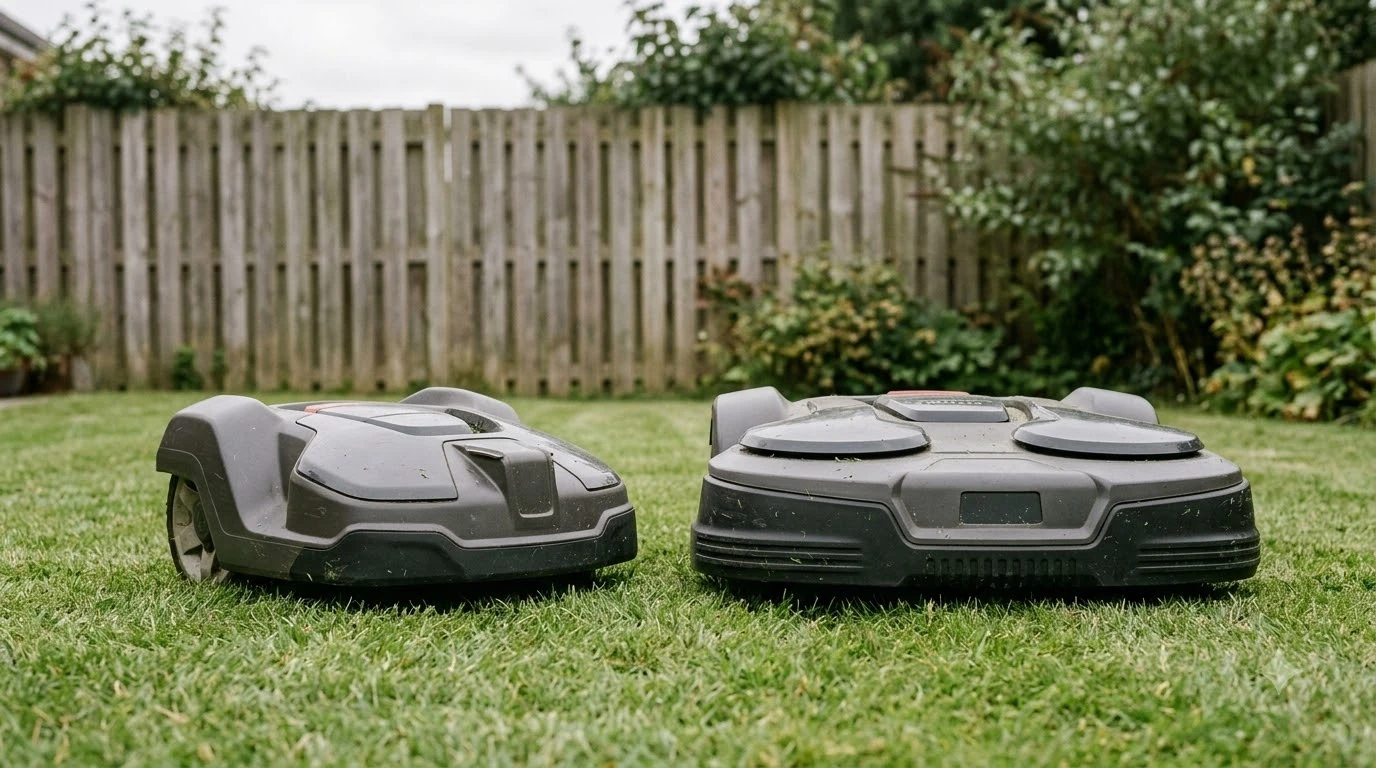

The best robot mower for Kentucky bluegrass and fescue is one whose cutting height range covers the band these cool-season grasses need. Iowa State University Extension recommends 3 to 3.5 inches for Kentucky bluegrass in summer and 2.5 to 3 inches in spring and fall. This guide shows what to check on a spec sheet, why cool-season grass changes the choice, and where the research is still early.
The short answer
- Cutting height first: the mower’s height range should cover the 2.5 to 3.5 inch band your lawn needs.
- Summer: Iowa State extension advises 3 to 3.5 inches for Kentucky bluegrass.
- Spring and fall: 2.5 to 3 inches, per the same extension guidance.
- Stress: raise the setting under heat, drought or shade.
- Frequency: run often in short sessions so no single cut removes more than one-third of the leaf.
Cut height by season for Kentucky bluegrass and fescue
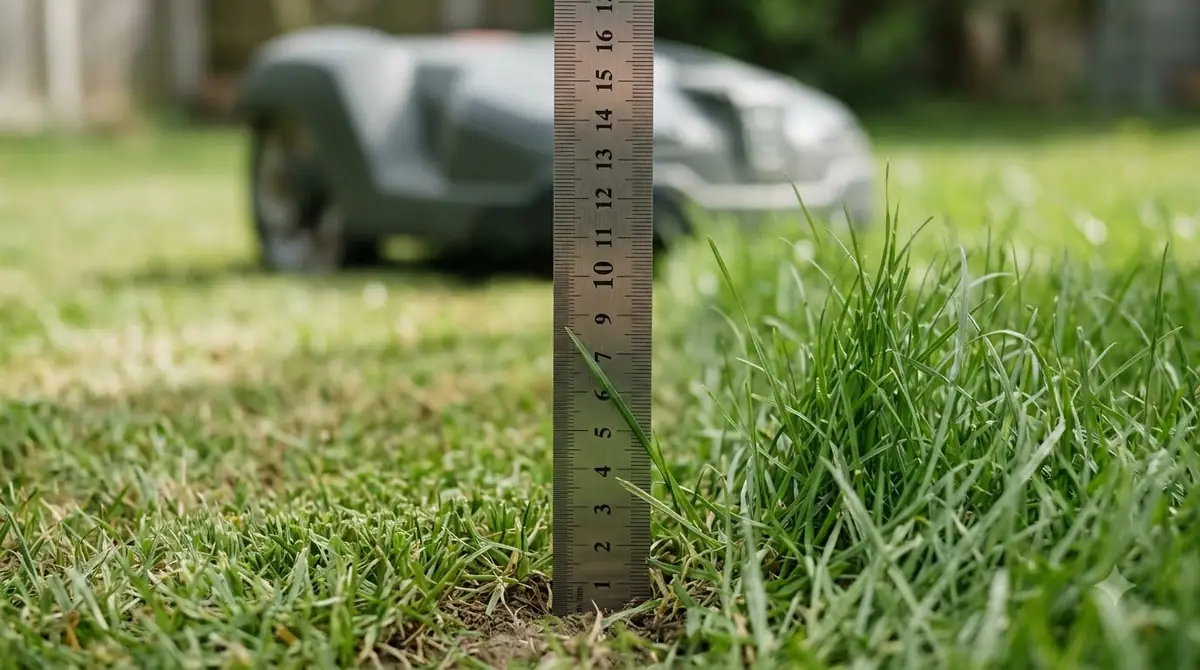
Kentucky bluegrass should be mowed higher in summer than in spring or fall (our guides to the best mowing height for Kentucky bluegrass and the best mowing height for fescue go deeper). Iowa State extension gives 3 to 3.5 inches for June through August and 2.5 to 3 inches in spring and fall. That page was last updated in February 2022, so check your local extension office for regional changes.
Other university guides put the range in a similar place. The University of Kentucky’s AGR-209 publication lists an optimum height of 2.0 to 3.5 inches for Kentucky lawns, and the University of Illinois gives 2 to 3 inches for Kentucky bluegrass. For a tall fescue and Kentucky bluegrass blend, the NC State home lawn calendar advises 2.5 to 3.5 inches from March to May and mowing every 5 to 7 days in late spring.
| Season | Kentucky bluegrass height | Source |
|---|---|---|
| Summer (June to August) | 3 to 3.5 inches | Iowa State Extension |
| Spring and fall | 2.5 to 3 inches | Iowa State Extension |
| Full-range check | 2 to 3.5 inches | University of Kentucky AGR-209 and Illinois Extension |
The practical point for a robot mower is simple. If the lowest setting is above 3.5 inches, the mower cannot follow the extension guidance even in summer. If the highest setting is below about 2.5 inches, it cannot reach the range even in spring and fall.
What the early research shows
A preliminary University of Connecticut trial tested autonomous mowers at 1.25, 2.25 and 3.25 inches. Tall fescue and Kentucky bluegrass gave their best quality and color at 2.25 inches. UConn describes these results as preliminary, so treat them as a direction rather than a settled answer.
A two-year trial in Norway reported that Kentucky bluegrass visual quality was higher in summer and fall under autonomous mowing than under the comparison mower, according to a summary of the study. The same summary noted that tiller count was not affected by mower type. Neither study is an independent test of consumer models, so the evidence supports the general point that robot mowing can work on cool-season turf, not a ranking of brands.
Cool-season fit for a robot mower
A University of Florida IFAS extension publication says most autonomous mowers were designed for cool-season grass, but it also lists lawns that need higher mowing heights as less suitable for them. Kentucky bluegrass and fescue sit in that tension, because the extension range runs up to 3.5 inches. Our reading is that the best robot mower for Kentucky bluegrass and fescue should be judged on both ends of its height range, not only on the lowest setting.
Robot mower manufacturers give a similar target. Robomow recommends a cutting length of 30 to 40 millimeters, which is about 1.2 to 1.6 inches. That is lower than the extension range for cool-season lawns, so a model set to Robomow’s figure would cut Kentucky bluegrass shorter than the extension guidance. Our reading is that the extension range should set your height, and the manufacturer figure only shows how low the mower is meant to run.
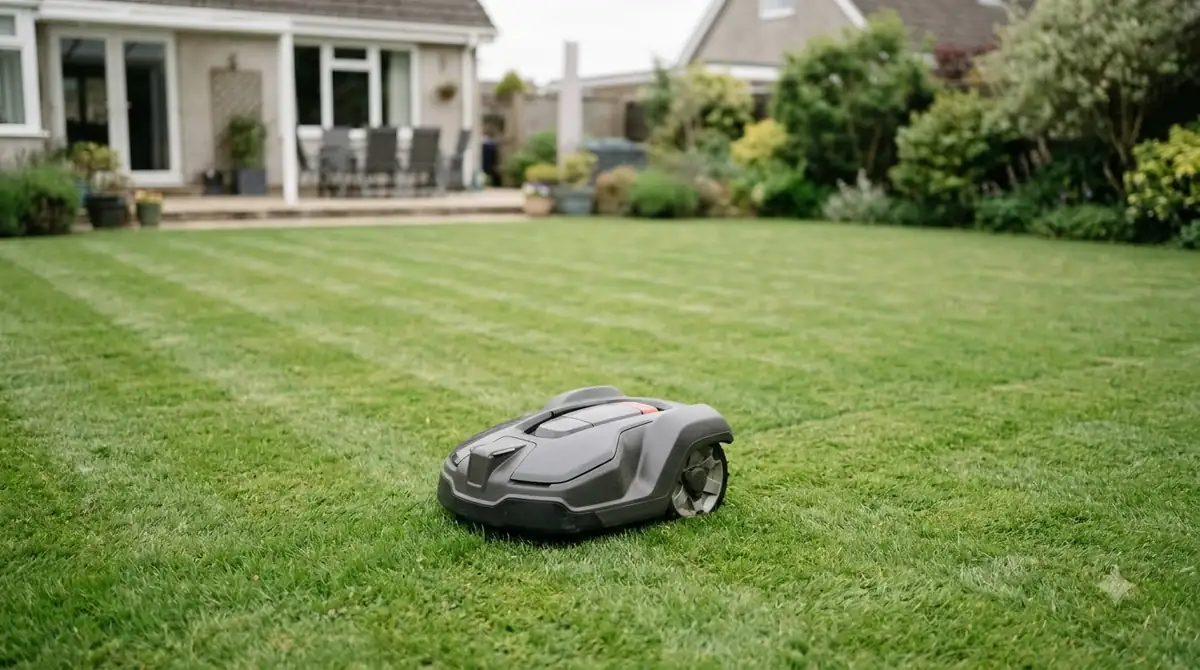
- Good sign: a range that covers about 2 to 3.5 inches, so you can follow the spring, summer and fall changes.
- Warning sign: a highest setting below about 2.5 inches, or a lowest setting above 3.5 inches, since either end leaves part of the extension range out of reach.
- Scope boundary: the cool-season fit applies when Kentucky bluegrass or fescue is the main grass, not to mixed lawns with many weeds.
Best robot mower for Kentucky bluegrass and fescue: what to check
Check the full cutting height range first, because a mower that starts too high keeps the grass too tall in spring and fall, and one that stops too low cannot reach the summer height. Compare the spec sheet against the seasonal range above before you look at features. The best robot mower for Kentucky bluegrass and fescue is one whose specification matches that range, not one with the most features.
- Lowest and highest cutting height. Confirm both ends of the adjustment range against the 2.5 to 3.5 inch band.
- Blade care. Check how the blades are replaced and how often, since a clean cut matters on fine turf.
- Slope capability. If your lawn has slopes, check the maximum slope in the manufacturer’s specification.
- Edge trimming. Check whether the mower cuts close to borders along beds and paths.
- Height adjustment method. Confirm whether the height changes by dial or in the app, and how large each step is, since you will change it with the seasons.
The table below turns these checks into a short comparison you can use on any model page.
| Check | Why it matters for these grasses |
|---|---|
| Lowest setting | Must not start above the 2.5 to 3.5 inch band, or the mower cuts too high |
| Highest setting | Must allow 3 to 3.5 inches for summer mowing |
| Maximum slope | Matters if your lawn has slopes or uneven ground |
| Edge cut | Keeps borders at the same height as the lawn |

Stress and summer mowing
Raise the cutting height when the grass is under stress. Clemson Extension advises mowing higher during heat, drought and shade, because a taller leaf keeps more of the plant green. When you choose the best robot mower for Kentucky bluegrass and fescue, that means the summer setting is usually the top of the range, not the bottom.
- Heat and drought: move the setting up toward 3.5 inches for Kentucky bluegrass.
- Shade: raise the setting in shaded zones under trees or fences.
- New or repaired patches: let the grass establish before returning to the lower end of the range.
Frequency and the one-third rule
Never remove more than one-third of the leaf height in a single cut, as the one third rule for mowing grass explains. UC IPM describes this as the standard guideline for turf mowing, and NC State’s calendar for the tall fescue and Kentucky bluegrass blend suggests mowing every 5 to 7 days in late spring.
A robot mower follows this rule naturally when it runs often in short sessions, because each pass removes only a small amount. Our reading is that a schedule of frequent short runs suits a robot mower for Kentucky bluegrass and fescue better than one long cut each week (see how often to mow fescue). Check how many hours per day the mower runs before you assume it will keep up with spring growth.
Frequently asked questions
What is the best robot mower for Kentucky bluegrass and fescue?
No single model wins by default. The best robot mower for Kentucky bluegrass and fescue is the one whose height range covers about 2.5 to 3.5 inches and whose schedule keeps each cut light.
What is the best cutting height for Kentucky bluegrass?
Iowa State University Extension recommends 3 to 3.5 inches in summer and 2.5 to 3 inches in spring and fall. Other extension guides give a range of 2 to 3.5 inches, so a setting near 3 inches is a safe middle for most lawns.
Can a robot mower cut fescue?
Generally yes. A UF/IFAS extension publication says most autonomous mowers were designed for cool-season grass, but it lists lawns that need higher mowing heights as less suitable. Check that the highest setting reaches the fescue height you want.
Should I cut Kentucky bluegrass higher in summer?
Yes. Clemson Extension advises mowing higher during heat, drought and shade. Iowa State gives 3 to 3.5 inches for summer, which is higher than its spring and fall range.
How often should a robot mower run on cool-season grass?
Frequent short runs keep each cut under one-third of the leaf height, which is the UC IPM guideline. NC State suggests mowing every 5 to 7 days in late spring for a tall fescue and Kentucky bluegrass blend.
Sources
- Iowa State University Extension: correct mowing height for summer (Iowa State University Extension): summer and spring and fall heights for Kentucky bluegrass.
- UConn Today: autonomous mowers trial (University of Connecticut): preliminary cut-height results for tall fescue and Kentucky bluegrass.
- UC IPM: mowing amount (UC Agriculture and Natural Resources): the one-third leaf removal guideline.
- Autonomous or Robotic Mower Use on Florida Lawns (UF/IFAS Extension): most autonomous mowers designed for cool-season grass; lawns needing higher mowing heights listed as less suitable.
 Up next7 min readBy YardCan a Robot Mower Cut Kentucky Bluegrass? Heights and ResearchUpdated Nov 10, 2026
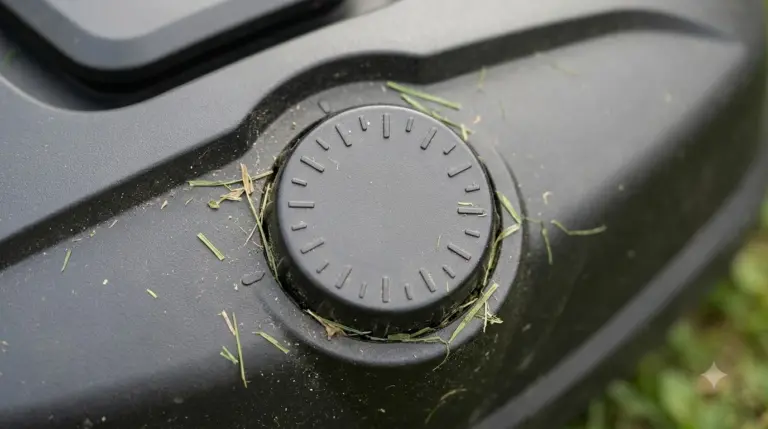 7 min readBy YardWhat Cutting Height Should a Robot Mower Use for Kentucky Bluegrass?Updated Nov 10, 2026
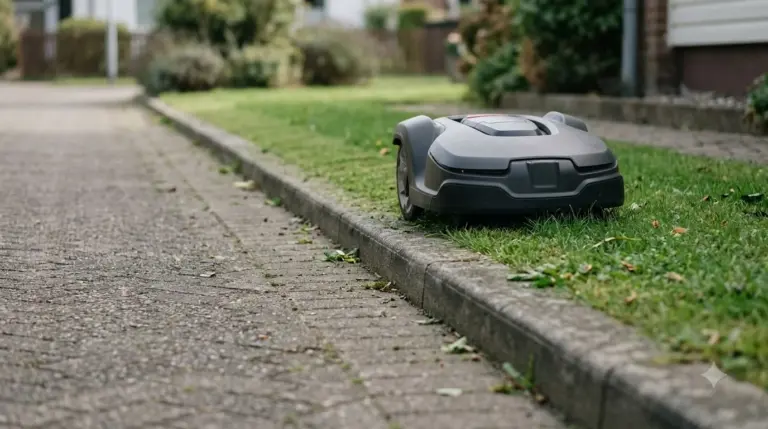 9 min readBy YardHow Often to Mow Kentucky Bluegrass by SeasonUpdated Nov 11, 2026
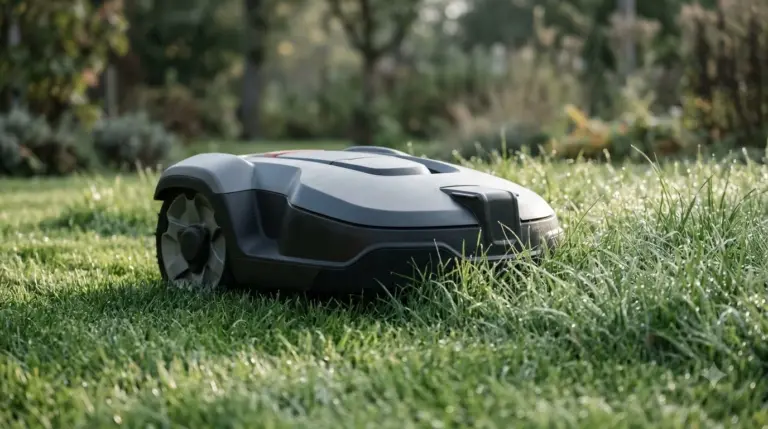 7 min readBy YardBest Mowing Height for Kentucky Bluegrass by SeasonUpdated Nov 11, 2026
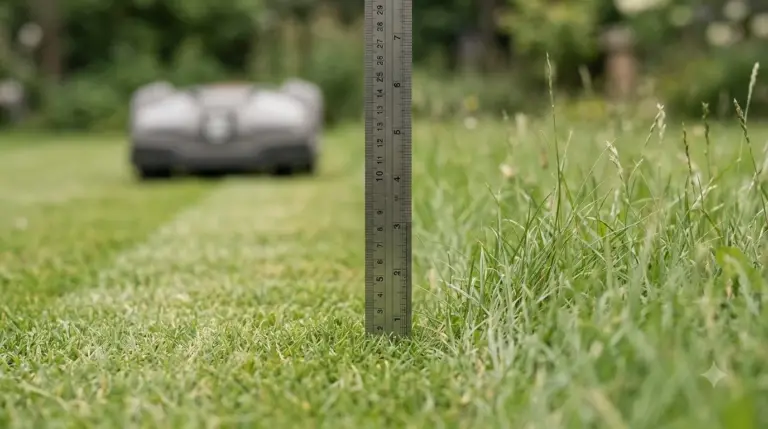 7 min readBy YardCan a Robot Mower Cut Fine Fescue? Heights and What to CheckUpdated Nov 11, 2026
 7 min readBy YardBest Robot Mower for Bunch-Type Tall Fescue: 3.5 Inch CheckUpdated Nov 14, 2026