
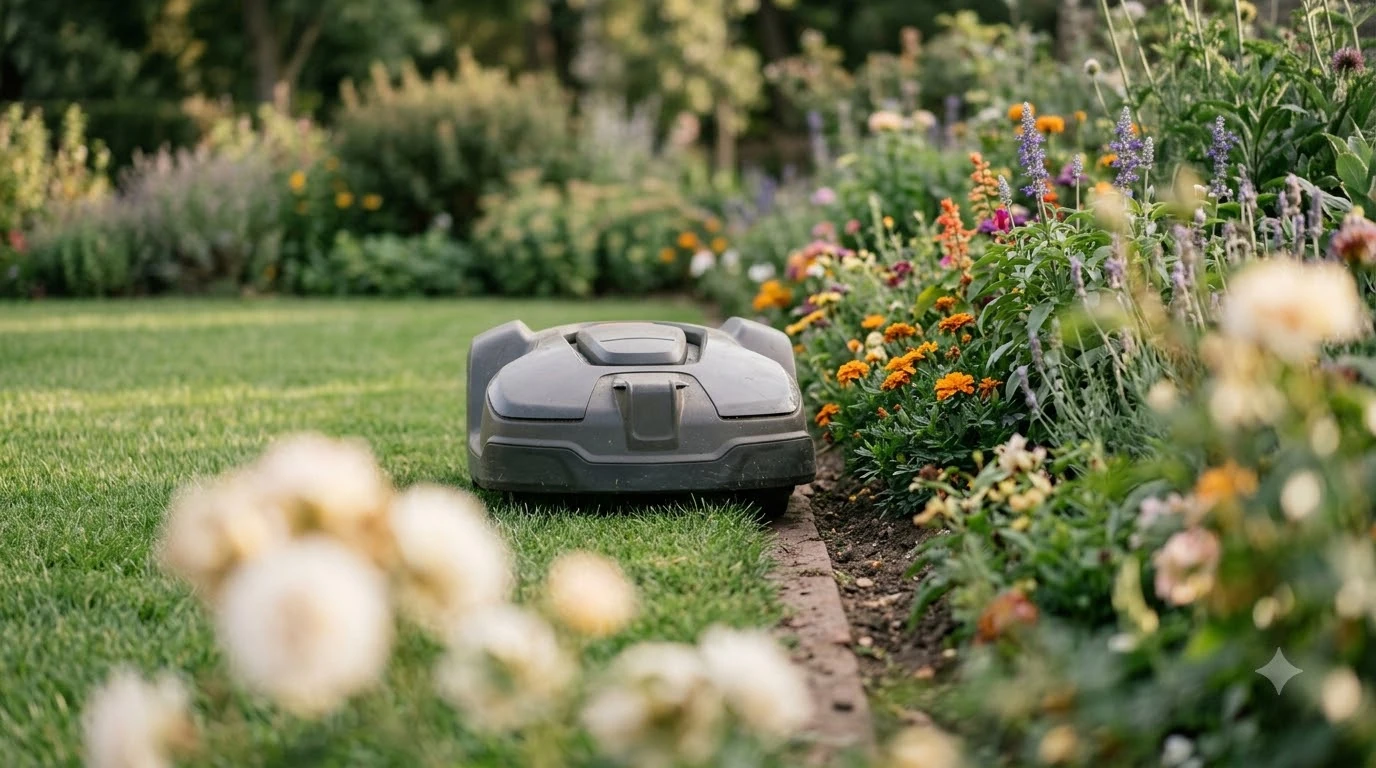

The best robot mower for a yard with flower beds is the one whose setup can keep its blades off the bed. That means a wired mower with a boundary-wire island or an app stay-out zone, or a wire-free mower with a virtual zone and a strong satellite signal. The right pick depends on how the beds sit in the lawn, how high they stand, and whether the yard has clear satellite view. Husqvarna’s setup guides and one brand’s installation guide, both read as of November 2026, explain how each option works.
The short answer
- Beds in the middle of the lawn: a wired mower with a wire island is the most direct fix, because the wire tells the mower where the bed is.
- Beds along the edges: a stay-out zone in the app, or a boundary wire along the bed, is usually enough.
- Clearance: one installation guide gives 10 to 15 cm for beds level with the grass and 30 to 35 cm for walls and raised beds.
- Wire-free mowers: they need a virtual zone for each bed, and the zone is less accurate where the satellite signal is weak.
- Sensors: they help at the edge of a bed but are not a guarantee, so do not rely on them alone.
Best robot mower for a yard with flower beds: why beds change the choice
A flower bed is an obstacle the mower should drive around, not through, and that shapes the best robot mower for a yard with flower beds. Its height, its edge, and the plants along it all matter. A bed sitting level with the grass can be approached closely, while a raised bed with a stone or timber edge can strike the blades if the wire runs too close. That is why a mower that works well in an open lawn can still need extra setup in a yard with beds.
Before comparing models for the best robot mower for a yard with flower beds, list your beds: how many there are, whether each one is level or raised, and whether any sits inside a bigger lawn or next to a path. Those three answers decide whether you need an island, a zone, or both.
Wired mowers: islands and stay-out zones
On a wired system, a bed in the middle of the lawn is handled with a wire island. Husqvarna’s guide describes the route: run the wire from the boundary to the obstacle, go around it, and close the loop. Our guide to how to lay boundary wire around obstacles shows the same idea on a plan. The wires must not cross, because the mower will not recognize the island and will stop.
Husqvarna’s instructions also say to lay the return wire close to the outgoing one so the mower can pass over both, which cancels the signal. The guide does not give a distance from the wire to the bed, so the clearance figures later in this guide come from a different source.
A stay-out zone is the second option, and it is drawn in the app rather than around the bed with wire. Husqvarna says zones can be made almost anywhere on the lawn, except over the charging station or the guide wire. Covering the charging station stops the mower from operating, and covering part of the guide wire stops it from returning. Zones can be switched on or off, but they cannot be scheduled. The feature applies only to installations with a physical boundary wire and to models that support it.
Heads up
A zone is not a barrier. Husqvarna says never to use a zone to keep the mower out of a pool or a street; instead fence the area with boundary wire and a barrier at least 15 cm (6 in.) high. A flower bed next to a path deserves the same care.
Wire-free mowers: virtual zones and their limits
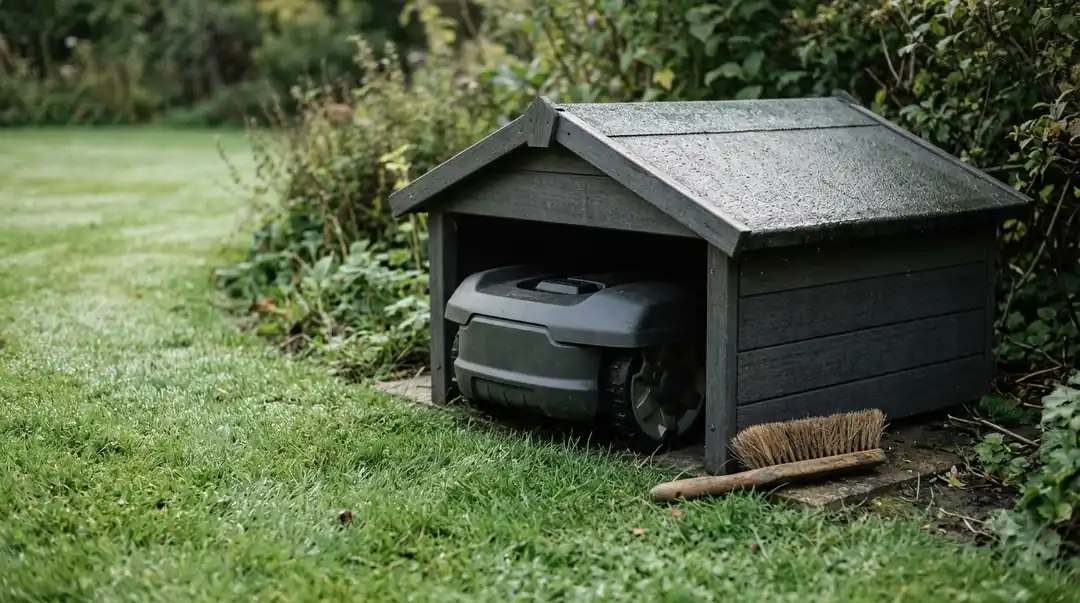
Wire-free mowers skip the buried or pegged wire and use RTK satellite positioning instead (see wire-free vs boundary wire robot mowers for the trade-off). For a flower bed, the setup is an EPOS stay-out zone drawn in the app, which keeps the mower out of sections where it is not allowed to mow. Husqvarna’s EPOS guide adds two limits that matter for a garden with beds.
First, where the satellite signal is weak, zone accuracy can drop, and the page recommends a boundary wire around the zones in those areas. Second, a wire island alone does not stop the mower from entering a bed on a wire-free system; an EPOS zone is always required for that purpose.
The guide gives no distances or placement limits for EPOS zones, so check the manual for your model before you draw a zone close to a bed edge.
| Setup | What it needs | Watch for around beds |
|---|---|---|
| Wired, with island | Boundary wire routed around the bed | Crossed wires stop the island; no wire within the bed itself |
| Wired, with AIM zone | Boundary wire plus an AIM-capable model | Zones cannot cover the charging station or guide wire |
| Wire-free, EPOS zone | Good satellite view and an app | Weak signal lowers accuracy; a zone is needed even if you also run wire |
Our reading: if your yard is under heavy tree cover and has flower beds, a wired system with islands is the safer starting point, because the wire does not depend on the satellite signal.
Clearance: how much room a bed needs
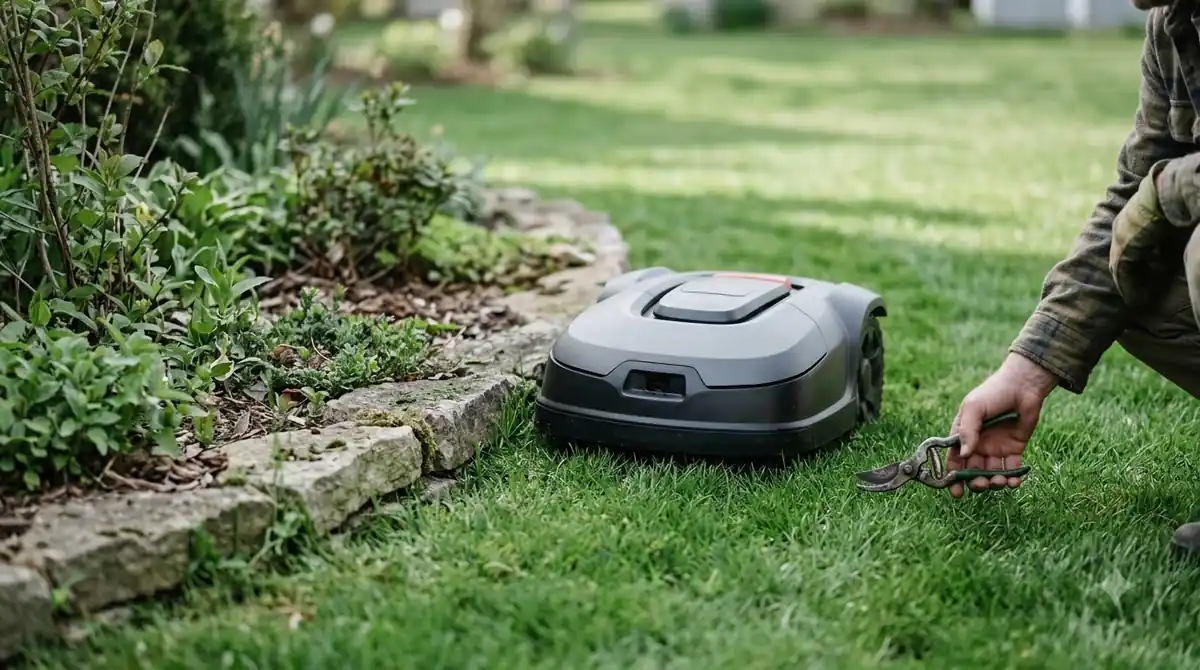
For the best robot mower for a yard with flower beds, how far the wire or the zone must sit from a bed depends on the bed’s height. One brand’s installation guide, read on 2026-11-11, gives 10 to 15 cm from flower beds, hedges, or paths that are level with the grass, and 30 to 35 cm from walls, fences, or raised beds, to keep the blades from striking the obstacle. Robomow’s installation blog gives about 35 cm from the boundary wire to a wall, and a passage of 70 cm in its own example.
| Obstacle | Clearance from one installation guide |
|---|---|
| Flower bed level with the grass | 10 to 15 cm |
| Walls, fences, raised beds | 30 to 35 cm |
| Passage between two boundary wires (Husqvarna, with guide wire) | At least 60 cm |
The gap matters because a narrow passage can trap the mower or let it cut too close. Husqvarna’s 60 cm minimum for a passage between boundary wires with a guide wire is the figure to plan around if a bed sits in a tight corner.
Sensors: what happens at a bed edge
Most robot mowers use bump sensors, and some add ultrasonic, infrared, lift, or tilt sensors. Husqvarna describes its collision sensor, placed next to the rear wheels, as the part that stops forward motion so the mower reverses and steers away. Its radar and ultrasonic object avoidance senses what is ahead and changes direction, but Husqvarna says this is not a safety feature. Wire-free models often add a front camera, according to PCWorld’s sensor overview.
A sensor reacts to an object it can see or touch. A low bed edge may be detected late, which is why sensors should back up the wire or zone, not replace it. Our guide to how robot mowers avoid obstacles covers the sensor types in more detail.
What to check before you buy the best robot mower for a yard with flower beds
- Map the beds. Note each bed’s height, its distance from the lawn edge, and any narrow passage between beds.
- Pick the setup. Choose wired islands for beds in the middle of the lawn, a zone for beds along the edges, and wire-free only if the satellite signal is good.
- Check the clearance figures. Use the manual’s number for your model; a raised bed needs more room than a level one.
- Confirm the zone rules. Make sure the mower supports the zone type you need, and that no zone covers the charging station or guide wire.
- Look at the sensors. Treat them as a backup for the bed edge, not the main protection.
- Consider the edge. A firm border can help; see rubber edging for flower beds with a robot mower.
Frequently asked questions
Can a robot mower drive around a flower bed without wire?
Yes, on models that support virtual zones, so a wire-free model can be the best robot mower for a yard with flower beds. Husqvarna’s EPOS zones keep the mower out of sections where it may not mow. Accuracy can drop where the satellite signal is weak, and Husqvarna recommends a boundary wire around zones in those areas.
How far should the boundary wire be from a flower bed?
One installation guide gives 10 to 15 cm for a bed level with the grass and 30 to 35 cm for raised beds and walls. Husqvarna’s own island guide does not give a distance, so use the manual for your model.
Is a wire island enough on a wire-free mower?
No. On a wire-free system, Husqvarna says a wire island alone does not stop the mower from entering the bed, and an EPOS stay-out zone is always required for that.
Do sensors keep a mower from hitting a bed edge?
They help, but Husqvarna describes its object avoidance as not a safety feature. Sensors react to what they detect, so they work best alongside a wire or zone that keeps the mower away from the bed in the first place.
Sources
- How to create islands in an Automower installation (Husqvarna): wire island route, no crossed wires, no distance given.
- Creating stay-out zones with AIM technology (Husqvarna): zone placement limits, switching, 15 cm barrier for pools and streets.
- EPOS support guide (Husqvarna): wire-free zones, weak-signal caveat, wire island does not replace a zone.
- Robot lawn mower boundary wire installation (Anker, Eufy brand): 10 to 15 cm from level beds, 30 to 35 cm from walls and raised beds.
- Laying the lawn boundary wire (Robomow): about 35 cm from boundary wire to walls.
- How to create a passage in an Automower boundary wire installation (Husqvarna): 60 cm minimum passage with a guide wire.
- Object avoidance with radar or ultrasonic sensors (Husqvarna): limits of object avoidance.
- How robot lawn mowers cut grass without whacking off your toes (PCWorld): sensor types overview.
 Up next8 min readBy YardRobot Mower Around Flower Beds: How to Keep It OutUpdated Nov 11, 2026
 8 min readBy YardBest Robot Mower for a Yard With a Dry Creek Bed: What to CheckUpdated Nov 12, 2026
 7 min readBy YardDoes a Robot Mower Cut Clover Flowers? Simple Height TipsUpdated Nov 14, 2026
 9 min readBy YardRobot Mower for Lawn With Mulch Beds: 5 Simple ChecksUpdated Nov 11, 2026
 9 min readBy YardWill a Robot Mower Get Stuck on a Lawn with Mulch Beds?Updated Nov 11, 2026
 8 min readBy YardHow Does a Robot Mower Handle Raised Garden Beds?Updated Nov 11, 2026