
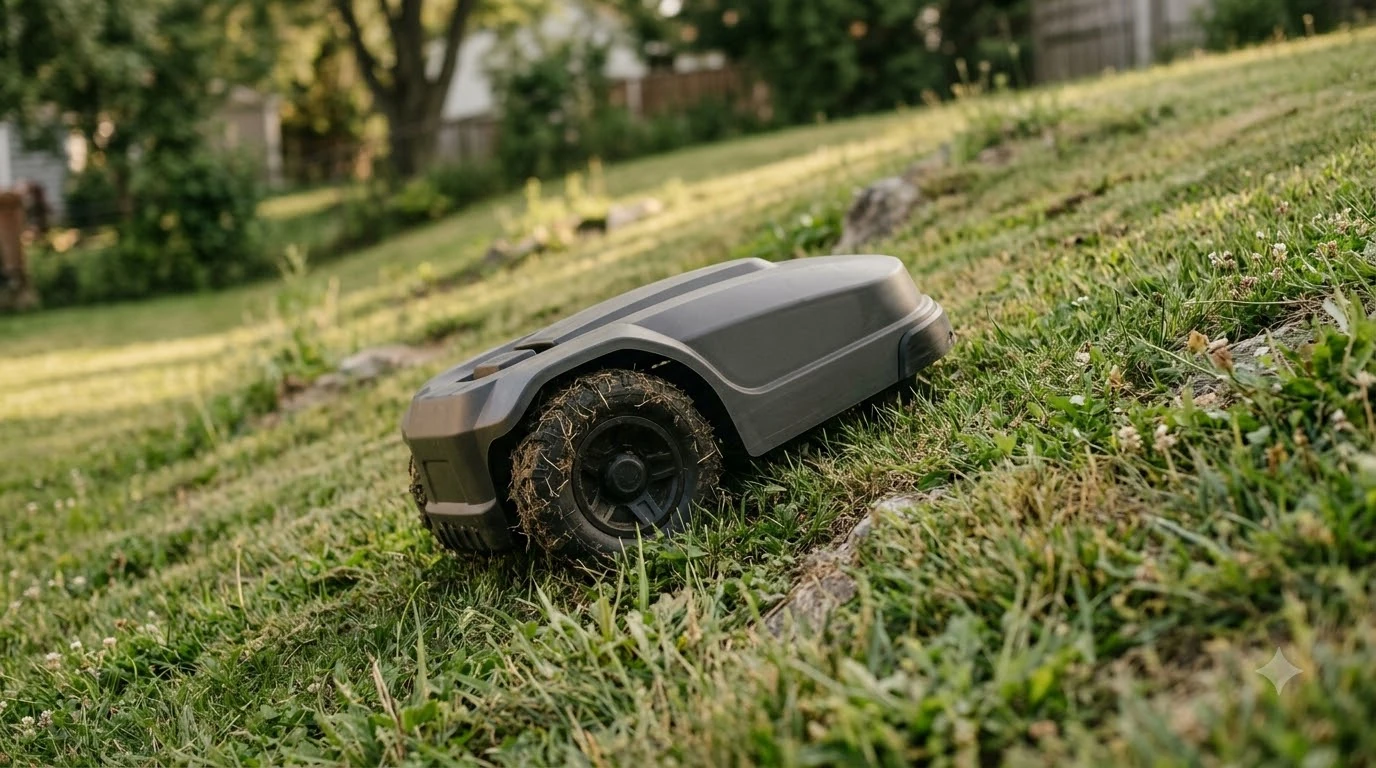

There is no single best robot mower for hilly 1 acre lawn. The right model is the one whose slope rating and boundary-wire limit clear your steepest strip, and whose per-charge coverage can handle a full acre of 43,560 sq ft, about 4,047 m2 (our arithmetic). Husqvarna and Navimow publish the figures below as of November 2026.
The short answer
- Measure the steepest strip in percent, not the lawn average.
- Compare the work-area slope limit and the lower boundary-wire limit for the exact model.
- Plan the boundary wire 1.5 m (5 ft) from the slope bottom on 50 to 70 percent slopes if you choose an AWD model.
- Check coverage: a 1-acre lot needs several charges even at the largest per-charge figure Navimow lists.
What one acre means on a hillside
An acre is the same size whether it is flat or steep. Its area is 43,560 square feet, which is about 4,047 square meters by our arithmetic. The slope does not change that number. It changes how much of the area a mower can work safely and how the boundary has to run along the hill.
Irregular hilly lots are hard to measure with a single rectangle. Clemson’s Home and Garden Information Center says the offset method is most often used to measure lawns of irregular shapes. You draw the longest straight line across the lawn, mark offset lines at right angles, measure the width at each one, and multiply. The guide adds that closer offset lines give a more accurate estimate. Clemson does not give an acre conversion, so the conversion above is our own.
Measure the steepest strip, not the average
Husqvarna defines slope as vertical height divided by horizontal distance, times 100. Its example is a 15 cm (6 in) rise over 100 cm (40 in), which equals 15 percent. Use a long level and a tape on the steepest strip you would really mow, and repeat the check where the hill bends. Our guide on how to measure yard slope walks through the method.
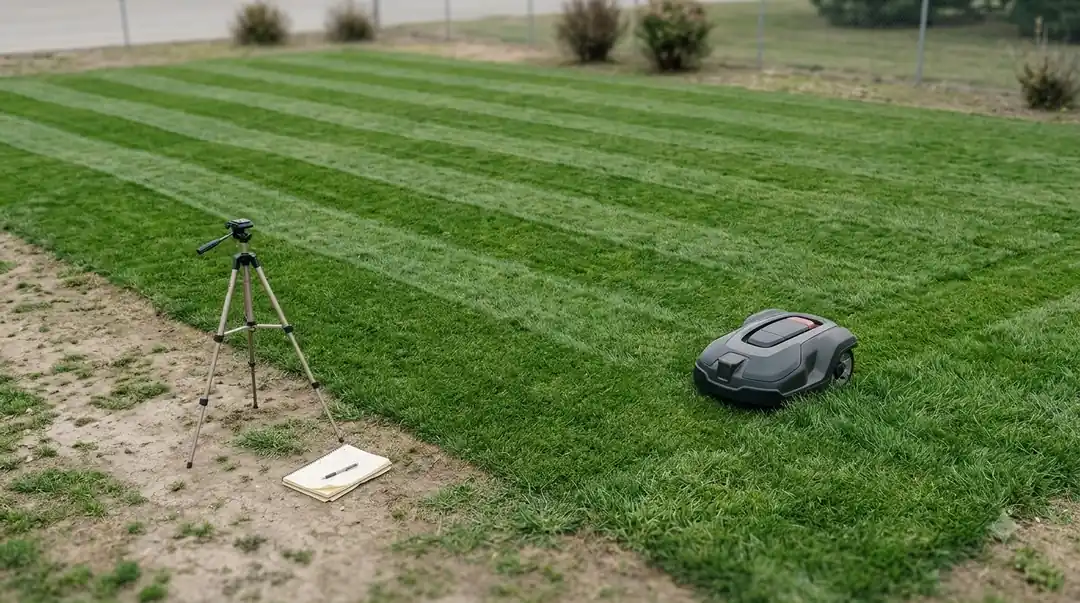
When you narrow the best robot mower for hilly 1 acre lawn, the worst strip matters more than the average because the mower has to climb it. Husqvarna’s support page rates standard Automower models at 25 to 50 percent, which it gives as 14 to 26 degrees depending on the model. The AWD 435X models are rated at 70 percent, or 35 degrees. Percent and degrees are different units, so compare the same unit on both sides. Husqvarna’s steep-slope guide is the source for these limits.
Our reading: if your steepest strip sits close to a rating, choose a model with more margin rather than one that only just clears it. See how steep a hill a robot mower can handle for the wider picture.
Read the work-area and boundary-wire limits together
Husqvarna lists two slope figures for most models, a work-area limit and a lower boundary-wire limit. On a hillside, the yard edge often sets the real ceiling, because the boundary figure is the stricter number in every row below.
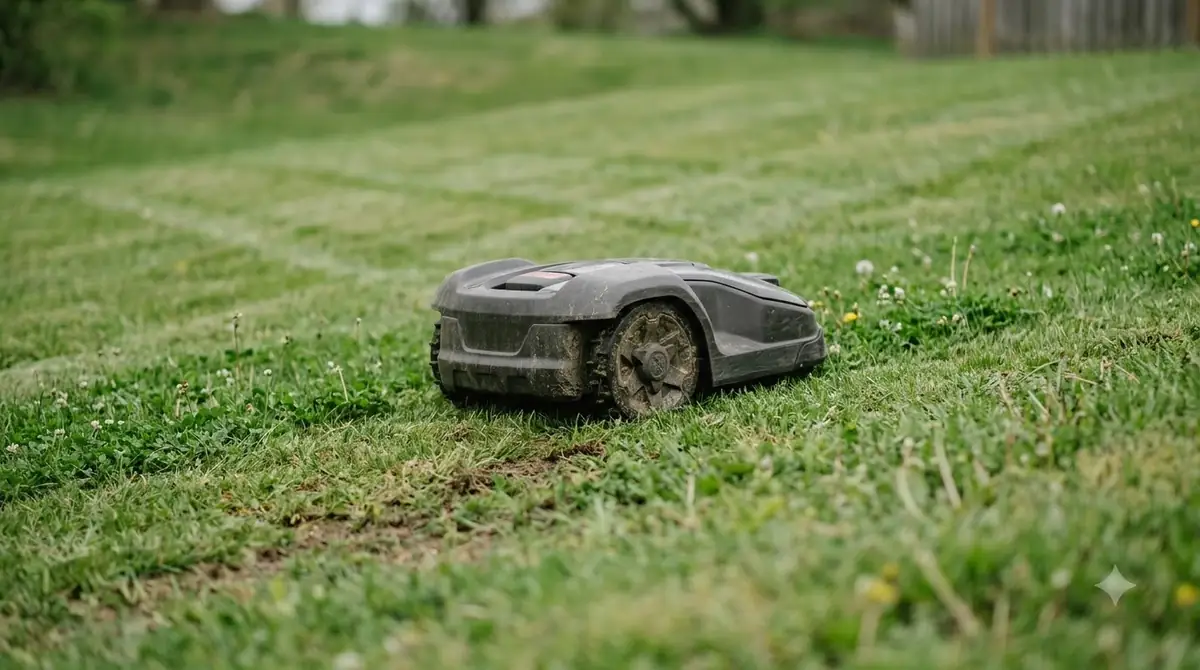
| Husqvarna model group | Work-area slope limit | Boundary-wire slope limit |
|---|---|---|
| Aspire R4 | 25% | 10% |
| 305, 310, 310 Mark II, 315, 315 Mark II, 315X | 40% | 15% |
| 405X, 415X, 420, 430X, 440, 450X | 40% | 15% |
| 320 NERA, 430X NERA, 450X NERA | 50% | 25% |
| 435X AWD, 435X AWD NERA | 70% | 50% |
The table comes from Husqvarna’s own slope page and lists model groups, not every model in the range. Check the manual for the exact model you buy before you rely on any single row.
Plan the boundary wire for AWD on steep ground
For AWD models on 50 to 70 percent slopes, Husqvarna asks you to keep 1.5 m (5 ft) from the bottom of the slope to the boundary wire. The same page says to avoid obstacles on those slopes. If you are weighing AWD, what AWD means on a robot mower explains the drivetrain. On a 1-acre lot the wire route can be long, so the perimeter around the hill is where setup time goes.
Our reading: before you buy, walk the slope bottom and mark where the wire would run, including any gates, beds and trees.
Guide wire direction on a hillside
Husqvarna gives different guide-wire rules by model type, so check which type you have before you lay anything. The direction decides how the mower meets the slope.
- Physical guide wire. Lay it diagonally across the slope.
- AWD models. The guide wire can run straight or diagonally from the bottom of the slope to the top.
- Wire-free EPOS models. Set mowing patterns straight up the slope where possible, and use irregular patterns in complex areas.
Husqvarna also says that EdgeCut models can use a systematic pattern at a 45-degree angle to the slope. That option is listed for one model family only, so confirm it in the manual before you plan around it.
Wet grass and slip risk on a hill
Husqvarna warns that obstacles on steep slopes raise the risk of slipping, especially in wet conditions. Tip-over worries are covered in whether robot mowers tip over on hills. The same page says obstacles can also wear out the grass on a slope. A damp hill is where slip matters most, so the wet-weather behavior of the model you choose should be part of the decision.
Several vendors describe AWD as better for wet grass. The pages we read for this article give no test method for those claims, so treat them as marketing until an independent source backs them up.
Per-charge coverage on a 1-acre lot
Navimow lists per-charge mowing areas of 675 m2 for the X420 and 1,300 m2 for the X450. For the best robot mower for hilly 1 acre lawn, the coverage figure is the second filter after slope. Against a 4,047 m2 acre, 4,047 divided by 1,300 is about 3.1, so even the largest listed figure needs at least four charges to cover the lot once. Navimow’s large-lawn guide gives these figures, and the page does not name the test conditions behind them.
The same guide recommends its X4 series, the X420 and X450, for lawns of 2,000 to 5,000 m2. It gives 800 to 2,000 m2 for the i LiDAR series and 1,000 to 2,000 m2 for the i LiDAR Pro. Its maximum slopes are 45 percent (24 degrees) for the i2 AWD and i2 LiDAR, 55 percent (29 degrees) for the i2 LiDAR Pro, and 84 percent (40 degrees) for the X4. Those are vendor ranges, so use them as a shortlist check, not a verdict. For a flatter lot of the same size, see our guide to the best robot lawn mower for 1 acre.
Our reading: expect less area per charge on steep ground than on flat ground, because the page gives no slope adjustment and climbing takes more energy.
What to check before you buy
Before you shortlist a best robot mower for hilly 1 acre lawn, confirm the steepest strip in percent, the boundary-wire limit for the exact model, the wire route along the slope bottom, and per-charge area against your full acreage. Work through these steps in order.
- Steepest strip. Write down the slope in percent from rise over run, not the lawn average.
- Model limits. Read the work-area and boundary figures in the manual for that exact model.
- Wire route. On AWD models, plan 1.5 m (5 ft) from the slope bottom to the boundary wire on 50 to 70 percent slopes.
- Obstacles. List trees, beds and garden items on the slope, since Husqvarna says to avoid obstacles on steep ground.
- Coverage. Compare the 4,047 m2 acre with the per-charge figure and assume less area on steep ground until the manual says otherwise.
- Guide wire. Choose the wire or pattern direction that matches the slope.
Best robot mower for hilly 1 acre lawn: who it suits
The best robot mower for hilly 1 acre lawn is the model whose slope rating clears the steepest strip with margin, and whose coverage figure can handle 4,047 m2 with several charges. A gently rolling lawn well inside the rating may not need AWD at all.
Our reading: if your steepest strip is beyond every rating in the tables above, a different lawn layout or a terrain fix may matter more than the choice of model.
Frequently asked questions
Is there one best robot mower for a hilly 1 acre lawn?
No single model suits every hill. Start with the steepest measured strip, then match it to the model’s work-area and boundary-wire limits. Husqvarna lists 70 percent for its AWD 435X and 25 to 50 percent for standard models, so the answer depends on your slope.
Does a 1-acre lot change the slope rating?
No. A slope rating describes how steep ground a model can climb. Acreage affects how much area the mower covers and how many charges it needs, so check both numbers separately for your yard.
How do I measure slope for a robot mower?
Divide the vertical rise by the horizontal distance and multiply by 100. Husqvarna’s example is a 15 cm rise over 100 cm, which equals 15 percent. Measure the steepest strip you would actually mow, not the average.
How many charges does an acre take?
Using Navimow’s X450 figure of 1,300 m2 per charge, a 4,047 m2 acre needs at least four charges, by our arithmetic. Real numbers depend on slope, grass and settings, and the page gives no slope adjustment.
Sources
- Optimising an Automower installation for steep slopes (Husqvarna support): slope limits, formula, AWD boundary distance and guide-wire rules.
- Measuring the Area of a Home Lawn (Clemson HGIC): the offset method for irregular lawns.
- Robotic lawn mower for large lawns (Navimow, vendor): per-charge areas, recommended lawn sizes and maximum slopes.
 Up next8 min readBy YardIs a Robot Mower Worth It for 1 Acre?Updated Nov 12, 2026
 7 min readBy YardBest Robot Lawn Mowers for Large Yards (1+ Acres)Updated Nov 16, 2026
 6 min readBy YardBest Robot Mower for a 1 Acre Property with a Horse PaddockUpdated Nov 17, 2026
 7 min readBy YardBest Robot Mower for a 1 Acre Rural PropertyUpdated Nov 13, 2026
 9 min readBy YardBest AWD Robot Mower for Hilly Backyard: 6 Things to Check Before You BuyUpdated Nov 13, 2026
 8 min readBy YardRobot Mower for Sandy Soil Lawn: What to Check FirstUpdated Nov 11, 2026