
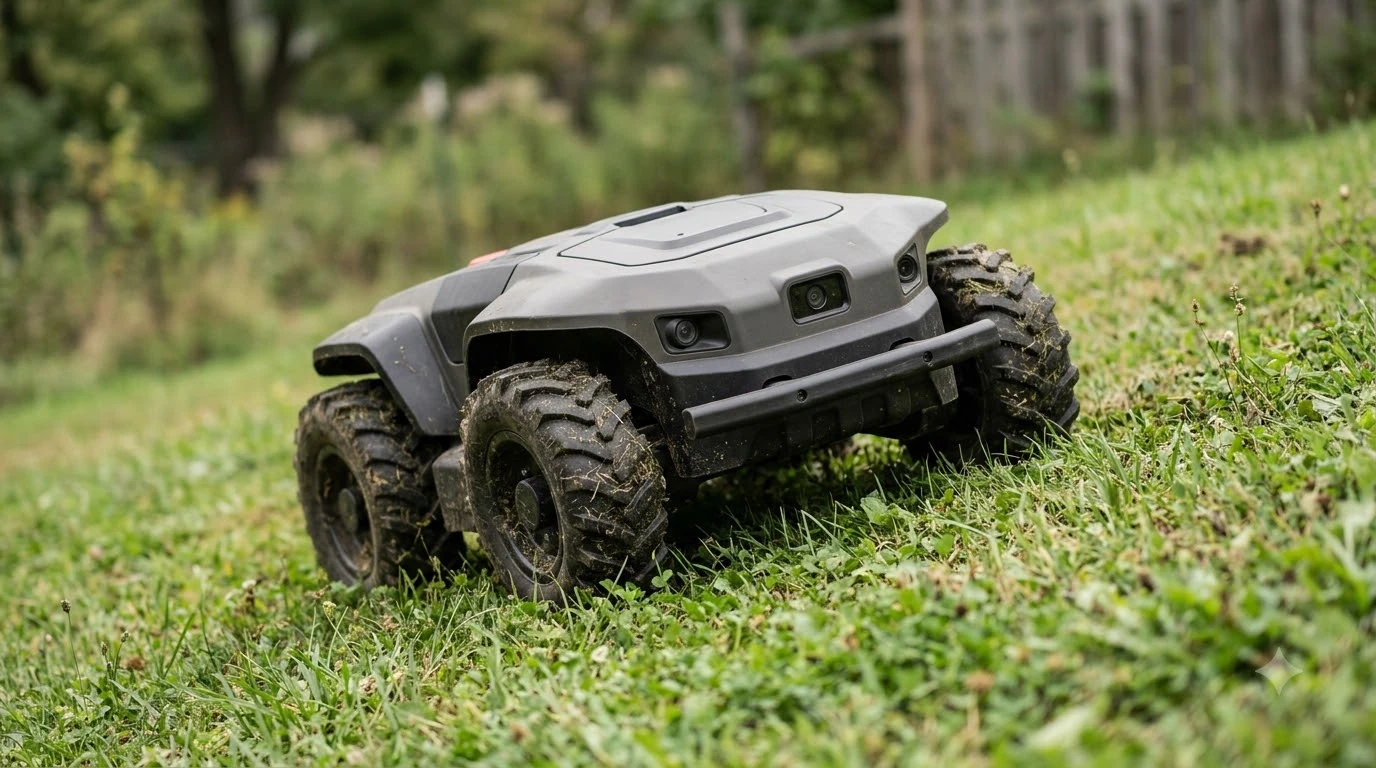

A robot mower for sandy soil lawn needs strong traction, a slope rating with margin, and a lawn thick enough to hold its wheels. Loose sand lets drive wheels sink and spin, so manufacturers focus on drive layout, tread, dips and turf height. The points below come from robot mower makers and Purdue Extension, as of November 2026.
The short answer
- Prefer all-wheel drive on loose ground: Mammotion says AWD spreads weight and power more evenly, which helps prevent sinking and wheel spin.
- Keep slopes well inside the rating: brand figures use different units and limits, so leave margin.
- Look for deep or stud-style tread: Robomow credits coarse studs with grip, and Lymow says shallow treads struggle on steep, wet slopes.
- Fill dips before the first cut: eufy’s AU guide advises packing soil into dips greater than 3 cm.
- Keep the lawn thick: Purdue advises mowing sandy turf at 2.5 inches at minimum and preferably 3.0 to 3.5 inches.
Why sandy soil is harder on drive wheels
Loose sand gives a tire less to bite into, so the wheel can dig in and spin instead of pulling the mower forward. Lymow, a robot mower maker, says that on loose, muddy or sandy ground “wheels dig into soft surfaces rather than gripping firmly.” Eufy, another maker, describes what happens next: when the drive wheels lose contact with solid dirt, the mower stops moving and sends an error alert. Both pages are manufacturer descriptions, not independent trials on sandy lawns. If the wheels already slip, see why a robot mower’s wheels slip on grass.
Our reading is that a robot mower for sandy soil lawn struggles most where the sand sits loose at the surface and the grass is thin enough to expose bare soil. A dense, well-rooted lawn on the same sand gives the wheels more to grip, so the lawn itself is part of the answer.
Robot mower for sandy soil lawn: AWD versus 2WD
For a robot mower for sandy soil lawn, all-wheel drive is the layout manufacturers favor on loose ground. Mammotion’s AWD guide says that “on loose ground with naturally low traction, all-wheel drive distributes both weight and power more evenly across the mower,” helping to prevent “sinking, wheel spin, or bogging down.” The same guide says that if one wheel loses grip, “power is instantly redistributed to the wheels with the most traction.” It is a brand guide, so read it as a description of the design, not a test result.
| Source | What it says about slope and drive | Type |
|---|---|---|
| Lymow blog | 2WD models manage gentle inclines of 20-25° (about 36-47% grade) | Manufacturer |
| eufy AU blog | Basic models 10-25%, mid-range 35%, AWD 70% (35°) | Manufacturer |
| Mammotion AWD guide | AWD listed for slopes up to 80% (38.6°) | Manufacturer |
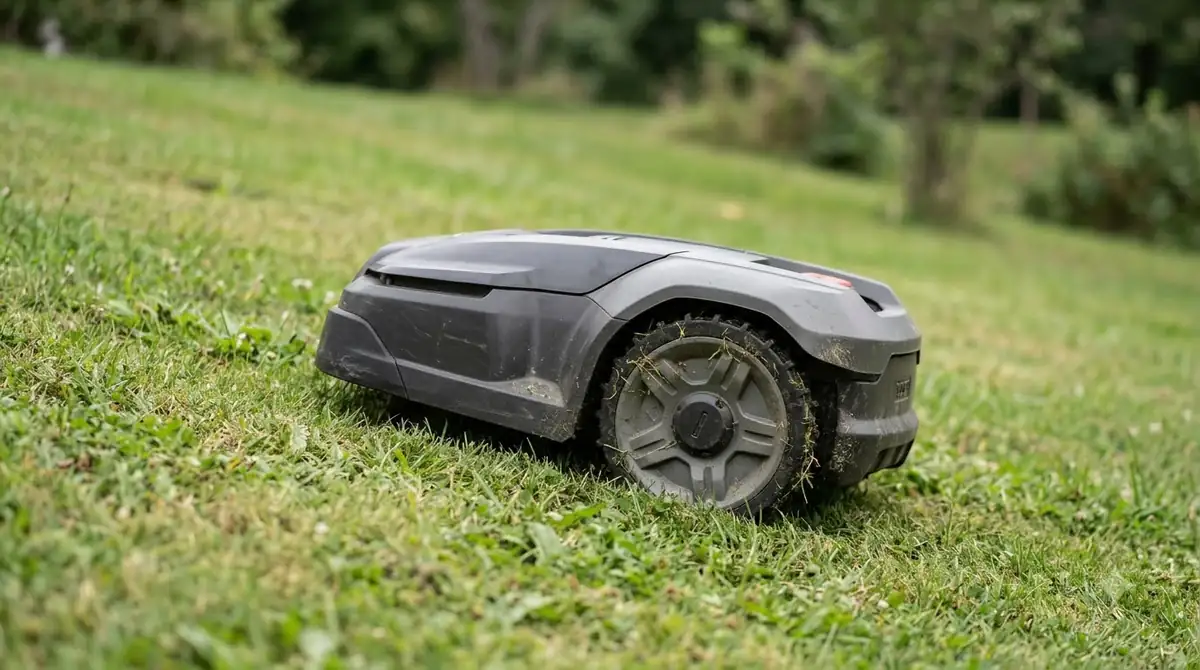
The figures are not comparable because each brand measures and tests differently. Our reading is that AWD matters most on sandy ground that also rises, while a 2WD model may suit a flat lawn that is firm and well filled. Check the drive layout on the spec sheet before you compare anything else, and see the all-wheel-drive robot mower roundup for models that use it.
Check the slope rating with a margin
Treat a brand’s slope figure as a ceiling, not a target. Robomow says its robotic mowers “are only designed for a certain slope. This can be 30%, 45% and even more,” and it advises a run-out zone near the boundary wire of about 15% or less. Eufy warns that running at the top of a rated slope “continuously strains the motor, drains battery reserves quickly, and increases tyre slip.”
When you compare a robot mower for sandy soil lawn use, the units also trip people up. Eufy’s AU guide lists 18° as 40%, but 18° is about 32% by simple arithmetic, so one rated number should not be the only check. Our reading is to keep sandy hills well inside the rated limit and to read whether the spec gives percent or degrees before you compare two models.
Tread and wheel design for sand
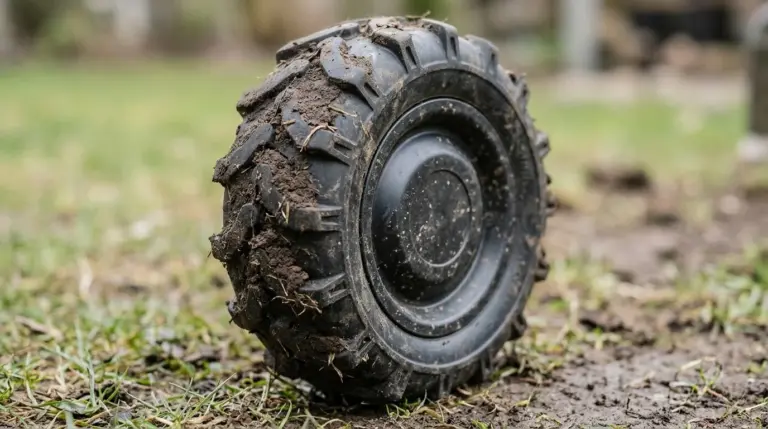
Look for coarse studs or deep lugs on the drive wheels. Robomow states that “coarse studs on traction wheels give grip,” while Lymow says that “Standard rubber wheels with shallow treads simply cannot maintain purchase on steep wet slopes.” Both are manufacturer statements about slope and wet ground, so they do not prove performance in sand.
Our reading is that tread matters most when the sand is loose and the slope is steep. Check the wheel width and tread on the spec sheet, and ask whether the brand sells a replacement or traction wheel for the model you are considering.
Fill dips, ruts and bare patches before mowing
Before the first cut with a robot mower for sandy soil lawn use, fill any dip deeper than about 3 cm. Eufy’s AU guide advises packing soil into ruts, holes and dips greater than 3 cm to create a smooth surface. Eufy’s UK lawn blog, now hosted on anker.com, adds that “Small bumps are usually fine, but deeper holes and ruts can cause the mower to tilt, lose grip, or get stuck,” and that “filling these problem areas with topsoil or a soil-and-sand mix can help smooth the surface and improve traction.”

Robomow adds two layout risks. A wheel can catch where the boundary wire runs too close to a dropping lawn edge, and a robot can get caught in a gravel bed. Keep the wire clear of drop-offs and plan the boundary around soft patches before you install. The UK guide gives no numeric dip depth beyond the 3 cm figure in the AU guide, so treat 3 cm as a rough guide rather than a standard. For the fill itself, compare topsoil for filling lawn holes before a robot mower.
Lawn care that keeps sandy turf firm
Purdue Extension advises a mowing height of “a minimum of 2.5 in and preferably 3.0 – 3.5 in” for lawns on sandy soils. Purdue also advises that sandy soils need irrigation that is “more frequent and in smaller amounts,” and slow-release nitrogen making up at least half of the fertilizer. These are general turf rules, not robot mower tests, but a thicker, deeper-rooted lawn gives the wheels more to grip.
Purdue’s guidance is written for lawns, so check the robot’s cutting range to confirm it can reach the height you need; how short a robot mower can cut grass depends on the model. Our reading is that a lawn kept at the height Purdue recommends is a better base for a robot than one cut very short.
What to check before you buy
Use this list when you shortlist a robot mower for sandy soil lawn use, based on the spec sheet and the turf guidance above, not on marketing claims.
- Drive layout. Note whether the model is AWD or 2WD, and whether the spec names it clearly.
- Slope rating. Record the figure and its unit, then keep your sandiest hill well inside it.
- Tread. Check for studs or deep lugs versus shallow rubber, and whether a traction wheel is sold for the model.
- Lawn surface. Walk the yard for dips deeper than about 3 cm, ruts and bare patches, and fill them first.
- Boundary. Keep the wire away from drop-offs, and note the run-out zone the brand recommends near the boundary.
- Cutting height. Confirm the cutting range reaches the 2.5 to 3.5 inches Purdue cites for sandy turf.
Our reading is that, for a robot mower for sandy soil lawn, the lawn often limits the mower more than the brand does, so start with the surface and then compare the drive, slope and tread on the sheet.
Frequently asked questions
Can a robot mower work on a sandy soil lawn?
Yes, many can, but the sources say loose sand can make wheels sink and spin. Drive layout, tread and a firm, filled surface matter more on sand than on dense soil.
Is all-wheel drive always needed on sand?
No. Mammotion’s AWD guide says AWD helps on loose ground, but a flat, firm and well-filled lawn may suit a 2WD model. Check the slope and the dips first.
How steep a slope is safe on sandy ground?
There is no single safe figure. The brand ratings in the sources run from 10 to 25% for basic models to 70 to 80% for AWD units, so keep sandy slopes well inside the stated limit.
What should I use to fill dips in a sandy lawn?
Eufy’s UK guide names topsoil or a soil-and-sand mix to smooth the surface and improve traction. Eufy’s AU guide advises packing soil into dips deeper than 3 cm.
Sources
- Maintaining Lawns on Sandy Soils (Purdue Extension): mowing height, irrigation and nitrogen guidance for sandy turf.
- AWD Lawn Mowers Guide (Mammotion): AWD on loose ground, weight and power distribution, slope figures.
- Robot mowers on hills and slope ratings (Lymow): sandy-ground wheel grip, 2WD slope figures, tread.
- Can a robotic lawnmower get stuck? (Robomow): slope limits, run-out zone, traction studs, boundary and gravel risks.
- Robot lawn mower slope limits (eufy AU): slope tiers, dip depth of 3 cm, motor strain on steep slopes.
- Do robot mowers work on uneven lawns? (eufy UK, hosted on anker.com): topsoil or soil-and-sand fill, ruts and tilt risk.
 Up next9 min readBy YardWill a Robot Mower Get Stuck on a Sandy Soil Lawn?Updated Nov 11, 2026
 8 min readBy YardRobot Mower for Compacted Soil Lawn: 4 Checks FirstUpdated Nov 11, 2026
 8 min readBy YardBest Robot Mower for Hilly 1 Acre Lawn: What to Check FirstUpdated Nov 11, 2026
 8 min readBy YardRobot Mower for a Lawn With Holes and Dips: What to Check FirstUpdated Nov 11, 2026
 9 min readBy YardBest Robot Mower for a Small Backyard in the City: What to Check FirstUpdated Nov 12, 2026
 7 min readBy YardBest Robot Mower for Bahia Grass: Check the Cutting Range FirstUpdated Nov 12, 2026