
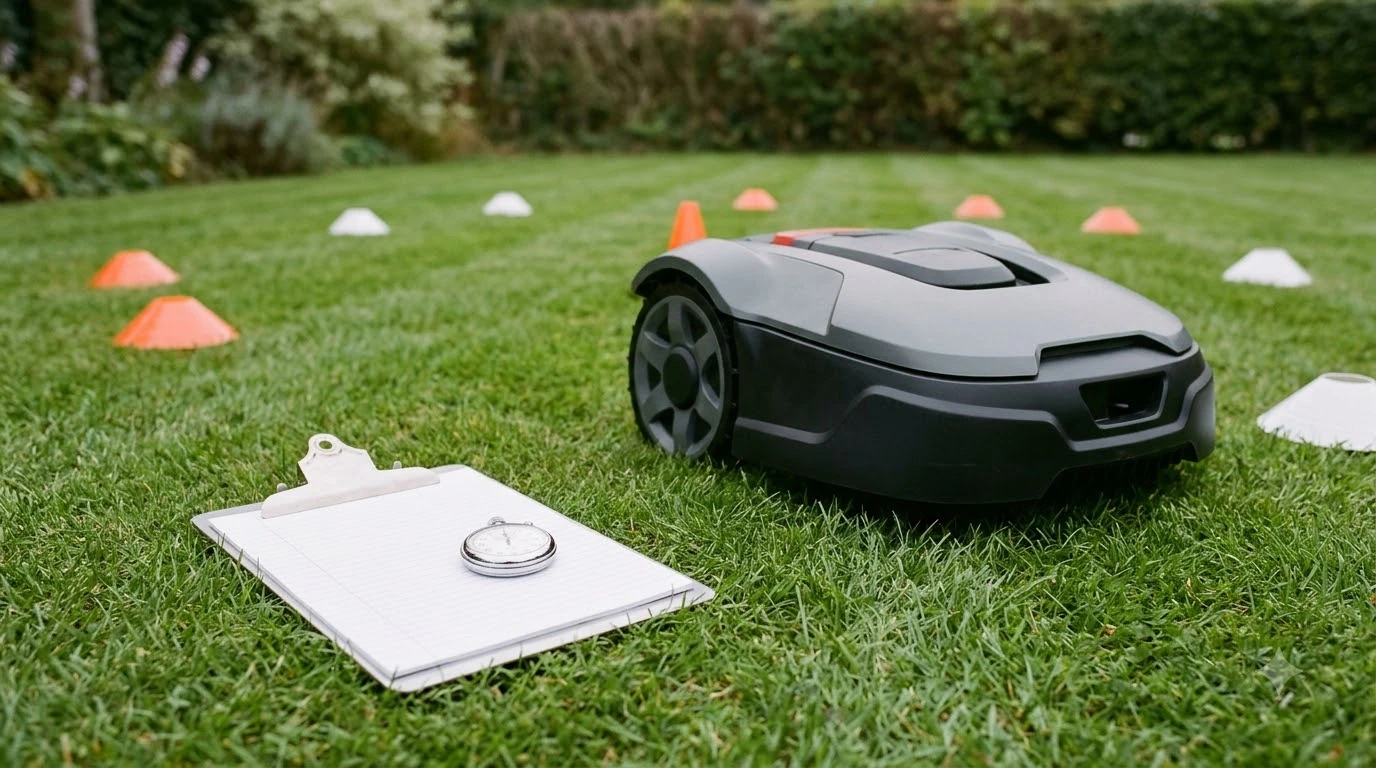

No manufacturer we checked sets an official minimum, so how small can a yard be for a robot mower depends on the layout more than the area. Manufacturers size their mowers by square meters or square feet, and the compact tier in one buyer guide covers lawns up to about 500 square meters. A narrow strip, a tight passage or a steep side slope can cause more trouble than a small total area.
The short answer
- No hard floor: none of the manufacturer pages we read publishes a minimum yard size for a robot mower.
- Area bands: compact lawns up to about 500 m² (roughly 5,400 sq ft) are the entry tier.
- Width counts: Husqvarna recommends a 2 m (6 ft 6 in) passage without a guide wire, and 60 cm (24 in) with one.
- Layout decides: check passages, slope and wire length before you check the square footage.
How small can a yard be for a robot mower, according to makers
Size guidance from robot mower makers uses a few different ranges, so it helps to compare them on one scale. Mammotion’s buyer guide places “small courtyards, townhouses and compact suburban lawns” in the up-to-500 m² band, where entry-level models are generally enough. The 500 to 1,000 m² band covers average suburban homes, and the guide suggests mid-range models with longer battery life for that range.
Ecovacs takes a different approach. Its buying guide says “what counts as a ‘small lawn’ varies by region, ranging from just 1,000 to 10,000 square feet,” and it gives the average US yard as about 23,301 square feet. That is just over half an acre. Our reading is that a typical American yard is therefore larger than what Ecovacs calls small, so a truly small yard is the exception rather than the rule.
Robomow’s blog uses a 300 m² lawn as its example of a small lawn that needs different handling. Its guidance focuses on maneuverability and cutting accuracy rather than a minimum size. Taken together, our reading is that a yard in the few-hundred-square-meter range is normal for a robot mower, and very small lots are handled by entry models rather than being excluded.
Converting square feet to square meters
Most robot mower specs use metric units, so a quick conversion helps when you ask “how small can a yard be for a robot mower” in square feet. One square meter is about 10.76 square feet, so the bands above translate to rough US numbers that are easy to compare with a tape-measure result.
| Lawn size band | Square meters | About square feet | Typical fit (per Mammotion) |
|---|---|---|---|
| Compact | Up to 500 | Up to 5,380 | Entry-level models |
| Average suburban | 500 to 1,000 | 5,380 to 10,760 | Mid-range models |
| Larger | 1,000 to 2,000 | 10,760 to 21,530 | Higher capacity, faster charging |
| Very large | Over 2,000 | Over 21,530 | Premium models |
Rated coverage is a best case. Robomow notes that real-world output can fall short of the manufacturer’s maximum, and that the factors it lists can reduce that optimum by up to 30 percent. Our reading is that a small yard should be compared with a model rated for noticeably more area than it actually has. For the next step, see choosing a robot mower by lawn size.
Why width matters more than area
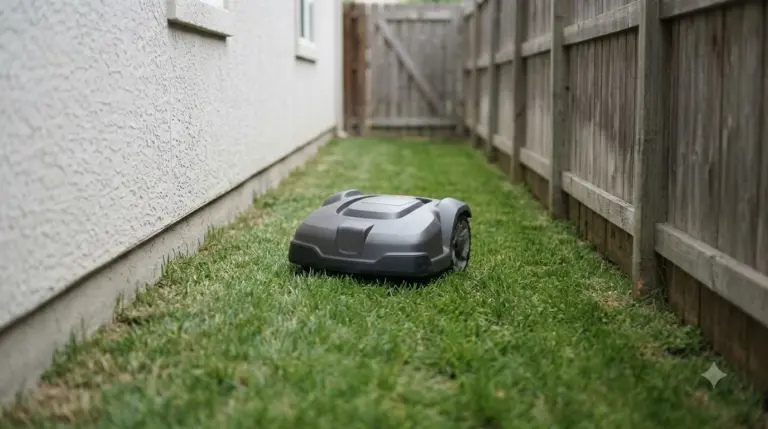
A small yard is often a long, thin strip beside a house or between two fences. For that kind of lot, the answer to “how small can a yard be for a robot mower” is really a question about width, because the mower’s ability to pass through a gap matters more than its rated area. Husqvarna’s passage guidance sets two numbers you can check against your own yard. Without a guide wire, the recommended minimum distance between the boundary wires on each side of a passage is 2 m (6 ft 6 in). With a guide wire, the recommended minimum drops to 60 cm (24 in). For a deeper look, see how narrow a robot mower passage can be.
Heads up
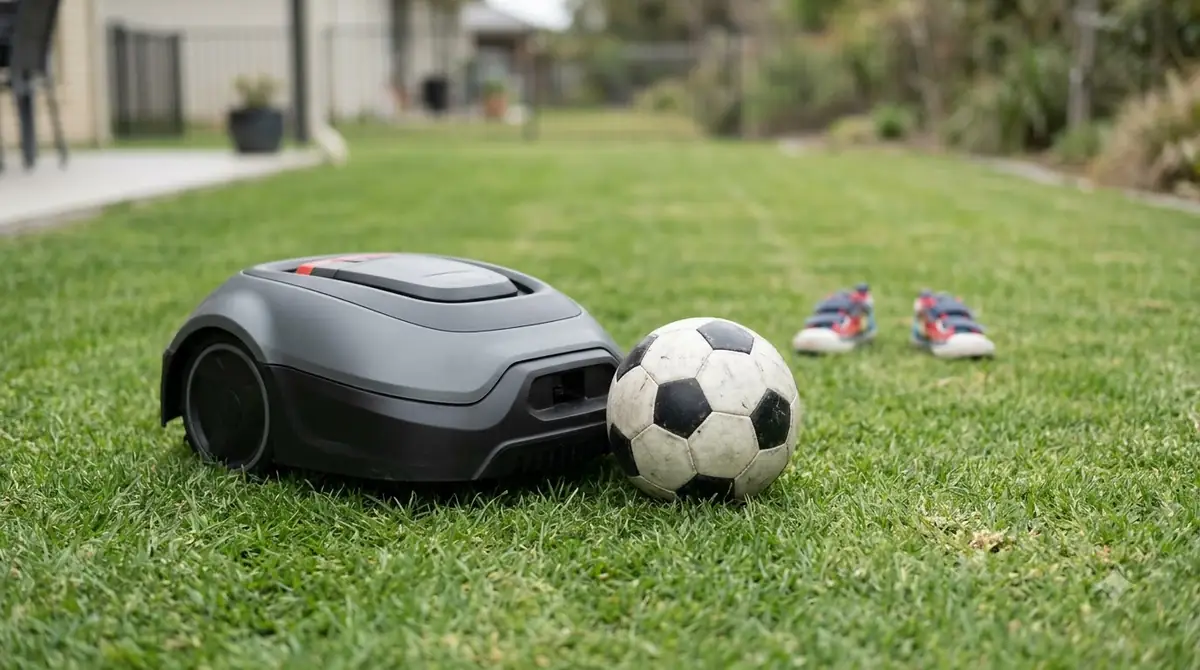
Husqvarna’s passage guidance recommends 2 m for a good cutting result on its Automower 435X AWD and 535 AWD. Our reading is that 60 cm is the tightest workable gap with a guide wire, not a target to aim for.
Robomow’s size guide lists a cutting width starting at 18 cm for small gardens, which shows that compact machines exist for tight lots. Mammotion’s guide adds a practical point: where a lawn sits between other lawns or alongside the house, check the minimum passage width the mower can reliably navigate, not just the area. Our reading is that a 1,000 sq ft strip that is 3 feet wide can be harder for a mower than a 3,000 sq ft open lawn.
Guide wires and loop length
A guide wire is an extra buried wire that leads the mower through a passage to a separate work area. Husqvarna gives separate passage widths with and without one, and says a guide wire is required for its systematic passage mowing feature. Where it is used, the guide wire must sit at least 30 cm (12 in) from the boundary wire, so a narrow yard needs enough room for both wires.
Wire length also shapes what a small yard needs. We recommend keeping the guide loop as short as the layout allows and checking your model’s manual for its loop limit, since limits vary by model. For wire planning, see how much boundary wire you need. Our reading is that a small yard with one simple loop is usually easier to set up than a larger yard split into several zones.
Slope and irregular shapes on small lots
A small yard can still be a hard one if it is steep, and slope is the other half of “how small can a yard be for a robot mower.” Mammotion’s slope bands run from flat or gently sloping lawns up to 20 percent, through moderate slopes of 20 to 35 percent and steeper residential blocks of 35 to 50 percent. Above 50 percent, the guide says only certain all-wheel-drive models are designed to work reliably. Manufacturers state climbing ability as a percentage, so compare percentages rather than degrees. Measuring your yard’s slope shows which band your steepest section falls in.
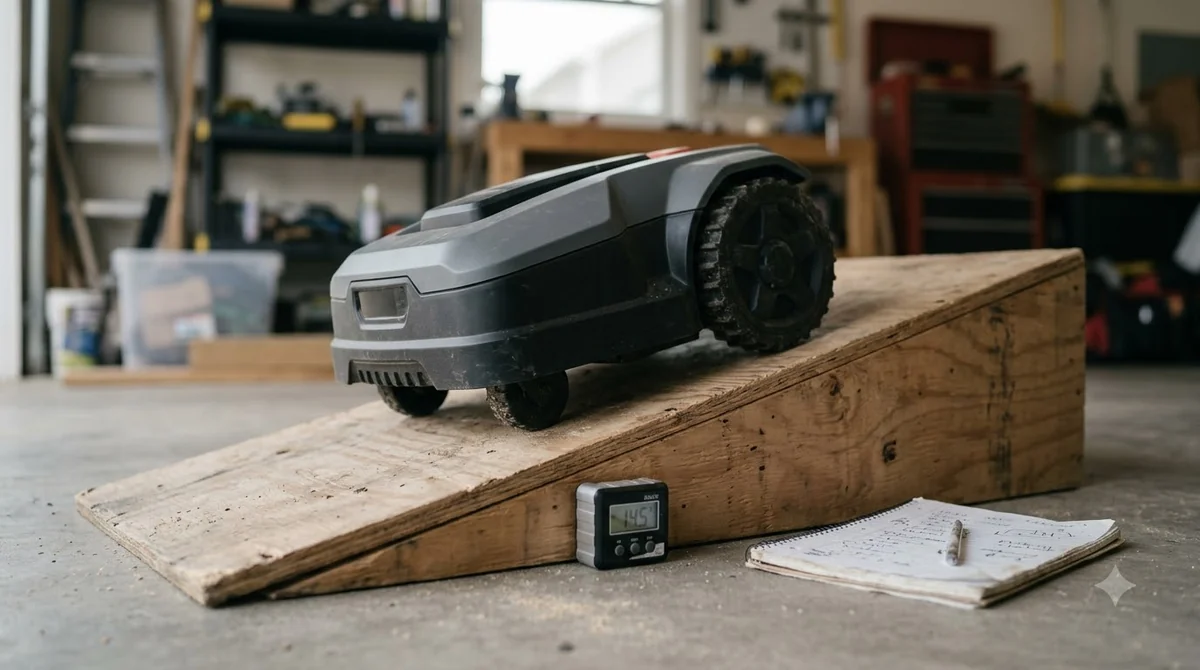
Robomow’s guidance also notes that many cheap models are designed only for slopes of 20 to 25 percent, while higher-end models can handle slopes of up to 45 percent and more. Irregular ground such as small embankments, sloping side paths and uneven transitions can affect a mower even when the lawn does not look hilly.
Multi-zone and irregular layouts
Some small yards are split by a path, a patio or a flower bed, so the mower has to work across more than one lawn area. Mammotion’s guide says a simple open lawn is much easier to maintain than a property with several lawn areas, narrow passages or many obstacles. A small yard with several zones can therefore be harder to cover than a larger open one.
Robomow’s guide describes winding gardens as needing maneuverability and accurate cutting. Our reading is that a small, irregular yard should be judged by how the mower reaches each zone, which is a question for the layout and the wire plan, not the total area. Layouts with two separate lawns are covered in front and back yard layouts for robot mowers.
A quick checklist for a small yard
To answer “how small can a yard be for a robot mower” for your own lot, run these five checks in order.
- Measure the narrowest passage. Check the gap between the house, fence and any beds. Compare it with 60 cm (with a guide wire) and 2 m (without one).
- Check the slope. Use the bands above and buy for the steepest part, not the average.
- Count the zones. A single open area is simpler than several lawns joined by passages.
- Estimate the wire length. Keep the guide loop short and check your model’s manual for its loop limit.
- Compare rated area with real area. Choose a mower rated for more than your lawn, since output can fall short.
Frequently asked questions
Is there a minimum yard size for a robot mower?
No manufacturer page we read gives an official minimum. Compact models are sold for lawns up to about 500 square meters, and Ecovacs describes small lawns as 1,000 to 10,000 square feet depending on region.
How narrow a passage can a robot mower use?
Husqvarna recommends a passage of 2 m (6 ft 6 in) without a guide wire, and a minimum of 60 cm (24 in) when a guide wire leads the mower through it.
Do I need a guide wire for a narrow yard?
For an ordinary passage it is optional, since Husqvarna gives a passage width for installations without one. It says a guide wire is required for its systematic passage mowing function.
Does slope matter more than the size of a small yard?
For many small lots it does. Mammotion says moderate slopes of 20 to 35 percent need good traction, and only certain AWD models are designed for slopes above 50 percent.
Sources
- How to choose a robot lawn mower (Mammotion): size bands, slope bands and passage guidance.
- Can you use a robot lawn mower on a small lawn? (Ecovacs): small lawn range and average US yard size.
- Which robotic lawnmower is suitable for which lawn size? (Robomow): small-lawn example, cutting width and rated-output reduction.
- How to create a passage in an Automower boundary wire installation (Husqvarna): passage widths and guide wire spacing.
 Up next8 min readBy YardHow Narrow Can a Robot Mower Passage Be? Simple 2026 RulesUpdated Nov 11, 2026
 9 min readBy YardBest Robot Mower for a Small Backyard in the City: What to Check FirstUpdated Nov 11, 2026
 7 min readBy YardRobot Mower for a Desert Landscaping With Small LawnUpdated Nov 11, 2026
 8 min readBy YardRobot Mower for Front and Back Yard: What WorksUpdated Nov 11, 2026
 7 min readBy YardHow to Measure Yard Slope in Percent and DegreesUpdated Nov 11, 2026
 7 min readBy YardCan a Robot Mower Work in a Long Narrow Yard?Updated Nov 11, 2026