
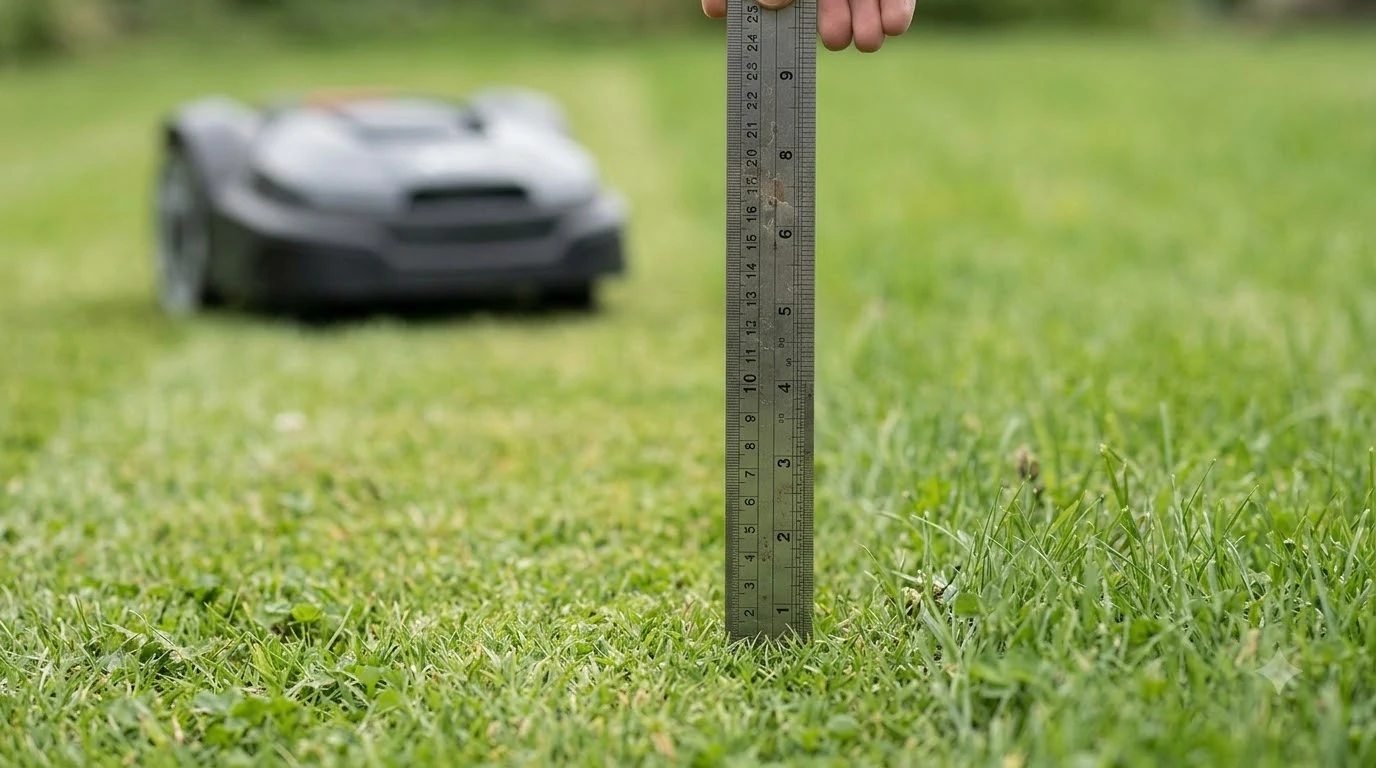

How often to mow bermuda grass depends on growth, but most homeowners need to mow once a week or three to four times a month in the active growing season, according to LSU AgCenter. That is a starting point, not a fixed calendar. The reliable signal is growth: mow whenever the grass has reached the regrowth height for your bermuda type.
Common (seeded) bermuda and hybrid bermuda grow at different rates and need different triggers. This guide explains the one-third rule, the height triggers UC publishes for each type, how the schedule changes through the year, and what a robot mower changes about the routine.
The short answer
- How often to mow bermuda grass: once a week, or three to four times a month, in spring and summer.
- Better rule for how often to mow bermuda grass: mow when the grass reaches 1 1/2 to 2 1/4 inches (seeded) or 3/4 to 1 1/2 inches (hybrid).
- Never remove more than one-third of the leaf height in a single cut.
- Fall and winter: mow less often as growth slows, and stop once the grass is dormant.
How often to mow bermuda grass in general
LSU AgCenter says homeowners may mow bermuda “on average once a week or three to four times per month” during the active growing season. That range assumes a typical lawn in its growth period. A lawn that is growing quickly after rain or fertilizer may need cuts sooner, while a slow lawn in a cool stretch can go longer between cuts.

The reason the calendar is only a guide for how often to mow bermuda grass is that bermuda grows fast when it is warm and wet. Two lawns on the same street can need very different schedules. Use the weekly figure as a check on your own pattern, then adjust it when the grass tells you to.
The one-third rule sets your mowing interval
Removing too much leaf at once is the main cause of stress after mowing, so the one-third rule is the core test for how often to mow bermuda grass. LSU states the principle as: “Never remove more than one-third of the leaf blade height in a single mowing.” Mississippi State Extension states the same idea for turf in general: no more than one-third of total turf height should come off at one time.
The rule turns into a simple interval. If you keep bermuda at 1 inch, mow before it reaches 1 1/2 inches, because a cut from 1 1/2 inches down to 1 inch removes exactly one-third. If the grass grows to 2 inches first, a single cut to 1 inch removes half the leaf, which breaks the rule.
- Target height 1 inch: mow at about 1 1/2 inches.
- Target height 1 1/2 inches: mow at about 2 1/4 inches.
- Missed cut: if the grass is taller than the rule allows, our reading is that a higher setting for the first pass limits the damage, with the target height restored on the next cut.
Mow by height, not by the calendar
The UC Integrated Pest Management program gives a mowing height and a regrowth trigger for each bermuda type, which is the most practical answer to how often to mow bermuda grass on your own lawn. The trigger is the height at which you should start the next cut. The pattern is the same for both: a lower mowing height means a lower trigger, so the grass gets cut more often.
| Bermuda type | Mower setting | Mow when grass reaches |
|---|---|---|
| Seeded (common) bermuda | 1 to 1 1/2 inches | 1 1/2 to 2 1/4 inches |
| Hybrid bermuda | 1/2 to 1 inch | 3/4 to 1 1/2 inches |
North Carolina State Extension makes the same point from the other direction. Its bermuda calendar says that “maintaining a lower height will require more frequent mowing to prevent scalping.” If you want hybrid bermuda at 3/4 inch, plan on more frequent cuts than you would need at 1 1/2 inches. Our guide to the best mowing height for bermuda grass covers the height ranges in more detail.
Mississippi State Extension also notes that hybrid bermuda may need mowing “several times a week” when kept low. That is the far end of the range, and it is most common on lawns held at the lowest setting in peak summer.
How often to mow bermuda through the seasons
Bermuda grows most in late spring and summer, so the schedule for how often to mow bermuda grass is tightest then. As growth slows in fall, the gaps between cuts get longer. The table below combines the UC and NC State guidance into a season-by-season pattern.
| Season | Growth | Mowing pattern |
|---|---|---|
| Spring green-up | Growth restarts after dormancy | First cut when the lawn turns green, before it passes 2 1/2 inches |
| Summer | Fastest growth | Mow frequently, at the regrowth trigger for your type |
| Early fall | Growth slows | Keep the spring schedule until several weeks before the first frost |
| Late fall and winter | Growth stops or the grass goes dormant | Mow only to remove leaves or debris |
NC State adds a regional detail for fall. In the North Carolina piedmont, it suggests raising the mowing height by 1/2 inch for lawns that are not overseeded, to protect against winter kill. Your county extension office can confirm the right timing for your area.
Spring green-up and avoiding scalping
The first cut of the year sets the pattern for how often to mow bermuda grass all season. NC State advises mowing “when the lawn first turns green,” using a rotary or reel mower set as low as possible without scalping, and before the grass grows taller than 2 1/2 inches.
Scalping is cutting grass too short, so low that brown stems show. It usually happens when the grass has grown too tall before a cut, so the mower takes too much at once. Regular mowing at the trigger height prevents most of it.
- Lower the height gradually in spring, so a single pass does not take most of the leaf.
- Mow more often after a missed week, rather than cutting a large amount in one pass.
- Raise the height in shade. Mississippi State notes that bermuda kept above 2 inches sheds lower leaves in shade, which can make a cut look scalped.
Robot mower schedule for bermuda grass
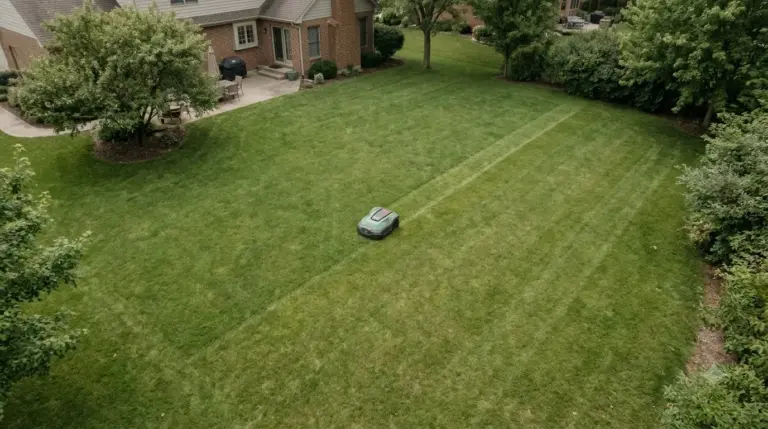
A robot mower can follow the growth-based rule for how often to mow bermuda grass more easily than a push mower, because it cuts a little at a time on its own schedule. The practical question is whether the mower is set to run often enough to keep the grass at the trigger height.

- Spring and summer: schedule run days so the grass never passes the trigger height. Seeded lawns can often run less than hybrid lawns held low, which may need several runs a week.
- Fall: reduce the run days as growth slows, and check the height weekly.
- Winter: stop running once the grass is dormant or frozen, and resume in spring when it turns green. See when the robot mower season starts and ends for timing.
These are our reading of how the sources apply to a robot schedule, not a manufacturer setting. Check whether the mower can reach the height you need, because its lowest setting limits how far down you can cut before scalping, and read whether a robot mower can cut bermuda grass for the fit.
Put simply, the best answer to how often to mow bermuda grass is the one that keeps each cut under one-third of the leaf height. Pick your target height, note the regrowth trigger, and let the calendar follow the grass. Checking height weekly in spring and summer beats any fixed schedule.
Frequently asked questions
How many times a week should I mow bermuda grass?
There is no single number for how often to mow bermuda grass. LSU AgCenter gives a homeowner average of once a week or three to four times a month in the growing season. Hybrid bermuda kept low may need mowing several times a week, according to Mississippi State Extension.
Can I wait two weeks between mowings?
Only if the grass has not grown past the one-third rule, which is the limit that matters most when you decide how often to mow bermuda grass. If it has reached more than 1 1/2 times your target height, a single cut will remove more than one-third. Check the height before you accept a long gap.
Should I mow bermuda grass in winter?
Usually not, except to remove leaves or debris. NC State Extension’s calendar lists winter mowing to remove leaves and other debris. Once the lawn is dormant, growth is minimal, so there is little to cut.
Does shade change how often I need to mow?
Shade slows growth, so shaded areas often need fewer cuts when you ask how often to mow bermuda grass. Mississippi State notes that bermuda kept above 2 inches sheds lower leaves in shade. Raise the height in shaded zones rather than cutting more often at a low setting.
Sources
- The One-Third Mowing Rule (LSU AgCenter): the one-third rule, weekly or three to four times a month, bermuda height range.
- UC Healthy Lawns: Mowing warm-season grasses (UC IPM): mowing heights and regrowth triggers for seeded and hybrid bermuda, and the seasonal pattern.
- Bermudagrass Lawn Maintenance Calendar (NC State Extension): first spring cut, scalping and mowing frequency, fall schedule.
- Proper Mowing Enhances the Beauty of Your Lawn (Mississippi State Extension): one-third rule for turf, hybrid mowing frequency, shade note.
 Up next8 min readBy YardHow Often to Mow Fescue, Season by SeasonUpdated Nov 11, 2026
 9 min readBy YardHow Often to Mow Kentucky Bluegrass by SeasonUpdated Nov 11, 2026
 8 min readBy YardHow Often to Mow Centipede GrassUpdated Nov 11, 2026
 8 min readBy YardHow Often to Mow Buffalo Grass (Schedule and Height)Updated Nov 11, 2026
 9 min readBy YardHow Often to Mow St. Augustine GrassUpdated Nov 11, 2026
 8 min readBy YardHow Often to Mow Zoysia GrassUpdated Nov 11, 2026